

Ancient Olive Oil Lamps: Artifacts of Faith
Ancient olive oil lamps were more than just tools for lighting; they were deeply tied to spiritual practices, cultural identity, and technological progress in the Mediterranean region. These clay vessels, fueled by olive oil, symbolized wisdom, peace, and divine presence across Jewish, Christian, and Islamic traditions. They lit homes, temples, and tombs while serving in rituals like anointing and sacred ceremonies.
Key points:
- Olive oil lamps date back over 5,000 years, with some examples as old as 12,000 BC.
- In Jewish traditions, olive oil fueled the Temple Menorah, symbolizing God's eternal presence.
- The Hanukkah miracle highlights the role of olive oil in Jewish faith.
- Early Christians used these lamps in ceremonies, funerals, and baptisms, with olive oil symbolizing the Holy Spirit.
- Archaeological discoveries reveal evolving designs, from simple stone vessels to intricate Roman and Byzantine lamps.
- Regional patterns reflected religious and artistic themes, like Menorahs in Jewish lamps and Christian symbols in Roman designs.
- Olive oil was central to anointing rituals, symbolizing purification, healing, and divine guidance.
These lamps were not just practical items but profound symbols of faith and light, offering a glimpse into ancient beliefs and traditions.
Ancient Oil Lamps - Objectivity 223
sbb-itb-4066b8e
Religious Origins and Sacred Texts
Olive oil, with its ancient liturgical roots, has remained a powerful symbol in religious rituals, evolving in significance over time.
The Temple Menorah and Scripture
In the Hebrew Bible, olive oil is explicitly designated for sacred purposes. Exodus 27:20 commands the Israelites to provide extra virgin olive oil to keep the lamp burning continuously. This oil fueled the Temple Menorah, a seven-branched lampstand made of pure gold, which adorned the Tabernacle and later the Temple in Jerusalem. The Menorah symbolized God's eternal presence and wisdom. The word "oil" itself appears more than 70 times in the Bible, underscoring its spiritual importance. These early traditions laid the groundwork for olive oil's role in later religious ceremonies.
Hanukkah and the Oil Miracle
The story of Hanukkah, also known as the Festival of Lights, highlights a miraculous event involving olive oil. During the rededication of the Second Temple, there was only enough pure olive oil to light the Menorah for one day. Yet, the oil miraculously burned for eight days, allowing time to prepare new consecrated oil. Beyond this miracle, olive oil lamps also became central to Sabbath observance. Some ancient lamp designs, such as those with a "pinched egg" shape, were crafted to hold oil for longer burns. This deepened olive oil's symbolic role, paving the way for its adoption in early Christian rituals.
Early Christian Use of Olive Oil Lamps
In the early days of Christianity, olive oil lamps were used during nighttime gatherings, eventually becoming a ceremonial emblem of faith by the late 4th century. St. Jerome noted:
in all the churches of the East, whenever the gospel is to be read, lights are lit, though the sun be rising, not to dispel darkness but as a sign of gladness.
These lamps became central to various Christian practices. They were used during Eucharistic celebrations, carried in funeral processions as a symbol of resurrection, and featured in baptisms. A perpetual flame, known as the Vigil or Sanctuary Lamp, was kept burning before the tabernacle to signify God's constant presence and the unending prayers of the faithful. Over time, the lamps came to represent Christ as the "Light of the World", with olive oil symbolizing the Holy Spirit and the spiritual anointing of believers. As Pope Benedict XVI explained:
olive oil is thus in a very particular way a symbol of the total compenetration of the man Jesus by the Holy Spirit.
Archaeological Discoveries and Design
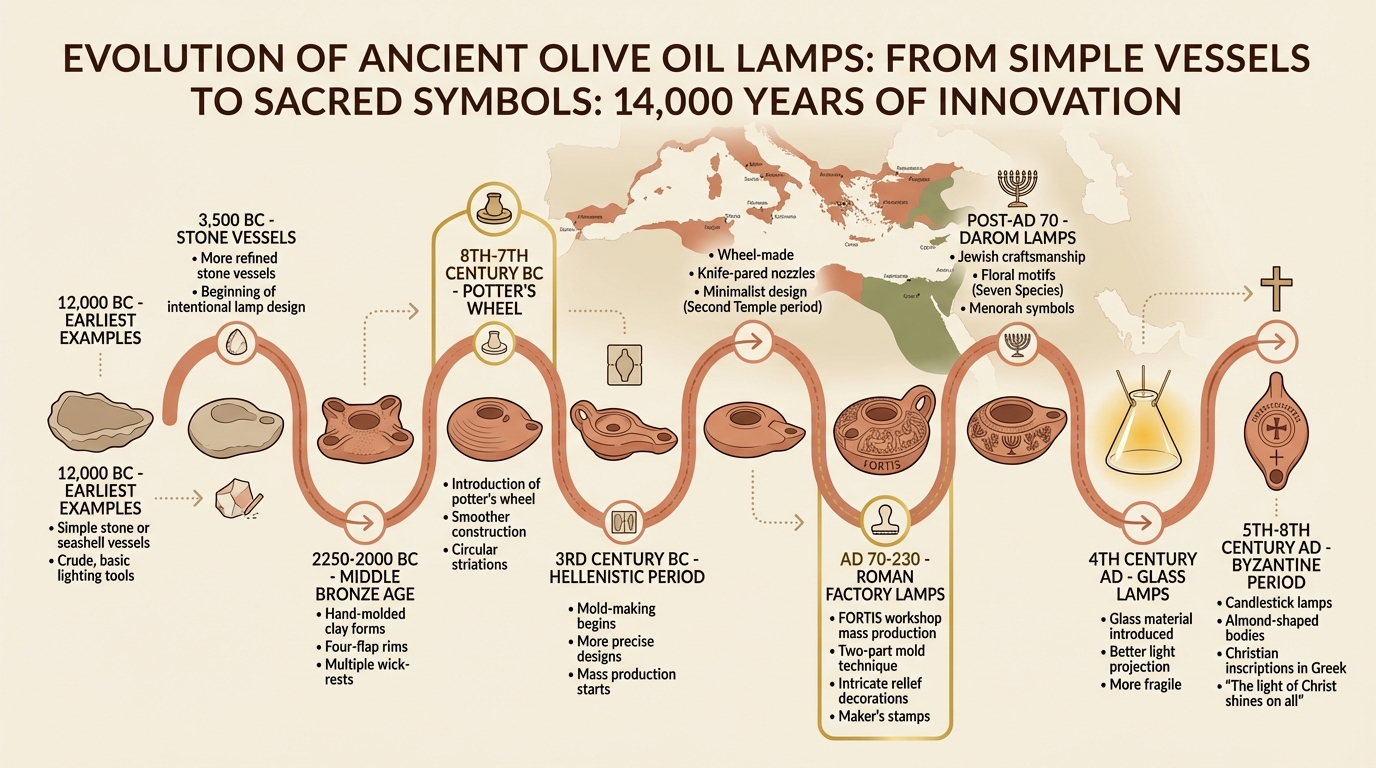
Evolution of Ancient Olive Oil Lamps: 12,000 BC to 8th Century AD
Main Lamp Types and Features
Archaeological digs across the Mediterranean have unearthed thousands of ancient olive oil lamps, revealing a fascinating progression in design. The earliest lamps, dating back to around 3,500 BC, were little more than crude stone or seashell vessels. By the Middle Bronze Age (2250–2000 BC), these evolved into hand-molded forms with distinctive four-flap rims and multiple wick-rests.
One notable design is the Herodian lamp, widely used in Judea from the 1st century BC to the 2nd century AD. These wheel-made lamps were known for their knife-pared nozzles and minimalist appearance, reflecting religious restrictions on graven images during the Second Temple period. After the Temple's destruction in AD 70, the Darom lamp became a hallmark of Jewish craftsmanship, adorned with symmetrical floral motifs symbolizing the "Seven Species" of the Holy Land - figs, wheat, barley, grapes, olives, pomegranates, and honey.
Roman factory lamps, or Firmalampen, demonstrate one of the earliest examples of industrial mass production. The FORTIS workshop in Northern Italy, active from AD 70 to AD 230, was so influential that its maker's stamp was widely copied by other potters in the provinces. Later, in the Byzantine period (5th–8th centuries AD), candlestick lamps with almond-shaped bodies became popular. Many of these lamps carried inscriptions like "The light of Christ shines on all", written in Greek.
These innovations in lamp design paved the way for more advanced manufacturing techniques.
Manufacturing Methods and Materials
The techniques used to produce lamps evolved significantly over time. Early lamps were hand-molded with thick walls, but by the Hellenistic period (3rd century BC), artisans began using molds to create more precise designs. The introduction of the potter's wheel around the 8th–7th centuries BC allowed for smoother, circular striations on the interiors of vessels, further refining their construction.
Mold production revolutionized lamp-making. Instead of using liquid slip casting, artisans pressed clay into two-part molds, enabling intricate relief decorations and mass production. This method allowed for the creation of complex, three-dimensional designs like helmets or animal heads. While terracotta remained the material of choice due to its affordability, wealthier families commissioned lamps made from bronze, silver, or gold as symbols of status. By the 4th century AD, glass lamps began to appear, offering better light projection despite their fragility and sensitivity to heat.
Even as manufacturing techniques became more sophisticated, regional artistic traditions ensured that each lamp carried distinct cultural and religious symbolism.
Regional Designs and Decorative Patterns
Lamp designs varied widely across the Mediterranean, reflecting the cultural and religious diversity of the region. During the Israelite Monarchy (1000–587 BC), northern lamps typically had low, flat bases, while those from southern Judea featured high disc bases. At Khirbat el-Ni'ana, archaeologist Varda Sussman uncovered around 110 mold-made clay lamps, including a "Khirbat el-Ni'ana-type" lamp that points to a local workshop active during the Late Roman and Byzantine periods.
Egyptian potters created "Frog lamps" between the 2nd and 5th centuries AD, featuring kidney-shaped bodies and abstract frog motifs representing Heqet, the goddess of fertility and resurrection. In North Africa, red-ware lamps from the 5th–6th centuries AD often carried Christian symbols like the Chi-Rho monogram. Meanwhile, Greek artisans produced high-quality, wheel-thrown lamps with black or green glazes designed to prevent oil seepage.
The designs of these lamps often reflected the spiritual and cultural identities of their makers. Jewish Darom lamps featured symbols like the Menorah and golden grape clusters, evoking the Temple. Roman lamps prominently displayed mythological and theatrical scenes. Samaritan lamps incorporated motifs tied to their temple and the story of the Binding of Isaac. After the Islamic expansion, lamp designs shifted toward geometric and floral patterns, adhering to traditions that avoided depicting living beings.
Spiritual and Sacred Uses of Olive Oil
Anointing Practices and Ceremonies
In ancient rituals, olive oil played a central role as a sacred anointing agent. It was used to sanctify priests, kings, and occasionally prophets, marking a rite of purification that typically followed ritual washing and preceded the wearing of sacred garments. One biblical recipe for anointing oil included 1.6 gallons of olive oil, 13 pounds of myrrh, and specific amounts of cinnamon, fragrant cane, and cassia. In the Israelite tradition, even objects like the altar, the ark of the covenant, and the seven-branched lampstand in the Tabernacle were anointed to make them "most holy."
This tradition continues today. For example, during King Charles III's coronation in May 2023, holy oil pressed near Bethlehem and consecrated in Jerusalem was used, a practice reminiscent of King Solomon's time.
Symbolism of Light, Healing, and Faith
Olive oil's ability to produce a slow-burning, smokeless flame gave it a special place as a symbol of divine guidance and God's presence. Over time, this practical use evolved into a powerful spiritual metaphor, with the light representing divine wisdom and direction.
By the 9th century, oil from martyrs' shrines, such as the tomb of Saint Menas in Egypt, was believed to possess miraculous healing properties. Pope Benedict XVI highlighted olive oil's multifaceted significance:
Olive oil has a wide range of meaning. It is nourishment, it is medicine, it gives beauty, it prepares us for battle and it gives strength. Kings and priests are anointed with oil, which is thus a sign of dignity and responsibility, and likewise of the strength that comes from God.
The term "Christ", meaning "anointed one", directly ties the essence of Christian faith to olive oil. In Christian practices, olive oil - often blended with balsam to create chrism - remains a key element in sacraments like baptism and confirmation, symbolizing the sanctifying power of the Holy Spirit.
Modern producers, such as Big Horn Olive Oil, honor these ancient traditions by crafting ultra-premium extra virgin olive oil, continuing olive oil's legacy as a symbol of light, healing, and faith.
Conclusion
Ancient olive oil lamps were far more than everyday household items - they were deeply tied to humanity’s connection with faith, light, and the divine. From the eternal flame in the Temple to lamps placed in humble tombs, these artifacts reveal how ancient societies found spiritual meaning in the simple act of lighting the darkness.
Their symbolism still resonates. Modern lighting floods spaces instantly, but ancient lamps offered a different kind of illumination - just enough light to take the next step forward. This concept is beautifully expressed in Psalm 119:105:
Your word is a lamp to my feet and a light to my path.
Rather than revealing the entire path, these lamps symbolized guidance through the present moment, a lesson that continues to inspire.
Archaeological finds strengthen this connection to the past. Lamps adorned with crosses, menorahs, and other religious symbols served as meaningful tools for expressing beliefs across Jewish, Christian, and Islamic traditions. Even the maker's marks on Roman-era lamps, like the FORTIS brand used between AD 70 and AD 230, provide a glimpse into ancient trade networks and craftsmanship. These artifacts tie together the ingenuity of the past with the traditions we honor today.
Producers like Big Horn Olive Oil carry on this legacy, crafting ultra-premium extra virgin olive oil that reflects centuries of tradition and the enduring symbolism of light and faith.
These humble clay lamps, filled with olive oil, continue to illuminate our understanding of faith - reminding us that spiritual light often comes one step at a time.
FAQs
How did ancient olive oil lamps change in design and technology over the centuries?
Ancient olive oil lamps underwent remarkable changes over the centuries, reflecting progress in both their practical use and artistic presentation. The earliest examples, dating back to around 2200 BC, were little more than clay or stone bowls with pinched edges to hold a wick. While functional, these early designs were quite plain.
As societies developed, so did the lamps. By the Iron Age and classical periods, they featured molded shapes, glazed surfaces, and sturdy bases, combining improved usability with decorative appeal. The Romans took these innovations further, creating lamps with multiple wicks, intricate designs, and even using materials like bronze and glass. These advancements reveal how these lamps served not just as sources of light but also as expressions of craftsmanship and creativity, deeply woven into both daily routines and spiritual practices.
What was the spiritual significance of olive oil lamps in ancient religious traditions?
Olive oil lamps carried profound spiritual significance in various ancient religious traditions. In Christianity, these lamps symbolized divine guidance and spiritual illumination. Their flames were often seen as representations of God's presence, making them a common feature in homes, sacred spaces, and biblical narratives. They provided not just physical light but also served as metaphors for unwavering faith.
In Jewish tradition, olive oil lamps held both practical and sacred value. Often adorned with symbols like the menorah, they were used in temples, synagogues, and homes. These lamps embodied ideas of purity and divine light, reinforcing their spiritual importance.
Similarly, within Islamic culture, oil lamps symbolized spiritual purity and the presence of the divine. They were frequently used in both religious ceremonies and everyday life, bridging the gap between the sacred and the domestic.
Across these traditions, olive oil lamps went far beyond their functional purpose. They became enduring symbols of faith, spirituality, and enlightenment.
Why has olive oil been a symbol of faith and healing throughout history?
Olive oil has held a deep symbolic meaning for centuries, woven into the fabric of religious and spiritual practices. Across traditions, it has been cherished for its role in sacred rituals, such as anointing leaders, blessing spaces, and offering comfort to the sick. These acts have long associated olive oil with purity, divine favor, and a profound spiritual connection.
Beyond rituals, olive oil played a vital role in lighting lamps, symbolizing the victory of light over darkness. Its slow, steady burn made it an ideal source of illumination, often seen as a metaphor for divine guidance and enlightenment.
In Christianity, Judaism, and Islam, olive oil has been integral to ceremonies like anointing, baptism, and healing rites. These practices underscore its timeless significance as a substance that connects the physical and spiritual realms, embodying themes of hope, renewal, and purity that transcend generations.