

Andalusian Olive Oil PDO Certifications Explained
Andalusian Olive Oil PDO certifications guarantee quality, origin, and adherence to strict EU standards. These certifications ensure that every step of production - from growing olives to bottling oil - occurs within specific regions in Andalusia, Spain. Here's what you need to know:
- What is PDO? Protected Designation of Origin (PDO) is an EU certification that ties products to specific regions, safeguarding their production methods and quality.
- Why it matters: PDO-certified Andalusian olive oils are made entirely in designated areas, using approved olive varieties and strict production methods, such as keeping acidity below 0.8%.
- Economic impact: PDO oils command higher market prices - $5.00 per kg in 2020 vs. $2.37 per kg for non-certified oils - due to their stringent quality standards.
- How to identify PDO oils: Look for the red-and-yellow EU PDO logo, the specific Andalusian region name (e.g., Priego de Córdoba), and a numbered back label from the Regulatory Council.
Andalusia leads globally in olive oil production, with over 1.5 million hectares of olive groves and a long history of olive cultivation. PDO certification supports local farmers and ensures consumers get premium-quality olive oil.
What Is Protected Designation of Origin (PDO)?
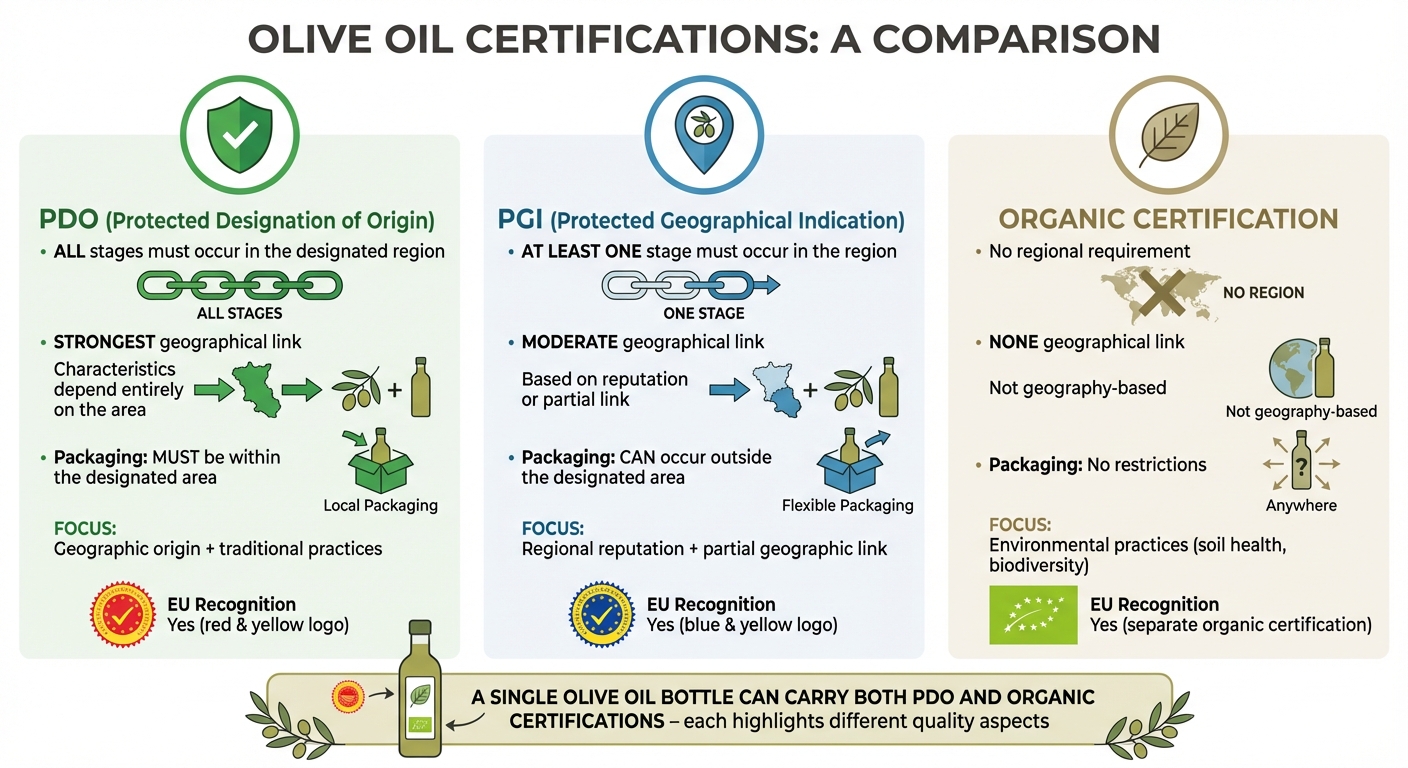
PDO vs PGI vs Organic Olive Oil Certifications Comparison
Protected Designation of Origin (PDO) is a European Union certification established under Regulation (EC) No 1151/2012. It safeguards the names of products that are deeply tied to a specific geographical area and traditional production methods. For olive oil to achieve PDO status, every step of production must take place within the designated region. The oil’s flavor, aroma, and overall quality must be directly influenced by the region’s unique environment and longstanding traditions.
Spain, for instance, boasts 32 PDOs and 2 PGIs for extra virgin olive oil, while the EU as a whole lists 110 PDOs and 24 PGIs across eight countries. Each PDO operates under strict guidelines set by a Regulatory Board. These rules cover everything from approved olive varieties to detailed production methods, often imposing stricter requirements than general legal standards - such as stricter controls on sensory qualities and acidity levels. This structure highlights the purpose and distinctiveness of PDO certification.
PDO Definition and Purpose
In regions like Andalusia, meeting PDO standards is essential for protecting the area’s olive oil heritage. PDO certification not only safeguards regional products but also verifies their quality. It serves as a form of intellectual property across the EU, ensuring that protected names cannot be misused or falsely applied. For example, non-local oils cannot be misleadingly marketed as "Andalusian-style".
PDO certification also preserves traditional farming and production methods passed down through generations. In Andalusia, olives from PDO-certified areas are typically milled within 48 hours of harvest to ensure maximum freshness. Storage conditions are equally stringent - certified oils are usually kept in cellars at temperatures between 59°F and 64°F (15°C to 18°C) to prevent oxidation.
"Designations of Origin are names that identify products originating in specific places, regions, or countries due to unique geographic factors, with production phases occurring entirely within defined areas."
- Council and Parliament Regulation (EC) No 1151/2012
PDO vs. Other Certifications
Understanding PDO certification becomes clearer when compared to other labels, such as Protected Geographical Indication (PGI). While both are recognized as EU intellectual property rights, they differ in their requirements. PDO mandates that all production stages occur within the designated region, whereas PGI only requires one stage to take place there. For example, a PDO olive oil must be entirely produced and packaged within its designated area, while a PGI oil could be packaged elsewhere.
| Feature | PDO: All stages occur locally | PGI: At least one stage occurs locally |
|---|---|---|
| Production Stages | Entire production must occur in the region | Only one stage must occur in the region |
| Geographical Link | Strongest; characteristics depend entirely on the area | Based on reputation or partial link to the area |
| Packaging Location | Must be within the designated area | Can occur outside the designated area |
Organic certification, on the other hand, operates on a completely different basis. While PDO emphasizes the connection between a product and its geographical origin and traditional practices, organic certification focuses on environmental practices like soil health and biodiversity. A single bottle of olive oil can carry both PDO and organic certifications, but each label highlights different aspects of quality. This distinction is crucial in understanding the role of PDO in maintaining the authenticity and high standards of Andalusian olive oils.
"In a PDO product the link between the characteristics of the product and the geographical area in which it is produced is stronger than in a PGI product."
sbb-itb-4066b8e
Why Andalusia Leads in PDO Olive Oil Production
Andalusia accounts for an impressive 69.54% of Spain's total PDO-certified extra virgin olive oil production as of 2021. This dominance is no accident - it's the result of a perfect mix of natural advantages and centuries of expertise. With 1.5 million hectares of olive groves, the region supports roughly 250,000 families across more than 300 municipalities and provides 40% of Andalusia's agricultural jobs.
The economic benefits of PDO certification are striking. In 2020, farmers received an average of €4.54 per kilogram (around $4.95 per kg) for PDO-certified olive oil, compared to just €2.15 per kilogram (about $2.35 per kg) for non-certified extra virgin olive oil. This price gap highlights the value added by stringent quality standards and the strong global demand for oils with protected designations of origin.
Andalusia's natural environment plays a huge role in this success.
Andalusia's Natural Growing Conditions
Andalusia’s Mediterranean climate is a major factor in its olive oil production leadership. Mild winters and long, hot summers create the perfect conditions for olives to develop rich, complex flavors. Even the region’s rocky, limestone-heavy soils - though not ideal for most crops - are well-suited for growing olives, often producing higher-quality fruit than more fertile soils.
The region’s diverse olive varieties further bolster its position. Picual olives are cherished for their high yield, disease resistance, and bold, peppery flavor. Hojiblanca olives bring a softer, buttery profile with hints of artichoke, while Verdial olives produce sweet, fruity oils with no bitterness [18,20]. Beyond flavor, Andalusia’s olive groves also benefit the environment: they act as carbon sinks, help reduce soil erosion, and increasingly contribute to renewable energy through olive waste repurposed as biomass.
Historical and Cultural Background
Andalusia’s dominance in olive oil production is deeply rooted in history. Olive cultivation in the region dates back to around 1050 BC, when the Phoenicians first introduced the trees. The Romans later expanded production on a large scale, turning olive oil into a valuable export. Then, in the 8th century, the arrival of the Arabs revolutionized the industry with advanced irrigation systems, improved extraction methods, and the introduction of new olive varieties. Even the Spanish word for oil, aceite, comes from the Arabic al-zait.
Generations of traditional techniques continue to shape Andalusian olive oil production today. Hand-harvesting methods, like using poles to shake olives into nets, ensure the fruit remains undamaged. Meanwhile, strict rules mandate that olives must be milled within 48 hours of harvest to lock in freshness. Modern research centers, such as the Mengíbar olive growing center in Jaén and the Fats and Oils Institute in Seville, have combined this rich heritage with cutting-edge technology, creating a PDO framework that balances tradition with modern quality assurance. These time-honored practices and innovations ensure Andalusia remains a global leader in high-quality olive oil production.
How PDO Certifications Ensure Quality
PDO certification guarantees strict quality control at every stage of production. To achieve PDO status, Andalusian olive oils must adhere to rigorous standards that surpass the basic requirements for extra virgin olive oil. For starters, only Extra Virgin Olive Oil can qualify for PDO certification. Additionally, every step of the process - from growing and harvesting to extraction and bottling - must take place within the specific geographical area defined by the PDO.
The standards are tough to meet. Oils must maintain an acidity level of 0.8% or lower and pass a series of detailed physico-chemical tests, including checks on peroxide levels, fatty acid profiles, and sterol composition. Beyond lab testing, trained tasting panels conduct sensory evaluations to ensure the oil is distinctly fruity and free from any defects like rancid or fermented notes.
To preserve both flavor and nutritional value, olives must be milled within 48 hours of harvesting, and storage conditions are tightly controlled, with temperatures kept between 59°F and 64°F.
Certification Requirements
The journey to PDO certification starts at the olive grove. Producers must register their land with the local Regulatory Council, establishing a traceable record of the oil's origin. Harvesting typically takes place early in the season, when the olives are at the greenish-purple stage. Although this timing results in a lower oil yield, it ensures a richer flavor profile. The extraction process relies solely on mechanical methods - such as washing, decanting, centrifuging, and filtering - all performed under carefully monitored thermal conditions.
Each batch of oil undergoes two levels of testing. First, laboratory analysis ensures that the chemical composition meets PDO standards. Then, official tasting panels evaluate the oil’s aroma, flavor, and texture. Only oils that exhibit a clear fruitiness and are completely free of defects earn the PDO label.
Once these standards are met, the process moves into the hands of regulatory bodies for final oversight.
Role of Regulatory Councils
Regulatory Councils, or Consejos Reguladores, play a crucial role in maintaining PDO standards across the entire supply chain. These public entities enforce the "Pliego de Condiciones" (Product Specifications), which spells out everything from the approved olive varieties to the required production methods for each PDO. The MDPI Agriculture Journal explains:
"The Regulatory Council of the PDO is responsible for guaranteeing the authenticity and traceability of EVOO with a PDO, through the certification of the product by a control body accredited by the National Accreditation Entity (ENAC)."
Regulatory Councils conduct regular inspections at every stage - from registered olive groves to bottling facilities. Brands that meet all quality requirements are issued numbered back labels (contraetiquetas), which serve as a key identifier for consumers looking for authentic PDO olive oil. This robust traceability system not only prevents fraud but also ensures that every bottle with a PDO seal lives up to the designation's high standards.
How to Identify Authentic Andalusian PDO Olive Oil
When it comes to ensuring the quality of Andalusian PDO olive oil, proper labeling is your ultimate safeguard. These labels, rooted in strict production standards, confirm the oil's origin and authenticity.
Reading Official Labels and Logos
Begin by locating the official European Union PDO logo. This logo, a red and yellow sunburst-style circle, is a hallmark of certified products. Be cautious if you spot a blue and yellow logo instead - that signifies a Protected Geographical Indication (PGI), which has less stringent rules, especially regarding packaging locations.
Look for terms like "D.O." (Denominación de Origen) or "D.O.P." (Denominación de Origen Protegida) on Spanish olive oil bottles. The label should also specify the Andalusian region, such as Priego de Córdoba, Sierra Mágina, or Estepa, alongside the EU PDO logo. The most reliable indicator of authenticity is a numbered back label issued by the PDO's Regulatory Council, verifying that the oil has passed all quality and origin checks.
Another essential detail is the grade - ensure the label states "Extra Virgin Olive Oil". If a bottle claims PDO status but omits this grade, it’s a red flag for inauthenticity. Additionally, the label should confirm that cultivation, extraction, and packaging all occurred within the designated Andalusian region.
| Feature | What to Check |
|---|---|
| EU Logo Color | Red and yellow sunburst (not blue and yellow) |
| Oil Grade | Must state "Extra Virgin Olive Oil" |
| Back Label | Numbered seal from the Regulatory Council |
| Region Name | Specific Andalusian PDO (e.g., Priego de Córdoba, Sierra Mágina) |
Double-check these details to ensure you're buying a genuine product.
Avoiding Mislabeling and Fraud
Misleading labels can be a problem, so stay alert for deceptive phrases like "Baena-style" or "produced as in Estepa". These terms are not allowed on PDO-certified products and suggest mislabeling. Authentic products will never use words like "style" or "type" alongside protected names.
To confirm authenticity, you can search for the product in the eAmbrosia database, which lists all protected geographical indications. Another helpful tool is the GIview portal, which verifies both EU and non-EU designations.
Some Andalusian oils may also feature the "Gusto del Sur" quality certificate. While not mandatory, this certification highlights premium regional products and provides additional assurance. If you're unsure, check the producer's credentials on the relevant Regulatory Council's website or the official "Olive Oils from Spain" platform.
At Big Horn Olive Oil, we strictly follow these PDO standards, ensuring every bottle represents the true quality and heritage of Andalusian olive oil.
Benefits and Challenges of PDO-Certified Andalusian Olive Oils
Advantages of PDO Certification
PDO certification ensures that Andalusian olive oils maintain their heritage and deliver consistent quality. It guarantees that every step of production - from cultivation to packaging - takes place within a specific region in Andalusia, preserving the authenticity of the product .
These certified oils stand out for their distinctive flavor profiles - whether fruity, peppery, or grassy - shaped by the region's unique climate and soil, as well as local olive varieties like Picual and Arbequina. Their complexity makes them ideal for raw uses, such as drizzling over salads or finishing dishes, where their nuanced character can truly shine.
By choosing PDO-certified oils, consumers also contribute to sustainable farming practices. Andalusian olive groves not only support local communities but also play a role in reducing carbon emissions and combating rural depopulation. The higher price tag reflects the genuine quality of these oils and supports small-scale producers, further emphasizing the value of PDO certification.
Still, there are challenges to consider.
Potential Limitations
While PDO certification upholds high standards and benefits local communities, it also comes with some hurdles. For starters, the price is significantly higher - PDO-certified oils typically range from $18 to $40 per liter, compared to $10 to $20 for extra virgin olive oils. This markup, often 20% to 50%, is due to factors like early harvesting, labor-intensive production methods, and strict regulatory requirements. Unfortunately, much of the additional cost benefits retailers, leaving producers with slim profit margins.
Another issue is accessibility. Despite Andalusia producing 69.54% of Spain's PDO-certified olive oil in 2021, only about 28% to 30% of this oil is sold with the official PDO label. The rest is marketed as standard extra virgin olive oil because the demand for premium-labeled products is limited. As a result, consumers often need to turn to specialized retailers or buy directly from producers to find authentic PDO-certified oils.
Conclusion
PDO certification stands as a guarantee of authentic Andalusian olive oil. It ensures that every stage - from cultivation to bottling - occurs within a defined region, using time-honored methods and renowned local olive varieties like Picual and Arbequina. This system not only shields consumers from fraud but also safeguards farming traditions across an expansive 1.5 million hectares.
The certification process is thorough, ensuring measurable quality differences. PDO-certified oils undergo rigorous chemical and sensory testing, often achieving acidity levels as low as 0.3%. In 2020, these oils fetched an average price of $5.44 per kilogram, significantly higher than the $2.58 per kilogram for non-certified oils. These benchmarks help consumers identify authentic, high-quality options.
To ensure freshness and authenticity, look for the official yellow-and-red EU PDO seal and check for a harvest date within the past 12–18 months. These oils shine when used raw, elevating salads and other dishes with their distinctive, region-specific flavors.
Choosing PDO-certified Andalusian olive oil is more than a purchase - it's an investment in quality and tradition. It supports sustainable farming and the livelihoods of approximately 250,000 families who rely on Andalusia's olive industry. The premium price reflects the craftsmanship and deep heritage that mass-produced oils simply can't match. By opting for PDO-certified oils, you contribute to preserving tradition, ensuring quality, and sustaining Andalusia's farming communities.
FAQs
Does PDO certification guarantee better taste?
PDO certification confirms that olive oil is made in a particular region and adheres to strict production standards. However, it doesn't necessarily mean the oil will taste better. Taste is subjective and depends on factors like individual preferences, the type of olives used, and how the oil is produced.
Can a PDO olive oil also be organic?
Yes, PDO olive oil can also be labeled as organic. The PDO certification guarantees that the olive oil adheres to strict standards for quality and originates from a specific geographic region. Meanwhile, organic certification ensures that the oil is produced using farming methods that prioritize sustainability and avoid synthetic chemicals. When an olive oil meets the criteria for both, it can proudly display both labels.
What should I do if a PDO label looks suspicious?
If you're unsure about a PDO label's authenticity, take a moment to verify it through official sources. Start by checking if the certification is registered with authorities such as the European Union or relevant national certification bodies. Look out for recognized seals from trusted organizations that evaluate quality and purity. If the label can't be confirmed or seems to deviate from established standards, it's safer to skip the purchase to ensure you're getting a genuine product.