

Anointing Practices: Early Christianity vs. Modern Traditions
The short answer: Christian anointing changed in structure, but not in core meaning. From the New Testament to current church practice, oil, prayer, healing, blessing, and being set apart stayed at the center.
If you want the whole picture fast, here it is:
- Early Christians used anointing mainly with prayer for the sick, often tied to elders, confession, and laying on of hands
- Modern churches still use oil, but many now place it inside set rites led by ordained clergy
- Catholic practice limits Anointing of the Sick to baptized Catholics facing serious illness or old age
- In both periods, olive oil remained the main symbol of holiness, care, and consecration
- The biggest change was who may perform the rite and how formal the service became
Put another way: the act stayed familiar, but the church built firmer rules around it over time.
Quick Comparison
| Point | Early Christianity | Modern Church Practice |
|---|---|---|
| Main use | Healing prayer and care for the sick | Healing, blessing, and sacramental or church rite use |
| Biblical basis | Mark 6:13; James 5:14–16 | Same passages, later applied through church rules |
| Who anointed | Elders and church leaders | Usually ordained ministers or priests |
| Main elements | Olive oil, prayer, laying on of hands, confession | Olive oil, prayer, blessing, set liturgy |
| Level of formality | More communal and direct | More fixed and structured |
| Meaning of oil | Set apart, healing, holiness | Same core meaning |
What I take from this comparison is simple: the form shifted, but the message stayed the same. Oil still points to prayer, healing, blessing, and a life set apart for God.
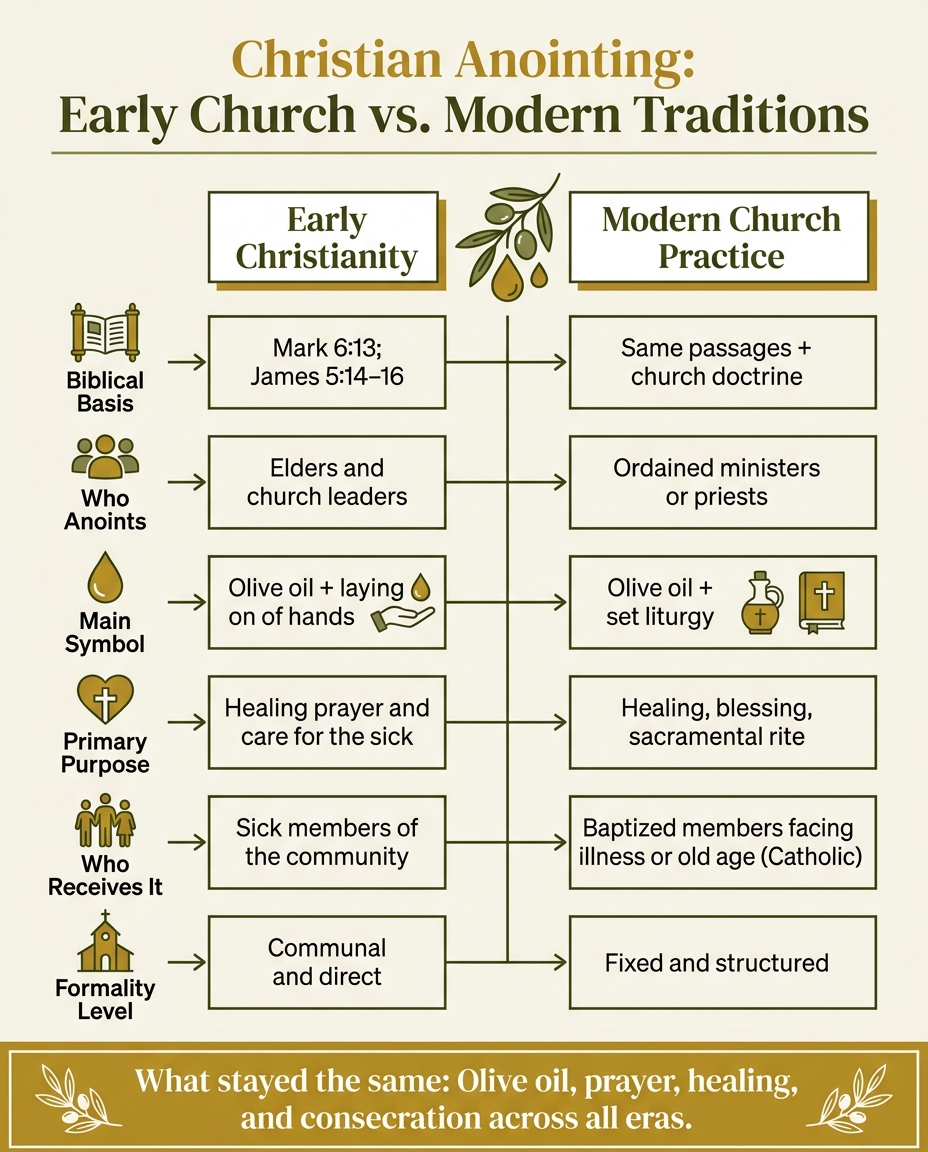
Early Christianity vs. Modern Church Anointing Practices
The Residue of Eden: Myth and Medicine in Early Christian Anointing Practices
sbb-itb-4066b8e
Early Christian anointing: Scripture, healing, and community practice
Early Christians carried biblical anointing into a shared practice of prayer, healing, and care for sick people. In the New Testament, that pattern moves from story into church life.
New Testament foundations in Mark 6 and James 5
Mark 6:13 shows the Twelve anointing sick people with oil and healing them. James 5:14–16 then gives direct instruction for the church: sick people should call the elders, and the elders should pray over them and anoint them in the name of the Lord. James 5:14–16 also ties anointing to prayer, confession, and forgiveness.
This matters because anointing was not treated like a stand-alone ritual. It worked alongside prayer and the life of the church. The act of applying oil was part of a larger pattern of care, trust, and repentance.
Early church use of blessed oil and laying on of hands
In early Christian communities, this biblical pattern took shape through blessed oil and the laying on of hands. The laying on of hands marked blessing and recognition, while olive oil was used in sacred settings. Put simply, early Christian anointing brought together olive oil, prayer, and the laying on of hands as signs of healing and consecration.
Over time, these biblical patterns became more formal in Catholic and Orthodox rites. Later churches kept these same elements, but they set firmer rules about who could anoint and when.
How historic church traditions formalized anointing rites
As anointing took shape over time, later churches turned it into set rites with clear uses, ministers, and recipients. Catholic practice kept that pattern, but it placed the rite under stricter sacramental rules.
Catholic Anointing of the Sick
In Catholic practice, Anointing of the Sick is for baptized Catholics who are facing serious illness or advanced age. The rite offers spiritual strength, peace, courage, and forgiveness of sins when confession is not possible.
This same move toward formal rites also shaped Eastern Orthodox practice, which developed its own sacramental forms.
Early Christianity vs. modern traditions: key similarities and differences
Across Christian history, anointing has kept a few core features, even as different churches shaped the practice in different ways.
What stayed the same: oil, consecration, and ritual action
Later rites kept the same basic symbols, but they placed them inside set liturgies. Anointing still marked people and sacred objects as set apart. The oil is applied directly, usually to the head, and it normally comes with prayer and blessing.
That common thread matters. It shows that, even when the ceremony looks more formal, the central act remains familiar.
What changed: authority and ritual structure
The biggest shift was about authority. Early Christians linked anointing with elders and prayers for healing. Later churches placed it within formal rites led by ordained ministers.
So the core act stayed much the same, while the rules around who performs it and how the rite is arranged became more fixed. Those shifts set up the modern forms discussed in the conclusion.
Conclusion: What this comparison shows about olive oil, faith, and tradition
Across both eras, the core act stayed the same, even as the church changed how it practiced anointing. Olive oil has remained a sign of consecration and holiness. In early Christianity, anointing was closely tied to prayer for healing. In many churches today, that same act lives on through formal rites of blessing and care.
Key points to leave with the reader
That continuity helps explain why anointing still feels familiar today, even when it appears in more formal settings. Biblical instructions called specifically for oil in sacred rites, showing care and reverence in worship. Modern practice carries that same intention forward, now through structured liturgies led by ordained ministers.
The form changed, but the meaning did not. Oil still points to healing, blessing, and sacred purpose.
FAQs
Why was olive oil used for anointing?
Olive oil was used for anointing as a sign of divine selection, consecration, and empowerment. When it was placed on kings, priests, prophets, or sacred objects, it showed that they were holy and set apart for God’s purposes.
It also pointed to the Holy Spirit, divine blessing, and authority. In ritual settings, it carried a sense of spiritual comfort, healing, and renewal.
When did anointing become a formal church rite?
Anointing didn’t become a formal church rite all at once. It took shape over time.
In the early Church, Christians used oil in ways tied to biblical examples, above all for healing. That practice came first. The formal rite came later.
By the first two centuries, writers such as Theophilus and Tertullian were already pointing to the importance of chrism. By the fourth century, Cyril of Jerusalem was teaching its sacramental use. From there, church councils and papal instructions gave it official recognition in rites such as Confirmation.
Can non-clergy perform anointing today?
In much of modern Christian practice, sacred anointing is set apart for clergy, especially in denominations that use consecrated oils like Chrism.
For example, in the Anointing of the Sick, a priest carries out the anointing. Anointing once had a broader range of uses, but today these sacramental acts sit at the center of the clergy’s role.