

Checklist for Choosing Baking Olive Oil
If I want olive oil that works in baking, I check 3 things first: flavor, label date, and recipe type. That’s the short answer.
Here’s the fast version:
- Use mild extra virgin olive oil for sweet bakes like cakes, muffins, brownies, and quick breads.
- Use medium or bold oil for savory bakes like focaccia, cornbread, and herbed breads.
- Check the label for extra virgin, a harvest date within 12 to 18 months, and acidity at or below 0.8%.
- Buy dark glass or opaque bottles, not clear ones left under store lights.
- Swap 1 cup of butter with 3/4 cup of olive oil only in recipes that already work with liquid fat.
- Skip olive oil in recipes that depend on creaming butter and sugar, or in doughs and frostings built around solid fat.
- Taste 1 teaspoon first. If it smells musty, sour, or off, I don’t bake with it.
- After opening, I try to use the bottle within 3 to 6 months and keep it in a cool, dark cabinet at 60°F to 75°F.
That’s the full buying and baking check in one place: pick the right flavor, confirm the bottle is in good shape, and make sure the recipe can handle liquid fat.
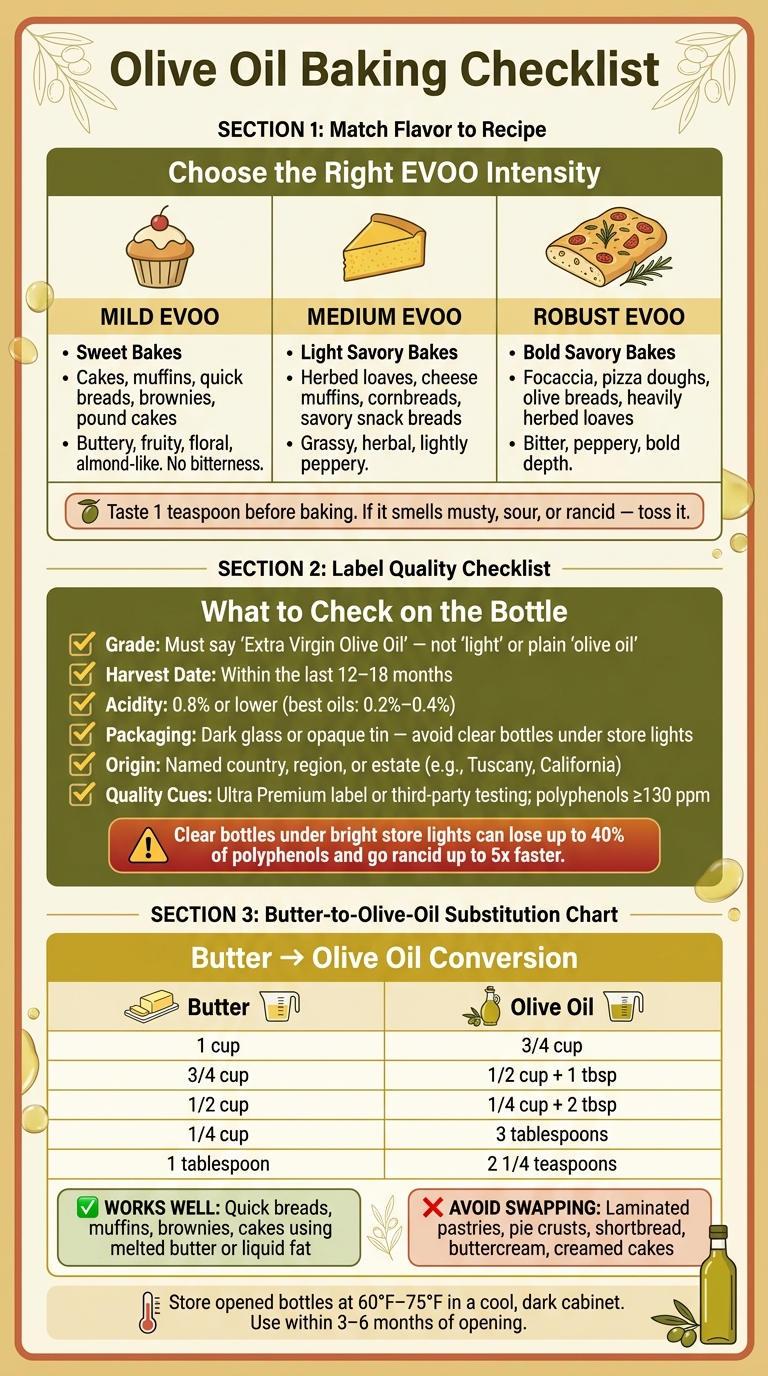
Olive Oil Baking Checklist: Flavor, Freshness & Substitution Guide
Quick comparison
| What I check | What I want |
|---|---|
| Best oil for sweet bakes | Mild EVOO |
| Best oil for savory bakes | Medium or bold EVOO |
| Label grade | Extra virgin olive oil |
| Harvest window | Within 12–18 months |
| Acidity | 0.8% or lower |
| Packaging | Dark glass or opaque tin |
| Butter swap | 3/4 cup oil per 1 cup butter |
| Best recipe match | Cakes, muffins, brownies, quick breads |
| Poor recipe match | Creamed cakes, shortbread, buttercream, flaky pastry |
If I run through this list before I buy, I avoid oil that tastes too strong, too old, or just wrong for the bake.
sbb-itb-4066b8e
Checklist 1: Match Olive Oil Flavor to the Recipe
Match the EVOO's intensity to the recipe. Mild, medium, or robust can help the bake along or take over the whole thing. Start by asking whether the recipe leans sweet or savory. Then pick the bottle based on intensity.
Choose mild EVOO for sweet baked goods
For cakes, muffins, quick breads, pound cakes, and brownies, go with a mild or delicate EVOO. These oils are often described as buttery, fruity, floral, or almond-like. They have very little bitterness and almost no peppery finish. That softer profile lets lemon, vanilla, and chocolate stay front and center.
Arbequina olives often make this kind of mild, fruity oil, which makes them a smart pick for sweet batters. Skip anything labeled bold, peppery, or intensely grassy for sweet baking. In dessert, those notes can come across as bitter or harsh.
Choose medium or robust EVOO for savory baking
Savory bakes play by different rules. Medium EVOO has a grassy, herbal, and lightly peppery character that fits herbed loaves, cheese muffins, and cornbreads, where a bit more flavor works in your favor. For bigger recipes like focaccia, pizza-style doughs, and breads packed with garlic, olives, or chili, reach for a robust EVOO instead. Its bitterness and peppery finish add depth to strong flavors instead of fading into the background.
Taste 1 teaspoon before baking
Once you've picked the intensity, make sure the oil tastes fresh. Before it goes into any batter or dough, taste about 1 teaspoon straight from the bottle. Swirl it, smell it, then let it coat your tongue. Fresh oil should taste fruity, nutty, herbal, or floral. A mild oil should feel gentle and buttery. A robust oil should leave a clear peppery finish.
If the oil smells musty, rancid, sour, or moldy, toss it. Here's the quick guide:
| Mild EVOO | Medium EVOO | Robust EVOO | |
|---|---|---|---|
| Best baking uses | Olive oil cakes, lemon cakes, muffins, quick breads, pound cakes, brownies | Herbed loaves, cheese muffins, cornbreads, savory snack breads | Focaccia, pizza doughs, olive breads, heavily herbed savory loaves |
Checklist 2: Verify Quality, Freshness, and Label Details
After you match the flavor profile, read the label. This is where a lot of the smart buying happens.
Grade, harvest date, origin, and packaging can tell you a lot about how the oil will behave in baking. Fresh, traceable, well-packaged EVOO tends to give you steadier results. Start with the grade, then check harvest date, origin, and packaging.
Confirm extra virgin olive oil grade and harvest information
First, make sure the label clearly says extra virgin olive oil. Not just olive oil. Not light olive oil.
That matters because extra virgin oil is mechanically pressed and not chemically refined. In baking, that helps keep the flavor and antioxidants you want.
Then check for a harvest date, ideally by month and year. A best-by date on its own doesn't tell you much, since it may be set as far as two years after bottling. In plain English: it doesn't show when the olives were picked.
Aim for oil harvested within the last 12–18 months. Once opened, use the bottle within 3–6 months.
Next, look at origin, acidity, and the container itself.
Check origin, acidity, and packaging
A label that names a specific country, region, or estate, such as Tuscany, Italy or California, is usually a better sign than a vague line like Product of EU. More detail often means better traceability, and that makes it easier to judge batch-to-batch flavor.
If the label lists acidity, look for free acidity at or below 0.8%. That's the international standard for extra virgin grade. Many high-quality oils land in the 0.2%–0.4% range.
Packaging matters more than people think. Go with dark glass or opaque packaging and a tight seal. Oil stored in clear glass under light can lose up to 40% of its polyphenols and turn rancid up to five times faster than oil kept in tinted glass in a cool, dark place.
So yes, that big clear bottle under bright store lights may be a bad bet.
Look for Ultra Premium quality and third-party testing
Some producers go beyond the extra virgin label with Ultra Premium standards. That can mean lower acidity limits, shorter harvest-to-bottle windows, and independent lab testing for purity and freshness.
These oils often have higher polyphenol content, often ≥ 130 ppm, which can help with better oxidative stability and a cleaner flavor in baked goods.
Independent testing adds another layer of trust. It helps confirm purity, freshness, and clean flavor.
Once the bottle checks out, the next step is to confirm the substitution ratio and baking temperature.
Checklist 3: Confirm Baking Performance and Substitution Ratios
Next, match the oil to the recipe's fat ratio, texture, and oven heat. Picking the right bottle is only half the job. After that, you need to line it up with the recipe's ratio, the texture you want, and the baking temperature.
Use the right butter-to-olive-oil conversion
Use 3/4 cup olive oil for every 1 cup butter in recipes built for liquid fat. Butter has water and milk solids. Olive oil is pure fat. So you use a bit less oil to make up for that difference.
For smaller U.S. kitchen measurements, use this chart:
| Butter | Olive Oil |
|---|---|
| 1 cup | 3/4 cup |
| 3/4 cup | 1/2 cup + 1 tablespoon |
| 1/2 cup | 1/4 cup + 2 tablespoons |
| 1/4 cup | 3 tablespoons |
| 1 tablespoon | 2 1/4 teaspoons |
This swap tends to work best in recipes that already use melted butter or another liquid fat, like quick breads, muffins, brownies, and some cakes. It’s less dependable in recipes that need solid butter to build structure and trap air, such as laminated pastries, pie crusts, and traditional sugar cookies.
And the change doesn’t stop at the measuring cup. It also shifts crumb and browning.
Expect a softer crumb and less crisp crust
Expect a softer crumb, thinner cookies, and a less crisp crust than butter gives. You may also notice a fruitier flavor and less of that buttery finish.
A simple way to judge the result: taste the bake while it’s warm, then try it again at room temperature. That side-by-side check can tell you a lot. If the texture feels off, adjust leavening or chill the dough before the next batch.
Next, check whether your recipe's bake temperature suits the oil you picked.
Check temperature range and health considerations
Most cakes, muffins, and quick breads bake at 325°F to 375°F. Some breads go up to 400°F to 425°F. Extra virgin olive oil handles those temperatures well when it is mixed into batter or dough.
Conclusion: A Simple Buying and Baking Checklist to Remember
Use this final checklist to check flavor, freshness, storage, and substitution before you bake.
Once you've checked flavor, quality, and ratio, do one last pass on storage and the label. Store opened bottles in a cool, dark cabinet at 60°F to 75°F, away from heat and light. Seal the bottle tightly after each use.
Final checklist for your next bottle
Use this quick recap before buying.
| What to Check | What to Look For |
|---|---|
| Grade | Extra Virgin Olive Oil clearly on the label |
| Freshness | Harvest date within the past 12–18 months |
| Acidity | Listed acidity at or below 0.8% |
| Packaging | Dark glass or tin; avoid clear plastic or open cruets |
| Origin | A single country or a clearly identified blend or source on the label |
| Quality cues | Ultra Premium designation or third-party testing |
| Flavor intensity | Mild for sweet bakes; medium or robust for savory recipes |
| Bottle size | Small enough to finish within 3–6 months after opening |
| Substitution | Use 3/4 cup olive oil per 1 cup butter when swapping |
If it passes the checklist and tastes fresh in a 1-teaspoon sample, it's ready to bake.
FAQs
Can I bake with regular olive oil instead of extra virgin?
Yes, you can bake with olive oil. For the best results, go with extra virgin olive oil (EVOO).
EVOO is the highest-grade option. It has a natural flavor and contains antioxidants. It also works well at normal baking temperatures.
In baked goods like cakes, muffins, and similar treats, EVOO can add moisture and a deeper flavor. That means your finished bake can taste a little richer, not just softer.
How do I know if olive oil is too old to use in baking?
Check the label first. For EVOO, aim to use it within 18–24 months of harvest or bottling. And if you’re buying a bottle now, it’s best to pick one harvested within the past year.
Once you open it, try to use it within about 60–90 days if you want the best flavor.
A quick smell and taste test helps too. If the oil smells musty or tastes flat or dull - instead of fresh and fruity with balanced bitterness and pepper - it’s probably past its prime or has started to break down. At that point, skip it for baking.
Which baked recipes should not use olive oil?
Olive oil works well in many baked recipes, especially cakes, muffins, and cookies. There isn’t a set group of baked goods that has to avoid it, but the oil’s flavor strength matters.
For sweet desserts, mild olive oils usually work best. For savory breads, stronger, peppery oils can be a good fit.
If a recipe leans on a very neutral fat flavor, another fat may be the better pick.