

Top Certifications for Ethical Olive Oil Production
If you buy olive oil, don’t trust the label alone. I’d look for three things first: a current certificate, a recent audit summary, and lot-level traceability from grove to bottle.
Here’s the short version: no single program covers every risk. Some focus on farms. Some check mills and bottlers. Some track product flow. And some help buyers review labor records across many suppliers. That matters because agriculture makes up 61% of global child labor cases, and in 2024 about 138 million children were in child labor worldwide, with 54 million in hazardous work.
What I’d review in this article:
- Rainforest Alliance for farm rules plus product traceability
- Sedex / SMETA for shared social audit reports across sites
- SA8000 for site-level labor management and worker protections
- Fairtrade for producer groups and community-based child labor response
- Organic + social standards for farming method checks paired with labor controls
- Advanced traceability systems for batch tracking and origin screening
What makes these programs worth checking:
- Independent audits
- Child labor rules with remediation steps
- Site scope that matches the actual supply chain
- Records that connect each lot to its source
Quick Comparison
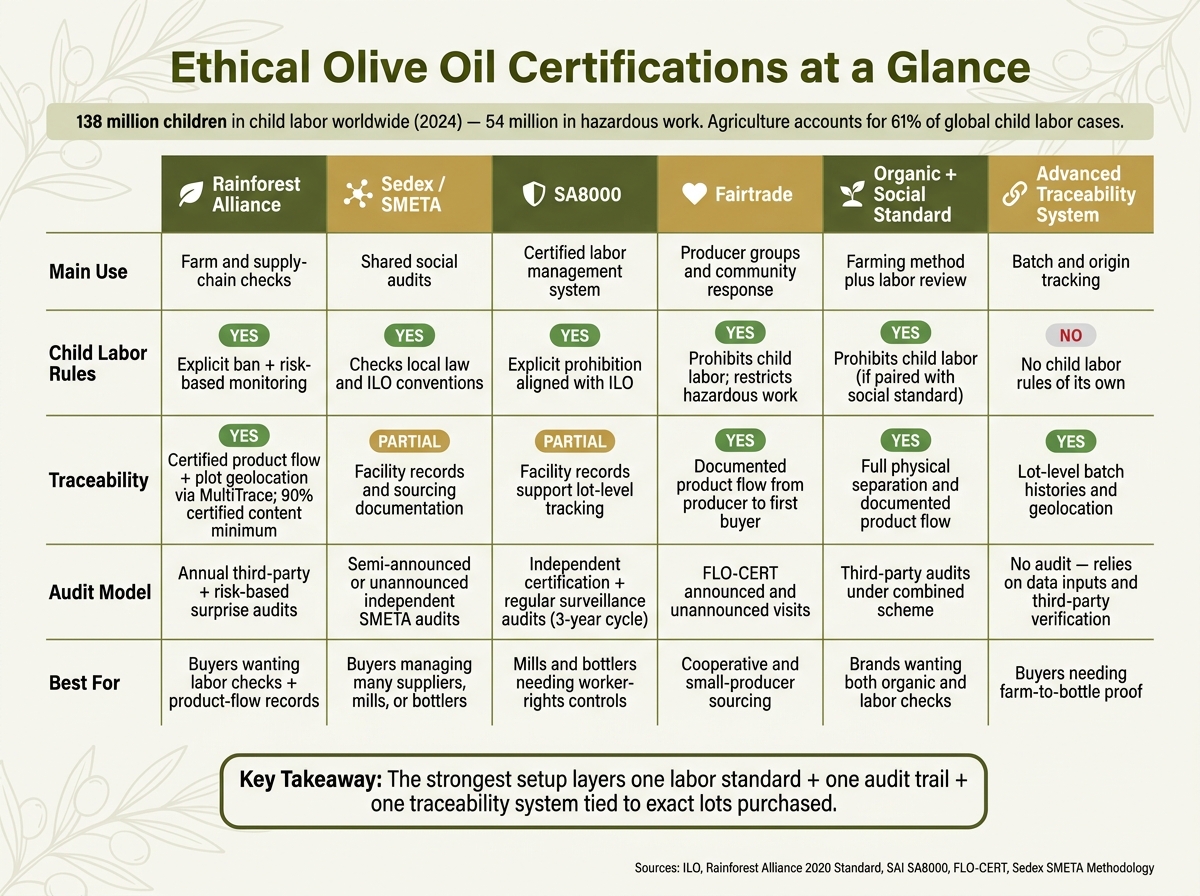
Ethical Olive Oil Certifications Compared: Child Labor, Audits & Traceability
| Program | Main use | Covers child labor rules | Covers traceability | Best fit |
|---|---|---|---|---|
| Rainforest Alliance | Farm and supply-chain checks | Yes | Yes | Buyers who want labor checks plus product-flow records |
| Sedex / SMETA | Shared social audits | Yes | Some site records | Buyers managing many suppliers, mills, or bottlers |
| SA8000 | Certified labor management system | Yes | Site records can support it | Mills and bottlers needing worker-rights controls |
| Fairtrade | Producer groups and community response | Yes | Product-flow records | Cooperative and small-producer sourcing |
| Organic + social standard | Farming method plus labor review | Yes, if paired | Yes | Brands that want both organic and labor checks |
| Advanced traceability system | Batch and origin tracking | No | Yes | Buyers that need farm-to-bottle proof |
My takeaway: the best setup is usually a layered one - one labor standard, one audit trail, and one traceability system tied to the exact lots you buy.
What Makes a Certification Meaningful for Ethical Olive Oil?
Not every certification carries the same weight. The strongest ones ask for independent audits, traceable records, and labor rules that can actually be enforced. That’s the lens to use when judging the certifications below.
Child Labor Rules and Remediation Requirements
A meaningful certification does more than ban child labor in a policy document. Stronger standards like Rainforest Alliance, Fairtrade, and SA8000 require written child labor policies, risk assessments, prevention steps, and documented remediation when violations are found.
That last part matters a lot. If a child is found doing harmful work, the response shouldn’t stop at removal. Remediation should get children out of danger, support their return to school, and deal with the root cause. A simple “zero tolerance” line, with no plan behind it, is a weak signal.
Audit Strength and Independent Verification
Third-party certification is stronger than self-reporting or buyer-run audits. Independent certification bodies check compliance through site visits, worker interviews, and document reviews. That gives buyers firmer evidence than a company assessing itself.
SMETA is one of the most used social audit methods across global supply chains.
Traceability From Grove to Bottle
Olive oil passes through several hands before it reaches a shelf: farms, mills, storage tanks, and bottling lines. If there’s no chain-of-custody system and no lot-level tracking, certified and non-certified oil can be mixed together. When that happens, ethical claims start to look shaky.
Some producers use parcel-level traceability for each batch. Rainforest Alliance also requires all certified product activities to be reported in a central platform every quarter. That gap matters when you compare one certification with another.
Supply Chain Coverage
Some certifications apply only to farms. Others extend to mills and exporters too. Buyers should check that scope before leaning on the claim.
1. Rainforest Alliance Certification
Rainforest Alliance is often a strong fit for buyers who want a standard that covers both child-labor rules and traceability checks. The Rainforest Alliance 2020 Sustainable Agriculture Standard bans child labor and backs that up with due diligence, remediation rules, and traceability controls.
A big part of that system is the assess-and-address approach, which follows five steps: commit, assess, mitigate, remediate, and monitor. In olive production, the highest labor risk often shows up during harvest. Seasonal crews, subcontracted picking teams, and migrant workers with children on-site need close review. It’s not enough to look only at year-round staff.
If child labor is found, the standard requires a formal Remediation Protocol. The first priority is the child’s safety. That can mean removing the child from harm, helping the child get back to school, and working with families, local authorities, or NGOs to deal with root causes like poverty. Farms must record both the case and the steps taken to fix it. If a farm keeps failing to remediate cases, it can face suspension or loss of certification.
This review doesn’t stop at the farm gate. It also reaches mills and bottlers. During site visits, auditors check child-labor due diligence systems, grievance mechanisms, and corrective actions. Certified farms must also run internal inspection systems along with outside audits.
The structure is fairly clear:
- Farm Requirements apply to groves.
- Supply Chain Requirements apply to mills, traders, and bottlers.
For traceability, MultiTrace records transactions and lot-level data as oil moves through the supply chain. Products that carry the seal must contain at least 90% certified content or an equal certified volume under mass balance. That gives buyers a direct way to check certified source coverage and lot-level oil movement.
2. Sedex Membership and SMETA Audits
Where Rainforest Alliance certifies the supply chain, Sedex is the system many buyers use to share audit records on labor practices. For olive oil buyers, that matters when they need labor documentation from several suppliers at once. Sedex is a supply-chain data platform, while SMETA is the audit method used for reviews of labor, health and safety, environmental, and business ethics. When a buyer asks for it, a supplier can go through a SMETA audit carried out by an independent third-party auditor.
SMETA requires compliance with local law and the ETI Base Code. That includes no child labor, proof-of-age records, written age-check procedures, and limits on the tasks young workers can do. In olive farming and milling, this gets extra attention during harvest, when seasonal workers and labor agencies are often part of the workforce.
If underage labor is found, SMETA treats it as a corrective-action finding. That means the site needs a remediation plan, often with support from the buyer, an NGO, or public authorities, to protect the child and stop the same issue from happening again.
One of Sedex's main draws is simple: a single audit report can be shared with more than one buyer. That can cut duplicate audits across farms, mills, and bottlers. For U.S. buyers, it's smart to ask for:
- the full SMETA report
- the corrective action plan
- the SAQ
- proof that the audit scope covers the exact site
- proof that any subcontracted labor is included in scope
If a buyer needs a certifiable social accountability standard, SA8000 goes deeper.
3. SA8000 Social Accountability Standard
While audit-sharing systems mainly show that a site meets a set of checks, SA8000 builds those rules into a certified management system. Developed by Social Accountability International (SAI), SA8000 certifies labor practices through a Social Management System (SMS). In plain English, that means issues like child-labor prevention, wages, working hours, and worker grievances become part of day-to-day operations instead of sitting in a policy binder.
If child labor is found, the response is strict and direct. The site must stop the practice and support the child’s return to school without cutting family income.
The certification process includes document review, an on-site audit, and surveillance audits across a three-year cycle. That setup keeps checks active during peak harvest and processing seasons, not just at the start when the first certificate is issued.
The SMS model also reaches past the certified site itself. SA8000 extends supplier accountability, so a certified bottler must assess its own suppliers and carry those ethical requirements farther up the chain.
SA8000 can be used by organizations of any size. And for suppliers that want to get ready before the formal audit, SAI’s Social Fingerprint self-assessment can help flag gaps early. For olive oil producers, that can be a practical first step.
4. Fairtrade International Standards
Fairtrade uses a community-based model that ties child-labor prevention to producer governance and local remediation. It bans child labor, requires decent working conditions, and adds community-level response through producer groups.
If child labor is found, Fairtrade requires immediate protection for the child, remediation through local child-rights partners, and suspension or de-certification in the most severe cases, including trafficking and other severe labor abuses.
In olive oil, this matters most in places where cooperative growers, seasonal harvest labor, and local milling operations all intersect. Fairtrade’s YICBMR program helps communities spot and respond to child-labor risks. It was piloted in 12 countries over a three-year period. Auditors pay close attention to high-risk products and regions.
The Fairtrade Premium can help pay for education, healthcare, and other measures that address root causes.
For brands that want social accountability alongside farming standards, the next step is organic certification with added social controls.
sbb-itb-4066b8e
5. Organic Certification Paired With Social Standards
Organic certification - whether USDA Organic or EU Organic - mostly deals with farming and production methods. It tells you how olives were grown and handled. On its own, though, it does not confirm labor conditions in olive groves or mills. That’s the missing piece, and it’s why ethical sourcing works best when organic is paired with a labor standard.
IFOAM-aligned organic standards add that social piece. Organic claims cannot cover production tied to human-rights abuse or clear social injustice. Operators also need a written social-justice policy that lines up with ILO conventions and the UN Convention on the Rights of the Child. Child labor is banned, aside from limited, supervised, non-hazardous family work that does not disrupt schooling.
This added layer means more when it’s checked alongside organic records. Pairing organic with SA8000 or Fairtrade gives buyers a stronger way to verify what’s happening. Organic audits look at inputs and lot records. Social audits look at things like:
- age checks
- payroll
- working hours
- grievances
- worker interviews
Together, those checks give a much clearer picture.
The same paper trail also helps with traceability. Organic traceability already follows oil from grove to bottler. Social standards can use that same chain to connect each lot to labor-risk checks and any remediation work. In plain terms, the system that tracks the oil can also help track labor safeguards.
Coverage across the supply chain matters just as much. Organic certification can include mills and bottling sites, while workplace standards can cover seasonal crews, permanent staff, and bottling employees. For buyers, the next move is simple: check whether the supplier’s scope documents line up with the sites that are actually involved.
6. Advanced Traceability and Certification Systems
Certification audits matter, but they’re only part of the picture. Buyers also need public risk-screening tools to spot trouble before it shows up in the supply chain.
Use the ILAB List of Goods Produced by Child Labor or Forced Labor to screen olive oil origins and supplier inputs before onboarding. In practice, that list can support certification screening, audit prioritization, and corrective-action checks. It helps buyers focus attention where the risk is higher instead of treating every supplier the same.
Traceability also needs to extend to downstream goods, not just raw inputs. That includes finished olive oil, blends, and packaged products, so each one can be linked back to higher-risk inputs.
That screening should then move straight into supplier onboarding and audit requests.
How Premium Olive Oil Brands Can Apply These Standards
Use certifications to screen suppliers, not as shelf stickers. Once you pick a standard, put it to work during supplier approval.
Use Certifications in Supplier Onboarding
Check every supplier against the U.S. Department of Labor's List of Goods Produced by Child Labor or Forced Labor before approval. The list covers 204 goods across 82 countries and areas. Think of it as a hard stop at the gate.
Then review the supplier's certification scope. If they show a certification like Rainforest Alliance, SA8000, or Fairtrade, make sure it covers the actual ingredients and source sites tied to your olive oil. A certificate can look fine on paper and still miss the farm or facility that matters.
If the supplier fails this screen, pause approval. Don't move forward until the risk is documented and resolved.
Request Audit Evidence and Corrective Actions
Ask for the audit summary, the corrective-action plan, and proof that any issue was closed. Don't settle for a badge or a one-page claim. You want the paperwork behind it.
If a sourcing region shows up on the ILAB list, ask for dated proof that child labor findings, age checks, and remediation records were handled. That follow-up evidence matters. Without it, you're taking the supplier's word for it.
After the paperwork checks out, confirm the claim at the lot level.
Match Ethical Claims With Traceability Records
Match each labor claim to the exact lot using farm, mill, and bottling records.
Comparison Table: Which Certification Covers What?
No single system covers every step in the olive oil chain. Some focus on farms. Others look at mills, bottlers, or trading groups. And some don’t set labor rules at all - they help prove where each lot came from.
This table gives you the fast comparison: scope, audit strength, traceability, and child-labor coverage.
| Dimension | Rainforest Alliance | Sedex / SMETA | SA8000 | Fairtrade | Organic + social standard | Advanced traceability system |
|---|---|---|---|---|---|---|
| Scope in olive oil | Farm / cooperative level | Facility level for mills, packers, and bottlers; audit framework, not a product certification | Facility level for mills and bottling plants | Small producer organizations and traders | Farm and processing under organic certification plus a social standard | Full chain, from grove to bottle |
| Child labor rules | Explicit ban; risk-based monitoring. | Checks local law and ILO conventions at the audited site | Explicit prohibition aligned with ILO conventions | Prohibits child labor; restricts hazardous work by minors. | Prohibits child labor; allows only limited, non-hazardous family help. | No child labor rules of its own; links lots to certified sources |
| Remediation expectations | Structured remediation protocol: removes children from hazardous work, supports schooling, and addresses root causes | Corrective Action Plan required for non-compliances | Written remediation procedures, including support for affected children to attend school | Remediation and prevention strategies; serious cases can lead to suspension or decertification | Immediate removal from work and a rehabilitation policy that guarantees schooling until adulthood | No remediation rules of its own; can help track and flag non-compliant lots |
| Audit model | Annual third-party audits plus risk-based surprise audits | Semi-announced or unannounced independent audits using SMETA methodology | Independent certification audits with regular surveillance audits | Audits by FLO-CERT, including announced and unannounced visits | Third-party audits under the combined scheme | No audit; relies on data inputs and third-party verification |
| Traceability contribution | Certified-product flow and plot geolocation. | Facility records and sourcing documentation. | Facility records that support lot-level tracking. | Documented product flow from producer to first buyer. | Full physical separation and documented product flow at all stages | Lot-level batch histories and geolocation. |
| Best for olive oil buyers | Ethical farm-level assurance for olive growers | Social audits for contract packers, mills, and private-label bottlers | Worker rights oversight at mills and bottling plants | Smallholder livelihoods, fair trade terms, and community-level child protection | Brands needing both chemical-free production and verified social protections | Brands proving farm-to-bottle ethical sourcing to U.S. retailers or regulators |
| Ask for | Current certificate, scope, recent audit summary, assess-and-address child labor evidence, and lot records | Sedex membership confirmation, latest SMETA audit report, CAP, and closure status | SA8000 certificate, sites covered, child labor remediation procedures, and surveillance audit dates | Fairtrade certificate, producer organization list, FLO-CERT audit summaries, and child labor findings and corrective actions | Certification scope documents, social compliance chapter, rehabilitation policy, and separation records | Lot-level reports, batch histories from farm to bottling, and links to social certifications |
The main point is simple: fit matters. Match the certificate to the site and the risk you need to check.
For Big Horn Olive Oil, the practical move is to layer farm records, facility audits, and lot-level traceability. That way, each ethical claim ties back to a specific source instead of sitting there as a broad promise.
What U.S. Buyers Should Ask Suppliers to Provide
Certificates are just the starting point. What you need is the paperwork behind them: documents that show scope, audit results, and traceability. In plain English, each ethical claim should tie back to a specific site, a specific date, and a specific auditor. Use the table above to narrow down the standard, then use this checklist to vet the supplier.
Current Certificates and Scope Documents
Ask for the full certificate PDF, not just a logo on a website or a verbal “yes, we’re certified.” The PDF should show the certificate number, issuer, issue date, and expiration date.
The scope statement matters even more. A certificate might apply only to the bottling plant if upstream sites aren’t listed. Ask for a scope document that names every covered site - farms, cooperatives, mills, storage facilities, and co-packers - plus the product categories and activities included.
Recent Audit Summaries and Corrective Action Plans
A current certificate tells you the supplier passed an audit. The audit summary tells you what the auditors actually found.
Request the most recent audit summary or findings report. Then look closely at any nonconformities, especially critical or major ones. After that, ask for the Corrective Action Plan (CAP). It should list each finding, the fix, the owner, the deadline, and proof of closure. If a supplier can’t produce a CAP that shows how nonconformities were closed out, treat that as a serious red flag before you sign a contract.
Traceability Records and Lot-Level Documentation
Once the paperwork checks out, verify the physical chain too. Ask for records that connect each finished lot back to the grove, mill, storage site, and bottling line.
This step matters because certified and uncertified oil can enter the same supply chain during milling or blending. Without lot-level documentation, you have no way to confirm that the oil in a specific bottle came from a certified source with proper labor controls.
Supplier Policies on Child Labor and Worker Protections
Don’t stop at audits and traceability. Ask for the supplier’s written child labor policy. It should clearly ban the employment of children below the legal minimum age, limit young workers from hazardous tasks, and spell out age-verification procedures, including which documents are checked and what happens when records are missing.
Also ask for records on grievance channels: how workers report concerns, who receives those reports, and what the escalation steps are if a child labor risk comes up. A policy on paper, without training records or working grievance channels, doesn’t do much to protect anyone.
Conclusion
Taken together, the certifications above make one thing clear: no single certification covers every gap. No certification guarantees that olive oil is free of child labor. These programs can lower risk, but they can't erase it.
The strongest setup pairs a recognized certification, independent social audits, and lot-level traceability. Each piece helps cover a different blind spot. That matters most when you're deciding what to buy.
For U.S. buyers, the standard is pretty simple. Ask for:
- a current certificate
- a recent audit summary
- lot-level origin records
Those three items should come before you trust ethical claims.
Brands that publish certifications, audit records, and traceability data make ethical sourcing much easier to check.
FAQs
Which certification should I prioritize first?
Start with certifications backed by independent, third-party audits and solid social compliance standards.
Focus on certifications that check human rights due diligence and labor practices, such as Fair Labor Accreditation or standards tied to ILO conventions. It also helps to look for brands that publish supply chain transparency reports or use digital tracing systems to help confirm ethical practices at the farm level.
Can one certification prove ethical olive oil sourcing?
No. No single certification covers every part of ethical olive oil production.
Each one looks at a different piece of the puzzle. Some focus on labor standards and human rights. Others deal with geographic origin and time-tested production methods. And some look at farming practices and how olives are grown.
If you want a better read on a product, look for more than one third-party audit, plus transparency reports and traceable data from grove to bottle.
How do I verify lot-level traceability?
Look for olive oil that includes digital tracking tools on the package, like QR codes or RFID tags. These can lead you to a Digital Product Passport or a blockchain-based record that shows the oil’s journey from the grove to the bottle.
The label can also tell you a lot. Check for batch codes, the harvest date, and certification seals like PDO, PGI, or COOC. Those details point to careful recordkeeping and traceability checked by outside auditors.