

Top 5 Olive Varieties for Organic Farming
If I were picking olives for an organic orchard in the U.S., I’d start with five names: Koroneiki, Picual, Arbequina, Frantoio, and Coratina. They stand out for disease tolerance, steady crops, harvest fit, and oil quality.
Here’s the short version:
- Koroneiki: high polyphenols, early bearing, strong fit for hot and dry areas
- Picual: steady yields, strong shelf life, good fit in Zones 8–10
- Arbequina: early production, easy machine harvest, mild oil
- Frantoio: good disease tolerance, layered flavor, works best in milder sites
- Coratina: very high polyphenols, bold oil, needs heat and pollinizers
If you want the fastest path to production, Arbequina is hard to ignore. If you care most about oil stability and stronger flavor, Koroneiki and Coratina lead the group. If you want a middle ground, Picual and Frantoio are strong picks.
Organic growers have fewer spray options, so variety choice matters more. In the article, I’d focus on four things: disease pressure, bearing pattern, tree shape for harvest, and oil traits like polyphenols and shelf life.
Quick Comparison
| Variety | Best known for | Bearing start | Oil style | Main watch-out |
|---|---|---|---|---|
| Koroneiki | Very high polyphenols | 2–3 years | Bold, peppery | Cold damage below 15–20°F |
| Picual | Stable oil, steady crops | 3–5 years | Bold, bitter, peppery | Sensitive to Verticillium wilt |
| Arbequina | SHD plantings, early crops | 2–4 years | Mild, fruity, buttery | Lower shelf life |
| Frantoio | Good disease tolerance | Early | Fruity, peppery | More site-sensitive |
| Coratina | Intense oil, high phenolics | Early | Bitter, peppery | Needs pollinizers |
Bottom line: I’d match the variety to the site first, then to the oil style and harvest system. That simple order can save years of trouble in an organic orchard.
Growing Organic Olives
sbb-itb-4066b8e
What Makes an Olive Variety a Good Fit for Organic Farming?
Organic orchards need cultivars that can handle pressure with fewer inputs and still make good oil. The best picks tend to share four things: disease tolerance, steady production, easy-to-manage tree shape, and strong extra virgin olive oil quality.
Disease and Pest Tolerance Under Organic Management
Disease tolerance comes first. In organic orchards, it’s the main gatekeeper.
Verticillium wilt is a soilborne fungus, and once a tree is infected, there’s no effective organic cure. Olive knot bacteria get in through pruning wounds and frost cracks, and the main organic defense is preventive copper sprays after frost events. Peacock spot, also called olive leaf spot, can lead to defoliation and lower yields, especially in humid or high-rainfall areas.
Picking varieties with better disease resistance can cut pesticide use by up to 50% compared with more susceptible cultivars. In California, the olive fruit fly is another big issue. Varieties with smaller fruit, such as Arbequina, often face less damage than large-fruited types.
Consistent Yield and Bearing Habits
Alternate bearing makes organic planning harder. One heavy year followed by one light year can throw off harvest schedules, labor needs, and oil output. Varieties that produce more steadily are usually easier to manage year after year.
Harvest Efficiency and Tree Structure
Compact, low-vigor trees make pruning and machine harvest easier. That matters a lot when labor is tight and every pass through the orchard costs money. Open canopies also improve airflow and light, which helps lower leaf disease pressure.
Oil Quality, Flavor, and Shelf Stability
Polyphenol content is one of the main markers to watch. Oils with high polyphenol levels resist oxidation for longer and often have a bolder taste. Those compounds also help protect the oil during storage, which supports flavor and shelf life. Varieties like Picual and Coratina are well known for high polyphenol levels.
"The variable that most influences the flavor profile of EVOOs is the variety, followed by the stage of ripeness." - European Journal of Lipid Science and Technology
That mix of orchard performance and oil traits is why the five varieties below stand out in organic orchards.
1. Koroneiki
Native to Crete and the Peloponnese, Koroneiki is a compact Greek cultivar that fits high-density organic orchards well. Its smaller canopy makes pruning and harvest easier. That mix of tight growth and steady oil quality is a big reason growers keep coming back to it.
Organic Disease and Pest Resilience
Koroneiki’s high polyphenol content helps with natural resistance, but it still needs close watching. Growers should scout for olive fruit fly, olive knot, and olive psyllid. Sticky traps or OLIPE traps from early summer can help time control steps well.
Oil Yield and Bearing Consistency
The fruit is tiny, but the oil output is strong. Koroneiki reaches about 27% oil content and starts bearing early, often within 2–3 years. It also fits high-density and super-high-density organic orchards, including 350–700 trees per acre.
That early and steady production matters in organic systems, where input options are more limited and consistency can make a big difference.
Phenolic Content and Oil Stability
Koroneiki often produces oil with 600–1,000+ mg/kg of polyphenols. Some organic single-estate oils have tested even higher, including SP360 Organic at 1,462 mg/kg and Pamako Premium at 1,222 mg/kg.
Those high phenolic levels help the oil hold up well against oxidation and support a longer shelf life. In the glass, the profile is bold and herbaceous, with notes of fresh-cut grass, green apple, wild herbs, artichoke, and pepper. For organic growers, those oil traits matter just as much as field performance.
Climate Fit for U.S. Growing Regions
Koroneiki does well in hot, dry climates and handles drought and wind well. It also has a low chill need, requiring only 200–300 hours below 45°F to flower.
Cold is the main weak spot. Temperatures below 15–20°F can cause serious damage.
| U.S. Region | Suitability |
|---|---|
| California | Premier region; performs well in the Central Valley and coastal areas |
| Florida | Successful in central and southern areas, including as far south as Ona |
| Texas | Suitable for the Hill Country and West Texas |
| Arizona | Marginal to good in southern regions with supplemental irrigation |
| Georgia | Viable only in the southern portion (Zone 8b); risky in Zone 7 |
It’s best to avoid low-lying frost pockets and heavy clay soils with poor drainage. Koroneiki does not handle standing water well and can be prone to root rot. Well-drained soil with a pH of 6.5–8.5 is the target.
2. Picual
Picual comes from Jaén, Spain. It’s a vigorous, upright cultivar that organic growers often choose for steady crops and oil that holds up well in storage. The tree has a naturally open canopy, which helps air move through the branches. In organic orchards, that matters. Better airflow can make field management a bit easier, especially when disease pressure shows up.
Organic Disease and Pest Resilience
Picual earns its place in organic systems partly because of what it can handle in the field.
It has moderate resistance to olive leaf spot, also called Peacock spot, which is useful under organic management. But there’s a catch: Picual is sensitive to Verticillium wilt. That makes site choice a big deal. Fields that previously grew tomatoes or peppers are best avoided.
Drainage also matters. Poorly drained soils can increase Phytophthora risk, so growers often use raised berms and drip irrigation to help keep roots out of trouble.
Oil Yield and Bearing Consistency
Picual is a strong, steady producer. Oil yield usually lands between 23% and 28%, and trees often start producing in 3–5 years. It also has a low alternate-bearing tendency, which helps smooth out year-to-year swings in production.
For growers, that kind of consistency can make a big difference. One year up, one year down? Picual is less likely to play that game.
Phenolic Content and Oil Stability
This is where Picual stands out. It’s known for shelf stability, thanks to its high oleic acid and low linoleic acid, which make the oil highly resistant to oxidation. Early harvest oils usually show polyphenol levels between 300 and 600 mg/kg.
The flavor is bold and aromatic. It starts fruity, then moves into clear bitterness and a peppery finish. Common tasting notes include tomato leaf, green grass, fig tree, and artichoke.
To help preserve polyphenols and shelf life, harvest at veraison, when 40% to 60% of the fruit has turned purple.
Climate Fit for U.S. Growing Regions
Picual fits best in USDA Zones 8–10 and can handle cold down to about 10°F to 12°F. It also needs about 200 to 400 chill hours below 45°F for proper flowering.
| U.S. Region | Suitability |
|---|---|
| California | Excellent; Central Valley and coastal regions are ideal |
| Texas | Well suited to the Hill Country |
| Arizona | Good in southern areas with drip irrigation |
Picual is self-fruitful, but adding pollinators like Frantoio or Leccino can improve fruit set and total yield.
3. Arbequina
Arbequina comes from Catalonia, Spain, and it has become the low- to medium-vigor workhorse of California’s super-high-density orchards. Compared with Picual, Arbequina gives up some intensity in exchange for speed. It bears earlier, grows with less vigor, and is easier to harvest by machine. Its weeping, spreading growth habit also makes it a strong match for SHD hedgerows built for mechanical harvest.
Organic Disease and Pest Resilience
Arbequina has moderate tolerance to olive knot (Pseudomonas savastanoi), and it handles salinity and high atmospheric moisture well. But it does have weak spots. Verticillium wilt, black scale, and nematodes can all cause trouble, which is why site choice matters so much. Wilt-prone ground is a bad bet, and well-drained soil can help limit root disease.
Peacock spot (leaf spot) is another issue, especially in dense plantings where air doesn’t move well. In organic SHD systems, wider tree spacing can cut foliar disease pressure without leaning on synthetic fungicides.
Oil Yield and Bearing Consistency
One of Arbequina’s biggest selling points is how fast it starts producing. Trees often bear fruit within 2 to 4 years of planting. By year 5, yields can climb fast, reaching about 13,400 lb/acre. It’s also self-fertile.
Phenolic Content and Oil Stability
Arbequina oil is mild, buttery, and fruity, with notes of apple, almond, and fresh herbs. Polyphenol levels are low, around 270 to 400 ppm, and oxidative stability is modest at about 7.9 hours at 120°C. That lower polyphenol content means a shorter shelf life, but it also gives the oil a softer, fruitier profile.
For harvest timing, pick when the fruit shifts from yellowish-green to a faint blush. If you wait until it turns black, stability can drop even more.
Climate Fit for U.S. Growing Regions
Arbequina handles about 20°F to 22°F and fits USDA Zones 8–10. That makes it a practical pick in places where organic growers care more about harvest ease and orchard efficiency than bold, high-intensity oil.
| U.S. Region | Suitability |
|---|---|
| California | Dominant variety; ideal for SHD mechanical harvest systems |
| Florida | Popular choice; tolerates high atmospheric moisture |
| Texas | Well-suited to low-chill southern conditions |
4. Frantoio
Where Arbequina leans toward efficiency, Frantoio brings stronger disease tolerance and a more layered oil profile. It comes from Tuscany and is known for resilience and high-quality oil. The tree has medium vigor with a weeping canopy, and it needs regular pruning to keep production on track.
Organic Disease and Pest Resilience
For organic growers, this is where Frantoio stands out. Spray options are limited, so a cultivar with better tolerance can make life a lot easier. Frantoio shows tolerance to major fungal pressure, including Verticillium wilt and Anthracnose.
That said, it’s not trouble-free. The main risks are olive fruit fly, peacock spot, and olive knot. Because of that, many organic growers put out sticky traps and OLIPE traps early in the season.
Oil Yield and Bearing Consistency
Frantoio is productive, bears early, and handles rocky or heavy soils well. Its oil content is usually medium-high, around 20% to 23%.
Production also gets steadier with the right pollinizers. Planting Frantoio alongside Leccino, Pendolino, or Maurino can improve fruit set and help make year-to-year output more dependable. Site choice matters too. Heavy fog and cold winds can cut production, so those spots are best avoided.
Phenolic Content and Oil Stability
Frantoio oil is known for high natural stability and a complex profile. Expect a fruity, peppery oil with notes of fresh grass, artichoke, green apple, rosemary, celery, and almond.
It can also deliver strong polyphenol numbers. Frantoio oils have reached levels as high as 1,371 mg/kg. To get the best antioxidant content and shelf life, harvest at veraison - when the fruit shifts from green to purple - and press within 24 hours.
Climate Fit for U.S. Growing Regions
Frantoio fits USDA Zones 8–11 and can handle temperatures down to about 20°F. It also does well in select Pacific Northwest sites where winter cold is moderated. In the United States, it is planted on a commercial scale across California’s Ojai, Napa, Sonoma, and Central Valley regions.
| U.S. Region | Suitability |
|---|---|
| California (Ojai, Napa, Sonoma, Central Valley) | Strong commercial presence; performs well in long, dry summers |
| Pacific Northwest | Can succeed in select sites; gains cold hardiness with age |
| USDA Zone 8–11 locations | Best overall climate fit; avoid heavy fog and cold, windy sites |
For growers who want more intensity and stronger antioxidant levels, the next variety takes that profile a step further.
5. Coratina
Coratina comes from Corato in Puglia, Italy. It’s a vigorous, upright cultivar with very high polyphenol levels and a canopy that works well in organic orchards. The tree grows upright, forms a dense canopy, and develops arching branches. For organic growers, that matters. You get a tough tree and oil with strong character without leaning as hard on extra inputs.
Organic Disease and Pest Resilience
Coratina is a good match for organic farming because it is naturally vigorous and resistant to disease. It also stands up well to pest pressure, which makes it easier to manage under organic systems. That said, it still needs attention. Growers should watch for sooty mold and wood rot, and they should manage the canopy so air can move through the tree.
In early summer, sticky traps or OLIPE traps can help track olive fruit fly pressure. That’s especially useful because Coratina tends to do best with early harvest timing.
Oil Yield and Bearing Consistency
Coratina is a high-yielding variety, with oil content usually around 20% to 25%. In field trials, it has ranked near the top for both fruit and oil yield. It also fruits early and can keep yields strong even when conditions get tough.
It is not self-fruitful, so it should be planted with Frantoio or Leccino for pollination. It also needs about 300–400 chill hours.
Phenolic Content and Oil Stability
Early-harvest Coratina oil often delivers 500–800 mg/kg of total polyphenols, and top producers can go past 1,000 mg/kg. It is also rich in oleocanthal, a compound linked to anti-inflammatory activity. The oil is bold and intense, with marked bitterness, a peppery throat-catch, and notes of fresh artichoke, green tomato, and wild herbs.
That strong bite is part of the point. In Coratina, bitterness signals high-quality, polyphenol-rich oil, not a defect. Its 75% to 80% oleic acid content helps deliver strong oxidative stability and a shelf life of 18+ months when stored the right way.
To hold onto those phenolic levels, growers should harvest at veraison and mill the fruit fast. If harvest comes late, polyphenols can drop to 200–400 mg/kg.
Climate Fit for U.S. Growing Regions
Coratina fits well in USDA Hardiness Zones 8–10 and does best in warm, dry climates with full sun and well-drained soil. California’s warm growing regions are a strong match, and Mediterranean-style parts of the Southwest also suit it well. It also has moderate cold tolerance, which gives growers in cooler California sites a bit of breathing room.
| U.S. Region | Suitability |
|---|---|
| California (warm growing regions) | Excellent; warm, dry conditions suit the variety well |
| Southwest (USDA Zones 8–10) | Strong fit; full sun and well-drained soil support healthy growth |
| Cooler California sites | Viable; moderate cold tolerance gives it some buffer |
Coratina stands out because it brings together vigor, yield, and intense oil character in one package, which is why so many organic orchards keep it in the mix.
How the Top 5 Varieties Compare in Organic Orchards
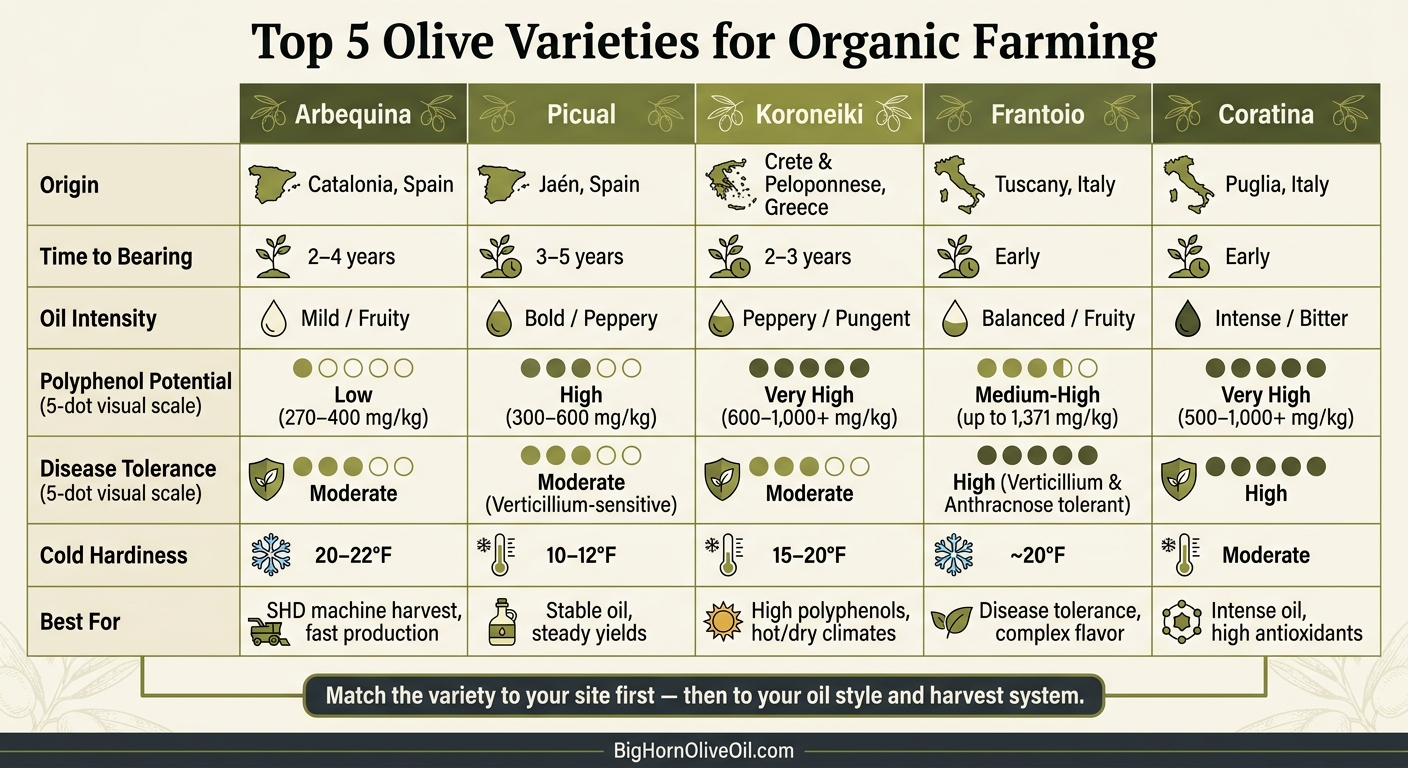
Top 5 Olive Varieties for Organic Farming: Side-by-Side Comparison
After looking at each cultivar on its own, it helps to put them side by side. That’s where the trade-offs start to stand out.
The table below compares the five by the factors that matter most in organic orchards.
| Variety | U.S. Climate Fit | Yield | Time to Bearing | Tree Vigor | Oil Intensity | Phenolic Potential |
|---|---|---|---|---|---|---|
| Arbequina | High cold tolerance; adapted to many soils | High, steady | Very early | Low (compact) | Mild / fruity | Low |
| Picual | Mediterranean; widely adaptable | Very high | Early | High | Bold / peppery | High |
| Koroneiki | Cold sensitive; drought tolerant | High | Early | Medium | Peppery / pungent | Very high |
| Frantoio | Highly cold sensitive | High | Early | Moderate | Balanced / fruity | Medium-high |
| Coratina | Adaptable; needs heat to ripen | High | Early | Medium | Intense, bitter | Very high |
Some patterns are pretty clear.
Arbequina gives the fastest payoff and makes up about 65% of California SHD acreage. That’s a big reason growers keep coming back to it. The tree stays compact, bears very early, and handles a range of soils.
Picual also bears early and has the highest oil content in this group, but there’s a catch: it needs more canopy management. So while production can be strong, it may ask for more pruning attention in the orchard.
If polyphenols and oil stability are high on your list, Koroneiki and Coratina stand out. Both are known for stronger oils, and both can help if you're aiming for punchier flavor and longer shelf life.
Frantoio is more site-dependent. It works best in mild areas and produces a balanced, fruity oil. That profile can make it a good fit for growers who want something less aggressive than Coratina or Koroneiki.
After cultivar choice comes propagation and nursery stock, which determine whether those traits hold in the orchard.
Propagation and Orchard Planning
Once you pick a cultivar, propagation and planting shape what actually shows up in the orchard. A tree can have strong traits on paper, but if propagation is handled poorly, those traits may not carry through the way you expect.
Why Growers Use Cuttings and Grafting Instead of Seed
Most olive growers use cuttings or grafting, not seed. The reason is simple: seed-grown trees don't come true to type. They can lose key cultivar traits like oil quality and flavor, vigor, bearing habit, and harvest timing.
Grafting also helps growers get into production sooner. Grafted trees usually start bearing fruit within 2–4 years after planting and reach full production by years 5–8. If a variety roots poorly, growers often graft it onto a strong rootstock instead. Kalamon (Kalamata) is a common case.
Certified Nursery Stock and Disease Prevention
Organic orchards don't leave much room for cleanup after planting. If disease comes in early, it can stick around for years.
Certified nursery stock is screened for pathogens such as Verticillium wilt, olive knot, and peacock spot. These diseases can damage a grove badly and are hard to manage once they're in place. When you're sourcing stock, ask for documented disease-free certification from the nursery. For an organic orchard, that paperwork isn't just nice to have. It matters from day one.
Varietal Records, Pollination, and Mixed Plantings
Even self-fertile olives can do better with cross-pollination close by. Pairing compatible varieties can increase yields by 20% to 30% compared with single-variety plantings. That's a big jump. Because of that, many researchers suggest planting at least three varieties near each other to support steady fruit set. Before planting, match each variety with pollinizers that bloom at the right time.
Good recordkeeping matters too. Keep a grove log that tracks:
- flowering by variety
- pests
- soil treatments
- harvest timing
- block performance for certification and year-to-year comparison
It also helps to map pollinizers before planting and label each block by variety. That way, when one section does better - or worse - you'll know exactly what you're looking at.
Conclusion
No olive variety works for every organic orchard. The right pick depends on your climate, your harvest system, and the kind of oil you want to make.
In simple terms, these five varieties fall into three buckets: high-phenolic oils (Koroneiki, Coratina), easy-to-manage trees (Arbequina), and balanced all-rounders (Picual, Frantoio). For U.S. growers, location narrows the list fast. Match the variety to the site - not the site to the variety.
A smart way to start is small and deliberate. Begin with one or two varieties that suit your climate and harvest setup, buy certified nursery stock, keep detailed grove records from day one, and fine-tune your approach as the orchard matures. Varietal choice pays off only when it sits on top of sound orchard planning. Big Horn Olive Oil offers Ultra Premium Extra Virgin Olive Oils that reflect the quality organic growers aim for.
FAQs
Which olive variety is best for beginners?
Arbequina is often seen as the best olive variety for beginners. It stays compact and easy to handle, which makes it a good fit for both orchards and containers. It’s also self-fertile, so you don’t need a second tree for pollination.
Another big plus: it starts bearing fruit early, often within 2 to 3 years. It also handles different soil conditions well and tends to produce steady, reliable yields.
How do I choose the right olive variety for my climate?
Start by figuring out your USDA hardiness zone. That one detail tells you a lot, because it shows which olive trees can live through the coldest temperatures in your area.
Most olive trees grow best in zones 8–11, where summers are long and dry and winters stay mild.
If you're in zone 7, go with cold-hardy types like Leccino or Frantoio. If you live in a hot, dry area, growers often lean toward heavy-producing cultivars like Picual or Koroneiki.
One more thing matters here: your planting site should get 200–400 winter chill hours below 45°F.
Do I need more than one olive variety for pollination?
Some olive varieties are self-fertile, but most do better with a pollination partner. And even self-fertile trees often produce more fruit when they’re cross-pollinated by a different variety growing nearby.
Olives rely on wind for pollination, so planting more than one variety is a common way to help with steady fruit set and better yields. When you plan your orchard, check the pollination needs of each variety so the trees can work well together.