

Black vs. White Truffle Olive Oil: Key Differences
If I had to boil it down to one rule, it’s this: black truffle oil fits rich food, white truffle oil fits lighter food. Both are usually extra virgin olive oil with added truffle aroma, and both work best as a finishing oil, not a cooking oil.
Here’s the short answer:
- Black truffle olive oil tastes more earthy and umami-heavy
- White truffle olive oil smells sharper and hits faster
- Black works well on steak, fries, mushrooms, pasta, and mashed potatoes
- White fits eggs, risotto, seafood, simple pasta, and popcorn
- Heat can dull the aroma, so I’d add either oil after cooking
- A small amount is enough: often ¼ to 1 tsp per serving, depending on the oil and dish
One detail matters more than most people think: white truffle oil often smells stronger than black truffle oil, even if black feels heavier on the palate. That’s why white usually needs a lighter hand.
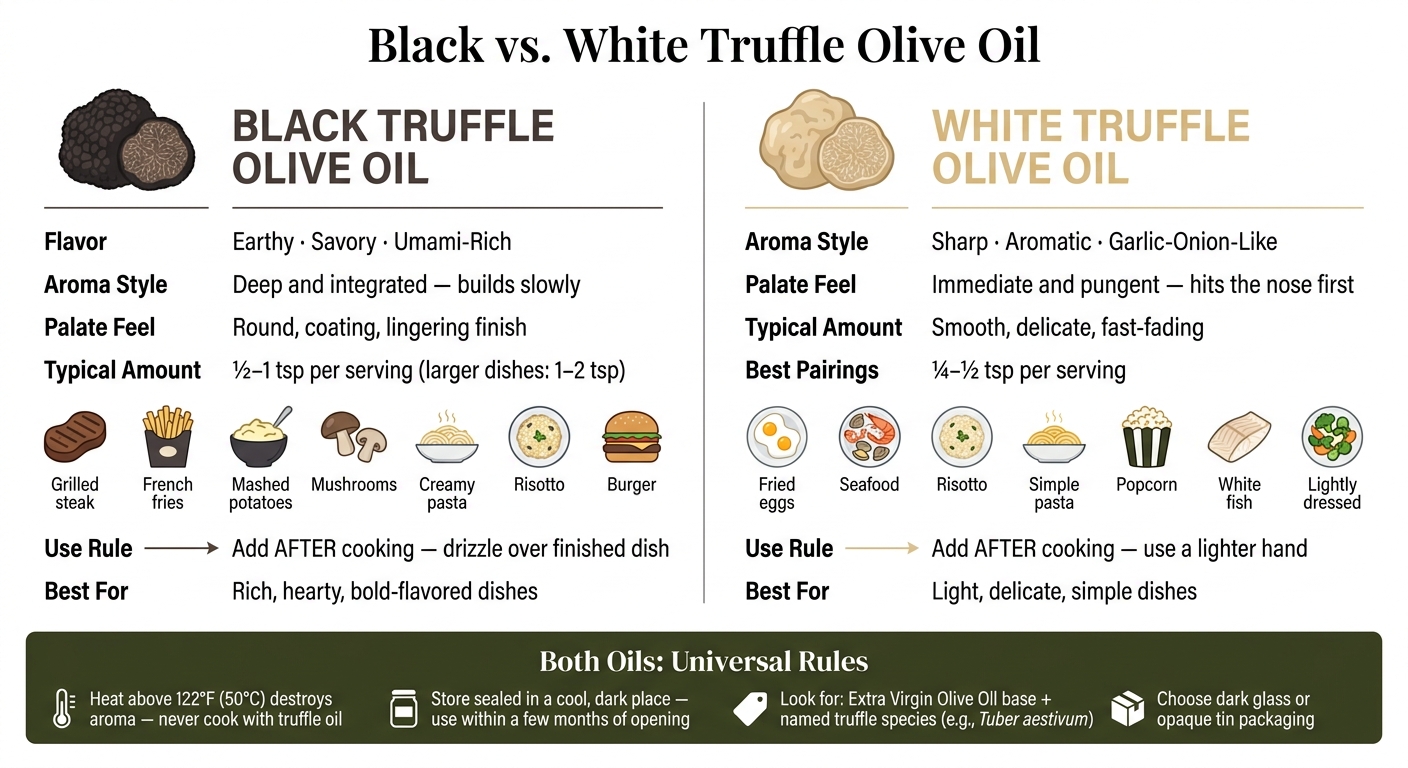
Black vs. White Truffle Olive Oil: Side-by-Side Comparison
Demo Black truffle Oil & White truffle oil | Urbani Truffles US
sbb-itb-4066b8e
Quick Comparison
| Point | Black Truffle Olive Oil | White Truffle Olive Oil |
|---|---|---|
| Main flavor | Earthy, savory, umami-rich | Sharp, aromatic, garlic-onion-like |
| First impression | Builds more slowly | Shows up right away |
| Best with | Hearty dishes | Light dishes |
| Usual amount | About ½–1 tsp per serving | About ¼–½ tsp per serving |
| Good pairings | Fries, steak, potatoes, mushrooms, creamy pasta | Eggs, risotto, seafood, popcorn, simple pasta |
| How to use | Finish after cooking | Finish after cooking |
If I’m choosing fast, I use black for depth and white for aroma. And if the bottle label only says things like “truffle flavor” without naming the truffle or listing extra virgin olive oil, I’d look a little closer before buying.
Flavor Profile: Black Truffle Olive Oil vs. White Truffle Olive Oil
The main difference comes down to aroma intensity and how the flavor lands on your palate. Black truffle olive oil builds more slowly and feels heavier, while white truffle olive oil shows up fast and hits your nose first.
Black Truffle Olive Oil: Earthy Depth and a Rounder Finish
Black truffle olive oil is often described as earthy, musky, and umami-forward. Common tasting notes include roasted mushrooms, deep earth, and a light nuttiness - think porcini or cremini, with a hint of hazelnut or walnut underneath.
What stands out most is how the flavor unfolds. It doesn't rush in all at once. Instead, it develops step by step, which gives it a round, coating feel on the palate.
That long finish is a big part of why it works so well in heavier dishes. Black truffle olive oil blends into the food and adds depth instead of sitting on top of it. It can make a dish taste meatier and more layered without adding any actual meat, which is why it fits so well with risotto, potatoes, pasta, and soups. If you're adding it to a larger dish, 1–2 teaspoons per serving is a common place to start.
White truffle oil works in a very different way.
White Truffle Olive Oil: Strong Aroma and a Sharper First Impression
White truffle olive oil leads with aroma. Its main notes often include garlic, shallot, onion, and white pepper, sometimes with a Parmesan- or cheese-like edge underneath. Even a small drizzle can perfume the whole dish before the first bite.
People sometimes call white truffle olive oil more delicate, but that can be a little misleading. It is actually more intense on the nose than black truffle olive oil. In this case, delicate refers to a smoother feel on the palate, not a weaker smell. Since those aromatic compounds are so strong, it usually makes sense to use white truffle oil with a light hand - about ¼ teaspoon per serving is a good starting point.
These differences make the side-by-side comparison much easier to understand.
Key Differences at a Glance
Use this quick comparison to pick the right oil fast.
Side-by-Side Comparison Table
| Feature | Black Truffle Olive Oil | White Truffle Olive Oil |
|---|---|---|
| Flavor | Earthy, umami-rich | Sharp, aromatic |
| Aroma Style | Deep and integrated | Sharp and immediate on the nose |
| Perceived Intensity | Robust and lingering on the palate | Pungent and sharp on the nose |
| Best Use | Hearty dishes | Light dishes |
| Typical Finish Amount | ½–1 tsp per serving | ¼–½ tsp per serving |
That’s the main split: black truffle oil sits into the dish, while white truffle oil stands out right away.
When to Choose Black and When to Choose White
Choose black for rich, savory dishes and white for lighter, simpler ones.
Here’s the plain-English version. Black truffle oil mixes in with the food. It pairs well with fats, starches, and umami-heavy sauces, so it adds depth without taking over. That makes it a good fit for things like pasta, fries, mashed potatoes, or meat-based dishes.
White truffle oil does something different. You notice it first through the aroma. It tends to work best when the dish has room to let that sharp first note come through, like creamy risotto, eggs, seafood, or lightly dressed vegetables.
If you’re not sure, use less than you think. A few drops of white truffle oil over eggs is often enough, and about ½ teaspoon of black truffle oil over fries gives you a clear hit without drowning out the dish.
Best Uses and Pairings for Each Oil
A simple way to think about truffle oil is this: black goes with richer foods, white goes with lighter ones.
Best Uses for Black Truffle Olive Oil
Black truffle olive oil has an earthy, savory flavor that fits best with foods that can soak it up.
For steak and burgers, cook them as usual, let them rest, then drizzle about 1/4 to 1/2 tablespoon per 6–8 oz serving over the sliced meat or patty. It gives the dish that polished, restaurant-style finish.
Roasted potatoes and fries are another classic match. Toss hot potatoes with about 1/4 tablespoon per serving, plus salt and Parmesan if you want. For mashed potatoes or polenta, stir in 1/4 to 1/2 tablespoon per serving off the heat right before serving.
It also pairs nicely with risotto, creamy pasta, and mushroom dishes like sautéed cremini or mushroom ragù. Those foods already have a deep umami flavor, and black truffle oil leans right into it.
White truffle oil works by the same finishing rule, but it needs a gentler touch and simpler dishes.
Best Uses for White Truffle Olive Oil
White truffle olive oil has a sharper aroma, so it stands out more on lighter foods that won’t drown it out. Use less than you would with black truffle oil. Its aroma is stronger.
Soft-scrambled or poached eggs are a classic pairing. Cook the eggs gently, plate them, then add just a few drops up to about 1/4 tablespoon per serving. If you’re making a simple pasta with Parmesan, finish each serving with a light drizzle, often less than 1/4 tablespoon per serving.
White truffle oil also works well with seafood risotto, white fish like cod or halibut, and popcorn. For popcorn, about 1 teaspoon per 4–6 cups is enough. A little goes a long way here.
How to Serve and Store Truffle Olive Oil
Once you’ve picked the right oil, the next job is keeping its aroma intact.
Use both oils after cooking, not during it. Temperatures above roughly 122°F (50°C) can destroy the volatile compounds that give truffle oil its aroma, so cook with regular olive oil or butter first, then add truffle oil after plating.
Store truffle oil tightly sealed in a cool, dark place. After opening, use it within a few months.
How to Pick a Quality Truffle Olive Oil and Final Takeaway
What to Look for on the Label
When you buy truffle oil, the label tells you a lot.
Start with the base oil. It should clearly say extra virgin olive oil. Not just "olive oil", "pure olive oil", or "light olive oil."
Then check the ingredient list. You want to see actual truffle ingredients, such as black truffle extract, white truffle extract, or species names like Tuber aestivum and Tuber magnatum. Be careful with vague terms like "natural flavor", "truffle flavoring", or "truffle essence" if the label doesn't name a truffle species.
Packaging matters too. Dark glass bottles or opaque tins help shield the oil from light. Clear bottles, especially sitting under bright store lights, are a bad sign.
Freshness counts. Try to pick a bottle with a harvest date or packaging date from the last 12–18 months. A "best by" date on its own doesn't tell you as much.
Conclusion: The Simplest Way to Decide
Once you've checked the quality, the choice gets pretty easy.
If the dish is hearty and rich - like steak, roasted mushrooms, potatoes, or creamy pasta - go with black truffle olive oil. Its earthy depth works well with bold flavors. You can even use it to make a black truffle hummus for a savory snack.
If the dish is light and delicate - such as eggs, risotto, seafood, or simple vegetables - white truffle olive oil is often the better pick. Its sharper aroma pairs better with lighter food.
Whichever one you choose, use truffle oil sparingly and add it after cooking. Think of it as a finishing touch, not a cooking oil. In most cases, a small drizzle over the finished dish is plenty.
FAQs
Can I cook with truffle olive oil?
Yes, but it depends on the type of truffle oil and the dish you’re making.
Heat can dull truffle oil’s delicate aroma, so it’s usually best used as a finishing touch right before serving. That way, you keep more of its flavor and smell on the plate.
That said, it can still work for light cooking. A gentle sauté is a good example. Black truffle-infused olive oil tends to do better here, especially with richer, heartier dishes. Its stronger flavor stands up better to heat, and it can be used for cooking and finishing at temperatures up to 410°F.
How do I know if a truffle oil is good quality?
Check the ingredient label for real truffles like Tuber melanosporum or Tuber magnatum. Those names matter.
Be careful with vague terms such as truffle aroma, truffle flavor, or truffle essence. They often point to lab-made additives like 2,4-dithiapentane instead of actual truffles.
It also helps to look for a high-quality extra virgin olive oil base. And if the oil comes in a dark glass bottle, that’s a good sign too, since it helps protect the oil’s delicate aroma and overall quality.
What if I use too much white truffle oil?
Using too much white truffle oil usually backfires. Instead of adding depth, it can leave the dish with an overpowering, artificial taste that covers up everything else.
White truffle oil works best as a finishing touch, not as your main cooking oil. Its aroma is delicate and layered, so a small amount goes a long way. In most cases, a light drizzle is all you need.