

Brown Fat Activation with Olive Oil
Olive oil is not a fat-loss trick. But when I use extra virgin olive oil instead of butter or other high-saturated-fat fats, it may help my body burn a bit more energy after meals and may support brown fat activity.
Here’s the short version:
- Brown fat burns calories for heat
- Brown fat activity often drops with age, higher body weight, and poorer metabolic health
- Extra virgin olive oil (EVOO) contains oleic acid and polyphenols
- These compounds may support UCP1, mitochondria, and post-meal fat burning
- The human research is limited, and results are mixed
- The best use is a swap, not extra intake, because EVOO has about 120 calories per tablespoon
- A simple intake in the article is 1 to 2 tablespoons per day with meals
What stood out to me most is this: fat type may matter as much as fat amount for thermogenesis. In the research covered here, meals with olive oil often led to more post-meal fat oxidation than meals high in saturated fat. Some animal studies also found more UCP1 activity in brown fat with olive oil-rich diets.
A few points matter if you want the plain answer:
- Best fit: use EVOO in meals, not as a stand-alone fix
- Best move: replace butter, margarine, shortening, or similar fats
- Best target: support metabolism in a small way, not force body fat loss
- Big limit: most mechanistic data comes from animal or cell studies, not people
- Who may see less effect: people with overweight, obesity, or lower brown fat activity
If I were to boil the whole article down to one idea, it would be this: olive oil may help support calorie burning pathways, but only as one small part of a solid diet pattern.
Brown Fat & Body Heat Activated by Olive Oil!
sbb-itb-4066b8e
The Problem: Low Thermogenesis and Modern Eating Patterns
Modern eating in the U.S. often leans hard on refined carbs, added sugar, ultra-processed foods, and low-grade fats heavy in saturated and trans fats. Over time, that pattern pushes the body more toward storing energy than burning it and is linked with weaker metabolic flexibility, which is the body's ability to shift between carbs and fat for fuel.
So the issue isn't just too many calories. It's also that the body may burn fewer of them along the way.
How Low Brown Fat Activity Connects to Weight Gain
When BAT activity is low, the body tends to burn fewer calories on autopilot during the day. Human studies suggest BAT makes a modest contribution to daily energy use, but cold exposure can expose a much bigger gap between BAT-positive and BAT-negative people.
BAT activity also tends to drop in older adults and in people with a higher BMI. In plain terms, the people with the highest risk of weight gain often have the least thermogenic backup. And when BAT activity is already low, the kind of fat in a meal starts to matter even more.
Why Fat Type Matters More Than Fat Amount
Total fat intake matters, but fat type has a strong effect on how much energy the body uses after a meal. Meals high in monounsaturated fats (MUFAs), like those found in extra virgin olive oil, lead to higher diet-induced thermogenesis than meals high in saturated fat.
One study found that a breakfast rich in olive oil increased post-meal fat burning and lowered the fuel mix the body was using, compared with a breakfast rich in saturated fat.
That helps explain why EVOO stands out. Its MUFAs support more post-meal fat oxidation than saturated fat. The smart move is to use EVOO as a swap, not an add-on. Replacing butter, margarine, or shortening with EVOO improves fat quality without adding more calories. That sets up why EVOO's fatty acid profile and plant compounds matter next.
How Extra Virgin Olive Oil May Support Brown Fat
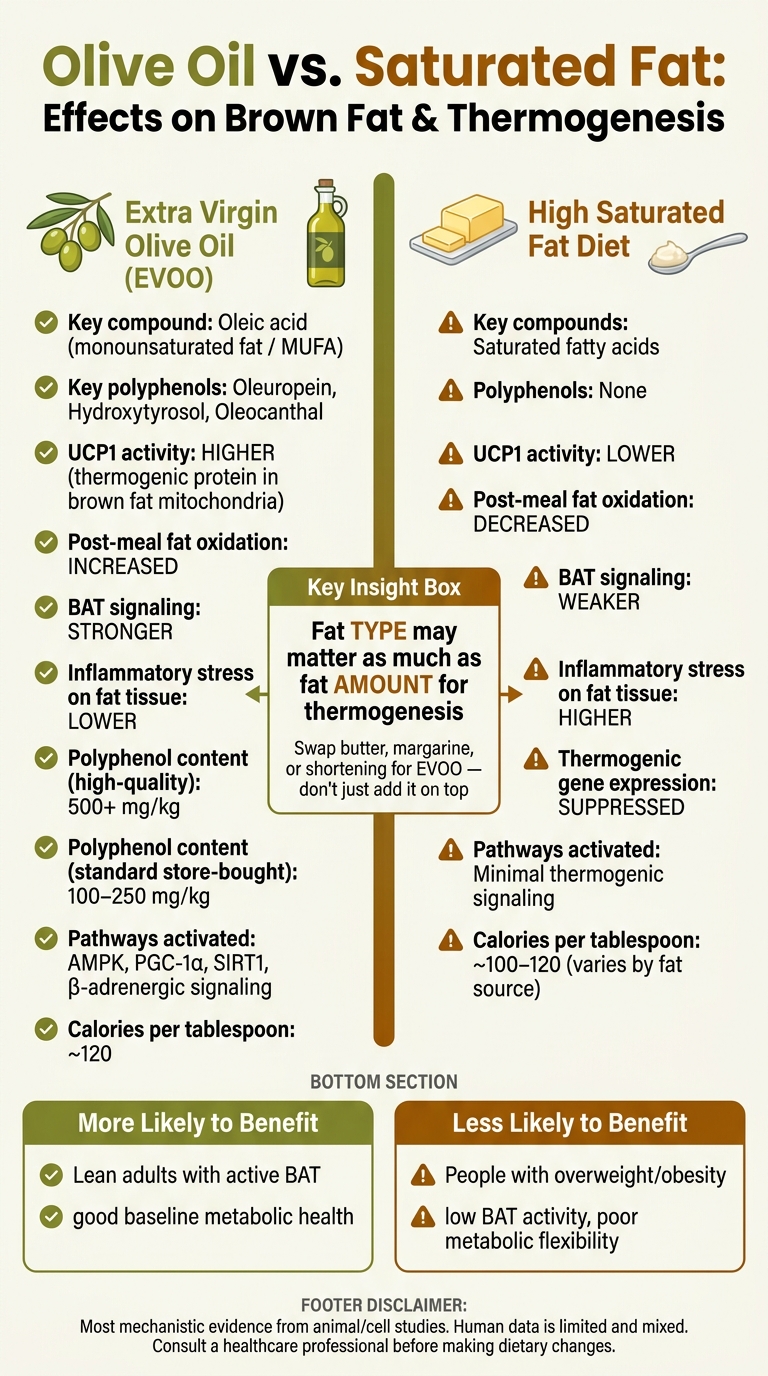
Olive Oil vs. Saturated Fat: Brown Fat & Thermogenesis Effects
EVOO may support brown fat through two main paths: oleic acid and polyphenols.
Oleic Acid, Brown Fat, and Energy Expenditure
Oleic acid, the main monounsaturated fat in olive oil, may directly activate UCP1, the thermogenic protein in brown fat mitochondria that helps turn energy into heat instead of ATP. That matters because UCP1 is one of the key switches behind brown fat’s calorie-burning role.
Animal data points in that direction. In rat studies, diets built around EVOO produced the highest UCP1, UCP2, and UCP3 mRNA expression in brown adipose tissue compared with diets using other fat sources. Those same rats also showed higher whole-body oxygen consumption. In plain English, their brown fat looked more active, and their bodies appeared to burn more energy.
Human data is more mixed. In one controlled study, lean adults on an olive oil–enriched diet showed higher BAT activity and thermogenesis-related hormone changes. Overweight and obese participants did not show the same response.
Polyphenols may push on many of these same pathways too.
Polyphenols and Thermogenic Signaling
EVOO’s polyphenols - especially oleuropein, hydroxytyrosol, and oleocanthal - may add another layer on top of oleic acid’s effects.
In obese rat studies, oleuropein supplementation raised urinary norepinephrine and epinephrine levels and increased UCP1 in brown adipose tissue. It also reduced total abdominal fat mass compared with high-fat controls. That pattern lines up with β-adrenergic signaling, one of the body’s main triggers for brown fat activation.
These compounds may also activate AMPK, PGC-1α, and SIRT1, which support mitochondrial biogenesis and fat oxidation. Hydroxytyrosol and oleocanthal may lower inflammatory signaling in fat tissue as well, and that matters because inflammation can suppress thermogenic genes.
That said, most of this mechanistic evidence comes from rodent or cell models. So it’s best to read it as preclinical evidence, not settled human physiology.
Olive Oil-Rich Diets vs. High-Saturated-Fat Diets: A Comparison
When olive oil–rich diets are compared with diets heavy in saturated fat, the pattern tends to hold. In animal studies, olive oil–rich diets generally show stronger BAT signaling, higher post-meal energy expenditure, and less inflammatory stress.
Using Extra Virgin Olive Oil in Daily Meals
The research only matters if EVOO becomes part of your normal routine at the table.
Simple Ways to Use EVOO Every Day
Use 1 tablespoon of high-polyphenol EVOO twice daily with meals. The easiest move is to add it at the end of cooking or use it in low-heat dishes. Drizzle it over roasted vegetables after they come out of the oven, whisk it into a salad dressing, or stir it into cooked beans and lentils. That helps protect delicate polyphenols. Taking EVOO with meals may also help support absorption. From there, two things matter most: daily dose and oil quality.
Why EVOO Quality and Freshness Affect Its Benefits
Dose matters, but the oil itself matters too. Polyphenol-rich EVOO keeps more of the compounds linked to thermogenic signaling. High-quality EVOO usually contains 500 mg/kg of polyphenols or more, while many standard store-bought versions land in the 100–250 mg/kg range.
That gap isn't small. Part of EVOO's metabolic effect is tied to its polyphenol content and oleic acid levels. So when you're buying a bottle, check for a harvest date. Then store it in a cool, dark place, ideally in a dark glass bottle, and use opened EVOO within a few weeks.
Who May See More or Less Benefit
Even with the right dose, people don't respond the same way. The biggest differences tend to come from baseline metabolic health and body composition. People with lower BAT activity or poorer metabolic health may notice smaller, slower effects. In plain English, the thermogenic compounds in EVOO work with the metabolic capacity a person already has; they don't replace it.
That also helps frame where EVOO fits best. It's most useful as a fat replacement within meals, where it may support post-meal fat oxidation and thermogenic signaling, rather than as a general wellness supplement.
Limits, Safety, and Key Takeaways
What the Research Does and Does Not Show Yet
These mechanisms make sense, but the human evidence is still limited. The science looks promising, though it's still in the early stages. Most of the findings so far come from animal and cell studies, while human results remain limited.
The clearest human data comes from a short dietary intervention. In that study, increasing olive oil-derived monounsaturated fats boosted BAT activity in lean adults, but not in people who were overweight or obese. A 2025 review on dietary fats and brown fat also found that the effect of dietary fats on human BAT activity is still controversial, with only a small level of evidence overall.
So, it helps to think of EVOO as modest support, not a fat-loss switch.
How to Use EVOO Safely in a U.S. Diet
Use EVOO as a replacement, not an add-on. If you swap butter, margarine, or refined seed oils for about 1½–2 tablespoons per day, you improve the type of fat in your diet without stacking on extra calories. That matters because EVOO has about 120 calories per tablespoon.
If you have gallbladder disease, gallstones, chronic pancreatitis, or fat-malabsorption conditions such as Crohn's disease, talk with a healthcare professional before increasing dietary fat, including EVOO. Fats trigger gallbladder contractions, and a sudden jump in intake can cause discomfort for people who are more vulnerable.
A simple tip: split EVOO across meals. That can help with tolerance and absorption.
Conclusion: Olive Oil as One Part of a Smarter Metabolic Plan
Used this way, EVOO fits into a broader metabolic routine instead of trying to do all the work on its own. Fresh, high-polyphenol EVOO lines up best with the research. Pair it with a balanced diet and steady activity, and it can be a useful part of a smarter metabolic plan.
FAQs
Can olive oil really activate brown fat?
Yes. Extra virgin olive oil (EVOO) may help support thermogenesis, which is your body’s natural way of burning calories to make heat.
Research suggests that EVOO’s polyphenols and monounsaturated fats may help support metabolic function and calorie burn after meals. Compounds such as tyrosol may also increase UCP1 expression in fat tissue, which helps the body release energy as heat.
How much EVOO should I use each day?
For general metabolic health and weight management, research points to 1 to 2 tablespoons (15–30 mL) of extra virgin olive oil per day.
Some plans use 1.5 tablespoons (20 grams), while others go as high as 4 tablespoons (60 mL), depending on the person’s diet and calorie needs.
An easy way to work it in:
- Drizzle it over vegetables
- Use it in salad dressings
- Add it as a finishing oil after cooking
That range gives you some room to fit it into meals without making things complicated.
Does olive oil help with weight loss or just metabolism?
Olive oil may help with weight management, not just metabolism. It can support resting energy expenditure and fat oxidation, and it may also help with appetite control and satiety.
High-quality extra virgin olive oil contains monounsaturated fats that can support OEA production in the gut. OEA then signals fullness to the brain, which may help reduce hunger.