

Butter, Coconut Oil, or Olive Oil: Study Insights
Which fat is best for heart health? Here's what the research says:
- Butter: Raises LDL ("bad" cholesterol) significantly (+15.08 mg/dL). Slightly decreases HDL ("good" cholesterol) and increases overall heart disease risk due to high saturated fat content.
- Coconut Oil: Slightly lowers LDL (-1.16 mg/dL) and boosts HDL (+6.57 mg/dL). However, its high saturated fat content makes it controversial for long-term use.
- Olive Oil: Minimal impact on LDL (+0.39 mg/dL) but supports heart health due to high monounsaturated fats. It’s the most heart-friendly option among the three.
Key takeaway: Olive oil is the healthiest choice for reducing cardiovascular risk. Coconut oil may offer some benefits but should be consumed cautiously, while butter has the most negative impact on cholesterol levels.
Quick Comparison
| Fat | LDL Change (mg/dL) | HDL Change (mg/dL) | Heart Health Impact |
|---|---|---|---|
| Butter | +15.08 | -0.39 | Increases heart disease risk |
| Coconut Oil | -1.16 | +6.57 | Mixed effects; use cautiously |
| Olive Oil | +0.39 | +0.39 | Best for heart health |
Switching to olive oil, especially high-quality extra virgin options, can lower heart disease risk. For those with high cholesterol, limiting butter and coconut oil is advised.
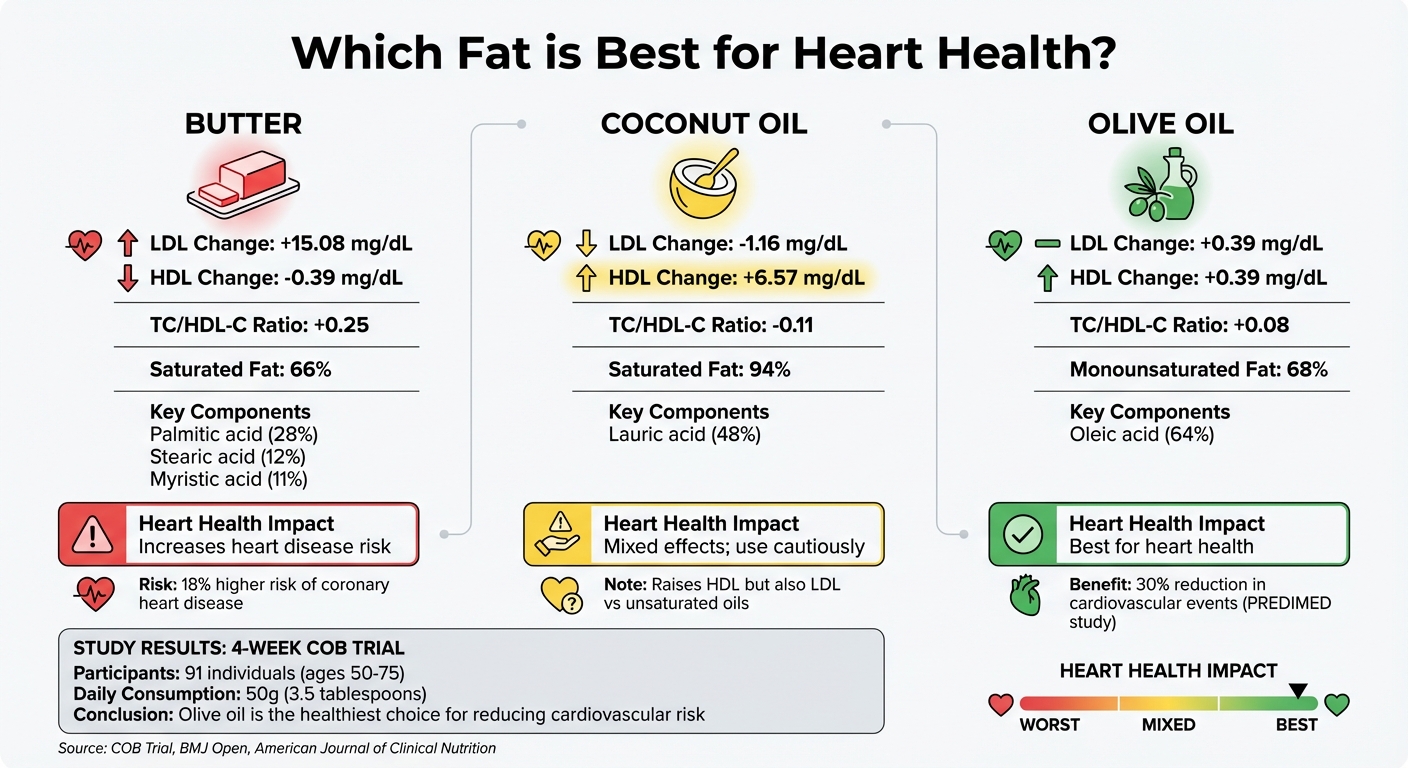
Butter vs Coconut Oil vs Olive Oil: Heart Health Comparison Chart
Study Results: Comparing Three Dietary Fats
How the Study Was Conducted
The COB Trial, carried out in the UK during mid-2017, involved 96 healthy adults aged 50 to 75. Of these, 91 participants successfully completed the study. Each participant was randomly assigned to consume 50 grams (about 3.5 tablespoons) of extra virgin coconut oil, extra virgin olive oil, or unsalted butter daily for four weeks. The fats were incorporated into their regular diets. Led by Professors Kay-Tee Khaw and Nita Forouhi from the University of Cambridge, the research team focused on measuring changes in blood lipids and other health markers to assess cardiovascular risk. This approach provided precise insights into how these fats influenced lipid profiles.
Main Results Summary
The study revealed clear differences in how each fat affected cholesterol levels. Butter raised LDL cholesterol ("bad" cholesterol) by 15.08 mg/dL, while coconut oil lowered it slightly by 1.16 mg/dL, and olive oil caused a minor increase of 0.39 mg/dL. When it came to HDL cholesterol ("good" cholesterol), coconut oil had the most pronounced effect, increasing levels by 6.57 mg/dL. In contrast, butter slightly decreased HDL by 0.39 mg/dL, and olive oil increased it by the same modest amount - 0.39 mg/dL. These findings challenge the idea that all saturated fats behave the same way, highlighting notable differences between butter and coconut oil.
"Two different dietary fats (butter and coconut oil) which are predominantly saturated fats, appear to have different effects on blood lipids compared with olive oil... with coconut oil more comparable to olive oil with respect to LDL-C." - BMJ Open
Cholesterol and Health Metrics Comparison
Here’s a breakdown of the key cholesterol changes observed:
| Dietary Fat | LDL-C Change (mg/dL) | HDL-C Change (mg/dL) | TC/HDL-C Ratio Change |
|---|---|---|---|
| Butter | +15.08 | -0.39 | +0.25 |
| Coconut Oil | -1.16 | +6.57 | -0.11 |
| Olive Oil | +0.39 | +0.39 | +0.08 |
Values have been converted from mmol/L to mg/dL. Data reflects results from the 4-week COB Trial.
The table further emphasizes the distinct effects of these fats. Particularly, coconut oil and olive oil showed similar impacts on LDL cholesterol, with both differing significantly from butter. Coconut oil’s ability to raise HDL cholesterol stands out as a unique benefit, setting it apart from the other two fats.
Butter's Effect on Cholesterol
Higher LDL Cholesterol Levels
Butter has been found to raise LDL cholesterol (LDL-C) levels significantly compared to other fats. Over a four-week period, butter increased LDL-C by 0.42 mmol/L more than coconut oil and 0.38 mmol/L more than olive oil. It also raised the total cholesterol-to-HDL ratio by 0.36 points compared to coconut oil and 0.22 points compared to olive oil. Non-HDL cholesterol levels increased by 0.39 mmol/L more as well.
"Butter increased total and LDL cholesterol more than did olive oil intake (P < 0.05) and the run-in period (P < 0.005 and P < 0.05, respectively)." - The American Journal of Clinical Nutrition
These findings highlight how butter's saturated fat content contributes to changes in lipid profiles, which are closely tied to heart disease risk.
Saturated Fat and Heart Disease Risk
Butter is made up of 66% saturated fat, with palmitic acid (28%), stearic acid (12%), and myristic acid (11%) being its primary components. Research links high palmitic acid consumption to an 18% higher risk of coronary heart disease. Moreover, replacing just 1% of daily energy from saturated fats with polyunsaturated fats can lower the risk by 8%.
Because of this, experts advise people with high cholesterol to limit their butter intake. While moderate consumption may be less concerning for those with normal cholesterol levels, butter generally has a more negative impact on heart health markers compared to alternatives like olive oil.
Coconut Oil's Mixed Effects
Increased HDL Cholesterol
Coconut oil stands out for its ability to raise HDL cholesterol levels more effectively than butter or olive oil. Research indicates that consuming 50 g (about 1.8 oz) daily increased HDL-C by 0.18 mmol/L compared to butter and 0.16 mmol/L compared to olive oil. Similarly, taking 30 mL (approximately 1 fl oz) of virgin coconut oil daily over eight weeks boosted HDL-C by 5.72 mg/dL.
However, this benefit comes with a caveat. While coconut oil elevates HDL-C, it also increases LDL cholesterol levels when compared to unsaturated oils. Butter, however, raises LDL-C even more. The American Heart Association has expressed concerns, stating:
"Because coconut oil increases LDL-C, a cause of cardiovascular disease and has no known offsetting favourable effects, we advise against the use of coconut oil".
These conflicting effects highlight the need to examine coconut oil's unique fatty acid profile.
Lauric Acid and Medium-Chain Fatty Acids
The composition of coconut oil sheds light on its mixed effects. It contains 94% saturated fats, with lauric acid making up about 48% of its total fat content. Unlike the palmitic acid found in butter (28%), lauric acid is classified as a medium-chain fatty acid, which some researchers suggest may be metabolized differently in the body.
In one four-week study, participants who consumed 50 g (around 1.8 oz) of coconut oil daily experienced a doubling of circulating lauric and myristic acid levels.
Despite these findings, coconut oil remains a debated topic. Meta-analyses show it increases LDL-C by approximately 8.6% to 10.47 mg/dL compared to nontropical vegetable oils. For those with high cholesterol, experts recommend limiting coconut oil intake, much like they advise with butter.
sbb-itb-4066b8e
Olive Oil's Heart Health Benefits
Monounsaturated Fats and Cholesterol
Olive oil plays a key role in promoting heart health, thanks to its high levels of monounsaturated fats. Extra virgin olive oil, in particular, contains about 68% monounsaturated fats - mostly oleic acid (64%) - setting it apart from options like butter and coconut oil.
Studies highlight the benefits of swapping butter for olive oil. For example, a four-week study found that butter raised LDL cholesterol by 0.38 mmol/L more than extra virgin olive oil. The American Heart Association also supports replacing saturated fats with unsaturated fats, such as those in olive oil, to help lower LDL cholesterol and reduce the risk of cardiovascular disease.
The PREDIMED study offered even more evidence of olive oil's impact. Participants on a Mediterranean diet enriched with extra virgin olive oil experienced about a 30% reduction in cardiovascular events compared to those on a low-fat diet. Regular consumption of olive oil has also been shown to increase plasma oleic acid concentrations by roughly 1 mol%, while decreasing harmful saturated fatty acids like lauric and myristic acid.
However, these benefits depend heavily on the oil's quality and how it’s processed, making it essential to choose premium products.
Big Horn Olive Oil: Quality and Freshness
To fully enjoy olive oil's heart health advantages, quality and freshness are crucial. Big Horn Olive Oil stands out by offering Ultra Premium Extra Virgin Olive Oils that exceed standard quality measures. Their oils are cold-pressed within two hours of harvest and reach consumers within three months, preserving high levels of polyphenols and antioxidants.
The Ultra Premium label signifies better concentrations of the compounds linked to cardiovascular health compared to standard extra virgin olive oils. Big Horn Olive Oil sources their products from top-quality olives and offers selections like Estate Reserve, Picual, and Coratina. These oils deliver the monounsaturated fats and antioxidants tied to cholesterol-lowering and heart health benefits. At just $8.99, they combine exceptional freshness with health-boosting properties.
Other Health Effects Beyond Cholesterol
Cholesterol is just one piece of the puzzle when it comes to heart health. Other factors like weight, inflammation, and blood sugar levels also play a role. However, much like cholesterol, these markers tend to show little change during short-term dietary interventions.
Effects on Weight, BMI, and Body Fat
Short-term studies suggest that adding different fats to the diet doesn’t significantly alter weight or body composition. In a four-week study involving 94 healthy participants (average age 60), individuals consumed 50 grams daily of either extra virgin coconut oil, unsalted butter, or extra virgin olive oil. After the trial, results showed the following changes:
- Coconut oil: a slight weight gain of 0.27 kg
- Butter: a small gain of 0.04 kg
- Olive oil: a modest weight loss of 0.04 kg
There were no notable differences in body fat percentage or central adiposity among the groups. Long-term data from the Framingham Offspring cohort suggests that consuming more than 7 grams of non-hydrogenated oils daily might be linked to a BMI that’s 0.6 kg/m² higher compared to lower intakes.
"There were no significant differences in changes in weight, BMI, central adiposity, fasting blood glucose, systolic or diastolic blood pressure among any of the three intervention groups." - Kay-Tee Khaw, Professor of Public Health, University of Cambridge
When it comes to body composition, these fats seem to have minimal impact, even over time.
Inflammation and Blood Sugar Markers
The Cambridge trial also highlighted how these fats affect inflammation and blood sugar. Coconut oil stood out by reducing C-reactive protein (CRP) - a key inflammation marker - by 0.58 mg/L compared to olive oil after four weeks. However, another 12-week study involving individuals with central obesity found no major differences between extra virgin coconut oil and extra virgin olive oil in terms of inflammatory markers.
Blood sugar and blood pressure levels remained steady across the board. Fasting glucose showed only minor changes:
- Coconut oil: +0.07 mmol/L
- Butter: +0.03 mmol/L
- Olive oil: +0.03 mmol/L
As for blood pressure, systolic levels dropped slightly with butter (-3.79 mm Hg) and olive oil (-3.67 mm Hg), while coconut oil had almost no effect (+0.18 mm Hg).
Conclusion: Selecting the Right Fat for Heart Health
Main Findings from the Research
Research clearly shows that not all fats are created equal when it comes to heart health. Butter, for example, raises LDL cholesterol levels more than coconut oil and olive oil. Regular consumption of butter has also been associated with a 15% higher risk of premature death.
Coconut oil, while increasing HDL cholesterol (the "good" cholesterol), also raises LDL cholesterol. Specifically, it boosts HDL-C levels by 0.18 mmol/L compared to butter. However, its high saturated fat content remains a point of concern. On the other hand, olive oil stands out as the most heart-friendly option, showing the lowest cardiovascular risk and reduced mortality rates. In fact, replacing one tablespoon of butter with two teaspoons of olive oil can lower the risk of premature death by 17%.
"Our findings support shifting the intake from solid fats to non-hydrogenated vegetable oils for cardiometabolic health and longevity." – BMC Medicine Study
These insights highlight the importance of choosing oils that actively support heart health.
Choosing High-Quality Olive Oil: Big Horn Olive Oil
With such varying effects on heart health, selecting the right fat becomes essential. When it comes to olive oil, quality is key. Extra virgin olive oil, particularly when cold-pressed within two hours, retains critical antioxidants that contribute to its heart-protective properties. The freshness and processing of olive oil play a significant role in its health benefits.
Big Horn Olive Oil offers Ultra Premium Extra Virgin Olive Oils that are cold-pressed within two hours and delivered fresh within three months, priced at $8.99. This ensures the oil retains its maximum antioxidant content. Their range includes single-source varieties like Picual and Coratina Extra Virgin Olive Oil, along with their Estate Reserve Ultra Premium EVOO. Switching to plant-based fats, such as these, can make a measurable difference - each tablespoon of plant-based fat has been linked to a 6% reduction in the risk of death from heart disease. Opting for fresh, high-quality olive oil is a small but impactful step toward better heart health and overall longevity.
FAQs
Why is olive oil often recommended for heart health?
Olive oil is a popular choice for heart health, thanks to its role in maintaining healthy cholesterol levels. It works by boosting HDL (good cholesterol) and lowering LDL (bad cholesterol). Research even suggests that regular olive oil consumption can reduce the risk of heart disease by 19%, offering lasting benefits for your cardiovascular system.
Packed with antioxidants and monounsaturated fats, olive oil not only supports your heart but also adds a delicious touch to your meals.
Why is coconut oil considered controversial for heart health?
Coconut oil sparks plenty of discussion because it’s packed with saturated fat - a type of fat that’s long been associated with higher LDL (bad) cholesterol and an increased risk of heart disease. On the flip side, some studies hint that coconut oil might help raise HDL (good) cholesterol and provide certain health perks. This dual nature has left many wondering about its true impact on heart health.
The debate largely comes down to conflicting research and the complicated connection between saturated fats and cardiovascular health. Because of these uncertainties, many experts suggest using coconut oil sparingly. Instead, they recommend incorporating healthier fats - like those in olive oil or nuts - to maintain better heart health over time.
How does butter affect cholesterol compared to other fats?
Butter has a reputation for raising both total cholesterol and LDL - often referred to as "bad" cholesterol - more than other fats. On the flip side, it can also increase HDL, the "good" cholesterol, when compared to a standard diet. While there might be some upside to butter, it's crucial to enjoy it in moderation. For a heart-healthier alternative, consider swapping it for extra virgin olive oil.