

California Olive Oil Council vs. IOC Standards
If you want the short answer: COOC is stricter for California oils, while IOC is the global baseline for extra virgin olive oil.
I’d look at it this way:
- IOC sets the main trade rules for extra virgin olive oil
- COOC adds tighter limits on some lab tests
- COOC also requires 100% California olives, sensory approval, and a harvest date
- IOC extra virgin allows up to 0.8% free acidity
- COOC cuts that to under 0.5%
- COOC also uses a lower peroxide cap: 15 meq O₂/kg vs. 20 meq O₂/kg under IOC
So if you’re shopping in the U.S., a bottle can meet IOC extra virgin rules and still tell you less on the label. A COOC seal gives you more detail about origin and harvest timing, not just grade.
Quick Comparison
| Criteria | COOC | IOC |
|---|---|---|
| Main role | California certification seal | Global trade standard |
| Olive source | 100% California-grown olives | No California-only rule |
| Free acidity | < 0.5% | ≤ 0.8% |
| Peroxide value | ≤ 15 meq O₂/kg | ≤ 20 meq O₂/kg |
| K232 | ≤ 2.40 | ≤ 2.50 |
| K270 | ≤ 0.22 | ≤ 0.22 |
| Sensory panel | Required | Required |
| Defects allowed | None | None |
| Fruitiness | Must be present | Must be present |
| Harvest date on label | Required | Not required |
| Origin on label | Required | Not required |
| Main use | Buyer-facing seal | Category and trade rules |
Bottom line: if I wanted the stronger buying signal, I’d choose a bottle with COOC certification, a harvest date, and clear origin. That tells me more than a plain “extra virgin” claim on its own.
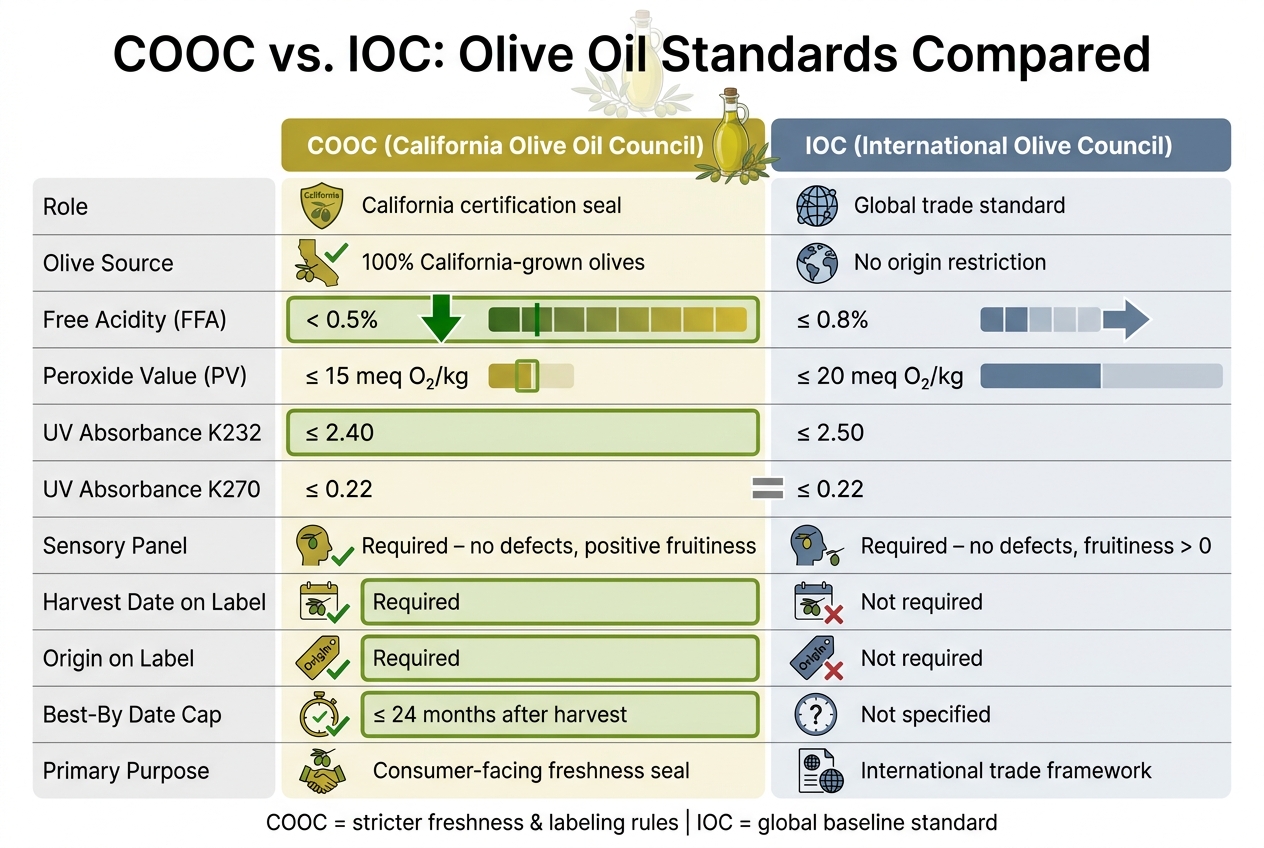
COOC vs. IOC Olive Oil Standards: Side-by-Side Comparison
COOC Standards: California Benchmarks for Extra Virgin Olive Oil
To earn the COOC Seal, an oil must come from 100% California-grown olives and be extracted only by mechanical means. That means no solvents and no high heat. Put simply, COOC sets a California quality bar that can be lined up against the IOC global standard.
COOC Limits for Acidity, Peroxide Value, and UV Absorbance
COOC sets strict chemistry limits for extra virgin olive oil.
| Test | COOC Limit |
|---|---|
| Free Fatty Acidity (FFA) | < 0.5% oleic acid |
| Peroxide Value (PV) | < 15 meq O₂/kg |
| UV Absorbance K232 | < 2.40 |
| UV Absorbance K270 | < 0.22 |
| Delta K (ΔK) | < 0.01 |
These numbers help measure freshness, oxidation, and degradation. California's state standard uses the same core thresholds.
Sensory Panel Review and Freshness Checks
Chemistry alone doesn't tell the whole story. COOC also requires sensory-panel approval: the oil must have no defects and show positive fruitiness. Some premium programs also track DAGs and PPP as added freshness checks.
Harvest Date and Labeling Rules
COOC also requires harvest-date labeling on the label or seal. If an oil blends olives from more than one harvest year, the label must list every harvest year included.
That sets up the next comparison. IOC uses many of the same chemistry and sensory tools, but it applies them as part of a global trade standard rather than a California seal.
sbb-itb-4066b8e
IOC Standards: Global Trade Rules and Test Methods

Unlike COOC's California seal, the IOC uses a global rulebook built for trade and verification. It sets the baseline for extra virgin olive oil in international trade through chemical limits, sensory evaluation, and checks for whether an oil is genuine.
IOC Limits for Extra Virgin Classification
| Test | IOC Limit |
|---|---|
| Free Fatty Acidity (FFA) | ≤ 0.80% oleic acid |
| Peroxide Value (PV) | ≤ 20 meq O₂/kg |
| UV Absorbance K232 | ≤ 2.50 |
| UV Absorbance K270 | ≤ 0.22 |
Those numbers matter, but they don't tell the whole story. Under the IOC standard, chemical limits alone are not enough. Sensory review is part of the classification too.
IOC Sensory Method and Trained Tasting Panels
The IOC requires a trained sensory panel using COI/T.20/Doc. No. 15 Rev. 11. And the panel works from median scores, not averages. That detail matters because it helps the result reflect the panel's shared judgment instead of being skewed by outliers.
For an oil to qualify as extra virgin, the panel must find zero defects and positive fruitiness.
The IOC doesn't stop there. It also uses lab tests to check if the oil is actually what the label says it is.
Purity and Authenticity Tests
The IOC uses authenticity tests to detect fraud. Three stand out:
- Sterol profile: Genuine olive oil has a characteristic sterol distribution. If that pattern shifts, it can point to seed-oil adulteration.
- Wax content: Measuring specific wax fractions against IOC limits can show the presence of pomace oil or refined by-products.
- Fatty acid ethyl esters (FAEEs): These are quantified using COI/T.20/Doc. No. 28/Rev. 4. High levels can point to poor fruit, fermentation, or refined-oil blending.
These tests help verify authenticity when basic quality checks aren't enough.
COOC vs. IOC: Direct Comparison of Benchmarks and Testing Methods
COOC and IOC rely on the same basic tests, but COOC sets tighter rules around freshness and label details. IOC also checks K270 and ΔK.
| Category | COOC | IOC |
|---|---|---|
| Peroxide Value (PV) | ≤ 15 meq O₂/kg | ≤ 20 meq O₂/kg |
| UV Absorbance (K232) | ≤ 2.40 | ≤ 2.50 |
| Sensory Panel | Required; no defects, positive fruitiness | Required; no defects; fruitiness above zero |
| Harvest Date on Label | Required | Not required in the IOC trade standard |
| Origin Requirement | 100% California-grown and produced olives | Not required in the IOC trade standard |
| Primary Purpose | Consumer-facing certification seal | International trade framework |
Where COOC Is Stricter Than IOC
COOC sets a lower peroxide value cap: 15 meq O₂/kg instead of IOC's 20 meq O₂/kg. It also sets a lower K232 limit: 2.40 versus 2.50 under IOC. Put simply, COOC allows less oxidation before an oil can pass.
That tighter margin matters when someone is weighing freshness claims or trying to gauge how well an oil may hold up on the shelf. A small numeric gap can make a big difference in practice.
Where Both Standards Overlap
Both standards require chemistry testing and a trained sensory panel. Passing lab tests alone doesn't get the job done.
Different Goals: Consumer Seal vs. Trade Framework
COOC goes further on label rules. It requires California origin and harvest-date disclosure, while IOC does not include those requirements in its trade standard. COOC also limits any Best If Used By date to no more than 24 months after harvest.
That's the key split between the two. COOC is built to signal California origin and freshness at the consumer level. IOC, by contrast, sets the trade category.
Conclusion: What These Standards Mean for U.S. Buyers of Premium EVOO
For U.S. buyers, the main difference shows up on the label. IOC sets the global baseline for extra virgin olive oil. COOC goes further, with tighter rules on freshness control and origin checks.
That means a bottle labeled “extra virgin” can still meet IOC baseline standards. But a COOC seal gives you a stronger signal that the oil went through stricter freshness and labeling checks. In plain English, harvest date and origin tell you more than a generic extra virgin claim.
A best-by date is not the same as a harvest date. Best-by dates tell you less about when the olives were picked and the oil was made. If you want a better read on freshness, look for the harvest year on the label and, if possible, choose the most recent season.
Key Points to Remember
- COOC is California-specific and adds stricter freshness and labeling rules.
- IOC is the global baseline for extra virgin olive oil.
- Harvest date, origin, and sensory panel approval are the most useful buying cues. Buyers who want the strongest freshness signal should look for a harvest date, clear origin, and sensory panel approval.
COOC is a stricter California certification seal; IOC is the broader global standard.
FAQs
Does COOC certification mean better olive oil?
Generally, yes. COOC certification points to tighter, verified quality standards than IOC standards, including stricter chemical limits and blind sensory testing.
To qualify, oils must show no defects, fruity traits, approved lab results, and meet harvest and date rules that help protect freshness.
Why does harvest date matter more than a best-by date?
A harvest date tells you more about olive oil quality because it shows the oil’s actual age and how fresh it is.
That matters because olive oil is perishable. As time passes, its flavor, aroma, and antioxidants start to fade.
A best-by date can be somewhat arbitrary. The harvest date, on the other hand, helps you check whether the oil came from the most recent production cycle.
For the best quality and health benefits, extra virgin olive oil is best used within 9 months of its crush date.
Can an oil meet IOC standards without showing origin?
Yes. IOC standards for extra virgin olive oil deal with chemical, production, and sensory rules. They do not require a stated regional origin.
COOC works differently. It requires oils to be 100% California-grown.
So an oil can meet IOC extra virgin standards without saying where it was produced.