

Canadian Organic Standards for Olive Oil
If olive oil is sold as organic in Canada, it must be certified and the label has to match the product’s organic percentage. That is the main rule.
Here’s the short version:
- 95% or more organic content: the product can be labeled organic
- 70% to less than 95%: the label can say only “Contains X% organic ingredients”
- Less than 70%: no front-label organic claim; “organic” can appear only in the ingredient list
- Imported products: need a valid organic certificate, and products using the Canada Organic logo need origin wording near the logo
- Rebottled bulk oil: may need its own certification if it is processed and sold with an organic claim across provinces or with the logo
If I’m checking an organic olive oil for the Canadian market, I look at 3 things first: the certificate, the organic percentage, and the exact label claim. If those 3 do not match, the product can run into border, retail, or label problems.
| Organic content | Can say “organic”? | Can use Canada Organic logo? | What the label can say |
|---|---|---|---|
| 95%+ | Yes | Yes | Organic olive oil |
| 70% to <95% | No | No | Contains X% organic ingredients |
| <70% | No | No | “Organic” only in ingredient list |
Bottom line: in Canada, organic olive oil is not just about how the olives are grown. It is also about certification, import records, label wording, and whether the product stays within the 95% / 70% / under 70% rules.
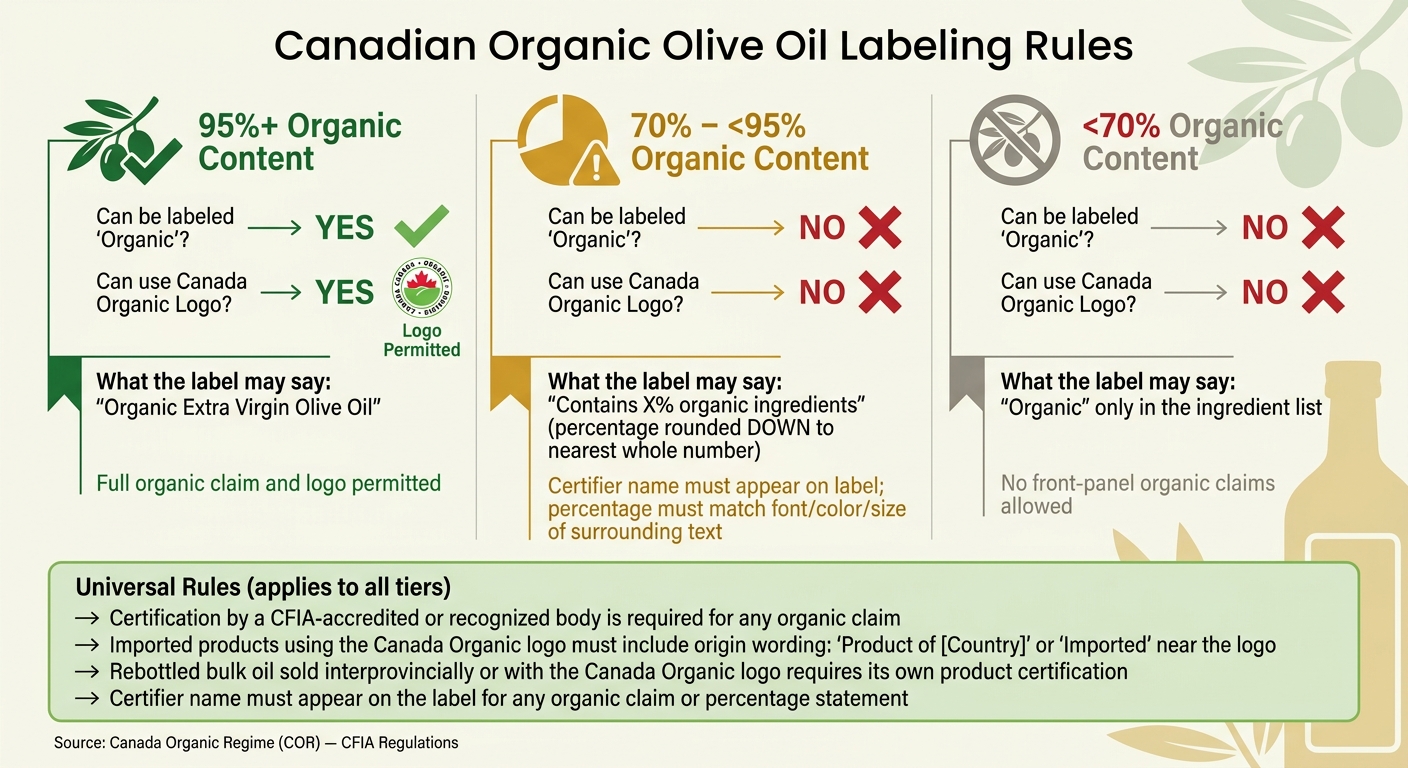
Canada Organic Olive Oil Label Rules: 3 Thresholds Explained
Organic Content Thresholds for Olive Oil Products
Once a product is certified, the label still has to match its organic share. In Canada, that comes down to one number: the percentage of certified organic agricultural ingredients in the finished product, measured by weight and excluding water and salt. That percentage decides whether the product can be labeled organic, whether it can show the Canada Organic logo, or whether the word "organic" can appear only in the ingredient list.
95% or More Organic Content: When Olive Oil Can Be Labeled Organic
This is the ONLY category that can be labeled or advertised as organic. Products with 95% or more organic content may be sold as organic, may display the Canada Organic logo, and may use organic claims in advertising.
For single-ingredient olive oil, the rule is pretty simple: certified organic oil with no added non-organic agricultural ingredients qualifies. Infused oils are a little different, because every ingredient counts in the calculation.
Anything under 95% moves into a much tighter labeling rule.
70% to Less Than 95%: When Only Percentage Statements Are Allowed
Products in this range cannot be called organic and cannot use the Canada Organic logo. They may use only a percentage statement such as "Contains 80% organic ingredients" or "Made with 75% organic ingredients," and the certifier's name must appear on the label.
There’s also a strict math rule here: the percentage must be rounded down to the nearest whole number. So 75.9% becomes 75%, not 76%. The percentage statement must also match the rest of the label in size, color, font, and style.
A vinaigrette made with organic extra virgin olive oil and organic herbs, but with a non-organic vinegar, could land at 80% organic content. In that case, the label could say "Contains 80% organic ingredients" and list "organic extra virgin olive oil" in the ingredient list. But it could not be called "organic vinaigrette" and could not display the Canada Organic logo.
Below 70%: When Organic Can Appear Only in the Ingredient List
Below 70%, the rules get tighter still. These products cannot make any organic claim on the principal display panel or elsewhere on the packaging, cannot use a percentage statement, and cannot display the Canada Organic logo. The word "organic" may appear only in the ingredient list, where individual certified organic ingredients may still be named as organic.
| Organic Content | "Organic" Label Allowed? | Canada Organic Logo? | What the Label May Say |
|---|---|---|---|
| 95% or more | Yes | Yes | "Organic Extra Virgin Olive Oil"; Canada Organic logo permitted |
| 70% to less than 95% | No | No | "Contains X% organic ingredients" only |
| Less than 70% | No | No | "Organic" in ingredient list only |
These thresholds control the label claim, and the certification and import documents need to line up with that claim.
sbb-itb-4066b8e
Certification and Import Rules for Organic Olive Oil in Canada
When Certification Is Required Under the Canada Organic Regime
Label thresholds only matter if the oil is properly certified and backed by the right paperwork. Under the Canada Organic Regime (COR), any olive oil sold with an organic claim in interprovincial trade or as an import must be certified by a CFIA-accredited or recognized certification body (CB). That rule applies to both single-ingredient extra virgin olive oil and multi-ingredient products that contain olive oil.
Certifiers check production methods, sourcing, processing controls, and label accuracy. If a product stops meeting organic standards, the certifier can suspend its certification.
What Imported Organic Olive Oil Must Show at the Border and on the Label
Every imported organic olive oil shipment must arrive with a valid organic certificate. That certificate must come either from a CFIA-accredited CB or from a body recognized under one of Canada's equivalency arrangements. Imported oil certified by a recognized foreign body can still qualify under COR.
The paperwork has to line up cleanly. The certificate must name the last certified operation before export, and the product name must match across the invoice, bill of lading, and label. If those details don't match, border delays or rejection of the organic claim can follow.
If a label uses the Canada Organic logo, two extra rules kick in:
- The product must meet the 95% organic content threshold.
- The label must show origin wording such as "Product of [country]" or "Imported" near the logo, usually in both English and French for products sold across Canada.
The certifier's name must also appear somewhere on the label for any product making an organic claim.
The same traceability rules apply when bulk oil is bottled in Canada.
How Repackaging or Bottling Bulk Organic Olive Oil Affects Compliance
Rebottling bulk certified organic olive oil counts as processing under COR. So if the repackaged product will be sold across provincial borders or carry the Canada Organic logo, the business doing the repackaging must hold its own product certification from a CFIA-accredited CB.
That certification step isn't just a box to check. The CB will confirm that the bulk oil source is certified and that no non-organic substances enter the process. Lot-level traceability also has to connect each finished bottle back to its source container.
Product certification may not be required for single-province repackaging without the Canada Organic logo. Even then, the retailer still needs records that show the organic status of the source oil, storage and handling steps, and how organic and non-organic products were kept apart. Those records need to be detailed enough to show that organic integrity stayed intact through bottling.
Labeling Rules for Organic Olive Oil and Olive-Oil-Based Products
Once certification and organic-content thresholds are in place, the label has to line up with them exactly. This is where a lot of brands slip up: the product may qualify, but the wording on the bottle or package still has to follow the rule.
Using the Word Organic on Olive Oil Labels
"Organic" on an olive oil label is a regulated claim. To use it, the product must be certified and contain at least 95% organic content. On the label, use "Organic Extra Virgin Olive Oil," not "100% Organic." The certifier’s name also needs to appear on the label.
That leads to the next label question: whether the Canada Organic logo is allowed.
When the Canada Organic Logo Can and Cannot Be Used
The Canada Organic logo is optional. But if you use it, the product must be 95% organic or more and certified under COR or a recognized equivalency arrangement.
There’s one extra rule for imported products. Origin wording such as "Product of [Country]" or "Imported" must appear near the logo.
For importers and retailers selling into Canada, that logo choice isn’t just a design detail. It affects certification scope, label layout, and how the product shows up on the shelf.
Why Claims Like Made with Organic Olive Oil Are Limited
Multi-ingredient products play by a different set of label rules. Claims like Made with organic olive oil are restricted on Canadian labels for multi-ingredient products.
If a product contains 70% to less than 95% certified organic content, it may use a percentage claim such as "Contains 80% organic ingredients." That claim has to appear on the principal display panel with matching color, size, font, and style. At that level, the product cannot use the Canada Organic logo, and it also cannot be labeled "organic."
If total organic content drops below 70%, front-panel organic claims are no longer allowed. At that point, the word "organic" may appear only in the ingredient list.
Key Takeaways for Producers, Importers, Retailers, and Consumers
Once the certification and labeling rules are set, the last step is simple: check how those rules show up on the bottle and in the supplier file.
Checklist for Evaluating an Organic Olive Oil Sold in Canada
Use this checklist to confirm the certificate, label claim, and product type before buying or selling organic olive oil in Canada.
A single-ingredient organic EVOO is the easy case. If it is certified, the oil itself can support an organic claim. An infused oil takes a closer look because you have to review the total organic content across all ingredients, excluding water and salt. The table below shows the basic checks for single-ingredient and multi-ingredient products.
| Check | Single-Ingredient EVOO | Multi-Ingredient (e.g., Infused Oil) |
|---|---|---|
| Certification and certifier identification | Required; certifier name must appear on label | Required for any organic claim or percentage statement; certifier name must appear on label |
| Allowed label claim | "Organic", if certified | "Organic" only if total organic content is at least 95% |
| Canada Organic logo | Permitted if certified and at least 95% organic | Permitted only if total organic content is at least 95% |
| Import origin wording | Required for imported products using the logo or Canada Organic wording | Required for imported products using the logo or Canada Organic wording |
How Specialty Retailers Can Apply These Standards in Practice
For retailers, the fastest check is to match the certificate to the exact SKU and the label. That one step can save a lot of back-and-forth later.
For Big Horn Olive Oil, the practical move is checking supplier records. Any product sold as organic in the Canadian market should come with a valid certificate from a CFIA-accredited or recognized certifier, and that certificate should line up with the claim on the label, whether the claim is full organic or percentage-based.
Infused oils need extra care. The base oil and the flavorings both count toward the organic percentage. If the combined organic content lands between 70% and 95%, the product can use only a percentage-based statement. It cannot use a full "organic" claim or the Canada Organic logo. Keep that review in the vendor file.
Key Points to Remember
In Canada, a full organic claim requires certification and at least 95% organic content. Products with 70% to less than 95% organic content may use only a percentage statement. Products below 70% may name organic ingredients only in the ingredient list. Imported products using the Canada Organic logo also need the required origin wording.
FAQs
How is organic content calculated for olive oil?
Under the USDA National Organic Program, a product’s organic claim depends on how much of it is made from organic ingredients.
- 100% Organic: made entirely from certified organic ingredients
- Organic with the USDA seal: made with at least 95% organic ingredients
- Made with organic ingredients: made with at least 70% organic content
Does imported organic olive oil need special paperwork?
Yes. Under the USDA’s Strengthening Organic Enforcement rule, every organic product imported into the United States must have an electronic NOP Import Certificate in the Organic Integrity Database.
This paperwork helps track the product through the supply chain and confirm that the goods meet organic rules. Importers, brokers, and traders also need to keep their own certification in place under these federal standards.
When does rebottled olive oil need its own certification?
Rebottled olive oil usually needs its own organic certification if you want to keep the organic label intact through the supply chain.
Here’s the simple reason: once the oil is rebottled, the new facility becomes part of the chain of custody. If that facility is not covered by the original producer’s certification, it needs its own certification. That helps maintain traceability and guards against exposure to prohibited substances or cross-contamination during the rebottling process.