

Carbon Footprint in Olive Oil: Circular Solutions
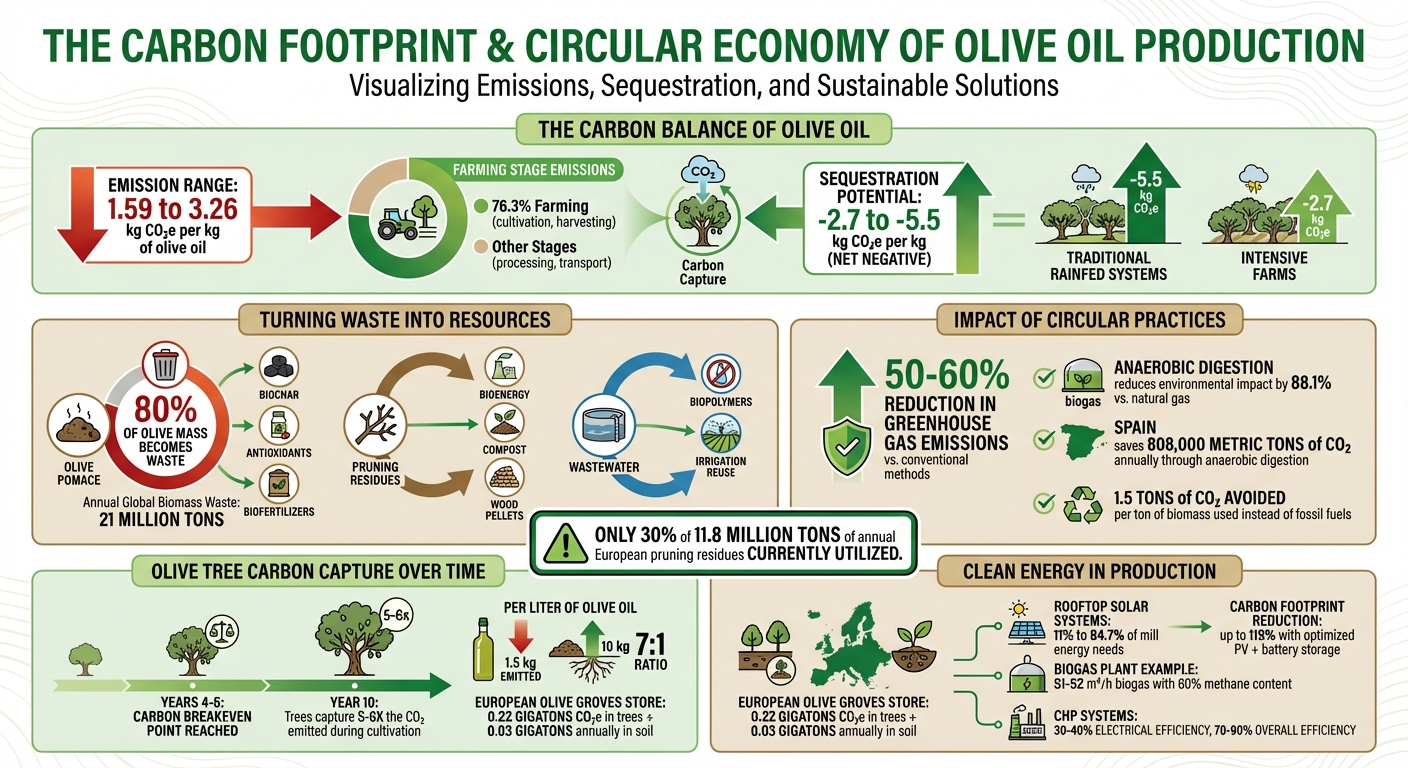
Producing olive oil emits 1.59 to 3.26 kg of CO2e per kilogram, but on a global scale, the environmental impact adds up. The farming stage alone accounts for 76.3% of emissions, driven by fertilizers, pesticides, and diesel use. Yet, olive trees naturally absorb CO2, turning olive oil into a potential net-negative product when including sequestration, ranging from -2.7 to -5.5 kg CO2e per kilogram.
Key points to know:
- 80% of an olive’s mass becomes waste, generating 21 million tons of biomass waste annually.
- Circular practices transform waste into bioenergy, fertilizers, or bioplastics, drastically cutting emissions.
- Renewable energy, like solar panels and biogas, is reducing reliance on fossil fuels in olive mills.
- Reusing pruning residues and organic farming methods enhance soil carbon storage and reduce waste.
Efforts like anaerobic digestion, biochar production, and renewable energy integration showcase how the olive oil industry is reducing emissions while improving resource efficiency. These methods are paving the way for more responsible production.
Carbon Footprint of Olive Oil Production: Emissions, Sequestration, and Circular Solutions
Tunisian company transforms olive waste into eco-friendly fuel | REUTERS

sbb-itb-4066b8e
Circular Economy Methods in Olive Oil Production
Circular practices in olive oil production are making strides in turning waste into energy and useful resources, significantly cutting down the crop's carbon footprint. By applying these principles, the olive oil industry is reducing waste, conserving resources, and addressing environmental concerns.
Converting Byproducts into Usable Resources
Olive pomace, a byproduct of oil extraction, finds new life in various industries. Initially, it’s used to extract natural antioxidants for products like pharmaceuticals, cosmetics, and biodegradable packaging. What’s left is transformed into biochar for soil improvement or processed through other recovery methods. Similarly, olive mill wastewater is treated to produce biofertilizers, biopolymers, or even reused in irrigation - though care must be taken to manage salt levels and phytotoxic compounds.
Advancements in extraction technologies help further minimize waste. For instance, Multi-Phase Decanter systems produce a nutrient-rich solid phase known as "paté", while two-phase decanters reduce water usage and cut down on highly polluting wastewater by creating a single wet pomace stream. These innovations are key to integrating resource recovery into olive oil production.
Producing Energy Through Anaerobic Digestion
Taking waste recovery a step further, anaerobic digestion turns residual biomass into renewable energy. This process generates biogas, primarily methane, which can be used for heating and electricity. Compared to natural gas extraction, anaerobic digestion reduces environmental impact by 88.1%, saving around 808,000 metric tons of CO₂ emissions annually in Spain. Alongside energy production, it stabilizes organic waste by cutting its organic load by 82–94% and produces a nutrient-rich digestate that works as a biofertilizer.
A practical example is the two-stage anaerobic digestion plant at Frantoio Oleario Domenico Cassese in Italy. Over 40 days, it processed olive pulp and pitted pomace, producing about 51–52 m³/h of biogas with 60% methane content. Many facilities combine anaerobic digestion with Combined Heat and Power (CHP) systems, achieving electrical efficiencies of 30–40% and overall efficiencies of 70–90% when waste heat is recovered. This approach even extends to using pruning residues for energy, creating a closed-loop system.
Reusing Pruned Olive Tree Material
Olive-producing regions in Europe generate about 11.8 million tons of pruning residues annually, but only 30% of this biomass is currently utilized. These residues are repurposed in several ways, including compost, mulch, livestock feed, and wood pellets for heating. Woody materials, in particular, are increasingly processed into pellets for both industrial and domestic use.
Research from Qassim University in Saudi Arabia highlights the benefits of reusing pruning waste. Processing 10.7–11.2 tons per hectare of biomass reduced waste by 65%, generated 96 GJ/ha of energy, and improved soil organic matter from 1.3% to 1.5%, delivering a net economic benefit of $70 per hectare.
"The circular strategy yielded a net benefit of ~70 $/ha, with revenues from bioenergy and compost exceeding processing costs."
Modern farming techniques, such as high-density and super-high-density systems, are also making it easier to recover pruning residues. Mechanized harvesting is replacing traditional burning methods, preserving the biomass's energy potential while enhancing carbon sequestration. This shift represents a meaningful step toward more efficient and sustainable olive oil production.
How Olive Trees Absorb and Store Carbon
Olive trees play a vital role in reducing atmospheric CO2 by acting as natural carbon sinks. They absorb carbon dioxide and store it in their wood, branches, roots, leaves, and fruit. Throughout their lifespan, this process never stops. Remarkably, in a productive year, about 50% of the carbon absorbed is stored in the fruit itself. The rest strengthens the tree's permanent structures - like the trunk, branches, and roots - where it remains locked away for decades. On top of that, adopting sustainable farming practices can significantly increase the soil's ability to store carbon beneath olive groves.
Currently, European olive groves store approximately 0.22 gigatons of CO2 equivalent in standing trees. Additionally, the soils in these groves can capture another 0.03 gigatons annually. To put this into perspective, producing a single liter of olive oil helps fix 10 kg of CO2 in the soil, which is about seven times the 1.5 kg emitted during production. This ongoing carbon capture lays the foundation for substantial accumulations over the tree's lifetime.
Carbon Absorption Over an Olive Tree's Lifetime
Young olive groves reach a critical milestone - called the carbon breakeven - around 4 to 5 years of age. At this point, the amount of carbon they sequester surpasses the emissions generated from their early cultivation. By the time the trees are 10 years old, they capture 5 to 6 times the CO2 emitted during their cultivation.
"The breakeven point between sequestration and emission is between 4 and 5 years, after which sequestered CO2 reaches 5 to 6 times the value of emissions after year 10." - Primo Proietti
Long-term studies further confirm that mature olive groves maintain a net-negative carbon balance, meaning they consistently absorb more CO2 than they release. These findings highlight the importance of farming practices in maximizing carbon storage over the tree’s lifetime.
How Farming Methods Affect Carbon Storage
Farming techniques can significantly impact an olive grove’s ability to capture and store carbon. Among these, traditional rainfed systems stand out, consistently outperforming intensive farming methods in reducing atmospheric CO2. A study published in September 2021 in the Journal of Environmental Management examined 11 olive farms in Andalusia, Spain. The researchers - R. García-Ruiz, F. Jurado, and D. Vera - found that traditional rainfed groves achieved a carbon footprint of -5.5 kg CO2 equivalent, compared to just -2.7 kg CO2 equivalent for intensive farms. The study also identified organic fertilizers and spontaneous cover crops as the most effective strategies for maintaining a positive carbon balance.
Organic farming practices further amplify carbon storage. For instance, systems using manure as fertilizer achieve a net carbon flux of -1.7 tons of carbon per hectare annually, compared to -0.52 tons per hectare in conventional systems. This improvement is largely due to the buildup of soil organic carbon (SOC), which enhances the soil’s ability to store carbon for the long term. Simple changes, like incorporating pruning residues into the soil instead of burning them, planting cover crops between trees, and replacing synthetic fertilizers with organic alternatives, can all increase carbon storage capacity.
"The contribution of the manure to increased SOC compensated for the higher carbon emission from the organic system, resulting in higher negative net carbon flux." - Ramez Saeid Mohamad
To support farmers in maximizing carbon capture, the International Olive Council introduced a Carbon Balance Calculation Tool in 2025. This tool helps farmers estimate their grove’s sequestration rates based on factors like location and farming practices. Such tools could pave the way for olive producers to participate in voluntary carbon markets, rewarding those committed to sustainable methods.
New Approaches in Olive Oil Production
Efforts to embrace renewable energy are transforming olive oil production, significantly reducing the industry's carbon footprint and aligning with circular economy principles.
Using Renewable Energy in Production Facilities
Some olive mills are turning their rooftops into energy hubs. Between 2022 and 2025, researchers from the University of Catania studied five olive mills in Abruzzi, Italy, to test an algorithm designed for optimizing rooftop photovoltaic (PV) systems with battery storage. The results were impressive: carbon footprints were reduced by up to 119% by maximizing energy self-consumption during the milling process, which is particularly energy-intensive. Depending on the setup, these rooftop solar panels can meet anywhere from 11% to 84.7% of a mill's total energy needs.
"Utilising existing agro-industrial building rooftops for PV system integration is generally recognised to optimise land use and facilitate distributed energy generation." - Grazia Cinardi, Researcher, University of Catania
Battery storage plays a critical role, especially since the peak olive oil production season (November to February) coincides with lower solar radiation. Stored energy ensures that mills can maintain operations year-round, even during less sunny periods.
Another innovative example comes from Agroenergy s.r.l., which, in 2019, installed a 500 KWel biogas plant in Andria, Apulia, Italy. This facility is the first in Europe to run solely on two-phase wet olive pomace. Through anaerobic digestion, the plant generates biogas to power a trigeneration system, which supplies electricity to the national grid and provides thermal energy for the mill. Additionally, the byproduct, known as digestate, is used as a natural fertilizer across the company's 400 hectares of organic olive groves, replacing chemical alternatives.
These advancements reflect a growing commitment to integrating renewable energy into olive oil production.
Regional Programs Supporting Circular Practices
Regional initiatives are also stepping up to support sustainability in the olive oil industry. The EU's Next Generation stimulus package funds various green projects in this sector. In Italy, the PNRR program (Mission 2 Component 1) specifically allocates government funding to enhance energy efficiency and promote sustainable practices in olive mills.
Spain's Andalusia region, the leading producer of Europe's olive oil, stands out for its focus on biomass utilization. The region currently uses 80% of its olive biomass for energy production, with 47% dedicated to electricity generation and 33% to thermal energy. Andalusia also encourages mills to convert waste on-site into renewable energy, further advancing circular economy goals.
These combined efforts are paving the way for a cleaner, more efficient olive oil production process.
Big Horn Olive Oil's Commitment to Quality and Freshness

Big Horn Olive Oil prioritizes quality and freshness while embracing sustainable practices in olive oil production. Their approach not only ensures exceptional products but also reduces environmental impact.
The company specializes in Ultra Premium Extra Virgin Olive Oils and authentic balsamic vinegars sourced directly from Modena, Italy. By focusing on high-quality olives and traditional production methods, they meet rigorous global standards for every bottle they produce.
Freshness plays a key role in crafting superior extra virgin olive oil. Big Horn Olive Oil delivers oils within three months of harvest and ensures cold-pressing takes place within just two hours of picking. This meticulous process helps preserve natural nutrients, antioxidants, and compounds like oleocanthal - known for its health benefits and bold flavor.
To maintain this high standard, Big Horn Olive Oil partners with suppliers who value quality over mass production. This careful sourcing reflects a commitment to authenticity, sustainability, and craftsmanship.
Their product lineup includes single-source EVOOs such as Picual and Coratina, as well as traditionally aged balsamic vinegars like the 18-Year Aged Dark Balsamic Vinegar and the Molto Denissimo 25-Year Aged variety. Each item showcases a harmonious blend of tradition and eco-conscious values.
This unwavering dedication ensures every product delivers exceptional taste while supporting sustainable practices.
Moving Toward Lower-Carbon Olive Oil Production
Circular methods in olive oil production have shown they can slash greenhouse gas emissions by 50–60% compared to traditional practices. This reduction comes from avoiding open burning, stabilizing carbon through composting, and replacing fossil fuels with renewable alternatives.
"The environmental analysis showed a 50–60% reduction in greenhouse gas emissions compared to conventional disposal, due to avoided open burning, carbon stabilization via compost, and the displacement of fossil fuels." - MDPI Sustainability Journal
Using dry olive biomass instead of fossil fuels is a game changer. For every ton of biomass burned, around 1.5 tons of CO2 emissions are avoided. Pruning residues, which average 25 kg per tree annually, can be converted into bioenergy or compost, directly contributing to these emission cuts. Additionally, about 80% of the carbon in olive fruit ends up in organic by-products like stones and pomace, highlighting the untapped potential of waste reuse.
Field studies further emphasize the real-world impact of these strategies. In May 2025, researchers in Al-Jouf, Saudi Arabia (29.79° N, 40.10° E), tested these methods on high-density Arbosana and Arbequina orchards. By transforming 10.7–11.2 tons of biomass per hectare into compost and bioenergy, they achieved a 50–60% reduction in emissions. The soil organic matter increased from 1.3% to 1.5%, and the project delivered ~$70 per hectare in net benefits through energy recovery and reduced fertilizer costs.
On an industrial scale, the Agresti Group in Andria, Italy, has taken these concepts even further. Between 2019 and 2020, they operated a 500 KWel biogas plant powered entirely by wet olive pomace. Using anaerobic digestion, the facility produced biogas for electricity and heat, while its pitting machinery extracted 20 kg of stones per 100 kg of olives, which were sold as solid fuel. By keeping by-products within the production loop, they also reduced emissions from transportation. These advancements highlight a meaningful shift toward more sustainable practices in olive oil production.
FAQs
Is olive oil really carbon-negative?
Olive oil itself isn't naturally carbon-negative, but it can be produced in ways that absorb more CO₂ than they release. Research highlights that methods like carbon capture and sustainable farming can help balance emissions. For instance, olive groves have the potential to store substantial amounts of CO₂, and advancements in production techniques are paving the way for olive oil to reach carbon-negative status under certain conditions.
What circular practices cut olive oil emissions most?
The olive oil industry can significantly cut emissions by adopting circular practices that focus on reusing and recycling resources. For instance, olive pomace, a by-product of olive oil production, can be converted into biogas, providing a renewable energy source. Similarly, waste cooking oil can be collected and processed into biodiesel, reducing reliance on fossil fuels. Another effective approach is implementing energy recovery systems, which capture and repurpose energy within the production process. Together, these methods promote better resource use and energy efficiency, making the supply chain more environmentally friendly.
How can consumers spot lower-carbon olive oil?
Consumers looking for olive oil with a smaller carbon footprint can focus on products made using environmentally friendly methods. This includes options produced through organic farming or by reusing by-products during production. These approaches align with the principles of a circular economy, working to cut carbon emissions and support eco-friendly practices.