

Castilla-La Mancha Olive Oil: Tech Transformations
Castilla-La Mancha, Spain's olive oil powerhouse, has shifted from old-school methods to cutting-edge processes, redefining its global reputation. Here's a quick breakdown of the transformation:
- Traditional Practices: Family-run farms relied on manual labor, stone mills, and basic tools. The process was slow, inconsistent, and prone to quality issues like high acidity and contamination.
- Modern Advancements: Farmers now use GPS, satellite imagery, and apps like RetoAgua for precision farming. Mills employ Pulsed Electric Field (PEF) and vacuum systems to boost efficiency and quality.
- Key Outcomes: Improved oil yield, better polyphenol retention, and advanced traceability using AI and blockchain. However, modern methods increase the carbon footprint due to irrigation and intensive farming.
This shift has helped the region produce premium extra virgin olive oils that meet global standards, catering to health-conscious consumers and international markets.
How a Spanish family business is revolutionising the olive oil business #EconomyStories
sbb-itb-4066b8e
1. How Olive Oil Was Made in Castilla-La Mancha
For generations, olive oil production in Castilla-La Mancha followed age-old techniques passed down through families. These methods, though labor-intensive, reflect the history and evolution of the region.
Farm Management and Harvest
Farmers adhered to a predictable yearly routine. Pruning took place in mid-February, and soil cultivation stretched from March to November, aimed at breaking the surface crust and managing weeds. Pest control was a seasonal effort, targeting issues like the olive fruit fly and the repilo fungus with treatments in spring and autumn.
When it came time to harvest, there were two primary methods. Some olives were hand-picked in a process called ordeño, while others were knocked loose using long sticks, a technique known as vareo. Nets were spread under the trees to catch the olives as they fell. A crucial step in maintaining quality was separating vuelo olives - those picked directly from the branches - from suelo olives, which had fallen to the ground. This practice helped avoid contamination.
Milling and Extraction Processes
After harvesting, olives were taken to be crushed. Traditional methods relied on large granite stone mills. One system, known as the molino de sangre, used animals to rotate a heavy conical stone over the olives, crushing 50–70 kilograms in about 30–50 minutes.
The crushed olives were turned into a paste, which was then spread onto capachos - round mats made from esparto grass. These mats were stacked and pressed using enormous wooden beam presses called viga de husillo. The pressing produced a liquid mix of oil and vegetation water, which was collected in stone pits. Gravity naturally separated the oil, which workers skimmed off the surface.
Quality and Sustainability Outcomes
However, this system had its drawbacks. Delays between harvesting and pressing often led to fermentation, increasing the oil's acidity and giving it a heavier, more pungent flavor. Additionally, the esparto mats were difficult to clean, and leftover paste trapped in the fibers could spoil, affecting the taste of future batches.
Despite these challenges, the traditional process had its reasons. The Cornicabra olive, a variety perfectly adapted to the region's tough soils and climate, thrived in these conditions. Olive groves also provided more than just oil - they were a cornerstone of rural life, offering both economic security and a sense of community long before modern production methods took hold.
These early practices laid the groundwork for the technological advances that have since revolutionized olive oil production in Castilla-La Mancha.
2. How Technology Has Changed Olive Oil Production in Castilla-La Mancha
Farm Management and Harvest
Farming practices in Castilla-La Mancha have undergone a massive transformation thanks to modern technology. Using tools like GPS, satellite imagery, and soil sensors, farmers can now fine-tune irrigation and fertilization based on real-time data from their fields.
The regional government has played a big role in this shift, increasing its Agriculture 4.0 funding from €8 million to €46 million. This investment has helped farmers acquire over 1,700 pieces of advanced equipment, including 550 tractors, 230 GPS guidance systems, and 31 harvesters.
"The digitalization of the field is not just technology; it is a way to make time profitable, take better decisions, save costs, and achieve more competitive and sustainable farms." - Julián Martínez Lizán, Minister of Agriculture, Livestock and Rural Development of Castilla-La Mancha
Water management has also seen a major upgrade. The RetoAgua app, introduced in 2023, offers farmers personalized advice to minimize water waste and optimize fertilizer use. This is a game-changer in a region where water resources are limited.
These technological advancements don't stop at the farm - they extend to the milling process as well.
Milling and Extraction Processes
The milling process has evolved from traditional manual methods to cutting-edge systems designed for efficiency and quality. Instead of relying on labor-intensive granite stone mills, modern mills use technologies like Pulsed Electric Field (PEF) and vacuum malaxation to improve oil extraction.
PEF technology, for example, uses short electrical pulses to open olive cell membranes before malaxation. This method not only speeds up the process by 33% but also preserves the extra-virgin quality of the oil. It boosts oil yield by 1.7% and reduces oil lost in pomace by 5.3% compared to older methods.
Vacuum malaxation systems, such as "Atmosphera" and "Olive Oil Booster", are also gaining popularity. These systems limit oxygen exposure during processing, which helps retain aromatic compounds and enhances the oil’s polyphenol content, resulting in a better sensory profile. Additionally, integrated automation systems now monitor production lines in real time, eliminating delays that were common in traditional setups.
Quality and Sustainability Outcomes
The impact of these technologies goes beyond efficiency - they also improve the quality and traceability of olive oil. AI-powered classification systems can now predict oil quality with over 90% accuracy before it leaves the mill.
Traceability has reached new heights with the introduction of PIDA (Plataforma Integral de Digitalización de la Agroindustria) in October 2025. This €27 million platform uses AI, Big Data, and blockchain to track olive oil from the field to the consumer, ensuring transparency in every transaction.
"The world leadership of Spanish extra virgin olive oil passes through artificial intelligence and the opening of new markets." - Begoña García Bernal, Secretary of State for Agriculture and Food
To support this digital transformation, the regional government has already trained over 7,600 individuals in the use of agricultural technology as of May 2026. The goal is to reach 8,500 trained professionals by June 30, 2026, not only to improve efficiency but also to attract younger generations to farming.
Pros and Cons
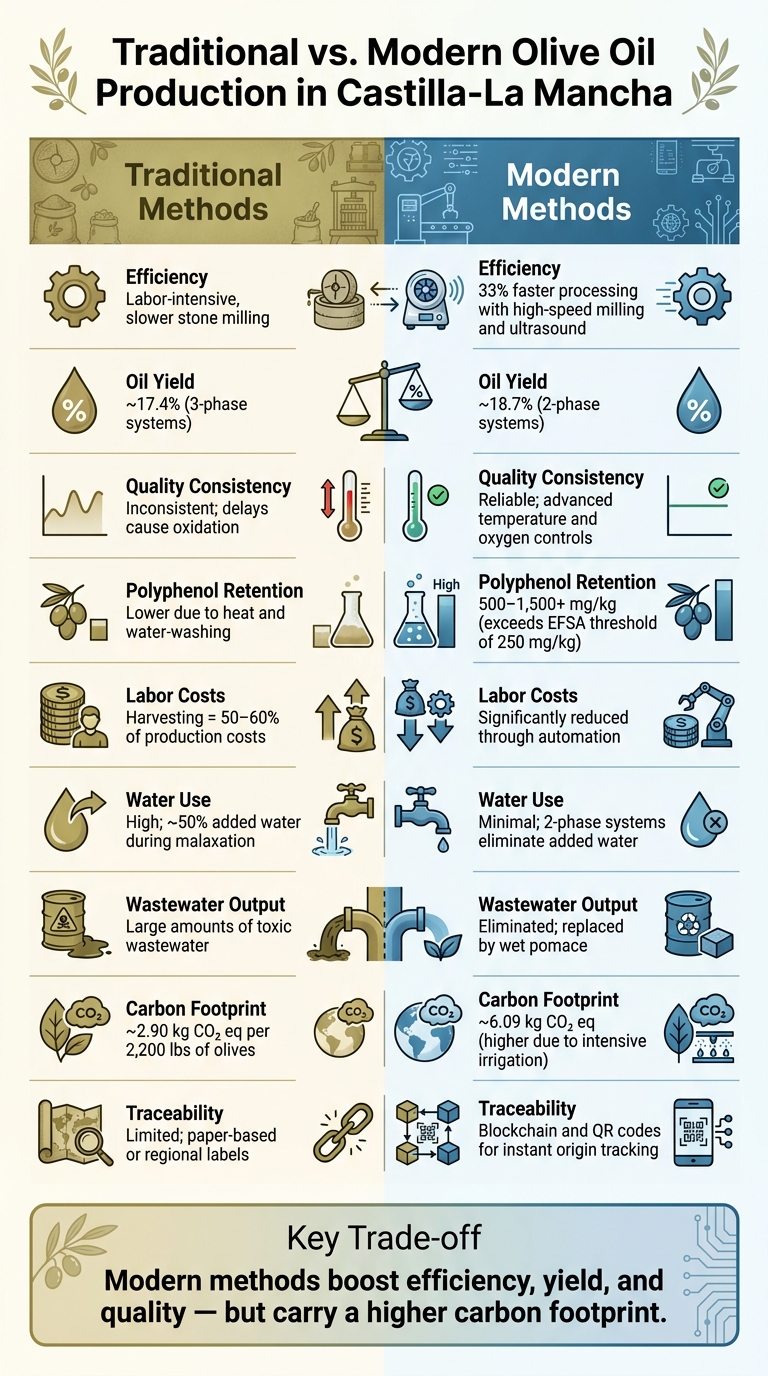
Traditional vs. Modern Olive Oil Production in Castilla-La Mancha
The transition from traditional to modern olive oil production in Castilla-La Mancha brings clear trade-offs. Each method has its own strengths and weaknesses, making the choice between them a matter of priorities and context.
Here’s how the two approaches stack up across key factors:
| Factor | Traditional Methods | Modern Methods |
|---|---|---|
| Efficiency | Labor-intensive; relies on slower stone milling | Faster processing with high-speed milling and ultrasound technology, cutting processing time by about 33% |
| Oil Yield | Around 17.4% using 3-phase systems | Slightly higher at ~18.7% with 2-phase systems |
| Quality Consistency | Inconsistent; delays can lead to oxidation | Reliable; advanced temperature and oxygen controls ensure consistency |
| Polyphenol Retention | Lower due to heat and water-washing during processing | Higher with cold extraction (below 77–81°F), preserving essential compounds |
| Labor Costs | Extremely high, with harvesting alone accounting for 50–60% of production costs | Reduced significantly through automation |
| Water Use | High; 3-phase systems need ~50% added water during malaxation | Minimal; 2-phase systems eliminate the need for added water |
| Wastewater Output | Produces large amounts of toxic wastewater | Eliminated; wet pomace replaces wastewater |
| Carbon Footprint | Lower for rainfed, extensive farming (~2.90 kg CO₂ eq per 2,200 lbs of olives) | Higher for super-intensive irrigated systems (~6.09 kg CO₂ eq) |
| Traceability | Limited; often paper-based or regional labels | Advanced; digital systems like blockchain and QR codes enable instant origin tracking |
One major takeaway is that while modern methods improve efficiency, yield, and quality, they come with a higher environmental cost. For example, intensive irrigation increases the carbon footprint, even as innovations like 2-phase milling reduce wastewater.
Modern methods also excel in polyphenol retention, with levels often reaching 500 to 1,500+ mg/kg - far exceeding the EFSA's threshold of 250 mg/kg. Traditional methods rarely achieve such levels.
"The sustainability that truly works is the one that can be applied in the field because it makes sense from an agronomic, economic and environmental standpoint." - Juan Vilar, Strategic Consultant for Agriculture and Agri-food
Conclusion
Castilla-La Mancha has transitioned from traditional stone mills and manual harvesting to cutting-edge technologies like AI, blockchain, and precision irrigation, delivering tangible results. Spain's olive oil output for the 2024/25 season hit 1.42 million tonnes, with growing demand from markets in the U.S., China, and Northern Europe. These regions now expect verified quality - complete with scannable details like proof of origin, harvest dates, and production methods. This shift not only aligns with global market expectations but also ensures that the health benefits of premium olive oil remain intact.
Modern methods such as cold extraction and pulsed electric fields (PEF) enhance yields while retaining phenolics, appealing to health-conscious consumers. For brands like Big Horn Olive Oil, these advancements reinforce their dedication to delivering exceptional quality and freshness, meeting the high standards that discerning buyers demand.
FAQs
How does PEF change olive oil extraction quality?
Pulsed Electric Field (PEF) technology works by creating tiny pores in cell membranes, which makes it easier to extract oil from olives. This method doesn’t rely on heat, which means it can increase oil yield, cut down malaxation time, and keep processing temperatures lower. By reducing heat exposure, PEF helps retain the oil’s natural flavor and enhances bioactive compounds like phenolics and tocopherols. The result? Extra virgin olive oil with better quality, improved efficiency, and a more eco-friendly production process.
Does modern irrigation make olive oil less sustainable?
Modern irrigation systems, if not managed carefully, can drain water supplies and negatively affect soil health. But by using precision technologies such as regulated deficit irrigation, farmers can fine-tune water usage, minimize environmental harm, and still achieve excellent yields. These approaches strike a balance between efficient production and environmental responsibility, supporting sustainable olive oil farming when used thoughtfully.
How can I verify an olive oil’s origin with blockchain?
You can check where your olive oil comes from by simply scanning the QR code on the bottle with your smartphone. This code links to a secure blockchain ledger, offering detailed, tamper-proof information about the product's journey. You'll see specifics like the grove where the olives were picked, the production date, and any quality certifications. It’s an easy way to verify the product’s authenticity and trace it from the source to your shelf.