

Castilla-La Mancha Olive Oil: Water Conservation Methods
Water scarcity is a growing challenge for olive oil producers in Castilla-La Mancha, Spain. With 450,000 hectares of olive groves and 80,000 family farms, droughts and extreme weather are putting pressure on production. To address this, farmers are adopting advanced water-saving techniques to maintain yields while conserving resources. Here’s a quick overview:
- Drip Irrigation: Delivers water directly to roots, reducing waste and boosting yields.
- Sensor-Based Scheduling: Uses soil and plant data to optimize watering only when needed.
- Night Irrigation: Reduces evaporation by watering during cooler hours.
- Ground Cover: Retains soil moisture with cover crops or mulch.
- Subsurface Irrigation: Minimizes evaporation by delivering water below the surface.
- Rainwater Harvesting: Collects and stores rainwater for efficient reuse.
- Reclaimed Water Systems: Incorporates treated wastewater to supplement irrigation.
These methods balance productivity with resource conservation, helping olive farmers adapt to water shortages. Below, we explore how each technique works, its benefits, and practical tips for implementation.
A traditional technique for irrigating olive trees improves water use efficiency in Tunisia
sbb-itb-4066b8e
Drip Irrigation Systems
Drip irrigation has become a key tool for conserving water in Castilla-La Mancha's olive groves. By delivering water directly to the roots of olive trees, it eliminates the waste associated with traditional methods like flooding or sprinklers.
Modern orchards using drip irrigation can produce up to 1.6 tons per hectare, compared to just 0.5 tons per hectare with older techniques. Rivulis, a prominent provider of irrigation equipment, emphasizes the importance of this technology:
"The investment made in an irrigation system is probably the most important decision in olive crop development and profit margin back to the grower".
Drip systems also support intensive farming practices. Traditional groves might have around 100 trees per hectare, but modern intensive orchards can accommodate anywhere from 300 to 3,000 trees per hectare. This precision watering system prevents both under-watering, which can cause water stress, and over-watering, which may lead to fruit or leaf drop. Additionally, drip irrigation enables fertigation, a process that delivers nutrients directly to the active root zone. In Spain, standard dripper flow rates of 3 liters per hour are common, with seasonal water requirements ranging from 389 to 418 mm.
Here’s a quick guide to setting up an effective drip irrigation system:
Steps for Setting Up Drip Irrigation
- Plan the system to suit your orchard’s water quality, soil type, and topography.
- Adjust lateral spacing based on soil type: sandy soils benefit from two closely spaced laterals, while clay soils require one lateral with wider spacing.
- Choose pressure-compensated driplines like Rivulis D5000 PC or HydroPC to ensure even water distribution.
- Incorporate fertigation by adding nutrient injection points.
- Consult local experts to finalize the hydraulic design and ensure optimal performance.
Sensor-Based Water Scheduling
Sensor technology takes irrigation to the next level by aligning water delivery with the actual needs of olive trees. Instead of sticking to rigid schedules or relying on visual assessments, producers in Castilla-La Mancha can employ soil moisture sensors and weather monitoring systems to irrigate only when necessary. This targeted approach minimizes overwatering while ensuring trees get the hydration they need, especially during critical growth stages. It builds on earlier water-saving methods by fine-tuning irrigation to match the trees' requirements.
The most effective systems pull data from several sources. Plant-based sensors, for instance, monitor how trees respond to water stress by measuring factors like sap flow, trunk diameter changes, and leaf turgor pressure. These metrics offer a clearer picture than soil moisture data alone, as olive trees can show signs of stress even when the soil seems adequately moist. Research supports this, noting:
"Evidence shows the great potential of plant-based methods as compared to those using measurements of soil water status or atmospheric demand".
Benefits of Sensor Technology
Using sensors for irrigation not only cuts down on water waste but also supports regulated deficit irrigation strategies. This is especially useful in areas where water resources are limited.
Installing and Calibrating Sensor Systems
Tools like microtensiometers, such as FloraPulse, provide automated monitoring by being inserted directly into the main trunks of olive trees to measure stem water potential (SWP). However, proper installation and calibration are critical for accurate readings. Each sensor must be individually calibrated, as readings can vary between trees.
During the initial setup, manual SWP measurements using a pressure chamber should be compared with the automated sensor readings. This step ensures the sensors are correctly calibrated for the specific conditions of your orchard. Once set, these sensors excel at tracking water status changes over time, helping you spot stress patterns early - well before they become visible. Many modern systems integrate sensor data with remote imagery and smartphone apps, making it easy to tweak irrigation schedules from anywhere. Keep in mind, sensors are most effective when used to monitor trends over time rather than focusing on momentary readings.
Much like drip irrigation, sensor-based water scheduling offers a practical way to improve water efficiency in Castilla-La Mancha's olive groves.
Night Irrigation Programming
Running irrigation systems at night is a smart way to cut down on water waste in Castilla-La Mancha's olive groves. Once the sun sets, cooler temperatures and higher humidity levels significantly reduce evaporation. This means more water actually makes it to the roots instead of evaporating into the air. By avoiding the heat of the day, olive trees can absorb moisture more efficiently, making this nighttime approach a perfect match for sensor-based scheduling, which already optimizes watering by monitoring conditions.
Using automation tools can take this efficiency even further. To fine-tune water delivery at night, growers consider factors like recent rainfall, evapotranspiration rates, and the specific needs of the orchard. For instance, a study in Castilla-La Mancha revealed that a single irrigated 'Manzanilla' olive tree used about 70 liters of water daily (roughly 18.5 gallons) when the reference evapotranspiration rate hit 7.9 mm (around 0.31 inches) per day.
Benefits of Night Irrigation
When paired with drip irrigation and sensor-based scheduling, night irrigation creates a well-rounded approach to using water wisely. Beyond minimizing water loss, this method brings several important agricultural perks. For example, controlled nighttime watering keeps fruit hydration at ideal levels, which is crucial for maintaining polyphenol content (≥ 100 mg/kg). These compounds are essential for the flavor and shelf life of olive oil.
Night irrigation also addresses "High Nighttime VPD" (Vapor Pressure Deficit), a less obvious issue that can quietly reduce yields if ignored. By applying water when atmospheric demand is lower, growers ensure optimal fruit hydration leading up to harvest. This prevents olives from becoming overly saturated, which can make them more susceptible to bruising and fermentation. Such conditions can increase free acidity, potentially disqualifying the oil from being labeled as extra virgin - an honor that requires acidity levels to stay below 0.8% by weight.
One challenge with night irrigation is the difficulty of monitoring systems in the dark. However, automated sensors now help track performance and adjust watering schedules in real time, making this approach more reliable.
Ground Cover for Soil Moisture Retention
In addition to modern irrigation techniques, ground cover plays a key role in conserving water by helping maintain soil moisture levels.
By covering the soil, ground cover reduces evaporation, especially during hot and dry summers. Using cover crops or mulch to replace bare soil protects it from direct sunlight and wind, cutting water runoff by over 60% and soil loss by more than 90%. This method also encourages rainwater to seep deeper into the soil rather than simply washing away. When combined with drip irrigation and sensor-based scheduling, ground cover becomes a powerful tool for improving water efficiency.
"The soil of an olive grove with herbaceous cover sequesters twice as much CO2 as another with bare soil." - ESAO
To maximize the benefits, keep cover crops in place from November through May. This allows them to capture rainwater during wetter months without competing with olive trees for moisture in the summer. By late spring (around May or June), mow the cover crops mechanically, leaving a layer of dead plant material that cushions the soil, reduces evaporation, and even captures morning dew. As these crops decompose, they release between 2.4 and 4.7 tons of carbon per hectare into the soil.
Choosing the Right Ground Cover
Selecting the most effective ground cover depends on your goals and local weather patterns. For instance:
- Graminoids like Brachypodium distachyon produce a high amount of biomass, offering excellent soil protection as they decompose.
- Crucifers such as Sinapis alba (White Mustard) and Eruca vesicaria (Arugula) adapt well to changing weather and are effective at fixing carbon.
- Pruning residues, including chopped olive tree leaves and twigs up to 3 inches (8 cm), decompose slowly and can maintain over 60% soil coverage for more than 700 days.
- Allowing spontaneous local vegetation to grow can provide baseline protection for minimal cost.
If your goal is high biomass production, Brachypodium distachyon is a solid choice. For fast carbon fixation, Sinapis alba works well. In orchards with heavy clay soils and frequent machinery use during harvest, combining temporary cover crops with pruning residues can improve water retention and strengthen soil structure.
Applying Ground Cover
Timing and proper application are crucial for getting the most out of ground cover:
- Sow cover crops in mid-fall to ensure they are well-established before winter rains.
- Mow the crops in early spring to create a layer of dead mulch that minimizes evaporation and prevents competition for moisture with olive trees.
- For pruning residues, chop them finely to create a uniform mulch layer that can protect the soil for at least two growing seasons.
- Avoid using tillage and herbicides. Instead, rely on mechanical methods to maintain soil moisture and organic matter.
- Preserve vegetation along streams, banks, and gullies to prevent erosion and safeguard farm infrastructure.
- Use controlled grazing between March and May to manage grass height while naturally enriching the soil with nutrients.
When integrated with other water-saving practices, this approach has proven effective in olive groves across Castilla-La Mancha, ensuring both moisture retention and improved soil health.
Subsurface Irrigation to Reduce Evaporation
Subsurface drip irrigation (SDI) delivers water and nutrients directly beneath the soil surface, targeting the root zone while cutting down on evaporation. Unlike surface irrigation, SDI keeps moisture exactly where olive trees need it - protected from harsh sunlight and wind. This approach is especially effective in high-density orchards, where trees are more susceptible to water stress, as it significantly reduces water loss through evaporation.
Before setting up an SDI system, it’s essential to consult an irrigation expert to design a system tailored to your water source, soil type, and landscape. Soil texture plays a big role in determining the number of laterals and dripper spacing. For sandy soils, two laterals per row with closely spaced drippers are recommended to address the limited wetted area. In contrast, clay soils typically require only one lateral per row, with wider dripper spacing to accommodate the soil’s ability to retain and spread water. Using pressure-compensated driplines ensures consistent water delivery, even across uneven terrain.
Between 2021 and 2023, the SUBALMA Operational Group - led by Beatriz from SISTEMA AZUD, S.A., along with ASAJA JAÉN and CEBAS-CSIC - implemented an SDI project at S.C.A. SAN ISIDRO LABRADOR de Canena in Andalucía and Murcia. This initiative incorporated nanobubble technology and repurposed olive-washing byproducts as organic fertilizer. The project demonstrated improvements in root system development and water distribution, showcasing the practical advantages of SDI systems.
Installing a Subsurface Irrigation System
To install an SDI system, start with a consultation to ensure the design suits your olive variety and local conditions. Use pressure-compensated equipment to maintain consistent water delivery across varied terrain.
For sandy soils, install two laterals per row with shorter dripper spacing to address the narrow wetted area. In clay soils, one lateral per row with wider dripper gaps is sufficient, as water spreads more efficiently in denser soil. Incorporate fertigation components to manage nutrient delivery directly to the root zone. Modern intensive orchards, which can host between 300 and 3,000 trees per hectare (about 121 to 1,212 trees per acre), can achieve yields of up to 1.6 tons of olive oil per hectare annually (approximately 0.65 tons per acre) with advanced irrigation techniques like SDI.
To maintain system efficiency, proper filtration is critical, especially when using organic fertilizers derived from olive milling waste. This practice helps keep subsurface emitters functioning smoothly and ensures consistent water distribution throughout the growing season. When combined with other water-saving strategies, SDI supports sustainability efforts, such as those seen in Castilla-La Mancha’s agricultural initiatives.
Wireless Sensors for Humidity and Conductivity Monitoring
Building on earlier advancements in sensor-based irrigation scheduling, wireless systems now offer olive growers a way to monitor soil conditions remotely and in real time. These sensors eliminate the need for manual field inspections, allowing farmers to track critical data like soil moisture and electrical conductivity directly from their digital devices. This is especially helpful in regions like Castilla-La Mancha, where rocky soils and widely spaced olive trees make traditional monitoring methods less practical.
While earlier discussions focused on soil moisture sensors, wireless systems now combine moisture and conductivity monitoring for a more detailed understanding of soil conditions. Non-invasive EMI sensors are particularly beneficial in rocky Mediterranean orchards. Unlike traditional soil probes, which struggle in such terrain, EMI sensors can measure both moisture and conductivity without needing to be deeply buried. These sensors provide simultaneous tracking of these variables, which often respond similarly to rainfall and evaporation throughout the growing season.
Sensor placement plays a crucial role in obtaining accurate data. For example, measurements taken 2 feet from a tree trunk can differ significantly from those taken 12 feet away due to variations in canopy coverage and root structure. Studies indicate that electrical conductivity tends to increase with distance from the trunk, while soil moisture patterns are less predictable. To capture these differences, sensors should be installed at multiple distances and depths.
"Stem water potential (SWP) is considered as the standard indicator, but this determination cannot be automated", noted Ramírez-Cuesta, J. M. et al.
Wireless sensors go beyond traditional methods like pressure chambers by offering continuous, automated monitoring. While manual techniques may provide more immediate sensitivity to changes, wireless systems excel at tracking diurnal and seasonal variations without requiring constant labor. For growers managing large-scale operations, this automation shifts water management from guesswork to precise, data-driven decisions.
Features of Wireless Sensor Systems
Modern wireless sensor systems come equipped with features that make them particularly useful for olive production:
- Dual monitoring: These systems measure both soil moisture and electrical conductivity simultaneously, giving growers a fuller picture of soil conditions. Since these metrics often follow similar seasonal patterns, monitoring both helps farmers understand not just water availability but also nutrient and salt distribution within the root zone.
- Scalability: Advanced systems allow for "coupled static-mobile" monitoring. This means growers can install permanent sensors in key areas while using mobile units to check other parts of the farm. This approach provides comprehensive coverage without the need for costly equipment in every corner of the property.
For trunk-based monitoring, microtensiometer sensors like FloraPulse® are an option. These sensors are inserted directly into the tree trunk to measure water status. However, they require local calibration against standard pressure chamber readings to provide precise measurements. Without calibration, they are better suited for tracking relative trends rather than exact water potential values.
When choosing wireless sensors for rocky olive groves, it's essential to select systems designed for high-rock-content environments. Standard probes often fail in these conditions, but specialized sensors maintain accuracy and reliability season after season. Additionally, systems that can adjust for proximity to the trunk are ideal, as readings vary significantly depending on distance from the root zone and canopy drip line.
Additional Water Management Practices
In Castilla‐La Mancha, olive producers have embraced collaborative water management strategies to address the challenges of water scarcity. By pooling resources through government-backed coordination, cooperative infrastructure, and collective funding models, these shared systems help sustain water availability across the region's vast 450,000 hectares (approximately 1.11 million acres) of olive groves. These efforts work alongside farm-level techniques to promote broader water conservation.
Rainwater Harvesting
Rainwater harvesting offers another practical way to reduce reliance on external water sources. One innovative method, the Hydroinfiltrator Rainwater Harvesting System (HRHS), uses a biochar-filled net shell around olive trees to direct rainwater deeper into the soil, minimizing evaporation during hot weather. A trial in Baena demonstrated remarkable results: soil moisture at 8 inches increased nearly threefold, olive production rose by 211%, and fat yield improved by 177%. As Rojano‐Cruz et al. highlighted:
"The use of the hydroinfiltrator rainwater harvesting system represents a significant improvement in the use of scarce water resources caused by climate change, providing agronomic and environmental benefits for rainfed, Mediterranean agricultural systems."
Reclaimed Water Systems
Another resourceful approach involves integrating reclaimed water through shared infrastructure. The REUTIVAR project, conducted between 2018 and 2019 in Montilla, Córdoba, demonstrated how treated reclaimed water can supplement traditional sources using smart irrigation systems. This initiative, carried out on a 150-hectare area within the Tintín irrigation community, used ultrasound technology to ensure pathogen-free water. Francisco Carrasco from FERAGUA explained the project's broader aim:
"Through the efficient use of regenerated water, we want to address the water deficit in Andalusia, improving the economic performance of olive groves to increase the creation of wealth, employment and sustainability in rural areas."
These practices show how producers can adopt innovative water management solutions to tackle the challenges posed by climate change.
Shared Water Resource Management
Coordinated resource management is another key element. The regional government of Castilla‐La Mancha oversees water distribution through the Mesa de la Sequía (Drought Table), a forum where the Consejería de Agricultura, Agua y Desarrollo Rural collaborates with agricultural stakeholders. This body has implemented emergency measures during droughts, including a €16 million aid program to help producers recover drought-affected crops. Francisco Martínez Arroyo, a former Consejero de Agricultura, remarked:
"Yesterday, in the Mesa de la Sequía, we decided to put in place a measure to recover them [crops], in case of necessity due to drought."
Large cooperatives also play a vital role as hubs for distributing shared resources and funding modernization efforts. For instance, the Cooperativa Santísimo Cristo de Villajos supports over 1,300 members by facilitating access to government grants and infrastructure upgrades. The FOCAL program has been instrumental in driving investment, with $1.38 billion (€1.27 billion) allocated to agro-industrial projects. Of this, $319 million (€293 million) in public funding has modernized nearly 1,000 projects, leveraging more than $4 (€4) in private investment for every $1 (€1) of public aid. Julián Martínez Lizán, Consejero de Agricultura, Ganadería y Desarrollo Rural, announced in February 2025:
"This same month of February we are going to publish a new call for FOCAL aid, which will be endowed with 80 million euros, the highest figure we have ever called for this line."
Comparison Table of Water Conservation Methods
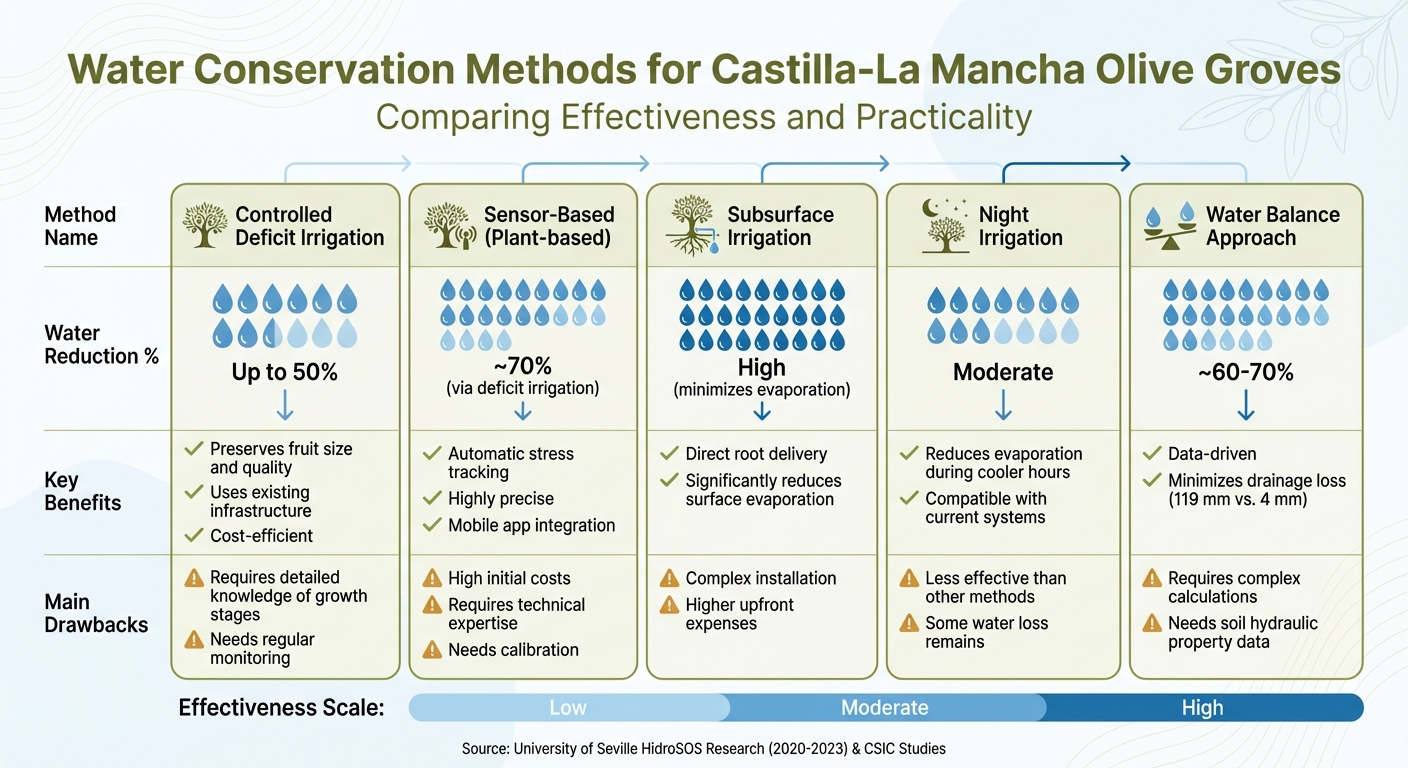
Water Conservation Methods for Olive Groves: Effectiveness and Benefits Comparison
Below is a table summarizing water-saving methods, comparing their effectiveness in reducing water usage and their practicality. This breakdown highlights the strengths and challenges of each approach:
| Method | Reduction | Benefits | Main Drawbacks |
|---|---|---|---|
| Controlled Deficit Irrigation | Up to 50% | Preserves fruit size and quality; utilizes existing infrastructure; cost-efficient | Requires detailed knowledge of growth stages and regular monitoring |
| Sensor-Based (Plant-based) | ~70% (via deficit irrigation) | Offers automatic stress tracking; highly precise; integrates with mobile apps | High initial costs; needs technical expertise and calibration |
| Subsurface Irrigation | High (minimizes evaporation) | Directly delivers water to roots; significantly reduces surface evaporation | Complex to install; higher upfront expenses |
| Night Irrigation | Moderate | Cuts evaporation during cooler hours; compatible with current systems | Less effective compared to other methods; some water loss remains |
| Water Balance Approach | ~60-70% | Relies on data; minimizes drainage loss effectively (119 mm vs. 4 mm) | Demands intricate calculations of soil hydraulic properties |
The choice of method plays a critical role in balancing water conservation with practicality, particularly in Castilla-La Mancha's olive groves. As Fernández and colleagues from CSIC observed:
"Full irrigation is rarely the best option, both because olive is usually grown in areas where water for irrigation is scarce and because of its remarkable response to low irrigation supplies".
Research highlights that plant-based sensor systems can cut water usage by up to 40% compared to full irrigation, showcasing their ability to manage water deficits with precision.
Conclusion
Water conservation plays a central role in the success of Castilla-La Mancha's olive oil production. With its semi-arid climate and frequent droughts, the region depends on precise water management to prevent crop failure. Research by the University of Seville's HidroSOS group (2020–2023) demonstrated that controlled deficit irrigation can cut water use by 50% while maintaining both fruit quality and yield levels comparable to fully irrigated groves.
This highlights the importance of careful irrigation strategies. Olive trees are uniquely suited to thrive with minimal yet well-timed watering. As Marta Sánchez Piñero from the University of Seville's Department of Agronomy explained:
"The capacity to adjust irrigation during critical phases of fruit development could help farmers face drought conditions without sacrificing production".
In essence, success comes from precision - not withholding water entirely.
Rainfed systems, on the other hand, lead to smaller canopies and undersized fruit. The key is providing just the right amount of water at critical times, guided by plant-based indicators rather than relying on estimates.
FAQs
Which water-saving method should I implement first in an olive grove?
The best way to save water in an olive grove is by using drip irrigation. This method delivers water straight to the roots, minimizing waste and maximizing efficiency. Beyond conserving water, it helps boost olive yields and improves oil quality, making it a smart first move toward more sustainable olive farming.
How do I know when my olive trees actually need water?
To figure out if your olive trees need watering, keep an eye out for signs like slower shoot growth, smaller flowers, or smaller-than-usual fruit. Key times to focus on watering include flowering (mid-March to mid-May), shoot growth (February through September), and the pre-harvest period.
Check soil moisture regularly and observe your trees for signs of stress, such as wilting or leaves dropping. Providing the right amount of water during these crucial stages supports healthy fruit development and helps maintain your overall yield.
Will water-saving irrigation affect extra virgin olive oil quality?
Water-saving techniques, such as regulated deficit irrigation, are effective in maintaining or even improving the quality of extra virgin olive oil. By carefully managing water stress and optimizing its use, these methods ensure that the oil's characteristics are preserved or enhanced.