

How Certification Ensures Olive Oil Authenticity
Buying olive oil can be tricky. Many products labeled as "extra virgin" aren't what they claim to be. Fraud in the olive oil market is widespread - some bottles contain lower-grade oils or are mixed with seed oils, which can pose health risks and mislead consumers. Certification programs are the best way to ensure you're getting what you pay for: high-quality, pure olive oil.
Here’s what you need to know:
- Certification seals (like COOC, USDA QMP, or NAOOA) verify that the oil meets strict quality and purity standards.
- Harvest dates help confirm the oil’s freshness - look for oils made within the past 18–24 months.
- PDO and PGI labels ensure the oil comes from specific regions with regulated production processes.
- Certified oils undergo rigorous testing, including chemical analysis and sensory evaluations, to guarantee quality.
Label Lessons: Identifying Authentic Vs. Fake Olive Oil
Key Olive Oil Certification Standards
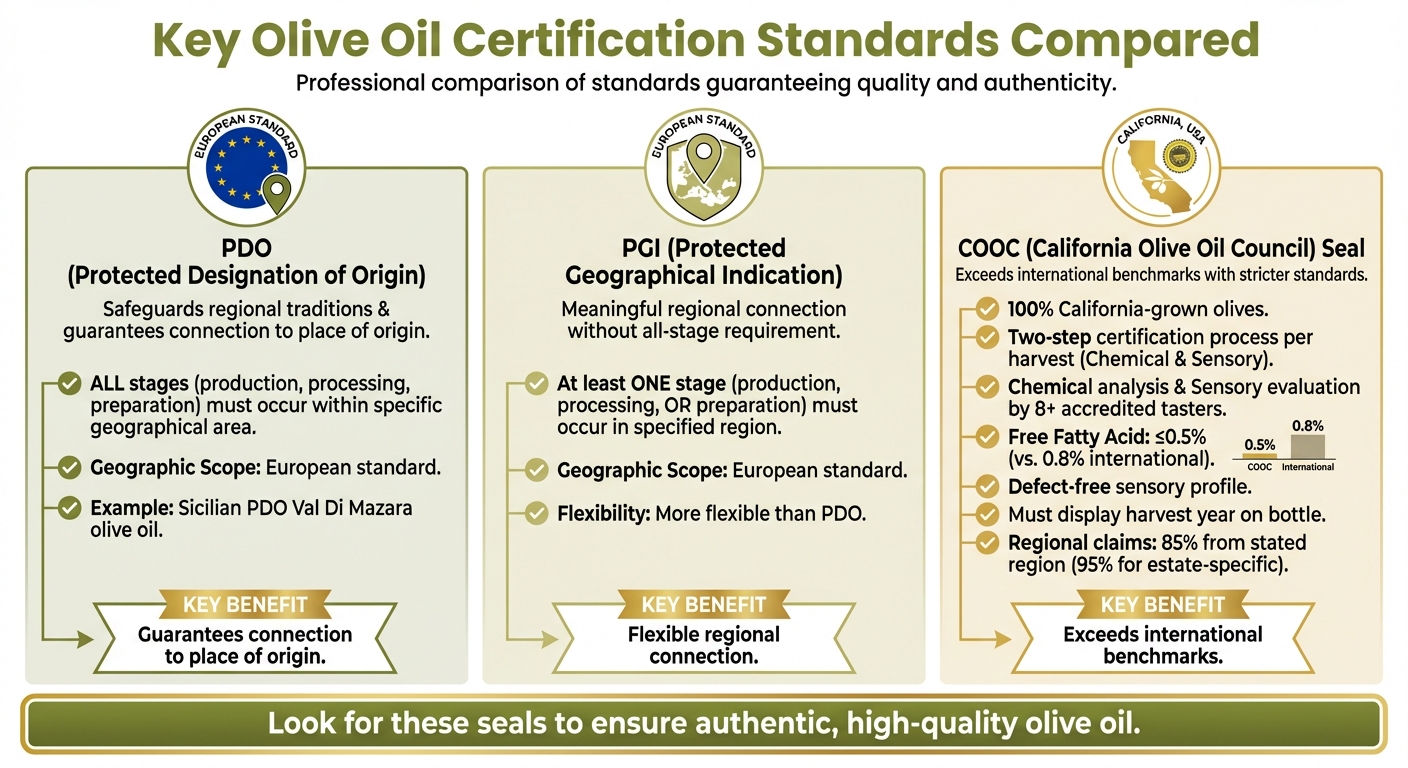
Major Olive Oil Certification Standards Comparison Guide
PDO (Protected Designation of Origin)
The PDO certification is a European standard that ensures olive oil is entirely produced, processed, and prepared within a specific geographical area. For example, Sicilian PDO Val Di Mazara olive oil adheres to this standard, with every step of production happening within the designated region. This certification not only safeguards regional traditions but also guarantees consumers receive products deeply connected to their place of origin. Alongside PDO, the PGI standard provides another way to emphasize regional identity.
PGI (Protected Geographical Indication)
PGI certification highlights a product's regional roots but offers more flexibility compared to PDO. While PDO requires every stage of production to occur within the specified area, PGI allows for just one stage - whether production, processing, or preparation - to take place regionally. This ensures a meaningful connection to the area without the stringent all-stage requirement. In contrast, the COOC Seal focuses on maintaining high standards specifically for California olive oil.
COOC (California Olive Oil Council) Seal
The COOC Seal is a mark of excellence for olive oil produced entirely in California, exceeding international benchmarks. To earn this certification, producers must undergo a two-step process for each harvest: chemical analysis and a sensory evaluation conducted by at least eight accredited tasters. The COOC enforces stricter standards, such as limiting Free Fatty Acid levels to 0.5% (compared to the international limit of 0.8%) and requiring a defect-free sensory profile with a distinctive olive fruitiness. As Nate Norris, Executive Chef at Zuni Cafe, explains:
"The California Olive Oil Council is such a critical organization. I rely on their certifications for selecting olive oils at home and in the restaurant."
The COOC also insists on transparency. Certified bottles must display the harvest year, ensuring consumers have access to the freshest oil. If a label specifies a California region like Napa Valley, at least 85% of the olives must originate from that region. For oils labeled from a specific estate, the requirement rises to 95%.
Consumer Benefits of Certified Olive Oil
Accurate Labeling and Product Traceability
When you buy certified olive oil, you're not just purchasing a product - you’re getting peace of mind. Certification programs ensure that labels are truthful and transparent. For example, the California Olive Oil Council (COOC) requires all member labels to undergo approval before hitting store shelves, preventing misleading claims about origin or composition. This means when a bottle says it's from a specific region or includes a harvest date, you can trust that information.
Certified oils also undergo rigorous checks for traceability. Organizations like the USDA Quality Monitoring Program conduct unannounced inspections to ensure production records align with what’s in the bottle. The North American Olive Oil Association steps it up a notch by randomly purchasing oils from retail shelves for testing at least twice a year. If a product fails, it must be pulled from stores across North America. These measures ensure not only transparency but also adherence to high-quality and freshness standards.
Quality and Freshness Standards
Certified olive oil isn’t just about where it comes from - it’s about how fresh and high-quality it is. Certification involves strict chemical and sensory tests to confirm the oil meets premium standards. For instance, the COOC enforces limits like Free Fatty Acid levels below 0.5% and Peroxide Values under 15 meq O₂/kg, which are far stricter than international thresholds. These tight controls help minimize oxidation and preserve the oil’s freshness.
Producers also follow best practices, like milling olives within 24 hours and maintaining extraction temperatures below 86°F to lock in flavor and quality. As Dan Flynn, Executive Director of the UC Davis Olive Center, puts it:
"Only the harvest date is going to let you know when that oil was made".
This attention to detail ensures you’re getting oil at its peak.
Preserved Health Properties
Certified olive oil doesn’t just taste better - it’s better for you. One key requirement is mechanical extraction, which avoids the use of chemical solvents or high heat, preserving the oil’s beneficial compounds. Research highlights that phenols in extra virgin olive oil are highly absorbable, with rates exceeding 50%. These compounds are also linked to preventing cholesterol oxidation in the bloodstream.
Certification also guards against adulteration with cheaper seed oils, which not only oxidize faster but may contain undeclared allergens. Mary M. Flynn, PhD, from Brown University, underscores the importance of these compounds:
"The phenol content of the olive oil provides the health benefits, as opposed to the fatty acid composition of the oil".
With certified oils, you’re assured that the health-promoting phenols remain intact, giving you all the benefits you expect from high-quality olive oil.
sbb-itb-4066b8e
Big Horn Olive Oil: Meeting Certification Standards
Ultra Premium Extra Virgin Olive Oils (EVOO)
Big Horn Olive Oil takes extra virgin olive oil to the next level with its Ultra Premium EVOO, adhering to stricter standards with a maximum free fatty acidity of ≤0.5%. For comparison, the International Olive Council (IOC) permits up to 0.8% acidity for extra virgin status. This lower acidity reflects the use of higher-quality fruit during milling and ensures better preservation of natural compounds.
To maintain these standards, the oils are cold-pressed within just two hours of harvest, locking in flavor and health-promoting phenols. This mechanical extraction process safeguards the oil’s natural properties. Each bottle is tested twice - first through chemical analysis and then through sensory evaluation - to confirm purity, absence of defects, and a clear fruity profile. These rigorous standards are further supported by careful sourcing practices.
Products from Certified Regions
Big Horn Olive Oil goes beyond processing by ensuring authenticity through certified regional sourcing. Its balsamic vinegars come from Modena, Italy, a region renowned for its strict certification protocols under European Commission regulations. This Protected Designation of Origin (PDO) status guarantees that products are crafted in specific areas using time-honored methods and local expertise.
For olive oils, the company partners with certified regions that enforce detailed traceability requirements. Producers must provide documentation verifying the country of origin and their participation in certification programs.
Quality Assurance Process
To guarantee authenticity, Big Horn Olive Oil employs a multi-step verification process. Every product undergoes chemical testing alongside sensory evaluation by a panel of eight trained experts. These tests ensure the oils meet critical parameters, such as peroxide values of ≤15 meq O₂/kg, and check for oxidation or the presence of refined oils through UV absorbency analysis.
Maintaining quality doesn’t stop at production. Big Horn enforces strict storage standards to preserve freshness until the product reaches customers. As highlighted by the North American Olive Oil Association:
"Quality should also be monitored over time because it changes and can be negatively affected by storage and handling".
To address this, Big Horn clearly labels harvest dates and advises consuming oils within 18 months of harvest. Typically, their oils reach customers within three months of harvest, ensuring peak freshness and maximum health benefits.
How to Verify Olive Oil Certification
Identifying Certification Seals
Certification seals are a key indicator of genuine olive oil. The COOC (California Olive Oil Council) Seal ensures the oil is 100% California-grown and meets strict extra virgin standards. The USDA Quality Monitoring Program (QMP) Seal signifies third-party verification, including unannounced inspections of production facilities. Similarly, the NAOOA (North American Olive Oil Association) Certified Seal guarantees that products are randomly tested from store shelves at least twice a year to meet International Olive Council standards.
When buying olive oil, always look for seals that confirm the harvest year and specify "Extra Virgin" quality. Be wary of labels using terms like "Pure", "Light", or just "Olive Oil", as these do not adhere to the same rigorous criteria. To further ensure quality, check for harvest and expiration dates, which can provide additional insight into the product’s integrity.
Checking Harvest and Expiration Dates
While certification seals are a good starting point, harvest dates are crucial for assessing freshness. Extra virgin olive oil is at its best within 18–24 months of harvest. Expiration dates that extend beyond two years may not reflect true freshness. The California Olive Oil Council emphasizes this point:
"Extra virgin olive oil is best used within 18 – 24 months of harvest. Some bottles are labeled with an expiration date over 2 years, which is why knowing the harvest date is so valuable."
Once a bottle is opened, it’s best to use the oil within three to six months to avoid oxidation. If a label only mentions where the oil was "packed in" or "bottled in" without listing a harvest date, it could mean the oil was made from older or blended harvests, making its origin and freshness harder to verify. For online purchases, always check product descriptions for harvest dates and reach out to the retailer if this information is missing.
Warning Signs of Fraudulent Products
Beyond seals and dates, there are red flags to watch for. Labels using terms like "pure", "light", or "olive pomace oil" often indicate chemically refined products that are far from the quality of extra virgin olive oil. Similarly, phrases like "packed in Italy" or "bottled in Greece" don’t necessarily mean the oil was produced in those countries - it could be a blend from various regions.
Packaging matters too. Avoid oils sold in clear glass or plastic bottles, as exposure to light can lead to oxidation. Unusually low prices can also be a warning sign, especially for early harvest oils, which are more expensive to produce due to their lower yield from unripe olives.
Fraud is a real issue in the industry. In November 2023, authorities in Spain and Italy arrested 11 individuals and seized over 260,000 liters of counterfeit olive oil that was falsely marketed as high-quality but deemed "unfit for consumption". At home, you can perform a simple taste test to check authenticity. Genuine extra virgin olive oil often has a slight bitterness and a peppery kick in the throat, a result of its natural antioxidants.
Conclusion
What Consumers Should Remember
Certification protects consumers from falling victim to counterfeit olive oil. Some products are diluted with cheaper oils like canola or sunflower, while others label low-quality refined oils as "extra virgin". This kind of adulteration not only alters the flavor but also strips away the health benefits - like antioxidants and heart-friendly fats - that genuine extra virgin olive oil delivers. Keeping these points in mind helps consumers stay committed to choosing only certified options.
When buying olive oil, look for certification seals such as COOC, NAOOA Certified, or USDA QMP, which guarantee purity and quality. As Charles W. Parrott, Deputy Administrator of the USDA Agricultural Marketing Service, explains:
"Olive oil labels with USDA's QMP seal provide consumers the assurance that the producer has taken proactive steps to ensure their product is authentic."
Another key indicator of quality is the harvest date. The COOC advises that "Best If Used By" dates should not exceed 24 months after harvest. Be cautious of labels that only mention where the oil was packed or bottled, as they might obscure the fact that the oil is from older or blended harvests. Also, terms like "light" or "pure" often signal refined oil, which lacks the qualities of true extra virgin olive oil.
Big Horn Olive Oil's Commitment to Quality
Big Horn Olive Oil takes these certification principles seriously, offering Ultra Premium Extra Virgin Olive Oils that meet the highest standards of authenticity. Their oils are cold-pressed within two hours of harvesting and delivered fresh within three months, ensuring peak flavor and maximum health benefits. This meticulous process mirrors the strict standards upheld by certification programs. By sourcing from certified regions and following rigorous production practices, Big Horn Olive Oil ensures traceability and freshness in every bottle.
Choosing certified olive oil is an investment in both your health and the quality of your meals. Big Horn Olive Oil’s dedication means that each bottle delivers a genuine extra virgin experience - pure, untainted, and premium.
FAQs
How can I tell if an olive oil is genuinely extra virgin?
To make sure your olive oil is truly extra virgin, check for certification seals from reputable organizations like the COOC or USDA. These certifications ensure the oil meets rigorous standards, such as having a free-acid content of 0.8 g/100 g or less, adhering to UV-absorbency requirements, and passing a sensory evaluation for vibrant, fruity flavors with no flaws.
Choosing certified extra virgin olive oils, like those from Big Horn Olive Oil, means you're getting genuine, high-quality, and fresh oil - giving you peace of mind about what you're bringing into your kitchen.
What is the difference between PDO and PGI certifications for olive oil?
PDO, or Protected Designation of Origin, ensures that every aspect of olive oil production - from harvesting to processing and final preparation - happens within a specific region. The unique characteristics of the olive oil are tied directly to the region's environment and long-standing traditions. On the other hand, PGI, or Protected Geographical Indication, is a bit more flexible. It requires that at least one stage of production takes place in the designated region, allowing for a broader but still meaningful connection to the area.
Both certifications serve as a mark of authenticity and quality, offering consumers confidence in the origin and craftsmanship behind their olive oil.
Why does the harvest date matter when choosing olive oil?
The harvest date plays a key role when choosing olive oil, as it directly reflects the product's freshness. Olive oil shines brightest when it's fresh - this is when its flavor, aroma, and nutritional perks are at their absolute best. However, as time goes on, exposure to air can cause the oil to lose its quality and health benefits through oxidation.
For the best experience, aim to buy olive oil with a harvest date within the past year. This ensures you're getting a product that’s not only flavorful but also retains its original quality. This is particularly important for extra virgin olive oil, which is minimally processed and depends on its natural characteristics to deliver its rich taste and healthful properties. Freshness truly makes all the difference.