

Steps to Certify Olive Oil as USDA Organic
If you want to sell olive oil as USDA Organic, you need more than organic groves. You need 3 years of clean land history, a written Organic System Plan, certification for each covered step, an inspection, and records that trace each bottle back to the grove.
Here’s the short version:
- Land must be free of prohibited substances for at least 3 years before harvest
- Each covered business in the chain may need certification
- You need records for inputs, harvest, milling, storage, bottling, and sales
- Organic and non-organic oil must stay separate at all times
- Imported shipments need a valid NOP import certificate
- Certification costs can range from a few hundred dollars to several thousand dollars per year
- Cost share may cover up to 75% of eligible costs, capped at $750 per scope
- You must keep records for at least 5 years
- You must update your plan and complete at least 1 inspection each calendar year
Put simply, I’d think about this process in four parts:
- Build the plan
- Apply with a USDA-accredited certifier
- Pass inspection and fix any gaps
- Keep records and stay in line each year
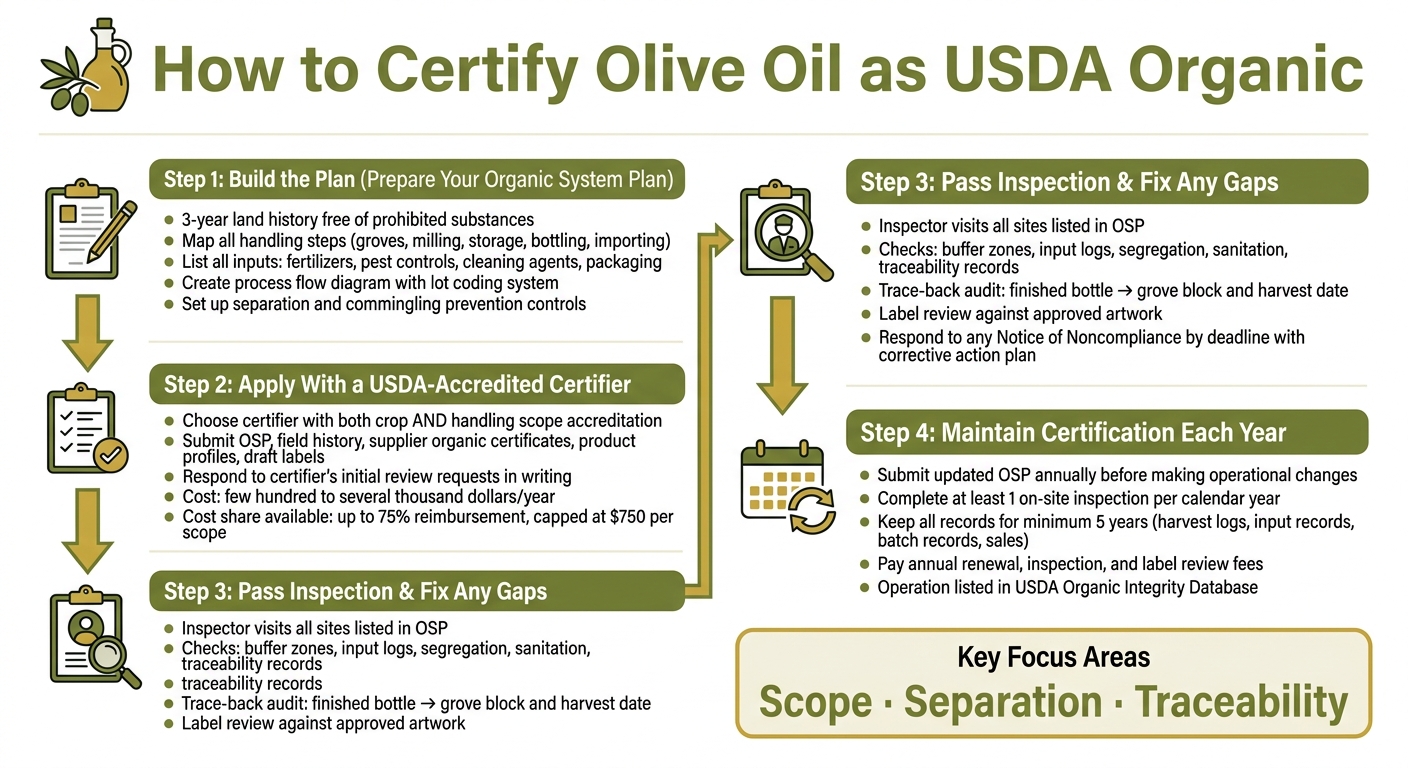
How to Certify Olive Oil as USDA Organic: 4-Step Process
Quick Comparison
| Step | What I’d do | Main thing the certifier checks |
|---|---|---|
| 1. Prepare | Write the OSP, map each handling step, gather records | Whether the system can protect organic status |
| 2. Apply | Send forms, records, supplier certificates, and labels | Whether the file is complete and fits NOP rules |
| 3. Inspect | Show groves, mill, tanks, bottling, and traceability records | Whether daily practice matches the written plan |
| 4. Maintain | Update the OSP yearly, keep records, pass annual inspection | Whether the operation stays in compliance |
If I were starting from scratch, I’d focus first on scope, separation, and traceability. Those three points drive most of the paperwork, inspection questions, and label approval work.
sbb-itb-4066b8e
Step 1: Prepare Your Organic System Plan for Olive Oil
The Organic System Plan (OSP) explains how your operation grows organic olives and handles the oil that comes from them. Once you’ve set the scope, build the OSP around every place where organic status could be lost.
That means listing every input you use, not just in the grove, but across the full operation. Include fertilizers, pest-control products, cleaning agents, processing aids, and packaging materials.
Identify which parts of your operation need certification
Before you draft the OSP, map every point where olives or olive oil are handled before packaging. If a product passes through that step, there’s a good chance it needs to be part of your certification scope.
This can include:
- Olive groves
- On-farm harvest and storage
- Milling
- Filtration
- Bulk storage
- Bottling lines
- Relabeling
- Private-label packing
- Importing
- Bulk oil handling
Scope affects your forms, inspection steps, and fees. It also decides what the certifier will review.
Here’s the part that trips people up: a certified press still can’t process organic olives unless it’s covered by the certified operation. And if unpackaged organic oil passes through an uncertified non-retail handler, it loses its organic status.
Gather input records, field history, and process flow documents
Once your scope is clear, start pulling the records your certifier will want to see.
| Document Category | Specific Records Expected | Purpose |
|---|---|---|
| Orchard Management | 3-year field history, maps, input logs | Shows the land meets organic requirements |
| Harvest & Milling | Harvest logs, cleaning logs, purge records | Prevents commingling with conventional olives |
| Handling & Storage | Tank logs, sanitation records, filtration logs | Helps maintain organic integrity during storage |
| Audit Trail | Lot codes, batch records, sales invoices | Allows traceability from bottle to grove |
These records are the backbone of traceability and inspection. If you didn’t control the land for the full three-year period, you’ll need records from the previous operator.
You’ll also need a process flow diagram. Track the olives from harvest reception through washing, milling, separation, filtration, storage, blending, bottling, labeling, and shipping. Mark where lot codes are assigned and how batches are recorded each time product moves from one step to the next.
Set up a lot coding system that ties each finished bottle or bulk lot back to the harvest date, field of origin, and milling batch. Put simply, the certifier should be able to start with a bottle and trace it all the way back to the grove.
Put controls in place to prevent contamination and commingling
Your OSP also needs to spell out how you keep organic oil separate from conventional product at every stage. Usually, that comes down to dedicated equipment or well-planned scheduling, plus written cleaning and purge procedures between runs.
If a purge is needed to clear out conventional residue from equipment, document the diverted material with care. Don’t sell that material as organic.
Storage needs the same level of control. Facility maps and tank logs should clearly show which vessels are set aside for organic oil. If tanks are shared, keep cleaning records for every changeover. A common move is to run organic product first, or only after a deep clean.
For imported oil, add shipping records and certificate records to the plan. Each shipment must come with a valid NOP Import Certificate issued through USDA's Global Organic Integrity (INTEGRITY) database, along with the supporting foreign organic certificates. Include those papers in the OSP so the certifier can check compliance before the oil enters your operation.
Step 2: Apply Through a USDA-Accredited Certifying Agent
With your Organic System Plan done, the next move is to send your application to a USDA-accredited certifying agent.
Choose a certifier with crop and handling experience
Pick a USDA-accredited certifying agent that covers both crop and handling scopes. That matters because olive oil certification can touch the whole chain: groves, mills, bottling lines, and blending facilities. It also helps to work with a certifier that has direct experience with olive groves and oil handling.
When you compare certifiers, focus on four practical things:
| Comparison Factor | What to Look For |
|---|---|
| Scope coverage | USDA accreditation for both crop and handling scopes |
| Geographic coverage | Inspectors who regularly work in your state or region |
| Fee structure | Clear application, annual renewal, and inspection travel fees |
| Responsiveness | Reasonable turnaround times for reviews and label approvals |
USDA says certification often costs anywhere from a few hundred dollars to several thousand dollars per year, based on the size and complexity of the operation. There is also some cost relief available. The USDA Organic Certification Cost Share Program can reimburse up to 75% of eligible certification costs, with a cap of $750 per certification scope.
Submit your application and supporting records
A complete application package is more than just the form. You’ll need to send your OSP, the Step 1 records, supplier organic certificates for any purchased olives, bulk oil, or ingredients used in infused oils, product profiles, and draft labels.
For each product you want certified, include a separate product profile that lists the ingredients, organic status, and processing steps. That applies to every SKU, including single-varietal oils, blends, and infused oils. For blends and infused oils, use only agricultural ingredients that are organic or allowed under the NOP National List.
You should also attach draft labels for every product. Certifiers must review each retail label before it goes into use, so sending those labels at the start can help prevent delays later.
Respond to the certifier's initial review
After you submit the application, the certifier reviews it before scheduling the inspection. At this stage, it’s common to get written requests for more information. Most of those questions center on processing aids, sanitation and cleaning chemicals, and the organic certificates for any imported olives or oil.
Infused oils usually get extra attention. Reviewers will want the full ingredient breakdown, including:
- The herb, spice, or citrus used
- Its organic certificate
- Any carrier solvents
- Its percentage in the finished product
Reply to each request in writing. Attach the records they ask for, and point to file names and dates so the review is easier to follow. Once the certifier accepts the file, the inspection phase starts.
Step 3: Complete the Inspection and Address Any Issues
Once the certifier accepts your application, the inspection checks whether your records line up with what’s happening on the ground. The inspector visits each site listed in your Organic System Plan (OSP) and compares the plan with your day-to-day operation.
What inspectors check at groves, mills, and bottling sites
At the grove, inspectors look at buffer zones between your organic trees and nearby conventional farms. They check that no prohibited substances have been used, and they review input logs and field-history records. At the mill and bottling site, they compare the facility to your OSP, with close attention to storage, segregation, cleaning procedures, and recordkeeping. In plain terms, they’re testing whether the segregation, sanitation, and traceability controls in your OSP are actually in place.
One of the main parts of the inspection is the trace-back audit. The inspector may pick a finished lot of bottled oil and track it backward through your records - bottling batch logs, bulk storage transfers, milling records, and receiving tickets - all the way to the exact grove block and harvest date. They may also compare inputs and outputs as part of an output-versus-input review.
Inspectors also review labels to make sure the labels in use match approved artwork and that the required certifier identification appears where needed. It’s smart to review labels before the inspection so you can catch issues early instead of getting blindsided later.
The inspection ends with an exit interview. This is your chance to clear up concerns and understand which issues the certifier plans to address in the inspection report. If something comes up there, it moves into the formal review.
How to handle noncompliances and corrective actions
If the certifier finds a problem, they issue a formal Notice of Noncompliance. Common examples include:
- Missing harvest or production records
- An unverified or prohibited material
- Undocumented cleaning between organic and conventional runs
- A label that does not meet NOP requirements
Your response should do one of two things: rebut the finding with evidence, or lay out a corrective action plan. A good response deals with each cited issue head-on and includes supporting documents, such as revised SOPs, updated records, corrected label artwork, or photos showing new segregation measures.
Timing matters here. You must respond by the deadline listed in the notice. If you miss it, the result can be denial, suspension, or revocation of certification. A prompt, organized response helps keep the file moving and gives the certifier what they need to close out the noncompliance. Once they accept your response, the file moves to final review.
Step 4: Get Certified and Stay Compliant Each Year
What the certification decision covers
Once the inspection is done, the certifier makes the final call. The certifying agent reviews the inspection report along with your Organic System Plan and then issues one of three outcomes: certification approval, a Notice of Noncompliance, or a denial of certification. If your operation is already certified and major problems still haven't been fixed, the certifier may propose suspension or revocation.
If you’re approved, the certifier issues an organic certificate. That certificate includes your operation name and address, the certifier’s contact details, your certified scope(s), approved products, and the annual update date. It does not include an expiration date. Instead, certification stays active unless it is surrendered, suspended, or revoked.
Your operation will also appear in the USDA Organic Integrity Database. That gives buyers, partners, and inspectors a simple way to verify your certified status and product scope.
Annual updates, inspections, and recordkeeping requirements
After certification, the work shifts from getting approved to staying in line year after year. You must submit an updated Organic System Plan each year. That update should reflect any changes to your operation, including new grove acreage, updated equipment, revised labels, new suppliers, or changed processing steps. Sending those changes in before you put them into practice can help you avoid noncompliances during the annual review.
Certified operations must also complete at least one on-site inspection every calendar year. During that visit, inspectors check whether your day-to-day practices match your OSP. They also review records tied to production, inventory, sales, labels, and suppliers.
USDA rules require you to keep harvest logs, input purchase records, processing and cleaning records, batch records, and sales records for at least 5 years. On top of that, annual costs can include renewal, inspection, and label review fees. Some eligible costs may be offset through Organic Certification Cost Share programs.
Conclusion: Key Steps to Certify Olive Oil as USDA Organic
Getting certified gives you clear market perks, but it also comes with steady yearly duties. Here's the tradeoff at a glance:
| Benefit | Obligation |
|---|---|
| Permission to use the USDA Organic seal on packaging | Annual certification and inspection fees |
| Increased consumer trust and premium pricing potential | Use only permitted organic inputs and pest controls |
| Access to retailers and markets requiring certified products | Rigorous recordkeeping for every stage from grove to bottle |
| Verified supply chain integrity | Annual on-site inspections of all certified facilities |
| Stronger process management and quality oversight | Mandatory reporting of all Organic System Plan changes to the certifier |
FAQs
Do I need certification for every step?
Yes. Detailed records are required throughout the USDA organic certification process to show compliance with organic standards.
You need to document each step, from soil treatments and harvest dates to handling, processing, and bottling. That record creates an audit trail, makes traceability possible, and helps show that no prohibited substances were used.
What if I use a shared mill or bottling line?
Using a shared mill or bottling line is allowed, but only if you have strict procedures in place to prevent organic and non-organic products from getting mixed.
Your Organic System Plan should spell out your cleaning and separation steps in plain detail. And during inspections, you need to show that your team follows those procedures all the way from extraction through storage so your organic certification stays protected.
Can imported olive oil qualify as USDA Organic?
Yes. Imported olive oil can qualify as USDA Organic if it’s certified to meet USDA standards.
Under the USDA’s Strengthening Organic Enforcement rule, imported organic products must include an electronic NOP Import Certificate in the Organic Integrity Database to verify organic status and traceability.