

Chemical Standards for Extra Virgin Olive Oil
Extra virgin olive oil is a legal grade, not just a taste label. To qualify, an oil has to pass lab limits for free acidity, peroxide value, UV absorbance, and a set of purity checks. It also has to pass a sensory test with no median defects and fruitiness above zero.
Here’s the short version:
- Free acidity must be 0.80% or less
- Peroxide value must be 20.0 mEq O₂/kg or less
- UV limits matter: K232 ≤ 2.50, K270/K268 ≤ 0.22, Delta K ≤ 0.01
- FAEEs must be 35 mg/kg or less
- Fatty acid ranges help confirm the oil fits olive oil norms:
- Oleic acid: 55.00% to 85.00%
- Linoleic acid: 2.50% to 21.00%
- Linolenic acid: 1.00% or less
- Purity checks look for mixing with seed oils, pomace oil, or refined oil
- Safety checks screen for:
- pesticide residues
- PAHs such as benzo(a)pyrene
- MOSH/MOAH
- 2- and 3-MCPD esters
- glycidyl esters
- heavy metals such as lead and arsenic
- solvent residues
In plain terms: if you want to know whether an olive oil meets the extra virgin grade, you need more than taste. You need chemistry, sensory review, and safety screening. That combination is what separates a legal EVOO from oil that only looks the part.
Below, I break the standards into two simple groups: quality/purity markers and contaminant checks, so you can see what each test is meant to catch.
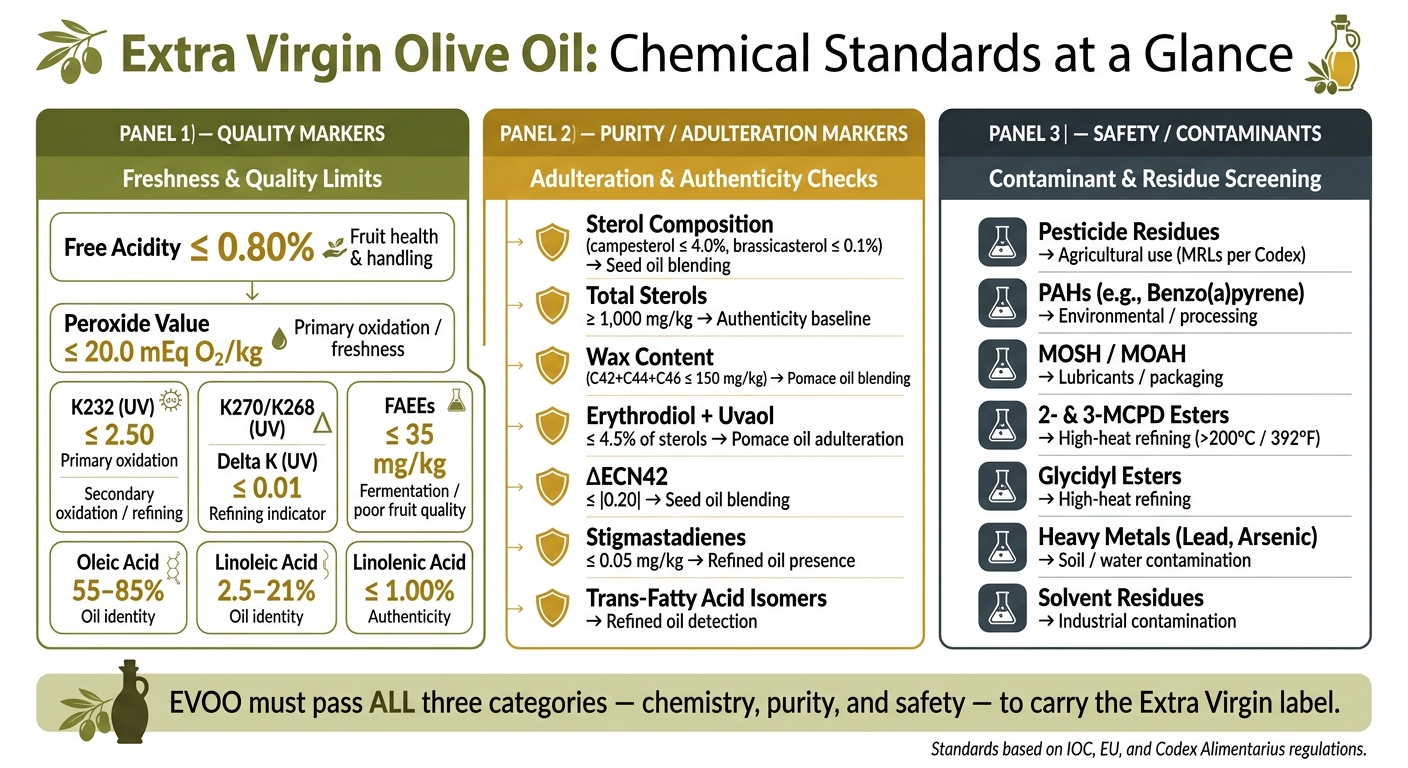
Extra Virgin Olive Oil Chemical Standards: Quality, Purity & Safety Limits
What Does Extra Virgin Actually Mean?
sbb-itb-4066b8e
International Definitions and Core Quality Limits for EVOO
EVOO is olive oil obtained directly from olives by mechanical means only.
Free Acidity, Peroxide Value, and UV Absorbance Limits
These three measurements are the main first-pass checks for any EVOO sample.
Free acidity shows fruit condition and how the olives were handled before milling. For EVOO, it must be 0.80% or less. Virgin olive oil can go up to 2.0%, while lampante oil is above that mark and must be refined before use.
Peroxide value measures oxidation products formed during production or storage. EVOO and virgin olive oil both have a maximum of 20.0 mEq O₂/kg. Refined olive oil, by contrast, has a lower limit of 5.0 mEq O₂/kg.
UV absorbance works as a third screen. K232 (≤ 2.50), K270/K268 (≤ 0.22), and Delta K (≤ 0.01) help flag primary oxidation, secondary oxidation, and signs that refined oils may be present.
After those oxidation checks, analysts look at the fatty acid profile to confirm that the oil still fits olive oil’s natural range.
Fatty Acid Profile and Freshness Markers
Oleic acid must be between 55.00% and 85.00%, linoleic acid between 2.50% and 21.00%, and linolenic acid at 1.00% or less. These ranges help confirm oil identity and show whether a sample still fits the lab standards for genuine EVOO, rather than oil that has aged, oxidized, or been poorly handled.
DAGs and PPP give clues about storage history and possible deodorization. Fatty acid ethyl esters (FAEEs) must stay at ≤ 35 mg/kg. Higher levels point to fermentation or fruit breakdown before milling.
Core EVOO Quality Indices at a Glance
| Parameter | EVOO Limit | What It Detects |
|---|---|---|
| Free Acidity | ≤ 0.80% | Hydrolysis; fruit health and handling |
| Peroxide Value | ≤ 20.0 mEq O₂/kg | Primary oxidation; freshness |
| UV Absorbance (K232, K270/K268, Delta K) | ≤ 2.50 / ≤ 0.22 / ≤ 0.01 | Primary and secondary oxidation; refining |
| FAEEs | ≤ 35 mg/kg | Fermentation; poor fruit quality |
| Oleic Acid | 55.00–85.00% | Oil identity and authenticity |
| Linoleic Acid | 2.50–21.00% | Oil identity and authenticity |
| Linolenic Acid | ≤ 1.00% | Authenticity verification |
These limits set the legal baseline. The next markers look more closely at authenticity and refining.
Chemical Markers Used to Detect Adulteration and Mislabeling
Quality limits tell you whether an oil is fresh. Purity markers answer a different question: Is this oil what the label says it is? That’s where labs use a separate group of chemical markers to spot blending, refining, and mislabeling.
Sterols, Waxes, Triacylglycerols, and ECN Analysis
Sterol composition is one of the main ways to spot adulteration. For EVOO, brassicasterol must be ≤ 0.1% and campesterol must be ≤ 4.0%. Total sterol content must also be ≥ 1,000 mg/kg.
Wax content is used to flag olive-pomace oil. EVOO must have a combined wax content of C42 + C44 + C46 ≤ 150 mg/kg. Erythrodiol + uvaol must stay ≤ 4.5% of total sterols.
Then there’s ECN42, which compares the measured triacylglycerol profile with the profile expected from the fatty acid composition. If ΔECN42 is above |0.20|, that points to seed-oil adulteration.
Stigmastadienes and UV Indicators of Refining
Refining leaves a chemical fingerprint in the form of stigmastadienes. These compounds form during decolorization and deodorization. For EVOO, stigmastadienes must be ≤ 0.05 mg/kg.
UV absorbance gives labs another way to check for refining. K270 must be ≤ 0.22 and Delta-K must be ≤ 0.01. When K270 or Delta-K runs high, that can signal refining or heavy oxidation.
Official Markers vs. Advanced Analytical Techniques
The IOC and EU regulations use a defined set of official methods, with lab techniques such as gas chromatography (GC), high-performance liquid chromatography (HPLC), and spectrophotometry. These methods are built to catch the fraud patterns labs see most often.
Official methods catch common fraud. More advanced tools are used when the issue is subtler, like light blending or origin disputes.
The main official markers are below.
| Marker or Technique | Target Fraud Scenario | Method Category |
|---|---|---|
| Sterol Composition | Addition of seed oils (e.g., rapeseed, sunflower) | Official (GC) |
| Wax Content (C42–C46) | Blending with olive-pomace oil | Official (GC) |
| Erythrodiol + Uvaol | Adulteration with pomace oil | Official (GC) |
| ΔECN42 | Blending with seed oils | Official (HPLC/GC) |
| Stigmastadienes | Presence of refined olive or vegetable oils | Official (GC) |
| UV Absorbance (K270, Delta-K) | Refining or excessive oxidation | Official (Spectrophotometry) |
| Trans-Fatty Acid Isomers | Presence of refined oils | Official (GC) |
| 2-Glyceryl Monopalmitate | Detection of esterified oils | Official (GC) |
These markers are used to verify authenticity. The next section moves to residues and contaminants that affect safety.
Contaminants and Residues: What Safety Standards Screen For
After authenticity testing, safety screening looks at a different issue: does the oil stay within contaminant limits? This is the last check. It looks at whether EVOO meets food-safety limits for pesticides, solvent residues, PAHs, mineral oil hydrocarbons, process contaminants, and heavy metals.
Pesticide Residues and Maximum Residue Limits
Pesticide monitoring in olive oil follows Maximum Residue Limits (MRLs) set by the Codex Alimentarius Commission. These limits differ from one pesticide to another, so labs don't test for just a handful of compounds. They usually run a broad residue panel with LC-MS/MS and GC-MS.
PAHs, Mineral Oil Hydrocarbons, MCPD Esters, Glycidyl Esters, and Heavy Metals
PAHs can get into olive oil through environmental exposure or during processing. The main marker labs usually track is Benzo(a)pyrene.
Mineral oil hydrocarbons are split into MOSH and MOAH fractions. These can come from contact with lubricants or packaging materials.
2- and 3-MCPD esters and glycidyl esters form during high-heat refining above 392°F (200°C). In EVOO, their presence can also help flag blending with refined oil. Heavy metals such as lead and arsenic are screened with ICP-MS.
Contaminant Classes, Sources, Limits, and Test Methods
The table below pulls together the main contaminant groups, where they tend to come from, and how labs test for them.
| Contaminant Class | Typical Source in EVOO | Regulatory Note | Primary Analytical Method |
|---|---|---|---|
| Pesticide Residues | Agricultural application during cultivation | MRLs vary by pesticide (Codex) | LC-MS/MS or GC-MS |
| PAHs | Environmental exposure or processing | Regulatory limits, including Benzo(a)pyrene | GC-MS or HPLC-FLD |
| Mineral Oil Hydrocarbons (MOH) | Contact with lubricants or packaging materials | Screening limits for MOSH/MOAH | GC-FID |
| 2- and 3-MCPD Esters and Glycidyl Esters | Processing contaminants from high-heat refining | Specific EU/Codex limits | GC-MS |
| Heavy Metals | Environmental contamination (soil/water) | Limits for lead and arsenic | ICP-MS |
| Solvent Residues | Industrial contamination or extraction residues | Specific limits per solvent | GC-MS |
Applying These Standards in Premium EVOO Quality Assurance
How Routine Testing Programs Use the Full Test Panel
Once the limits are set, the next job is simple: test against them, over and over. In U.S. supply chains, batch testing is repeated at harvest, during storage, and again at sale to confirm EVOO compliance.
Core quality indices are measured right after cold-pressing. These results show how fresh the oil is at the start. Purity results, on the other hand, check whether the oil is what it claims to be. During storage, UV indices are tested again to track oxidation and aging.
Purity testing happens alongside quality testing, not as an afterthought. Labs check sterols, waxes, stigmastadienes, and triacylglycerol profiles to spot blending with refined oils or seed oils.
After the oil passes those checks, the focus shifts to safety. Pesticide and heavy-metal screening complete the panel. Premium quality programs repeat these tests at key handoff points and use accredited laboratories that meet ISO 17025 requirements.
How Big Horn Olive Oil Aligns with International Standards

Big Horn Olive Oil stresses cold-pressing within 2 hours of harvest and bottling fresh oil within 3 months. Those steps help support EVOO freshness and keep the oil in line with compliance targets.
FAQs
Why isn’t taste alone enough to confirm EVOO?
Taste alone can’t prove that an olive oil is extra virgin. For an oil to qualify as EVOO, it has to pass two tests: a sensory review and strict physico-chemical standards.
Tasting can tell you a lot. It can point to flavor, balance, and possible defects. But it can’t confirm purity or verify whether the oil meets the required limits.
That’s where chemical analysis comes in. It’s used to check purity, authenticity, and compliance with set limits for free acidity, fatty acid composition, and wax content.
What do UV values like K232 and K270 show?
UV values like K232 and K270 are spectrophotometric measurements used to check olive oil quality and how well it has been preserved.
They work by measuring how much ultraviolet light the oil absorbs at specific wavelengths. That makes it possible to spot compounds formed during oxidation or industrial refining.
In plain English, these values help reveal chemical changes that can point to lower freshness or poor processing.
Which tests detect refined or blended olive oil?
Laboratories mainly use capillary gas chromatography to measure waxes and fatty acid alkyl esters. Those markers can help flag refined, deodorized, or blended oils.
Other standardized tests include stigmastadienes for refined vegetable oils, ultraviolet spectrophotometry for degradation, and fatty acid composition analysis for profiles that don’t line up with what the oil should show.