

Chemometric Fingerprinting with NMR
Chemometric fingerprinting with NMR spectroscopy is reshaping olive oil analysis by offering fast, precise, and non-destructive methods to verify quality and detect fraud. Here's what you need to know:
- Why It Matters: Olive oil fraud increased by 87.5% between 2009 and 2019, highlighting the need for reliable testing.
- How It Works: NMR spectroscopy captures a complete chemical profile of olive oil, identifying both major (triacylglycerols) and minor compounds (phenols, sterols).
- Advantages: Minimal sample prep, rapid results (~10 minutes), and high reproducibility. It detects adulteration as low as 5% and ensures accurate origin verification.
- Applications: Differentiates organic vs. conventional oils, verifies geographical origin, and identifies olive varieties. AI models achieve up to 94.6% accuracy in traceability.
- Challenges: High costs and specialized equipment limit accessibility, but newer, lower-frequency systems are addressing these hurdles.
NMR fingerprinting is transforming the olive oil industry by improving fraud detection, origin verification, and quality control, making it an essential tool for producers and consumers alike.
El aceite de oliva (cuantificación). Aprende RMN conmigo
How NMR Spectroscopy Works for Olive Oil Analysis
NMR spectroscopy uncovers the molecular structure of olive oil by exposing a sample to a powerful magnetic field. This process causes atomic nuclei, such as ¹H, ¹³C, or ³¹P, to absorb radiofrequency energy at specific frequencies, creating a unique molecular "fingerprint". The strength of each signal corresponds directly to the number of nuclei in a particular chemical environment, allowing for precise quantification without needing external standards. The following sections dive into specific NMR techniques and their application in analyzing olive oil.
To generate a spectrum, approximately 140 mg of olive oil is dissolved in deuterated chloroform with an internal reference. This spectrum identifies major components like triacylglycerols and trace compounds such as phenols and sterols. Thanks to advancements in technology, modern NMR spectrometers can detect even trace components at parts-per-million levels within complex mixtures.
Primary NMR Techniques
¹H NMR (Proton NMR) is widely used in olive oil analysis due to its speed and sensitivity. It identifies fatty acids and triacylglycerols while also detecting minor compounds such as squalene, β‑sitosterol, and cycloartenol. Phenolic markers like oleocanthal are found between 7.3 and 9.7 ppm. Techniques like NOESY can suppress dominant fatty acid signals, making it easier to detect minor compounds such as polyphenols.
¹³C NMR (Carbon NMR) provides detailed structural insights that complement ¹H NMR by showing how fatty acids are distributed on the glycerol backbone. It can differentiate between fatty acids at the sn‑1,3 positions versus the sn‑2 position. Professor Luisa Mannina from the University of Molise explains:
"Any olive oil in which a palmitic residue is found in position 2 of the glycerol must be considered as a fraud".
Although ¹³C NMR is less sensitive due to the natural abundance of carbon-13 being only about 1.108%, it is particularly useful for detecting geographical origins and identifying re-esterified oils.
³¹P NMR (Phosphorus NMR) involves an additional derivatization step using a phosphorus reagent. This technique excels at quantifying phenolic compounds and diglycerides with high precision, making it valuable for assessing acidity and specific phenolic fractions that influence both the health benefits and sensory properties of the oil.
How NMR Identifies Olive Oil Composition
Building on the techniques outlined above, NMR spectroscopy identifies olive oil components by detecting their unique chemical signatures.
For fatty acids, NMR identifies signals from methylene, allylic, and olefinic protons to determine levels of unsaturation and calculate the molar fractions of oleic, linoleic, and linolenic acids. This provides a detailed fatty acid profile without damaging the sample.
NMR's ability to detect minor compounds is crucial for verifying the authenticity and quality of olive oil. Phenolic markers play a key role in evaluating both sensory characteristics and health benefits. Secoiridoids like oleuropein, ligstroside, and oleocanthal appear in the 7.3–9.7 ppm range, while aldehydes such as trans‑2‑hexenal (9.448 ppm) and hexanal (9.705 ppm) contribute to "green-fruity" flavor notes. The presence of Mg‑depleted chlorophyll, indicated by a signal at –0.42 ppm, can reveal the use of artificial coloring.
Diglycerides are also assessed using NMR, with sn‑1,2 and sn‑1,3 diglycerides showing signals at 3.639 and 3.994 ppm, respectively. Professor Mannina emphasizes:
"The total diglycerides profile and the 1,2 : 1,3 ratio are strongly related to the quality and the freshness of olive oils".
Chemometric Data Processing Methods for NMR
After NMR spectroscopy generates a spectrum, the challenge lies in interpreting the complex, overlapping signals to gain meaningful insights. Olive oil, for example, contains hundreds of metabolites, producing a highly intricate spectrum. Chemometric techniques help translate this complexity into valuable information about the oil's quality, origin, and authenticity.
To start, preprocessing steps like baseline correction, alignment, and Pareto scaling are applied to clean up the data. These steps reduce noise and adjust the signal magnitudes within the dataset. Among these, Pareto scaling stands out as the preferred method for NMR data. It balances signal magnitudes effectively without amplifying background noise - an essential feature when dealing with the complex chemical makeup of food matrices.
Data analysis typically follows two main approaches: targeted quantification, such as qNMR for specific compounds, and untargeted spectral fingerprinting, which captures the entire chemical profile. Research indicates that the untargeted approach often achieves higher accuracy in authentication processes by detecting subtle variations across the full spectrum. These preprocessing steps lay the groundwork for advanced multivariate analysis techniques.
Principal Component Analysis (PCA)
Once the data is preprocessed, PCA is used to simplify the high-dimensional NMR spectra. This method reduces the data into principal components, highlighting key variances in olive oil composition. PCA is unsupervised, meaning it identifies natural groupings in the data without requiring predefined categories. Results are typically visualized in two ways: score plots, which show how samples cluster based on characteristics like geographic origin or olive variety, and loading plots, which pinpoint the metabolites - such as phenolic compounds, secoiridoids, or fatty acids - that drive these groupings. In most NMR studies involving complex food matrices, the first three principal components explain 75% to 80% of the total variance. This makes PCA a powerful tool for distinguishing sample origins and assessing quality.
A compelling example comes from a 2021 study at the Agricultural University of Athens. Researchers combined chemometric methods with other analytical techniques, using Linear Discriminant Analysis to classify three Greek olive oil cultivars - Koroneiki, Megaritiki, and Amfissis. They achieved a remarkable 100% accuracy in classification based on volatile compound profiles.
ANOVA-Based Discrimination
In contrast to PCA, which examines the dataset as a whole, ANOVA (Analysis of Variance) focuses on specific variables. This statistical method tests whether individual compounds identified by NMR differ significantly across groups, such as oils from various regions or olive varieties. ANOVA is particularly useful for feature selection, as it highlights chemical markers with statistically significant differences. For instance, it can determine whether secoiridoid levels vary between Tuscan and Sicilian oils or if diglyceride ratios distinguish fresh oils from aged ones. These markers are then used to develop reliable classification models.
| Method | Type | Purpose in Olive Oil Analysis |
|---|---|---|
| PCA | Multivariate, Unsupervised | Identifies natural clusters based on origin or composition; simplifies data |
| ANOVA | Univariate | Pinpoints specific compounds that differ significantly between groups |
| Pareto Scaling | Preprocessing | Adjusts signal magnitudes without amplifying noise in complex datasets |
sbb-itb-4066b8e
Benefits and Challenges of NMR Fingerprinting
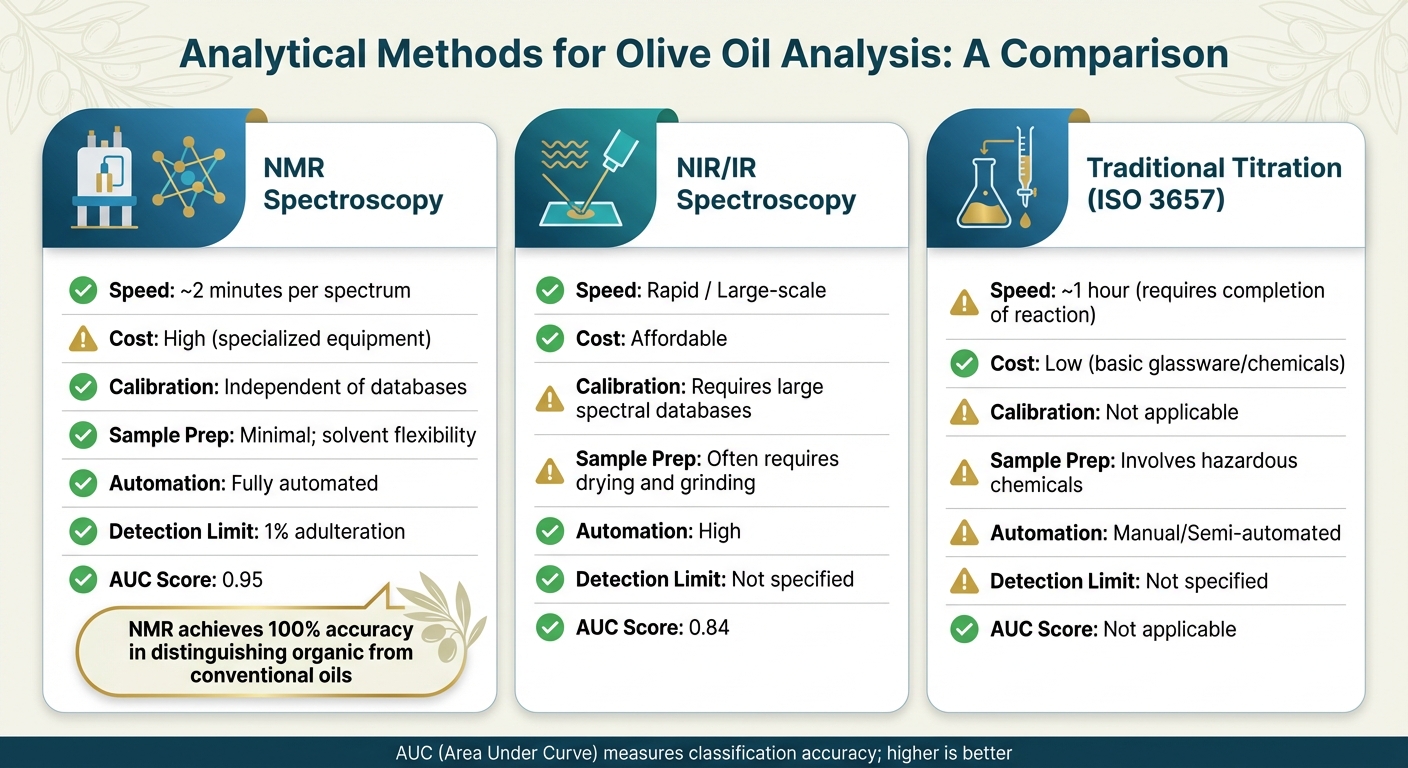
NMR vs NIR vs Traditional Titration Methods for Olive Oil Analysis Comparison
Advantages of NMR
NMR spectroscopy offers a unique ability to analyze various compound types in a single test, bypassing the need for multiple separate analyses. It can detect and quantify a wide range of molecules - charged, neutral, hydrophobic, and hydrophilic - all in one go. For example, it can measure over 15 regulated parameters, such as free acidity and oleic acid content, in one analysis.
What sets NMR apart is the wealth of data it provides. Each compound produces multiple signals, including chemical shifts, multiplicity, and intensity, creating a detailed and precise spectrum. Unlike other methods, it directly calculates quality indices like the Saponification Value with minimal deviation (around 3% from ISO 3657:2013), eliminating the need for extensive calibration databases.
Another strength lies in its reproducibility. Under standardized conditions, NMR ensures consistent chemical shifts, making it possible to automate compound identification using both public and commercial databases. Plus, the process is non-destructive - samples can be recovered by simply evaporating the solvent. For instance, a typical ¹H-NMR fat analysis requires only 200 mg of fat dissolved in 0.6 mL of CDCl₃ and takes about 2 minutes to complete.
While NMR offers these impressive benefits, it’s not without its hurdles.
Challenges and Limitations
The main roadblocks to wider NMR adoption are its high costs and the need for specialized infrastructure. High-field NMR systems (such as 400 MHz units) require significant investment in both equipment and facilities. Additionally, these systems rely on cryogenic gases like liquid helium and nitrogen for cooling, which adds to their operational expenses. As highlighted in a study published in Nature, npj Science of Food:
High-field NMR, however, has a number of drawbacks, such as the requirement of large, dedicated laboratory facilities with costly cryogenic cooling gases, complicated pre-analysis steps, and the need of a highly specialized workforce.
– Nature, npj Science of Food
Interpreting the complex spectra generated by NMR also demands skilled personnel and advanced bioinformatics tools to handle the large volumes of data. Furthermore, compared to other cutting-edge analytical techniques, NMR has relatively lower sensitivity and spectral resolution.
However, recent advancements are easing some of these challenges. Cryogen-free benchtop systems, operating at lower frequencies (e.g., 80 MHz), have emerged as a cost-effective alternative, eliminating the need for cryogenic gases. Modern software, like Bruker FoodScreener, simplifies the process with automated peak picking, allowing even non-experts to generate detailed reports. Machine learning and improved processing methods are also enabling these lower-field instruments to detect adulteration levels as low as 5%. These innovations are paving the way for more accessible and efficient tools to ensure the authenticity of olive oil.
Comparison with Other Analytical Techniques
Understanding the trade-offs between NMR and other methods helps put its capabilities into perspective. While NMR requires a higher upfront investment, its precision and independence from extensive calibration databases give it a clear edge over techniques like NIR and IR spectroscopy.
| Feature | NMR Spectroscopy | NIR / IR Spectroscopy | Traditional Titration (ISO 3657) |
|---|---|---|---|
| Speed | ~2 minutes per spectrum | Rapid / Large-scale | ~1 hour (requires completion of reaction) |
| Cost | High (specialized equipment) | Affordable | Low (basic glassware/chemicals) |
| Calibration | Independent of databases | Requires large spectral databases | Not applicable |
| Sample Prep | Minimal; solvent flexibility | Often requires drying and grinding | Involves hazardous chemicals |
| Automation | Fully automated | High | Manual/Semi-automated |
In 2023, the University of Seville's Research, Technology, and Innovation Center (CITIUS) collaborated with Bruker to implement the FoodScreener NMR system. This effort, led by Miguel Angel Rodríguez-Carvajal, used 400 MHz NMR to establish a reference database for the olive oil industry. Rodríguez-Carvajal shared:
The FoodScreener has provided excellent results whilst providing more detailed analytical data than other methods – in a faster timeframe.
– Miguel Angel Rodríguez-Carvajal, Head of the NMR facility, CITIUS
NMR-based methods have proven highly effective for olive oil classification, achieving an AUC of 0.95, compared to 0.84 for NIR and 0.73 for UV-Vis. Additionally, NMR can detect olive oil adulteration at levels as low as 1%.
Case Studies and Applications
Here’s a closer look at how NMR-based chemometric fingerprinting is being used to verify the quality and authenticity of olive oil.
Bayreuth Rapid Test
In February 2023, researchers from the University of Bayreuth and the National and Kapodistrian University of Athens conducted a study involving 241 EVOO samples from Spain, Italy, and Greece. Using untargeted ¹H NMR metabolite profiling with STOCSY, they identified secoiridoids like oleacein and oleocanthal as key indicators of geographical origin. Their PCA model explained 90.0% of the total variance in the dataset. Maria Halabalaki highlighted that this NMR-based approach could be easily adopted for assessing the quality and authenticity of European EVOOs.
Other cutting-edge techniques have also demonstrated the effectiveness of these methods.
Bruker FoodScreener Case
The Bruker FoodScreener, equipped with Olive Oil Profiling™ software, offers absolute quantitative data without relying on external standards. In April 2025, researchers from the University of Seville and Universidad Nacional de La Pampa analyzed 26 EVOO samples from the IFAPA experimental farm. Their work successfully differentiated organic from conventional Picual and Hojiblanca oils harvested in 2021 and 2022. Using PLS-DA models, they achieved nearly 100% accuracy in both calibration and cross-validation, identifying sterols as the main markers for organic authentication.
Big Horn Olive Oil: Setting the Standard

Big Horn Olive Oil is a prime example of how the industry is applying these scientific advancements to uphold quality. The company uses NMR fingerprinting to verify product authenticity, sourcing Extra Virgin Olive Oils that are cold-pressed within two hours of harvest and delivered within three months. These rigorous practices, supported by advanced NMR spectroscopy, ensure that oils marketed as single-origin - such as Picual or Coratina - are genuinely authentic. This commitment strengthens the trust between producers and consumers, reflecting the high standards the brand maintains.
Conclusion
Main Benefits of NMR for Olive Oil Analysis
NMR spectroscopy has transformed the way olive oil quality is verified. It offers a faster alternative to traditional methods, delivering results in just 15 minutes and requiring minimal sample preparation. Unlike destructive techniques, NMR preserves the sample while analyzing both major and minor compounds.
What sets NMR apart is its non-destructive and untargeted approach, which captures a complete metabolic fingerprint of the oil. This capability is especially useful for identifying new fraud schemes, such as seed oil adulteration at even low levels. When paired with chemometric models like PCA and PLS-DA, NMR achieves 100% accuracy in distinguishing organic from conventional oils and confirming geographical origins. This level of precision paves the way for future advancements, potentially making NMR more accessible to a broader audience.
Future Trends and Developments
The technology behind NMR is advancing rapidly. More affordable 400 MHz benchtop systems are now making routine quality control an option for smaller producers and testing labs. Additionally, new statistical tools like STOCSY (Statistical Total Correlation Spectroscopy) are emerging, allowing for the identification of specific biomarkers like oleacein and oleocanthal without prior assumptions.
Another exciting development is the creation of large-scale reference databases cataloging monocultivar oils from various regions and harvest years. These databases help producers confirm that commercial blends align with their declared attributes, such as bitterness, pungency, and cultivar composition.
"NMR methodology... is a reliable tool that should be adopted in an official way".
With fraudulent practices in the olive oil industry increasing by 87.5% between 2009 and 2019, the need for such rigorous scientific methods has never been greater. These innovations not only protect premium products but also reinforce consumer trust, ensuring that authenticity and quality remain at the forefront of the olive oil supply chain.
FAQs
How does NMR spectroscopy help detect olive oil fraud?
NMR spectroscopy provides a comprehensive molecular breakdown of olive oil, enabling precise verification of its origin and uncovering any adulteration. When paired with chemometric analysis, it becomes sensitive enough to detect even minor fraud, such as the addition of small quantities of seed oil.
What’s more, this approach is non-destructive and dependable, examining distinct molecular traits like relaxation and diffusion behaviors. This ensures both the authenticity and quality of olive oil, making it an invaluable asset for upholding rigorous standards in the industry.
What challenges come with using NMR for olive oil analysis?
Using ¹H-NMR to analyze olive oil comes with its fair share of challenges. For starters, interpreting the intricate spectral data requires advanced chemometric tools like principal component analysis (PCA) and partial least squares discriminant analysis (PLS-DA). These tools aren't exactly plug-and-play - they demand a solid understanding of multivariate statistics and access to reliable, well-tested software.
Another significant obstacle is the need for comprehensive, high-quality reference databases of authentic olive oils. Without these, pinpointing subtle variations in critical components - such as sterols, fatty acids, or phenolic compounds - becomes tricky, undermining the method's precision and dependability.
Consistency across the industry is also a sticking point. To make NMR-based fingerprinting a go-to method for olive oil quality control and traceability, standardized protocols, dependable instrument performance, and thorough cross-laboratory validation are absolutely essential.
How does NMR spectroscopy compare to NIR and IR methods for analyzing olive oil?
NMR spectroscopy offers an incredibly detailed molecular profile of olive oil, making it possible to identify and measure even minor components such as pigments, phenolic compounds, and squalene. These elements play a key role in evaluating the oil's nutritional value, verifying its authenticity, and determining its geographic origin. On top of that, NMR can spot adulteration at levels as low as 10%, all while leaving the sample intact.
On the other hand, NIR and IR spectroscopy are quicker and more budget-friendly options for routine quality assessments. They focus on analyzing major functional groups but fall short when it comes to detecting low-concentration markers, which are crucial for traceability. While NIR and IR are ideal for large-scale screening, NMR stands out for its precision, making it a go-to choice for premium producers like Big Horn Olive Oil to guarantee both authenticity and quality.