

How to Choose Quality Red Wine Vinegar
The right red wine vinegar can elevate your cooking. High-quality options bring depth, balance, and subtle fruity notes, unlike harsh, mass-produced alternatives. Here's how to pick the best:
- Check the Label: Look for simple ingredients - just red wine and water. Avoid additives like caramel coloring or thickeners.
- Acidity Matters: Aim for 5%-7% acidity for a balanced flavor.
- Grape Varietals: Seek specific grapes like Pinot Noir or Sangiovese for nuanced taste.
- Production Process: Terms like "barrel-aged" or "contains the mother" signal careful fermentation.
- Packaging: Choose dark glass bottles to protect flavor; avoid plastic.
- Appearance: Natural hues and slight sediment indicate care, while neon-pink suggests poor quality.
- Smell and Taste: Fruity, wine-like aromas and smooth acidity are ideal. Avoid chemical or overly sharp flavors.
A great vinegar doesn’t need to be expensive. Options like Colavita ($6) or Roland ($4) offer quality on a budget. Store in a cool, dark place to maintain its flavor.
What to Look for on Product Labels
Understanding Acidity Levels
Check the label for an acidity percentage between 5% and 7%. In the U.S., vinegar must have at least 4% acetic acid to qualify as vinegar. However, premium red wine vinegars typically start at 5%, offering a vibrant and balanced flavor. For instance, one well-regarded red wine vinegar maintains 5% acidity and consistently earns high customer reviews.
Interestingly, higher acidity doesn’t always translate to a sharper taste. Edward Behr, founder of The Art of Eating, explains:
"The more aroma there is, the less the acidity is apparent".
Artisanal vinegars aged in wooden barrels often develop rich aromas that soften the sourness, creating what producers describe as "soft acidity". After checking acidity, it’s essential to review the ingredient list to ensure the vinegar’s quality.
Reading the Ingredient List
A good red wine vinegar has a simple ingredient list - just red wine and water. Avoid products that include distilled white vinegar, caramel coloring, thickeners, or artificial additives.
High-quality brands also highlight the grape varietal. Look for specific names like Pinot Noir, Shiraz, Cabernet, Barbera, or Sangiovese instead of generic blends. For example, Colavita Red Wine Vinegar, which costs around $6, is highly rated (10/10 by Sporked) partly because it starts with quality grapes. Food writer Catherine Rickman advises:
"Because red wine vinegar is made from wine, you should act like you're shopping for wine when you pick up a bottle of the sour stuff".
Next, consider the source and production details to further gauge the vinegar’s quality.
Source and Production Information
Examining the label can also reveal how the vinegar was made, which is key to identifying a superior product. Look for mentions of traditional fermentation methods, such as "Orléans method", "slow-fermented", or "barrel-aged." These techniques often take 6 to 8 months - or even longer - to produce vinegar, compared to industrial methods that complete the process in just 16 to 24 hours using oxygen-pumping systems. Some artisanal producers age their vinegar in wooden barrels for up to five years, adding complex, earthy notes.
Terms like "unfiltered", "unpasteurized", or "contains the mother" indicate a naturally developed vinegar. Finally, choose bottles made from dark glass to preserve flavor and avoid plastic, which can leach unwanted chemicals.
How Production Methods Affect Quality
Traditional Fermentation Techniques
The way red wine vinegar is produced has a profound impact on its flavor. Traditional fermentation methods take their time, often stretching over several months, while industrial techniques can complete the process in just 16 to 24 hours with the help of oxygen-pumping turbines. This difference in fermentation speed plays a key role in shaping the final product's flavor profile.
One standout traditional method is the Orléans method, also called static surface fermentation. Here, wine is left to acidify naturally in loosely covered wooden barrels for a period of 6 to 8 months. Some producers take it even further, aging the vinegar in barrels for up to 5 years. This extended aging process adds layers of complexity, introducing fruity richness, woodsy undertones, and a smoother acidity to the vinegar.
On the flip side, industrial fermentation sacrifices these nuanced flavors for speed. As Michael Harlan Turkell, author of ACID TRIP: Travels in the World of Vinegar, puts it:
"This sped-up version of vinegar-making tends to strip away aromas and nuances that were once part of the base ingredient, producing a liquid that's devoid of any real character or backstory".
The "Mother" in Unpasteurized Vinegar
The "mother" in vinegar - a natural colony of acetobacter - is a hallmark of unpasteurized, traditionally made vinegar. Its presence, often seen as cloudiness or sediment in the bottle, signals ongoing flavor development and a natural production process.
Most commercial vinegars, however, are pasteurized and filtered to achieve a clear appearance and longer shelf life. While this makes them visually appealing, it also removes the beneficial bacteria and halts any further flavor evolution. High-quality artisanal vinegars, on the other hand, preserve the mother intentionally. That cloudiness or sediment? It’s proof of a product made with care and authenticity.
Evaluating Appearance, Smell, and Taste
Checking Color and Clarity
The color of red wine vinegar says a lot about its quality. It should reflect the wine it’s made from, ranging from light pink - like some Pinot Noir-based vinegars - to rich, deep-red plum hues. If you notice cloudiness or sediment, don’t worry. These are natural signs of an unfiltered and unpasteurized product, often indicating better craftsmanship.
Joe Sevier, Senior SEO Editor at Epicurious, cautions:
"Avoid any bottle that sports neon-pink vinegar. Some of the samples on our roster were practically the color of Easter eggs and these usually had harsh, lackluster flavor."
For the best quality, go for vinegar stored in dark glass bottles. These protect the vinegar from light, which can degrade its color and flavor, and they also avoid the risk of chemicals leaching from plastic. Once you’ve assessed the appearance, it’s time to evaluate the aroma.
Identifying Desirable Aromas
After examining its look, take a moment to appreciate the vinegar's aroma. High-quality red wine vinegar boasts a fruity bouquet that reflects the wine it originates from. You might also catch hints of floral, woody, or herbal notes. Edward Behr, author and founder of The Art of Eating, explains:
"The more aroma there is, the less the acidity is apparent."
This means a richer aroma profile often balances the vinegar’s sharp acidity, making it more pleasant overall.
Take a sniff. If the vinegar lacks any fruity character or smells like chemicals (think nail polish remover), that’s a red flag for poor quality. On the other hand, vinegar aged in wooden barrels often develops complex woody or oaky notes, adding depth and richness. Conversely, mass-produced options tend to have a flatter, less interesting aroma. Once you’ve evaluated the smell, tasting will reveal the full flavor profile.
Tasting for Balance and Depth
When tasting red wine vinegar, you're looking for harmony - acidity balanced with fruitiness and depth. Michael Harlan Turkell, author of ACID TRIP: Travels in the World of Vinegar, sums it up perfectly:
"A good vinegar should be delicious - a little slurp should make you salivate and want more, not blow out your palate so you can't taste anything else."
The best vinegars offer layers of flavor: notes of grape and berry, a peppery kick, and a touch of natural sweetness to offset the sourness. Depth often comes from tannins and the components found in the grape skins. If the vinegar tastes thin or overly sharp, it could be a sign of low-quality wine or fast, industrial production methods. And if it reminds you of battery acid or cleaning spray, it’s definitely time to find a better bottle.
Warning Signs of Poor Quality
Identifying Spoilage and Defects
Red wine vinegar has a natural resistance to bacterial growth due to its 5%–7% acetic acid content. However, its quality can still deteriorate over time. Watch for visual indicators like drastic color changes or excessive slimy deposits. While high-quality, unpasteurized vinegar often contains natural sediment or the "mother", anything beyond that could signal spoilage.
Pay close attention to the smell as well. If the aroma resembles nail polish remover, cleaning products, or even battery acid, it’s a clear sign of poor quality. Michael Harlan Turkell, author of ACID TRIP: Travels in the World of Vinegar, points out that industrial processing can strip away the complexity of vinegar, leaving behind "an insipid, throat-burning, cough-inducing vinegar that smells like nail polish remover".
Taste is another telltale sign. A rancid, overly sharp, or thin flavor profile often points to low-quality production. Some manufacturers even add caramel coloring, thickeners, or sweeteners to mask these shortcomings. Beyond sensory cues, the way vinegar is packaged and stored also plays a significant role in preserving its quality.
Proper Packaging and Storage
The packaging of vinegar is critical for maintaining its integrity. Avoid plastic bottles, as the acidity can cause chemicals to leach into the vinegar. Plastic packaging is often a red flag for lower-quality products. Similarly, metal containers - unless made from stainless steel - can react with the acid, leading to contamination and unpleasant flavors. As highlighted by Gustiamo:
"Real vinegar needs a dark glass bottle. That's because plastic can leach chemicals, and exposure to light kills flavor over time".
Storage conditions are equally important. Keep vinegar in a cool, dark place, like a pantry, where temperatures range between 50°F and 70°F. Direct sunlight and temperature swings can speed up oxidation, which diminishes the vinegar’s nuanced flavors and aromas. Always make sure the bottle is tightly sealed after each use. Exposure to oxygen can erode the protective acetic acid levels and allow moisture from the air to dilute the vinegar over time.
For best results, once opened, store vinegar in a pantry for 2 to 3 months or refrigerate it for extended freshness, lasting up to 6 to 8 months.
sbb-itb-4066b8e
World's Best Red Wine Vinegar Taste Test
High-Quality vs. Low-Quality Red Wine Vinegar
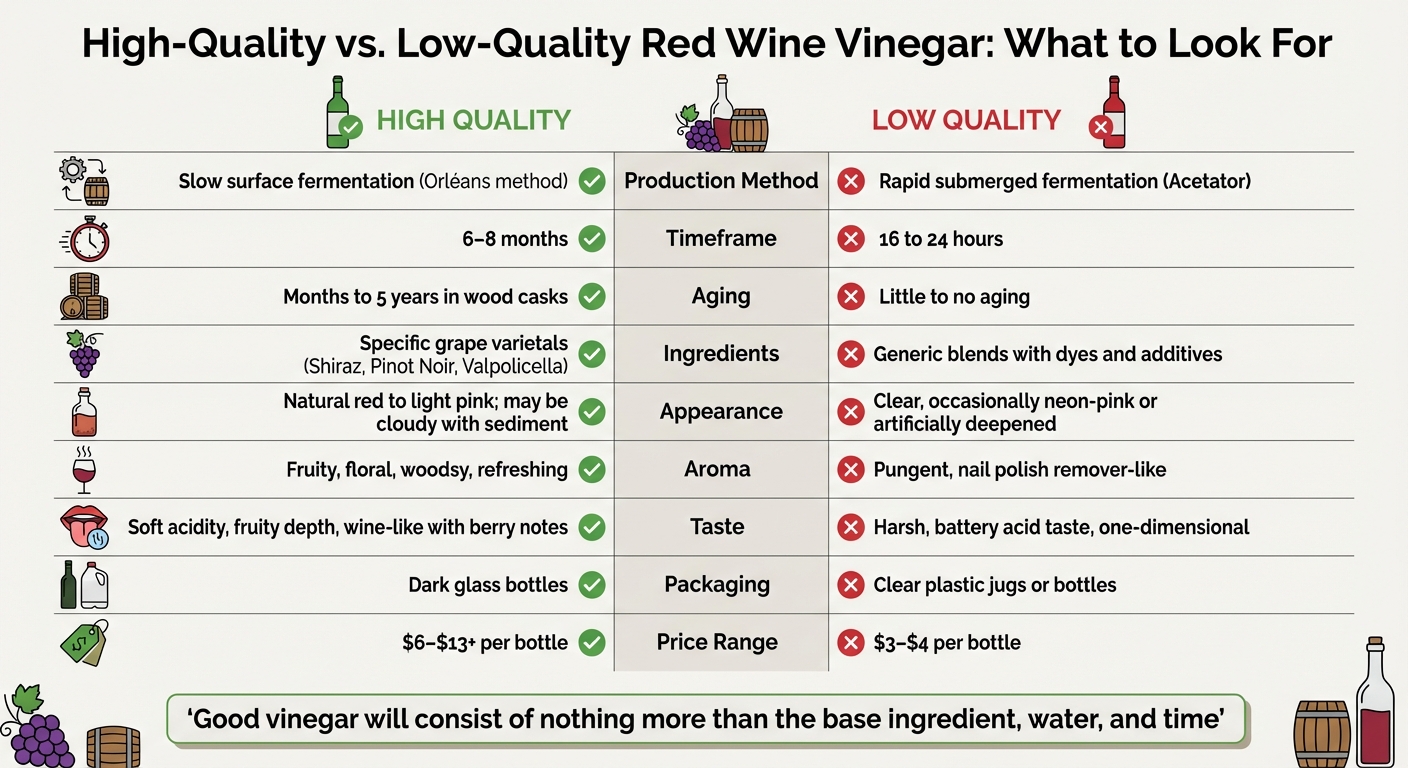
High-Quality vs Low-Quality Red Wine Vinegar Comparison Guide
Quality Comparison Table
Understanding the difference between premium and mass-produced red wine vinegars can help you steer clear of subpar options. Michael Harlan Turkell, author of ACID TRIP: Travels in the World of Vinegar, sums it up perfectly:
"Good vinegar will consist of nothing more than the base ingredient, water, and time".
Traditional methods, like the Orléans process, take their time - 6 to 8 months in wooden barrels - and some artisanal producers even age their vinegar for up to 5 years in oak casks. On the flip side, industrial vinegar is churned out in a mere 16 to 24 hours using oxygen turbines and acetators. This quick turnaround often comes at the expense of complex flavors.
Here’s a quick breakdown of what sets high-quality vinegar apart from its lower-quality counterpart:
| Feature | High-Quality Red Wine Vinegar | Low-Quality Red Wine Vinegar |
|---|---|---|
| Production Method | Slow surface fermentation (Orléans method) | Rapid submerged fermentation (Acetator) |
| Timeframe | 6–8 months | 16 to 24 hours |
| Aging | Months to 5 years in wood casks | Little to no aging |
| Ingredients | Specific grape varietals (Shiraz, Pinot Noir, Valpolicella) | Generic blends often contain dyes and additives |
| Appearance | Natural red to light pink; may be cloudy with sediment | Typically clear, occasionally neon-pink or artificially deepened |
| Aroma | Fruity, floral, woodsy, and refreshing | Pungent, reminiscent of nail polish remover or paint thinner |
| Taste | Soft acidity, fruity depth, wine-like with notes of berries or stone fruit | Harsh, with a battery acid taste that can be one-dimensional or flavorless |
| Packaging | Dark glass bottles | Clear plastic jugs or bottles |
| Price Range | Approximately $6–$13+ per bottle | Around $3–$4 per bottle |
To spot quality vinegar, pay attention to the label. As Gwynedd Stuart, Managing Editor at Sporked, puts it:
"The best tasting red wine vinegar is acidic, yes, but it's also a little sweet and definitely tastes like it began its life as grapes".
If the vinegar tastes harsh or chemically, it's likely of lower quality. Look for labels that highlight grape varietals, natural cloudiness from sediment, and dark glass packaging. These details are your best bet for finding a red wine vinegar worth savoring.
Conclusion
Summary of Key Points
When it comes to quality red wine vinegar, everything boils down to three essential elements: the base ingredient, water, and time. Michael Harlan Turkell captures this perfectly:
"Good vinegar will consist of nothing more than the base ingredient, water, and time".
As we've explored in earlier sections, understanding how to read labels and identify proper production methods is key to finding vinegar that enhances your cooking. Look for labels mentioning grape varietals like Shiraz, Pinot Noir, or Valpolicella, and keep an eye out for natural sediment - a sign of an unfiltered product. Traditional fermentation methods, which take months, yield complex, wine-like flavors, while industrial processes result in harsher, less refined products made in mere hours.
These insights can guide you to make better choices when shopping for red wine vinegar.
Practical Shopping Tips
Here are some practical ways to apply what you've learned and pick a high-quality red wine vinegar. Start by examining the ingredient list. Steer clear of bottles that list distilled white vinegar as a base or include additives like caramel coloring or artificial flavors. Choose vinegar in dark glass bottles rather than plastic - plastic can leach chemicals, and light exposure can compromise the flavor over time.
Pay attention to the vinegar’s color and aroma. Avoid neon-pink hues, which often signal a sharp, flat taste, and instead look for natural rose or deep amber tones. A good vinegar should carry the aroma of the wine it originated from, not a harsh scent reminiscent of nail polish remover or paint thinner.
You don’t need to break the bank to find a great option. Budget-friendly brands like Roland Red Wine Vinegar (about $4 for a 500 mL bottle) and Colavita (around $6 per bottle) prove that quality can be affordable. To preserve your vinegar’s flavor, store it in a cool, dark spot.
Armed with these tips, you'll be ready to choose a red wine vinegar that brings depth and richness to your dishes.
FAQs
What makes red wine vinegar with specific grape varietals a better choice?
Opting for red wine vinegar made from specific grape varieties can transform both the taste and quality of your dishes. These vinegars carry over the distinct traits of the wine they originate from - think fruity undertones, balanced acidity, and a hint of spice. For instance, a vinegar made from Cabernet boasts bold, earthy flavors, perfect for hearty sauces or savory stews. On the other hand, Pinot Noir-based vinegar offers a lighter, more delicate touch, ideal for fresh salads or lighter fare.
Using varietal-specific vinegar also speaks to a higher level of craftsmanship. Producers who focus on particular grape varieties often rely on authentic wine bases and time-honored fermentation techniques. This approach not only preserves the natural antioxidants found in the grapes but also results in a more intricate and layered flavor profile. The result? A vinegar that doesn’t just enhance your recipes - it also brings the added benefit of polyphenols, known for their health-promoting properties.
How does the production process affect the flavor of red wine vinegar?
The way red wine vinegar is made has a huge impact on its taste. Traditional techniques, like aging wine in wooden barrels for months - or even years - allow fermentation to happen slowly. This process develops layers of flavor, with hints of fruit and a smooth, balanced acidity. On the other hand, industrial methods often rely on quick fermentation, which tends to produce a sharper, less refined taste.
The choice of grapes is just as important. Aromatic, high-quality grapes bring depth and richness to the vinegar, while simpler wines result in a more straightforward, acidic profile. If you're after the best flavor, go for red wine vinegar crafted with slow, artisanal methods and top-notch ingredients.
Why should red wine vinegar be stored in dark glass bottles?
Storing red wine vinegar in dark glass bottles is a smart choice for preserving its flavor and quality. Light exposure can degrade the vinegar over time, and dark glass acts as a shield against this. Additionally, using glass prevents any harmful chemicals from leaching into the vinegar - a risk associated with plastic containers. This way, the vinegar retains its freshness and its characteristic taste.