

Climate-Smart Irrigation for Olive Groves
Olive growers are under pressure as rising temperatures and water scarcity disrupt farming practices. The Mediterranean, producing 95% of the world’s olive oil, faces challenges like reduced rainfall, higher evaporation, and extreme heat. These factors are slashing yields - global olive oil production dropped 26% from 2021 to 2024, and prices in the EU jumped 50% in 2024.
The solution? Smarter irrigation techniques. Drip irrigation, soil sensors, and weather-based systems help conserve water, maintain tree health, and improve oil quality. For example, drip systems can boost oil yields from 0.5 tons per hectare in rain-fed groves to 1.6 tons. Combining these tools with regulated deficit irrigation (RDI) and soil management ensures water is used efficiently, even in drought-prone areas.
Key Takeaways:
- Drip Irrigation: Delivers water directly to roots, saving water and increasing yields.
- Precision Sensors: Monitor soil, weather, and tree conditions for real-time irrigation adjustments.
- Regulated Deficit Irrigation (RDI): Reduces water during less critical growth phases, balancing water use and oil quality.
- Soil Management: Improves water retention and prevents runoff with organic amendments and cover cropping.
- Automation: Smart controllers use weather data to optimize irrigation schedules, cutting water use by up to 30%.
These methods are transforming olive farming, helping growers combat climate challenges while sustaining high-quality olive oil production.
ICARDA Olives Irrigation Project Video
sbb-itb-4066b8e
Drip Irrigation Systems: A Water-Saving Solution
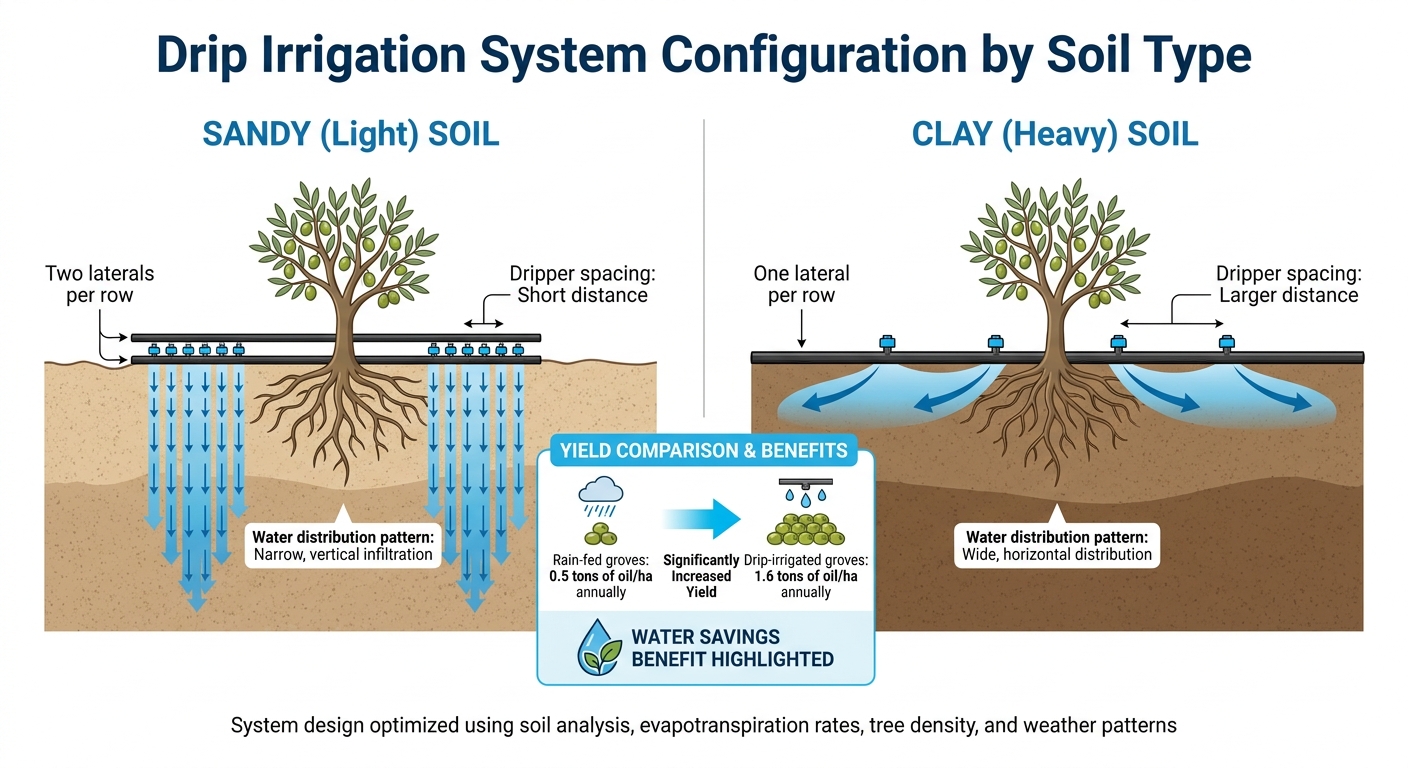
Drip Irrigation Configuration Guide for Different Soil Types in Olive Groves
How Drip Irrigation Works
Drip irrigation delivers water and nutrients directly to the root zone through a network of valves, pipes, and emitters (drippers). Instead of flooding fields or spraying water overhead, this system ensures precise delivery right where it's needed most - the roots.
The setup depends on soil texture. For sandy soils, two laterals with closely spaced drippers are used to accommodate the narrow, vertical water infiltration. On heavy clay soils, a single lateral with wider dripper spacing is sufficient, as water spreads horizontally across a larger area.
| Soil Type | Lateral Configuration | Dripper Spacing | Water Distribution Pattern |
|---|---|---|---|
| Sandy (Light) | Two laterals per row | Short distance | Narrow, vertical infiltration |
| Clay (Heavy) | One lateral per row | Larger distance | Wide, horizontal distribution |
The system design is fine-tuned using data like soil analysis, evapotranspiration rates, tree density, and local weather patterns. This precision ensures efficient water delivery and minimizes waste. Additionally, drip irrigation incorporates fertigation, which directly injects liquid fertilizers into the water supply. This method concentrates nutrients near the root zone, promoting healthy growth and reducing fertilizer runoff.
By targeting water and nutrients exactly where they’re needed, this system not only saves water but also boosts productivity in olive groves.
Benefits for Olive Groves
With climate change intensifying water scarcity, drip irrigation has become a game-changer for olive growers. It significantly reduces water use while increasing yields. For example, olive groves using drip systems can produce around 1.6 tons of oil per hectare annually, compared to just 0.5 tons in rain-fed groves.
Drip irrigation also minimizes evaporation and avoids over-watering, which can damage roots. Well-irrigated olive trees maintain pre-dawn leaf water potential above -0.50 MPa, while unirrigated trees can drop below -1.60 MPa. This stable moisture level allows trees to keep photosynthesizing and producing oil, rather than activating drought-survival mechanisms that halt production.
The system has also enabled the shift to intensive orchards, which can host 300 to over 2,000 trees per hectare, compared to the traditional 100. These dense plantings feature trees with shallower root systems that are more susceptible to water stress. In high-density setups, trees are spaced as closely as 1.6 feet to 8.2 feet apart, with rows 10 to 15 feet wide.
To ensure consistent water distribution across these orchards, professional hydraulic designs take into account factors like water quality, topography, and elevation. This ensures uniform pressure and flow, even in large groves.
Precision Irrigation with Sensor-Based Technology
Types of Sensors and Their Functions
Modern olive groves rely on advanced sensors to keep tabs on both environmental and tree-specific conditions. Soil moisture sensors measure water levels directly in the root zone, ensuring trees get just the right amount of hydration. Weather stations track key atmospheric factors like temperature, humidity, and evapotranspiration, providing a broader context for irrigation decisions. But the real game-changer? Plant-based sensors, which give direct feedback from the trees themselves.
For instance:
- Sap flow sensors monitor how water moves within a tree’s vascular system, offering insights into transpiration.
- Dendrometers detect subtle changes in trunk diameter, which can signal hydration levels.
- Leaf turgor pressure sensors measure internal leaf pressure, providing early warnings of dehydration.
"Evidence shows the great potential of plant-based methods as compared to those using measurements of soil water status or atmospheric demand." - José Enrique Fernández, Research Professor at CSIC
When combined with remote sensing imagery from satellites or drones, these sensors provide a complete picture of grove conditions. This approach captures spatial variability across large orchards, allowing for precise adjustments in irrigation based on real-time data.
Improving Efficiency with Data-Driven Insights
In 2025, researchers Luca Preite and Gianluigi Ferrari from the University of Parma unveiled an IoT framework that hit a 97% accuracy rate in predicting soil water content using an MLP Neural Network. This kind of precision gives growers the ability to forecast irrigation needs before trees even start to show signs of stress.
Regulated Deficit Irrigation: Balancing Yield and Water Use
What Is Regulated Deficit Irrigation?
Regulated Deficit Irrigation (RDI) is a method that carefully adjusts water supply to match the specific needs of trees throughout their growth cycle. It combines well with other water-saving techniques by delivering full irrigation during critical growth stages and reducing water during less sensitive periods.
For olive trees, water needs vary depending on the growth phase. Proper irrigation is essential during flowering, fruit set, and oil accumulation. However, during the pit hardening phase - typically from mid-June through late August in the Northern Hemisphere - trees are more drought-resistant, allowing for reduced watering during this time.
To fine-tune these adjustments, growers use tools like Stem Water Potential (SWP) readings to monitor water stress. For table olives, an SWP of around -2 MPa during pit hardening is ideal. Severe stress, such as SWP levels below -3.5 MPa, can lead to excessive fruit drop and smaller fruit size.
This careful management of irrigation provides measurable advantages, though it also comes with specific challenges.
Benefits and Challenges of RDI
RDI, much like drip irrigation and precision sensor technology, relies on data and timing to achieve efficient water use while maintaining yields and quality. Research highlights its effectiveness, with water savings of 25–30% in conventional orchards and up to 72% in super-high density groves. Yield reductions in these scenarios range from 10–15% in traditional setups to 26% in high-density systems.
Interestingly, moderate water stress doesn't just conserve water - it can also improve oil quality by boosting beneficial compounds. For table olives, employing moderate RDI during pit hardening has been shown to enhance flavor and texture.
However, timing is everything. If deficits are applied at the wrong stage, the consequences can be significant. For example, a study led by María Gómez-del-Campo at the Agrícola La Veguilla orchard in Spain revealed that early summer deficits (from the end of fruit drop to late July) saved 16% of water with only an 8% loss in oil production. On the other hand, late summer deficits during August led to a 21% drop in oil production while saving just 22% of water. This underscores the importance of avoiding stress during oil synthesis, a critical period for the trees.
Improving Water Retention with Soil Management
Getting the most out of advanced irrigation systems hinges on improving the soil's ability to hold water effectively.
Soil Amendments for Better Water Retention
Even the best irrigation techniques won’t work if the soil struggles to retain water. Organic matter plays a key role here, but Mediterranean soils naturally lack it due to fast decomposition caused by the warm climate. Adding organic amendments regularly can boost the soil's moisture-holding ability, encourage helpful microorganisms that shield roots from diseases like Verticillium, and release hormone precursors that enhance tree metabolism. However, the quick breakdown of organic matter in calcareous soils common to the Mediterranean means these amendments need to be replenished often. Mulching around the base of trees can also help, as it not only reduces surface evaporation but gradually enriches the soil with organic material over time.
Once the soil can hold moisture better, the next challenge is ensuring that water stays in place long enough for the trees to use it.
Preventing Soil Erosion and Runoff
Improving soil infiltration is key to minimizing runoff and erosion, especially in hilly olive groves with low stone content. When water flows off the surface instead of soaking into the ground, olive trees lose out on much-needed moisture - an even bigger issue in dry farming systems that depend entirely on rainfall. Two proven methods to enhance infiltration are cover cropping and deep tilling. Cover crops help stabilize slopes and improve water absorption, while deep tilling breaks up compacted soil layers, making it easier for roots to access water.
"Soil type plays a major role: trees planted in sandy soils need more frequent watering than those in clay soils because sand drains quickly and holds less moisture" - The Olive Centre
This insight highlights the importance of tailoring water management practices based on soil type. For sandy soils, more frequent irrigation is necessary to maintain adequate moisture. Additionally, controlling weeds is crucial to reduce competition for the stored water.
Integrating Weather Data and Irrigation Automation
Once you’ve optimized soil to retain water, the next step is ensuring irrigation happens at just the right time. This is where combining advanced weather data with automation can make a big difference.
Using Weather Data for Irrigation Scheduling
Weather forecasts help growers avoid overwatering by irrigating only when necessary. A key factor here is evapotranspiration (ET), which measures how much water is lost through soil evaporation and plant transpiration. On days when ET is high, olive trees need more water. Conversely, when rain is expected, irrigation can be paused. This approach can save between 20–30% of water compared to fixed schedules.
In California, growers have access to free tools like the CIMIS (California Irrigation Management Information System). Elsewhere in the U.S., NOAA weather APIs offer 7- to 14-day forecasts. By integrating these forecasts with ET-based models, irrigation schedules can be adjusted automatically. For instance, a study in a California olive grove showed water savings of 15–25% by stopping irrigation before forecasted rain. Beyond conserving water, keeping soil moisture at optimal levels - usually 50–70% of field capacity for olive trees - can reduce stress-related alternate bearing and even increase yields by up to 10%.
These strategies set the stage for automation tools that take irrigation management to the next level.
Automation Tools for Olive Groves
To complement weather-driven scheduling, advanced automation tools integrate sensor data for even more precise control. Smart irrigation controllers eliminate manual scheduling by making automatic adjustments. Systems like Rain Bird IQ Cloud and Hunter Hydrawise connect to local weather stations via Wi-Fi. They adjust valve timings based on real-time ET data and rainfall forecasts. Using olive-specific crop coefficients (typically 0.5–0.7 for full canopy cover), these systems calculate water needs and send alerts through mobile apps when changes are made.
In 2021, the Olive Center at UC Davis tested a weather-integrated automation system in a 50-acre grove in Coalinga, California, under the guidance of researcher Louise Ferguson. By linking Rain Bird controllers to the CIMIS weather network for daily ET updates, the grove saw impressive results: water use dropped by 28% (from 36 to 26 inches per season), yields increased by 12% to 4.2 tons per acre, and oil quality improved by 18%.
Similarly, from June to October 2023, the Spanish cooperative DCOOP in Jaén used Netafim's NetBeat automation system across 200 hectares (around 495 acres). Led by agronomist Miguel López, the integration of soil sensors with weather forecasts cut water use by 32% - saving approximately 650 m³ per hectare (around 9,300 ft³ per acre) - while maintaining yields at about 7.5 tons per hectare (roughly 3.0 tons per acre).
For U.S. growers, the USDA NRCS EQIP program can now cover up to 75% of the costs for smart irrigation systems, with grants of up to $75,000 per farm. This makes adopting these advanced tools more affordable than ever.
At Big Horn Olive Oil, we utilize these cutting-edge, weather-driven automation techniques to ensure the health of our olive trees and consistently produce Ultra Premium Extra Virgin Olive Oils of outstanding quality.
Implementation and Monitoring Best Practices
Planning and Installation Tips
Start with a detailed evaluation of your site. Soil type plays a huge role in irrigation needs - sandy soils drain quickly, requiring more frequent watering, while clay soils hold onto moisture much longer. If your area experiences hot, sunny summers, olive trees will naturally need more water to thrive. To improve efficiency, consider upgrading from traditional sprinklers to systems like micro-sprinklers or drip irrigation. These modern systems deliver water more precisely where it's needed.
When planning, factor in variables like tree age, canopy size, and local evapotranspiration rates. Using crop coefficients - typically between 0.5 and 0.7 for mature olive trees - can help you create a well-informed irrigation schedule based on data.
"Optimised irrigation is critical for balancing olive tree water stress, yield and oil quality"
- Dr. Giulia Marino
After installation, consistent monitoring becomes key to keeping your irrigation system running effectively.
Monitoring and Maintenance
To ensure your system continues to function optimally, leverage advanced sensors for continuous monitoring. Plant-based sensors, for example, can provide real-time updates on water status. For larger orchards, you can combine ground-based sensors with satellite or drone imagery to get a broader picture of your grove's health. Many modern systems also offer smartphone or tablet apps that make it easier to interpret sensor data and adjust irrigation schedules accordingly.
This combination of technology and regular oversight helps maintain efficiency and ensures your olive trees get the water they need without waste.
Conclusion
Key Takeaways for Growers
The advanced irrigation methods discussed earlier are critical for maintaining thriving olive groves, especially in the face of shifting climate conditions. Smart irrigation practices not only protect the health of olive trees but also play a major role in determining the quality of olive oil. Factors like olive water content during pressing directly impact flavor, shelf life, and nutritional value, making careful water management essential throughout the growing season.
"Meticulous irrigation management is a cornerstone of producing high-quality extra virgin olive oil with desirable flavor profiles, robust polyphenol content, and low acidity."
- Adolfo Levin, Chief Agronomist, Rivulis
As emphasized by experts, precise irrigation is key to achieving the desired polyphenol levels and maintaining low acidity in olive oil. Using tools like sensors and weather data ensures water is applied exactly when and where it’s needed. However, overwatering - especially close to harvest - can lead to bruising and fermentation, potentially compromising the oil’s Extra Virgin designation.
To create resilient and high-quality olive groves, growers should integrate drip irrigation, sensor-driven insights, regulated deficit irrigation, and smart soil management. These investments yield multiple benefits: reduced water waste, enhanced oil quality, and healthier trees that can better withstand environmental stresses.
Finally, remember that specific olive varieties, such as Picual and Arbequina, require customized water management strategies to achieve their best quality. Modern irrigation tools provide the data needed to fine-tune these strategies year after year, ensuring sustainable and efficient grove management.
FAQs
How do I know if my grove should use one or two drip lines per row?
When deciding whether to use one or two drip lines per row, think about the size of your trees, their root zones, and the soil conditions in your grove. Larger trees with widespread root systems often benefit from two drip lines, as this helps distribute water more evenly. On the other hand, smaller trees might only require a single line to meet their needs. Regularly check soil moisture levels and observe your trees' health to ensure your irrigation setup is working effectively.
Which sensor type provides the most reliable early warning of olive tree water stress?
The best way to detect early signs of water stress in olive trees is by continuously monitoring leaf turgor, fruit growth, and sap flow. These indicators are excellent for spotting even mild water stress, allowing for timely action to maintain tree health and save water.
When should I reduce irrigation with regulated deficit irrigation without hurting oil quality?
During the summer, reduce irrigation during the deficit-irrigation period, which typically spans from the end of fruit drop to late July - right before oil synthesis begins. This approach helps manage water stress efficiently while preserving the quality of the oil.