

COOC Seal: Standards and Requirements
If you want the short answer: the COOC Seal means a specific lot of olive oil was made from 100% California olives, mechanically extracted, and passed both lab tests and a blind taste panel.
In other words, I’d treat the seal as a checked claim, not just bottle design. To qualify, the oil must meet tight chemistry limits like free acidity under 0.5% and peroxide value under 15 meq O₂/kg, and it must also score 0.0 median defects with fruitiness above 0.0 in sensory review.
Here’s the whole point in a few bullets:
- Origin rule: the oil must come from 100% California-grown olives
- Production rule: it must be mechanically extracted, with no refining and no solvents
- Label rule: origin wording must match the lot, including 85% for a named region and 95% for a named estate
- Chemistry rule: every tested value must stay inside COOC limits
- Taste rule: the oil must show no sensory defects
- Lot rule: the seal applies to a specific certified lot, not every bottle a brand sells
- Timing rule: producers submit during November 1 through March 31
- Membership rule: producers must be COOC members to apply
I’d sum it up like this: the seal is a year-by-year check on where the oil came from, how it was made, and whether it still qualifies as extra virgin when tested.
| Area | What COOC checks |
|---|---|
| Origin | 100% California olives |
| Extraction | Mechanical only; no refining or solvents |
| Core lab limits | FFA < 0.5%, PV < 15, K232 < 2.40, K270 < 0.22, ΔK < 0.01 |
| Extra tests for larger producers | MOI < 0.2%, INI < 0.1%, DAGs > 35%, PPP < 17%, induction time testing |
| Sensory standard | Median defect = 0.0 and median fruitiness > 0.0 |
| Scope of approval | One certified lot only |
If I were buying, I’d read the COOC Seal as a simple shelf signal: this lot cleared both chemistry and tasting. If I were producing, I’d read it as a strict lot-by-lot standard that starts at harvest and ends with label use.
Eligibility Requirements for COOC Seal Certification
A lot has to clear a few baseline rules before lab or sensory testing even starts.
100% California Olives and Mechanical Extraction
The lot must be 100% California-grown. If any part of the oil comes from outside California, that lot can't carry the COOC Seal.
The oil also needs to be mechanically extracted, with no solvents and no refining. Olives should be milled soon after harvest, ideally within 24 hours, to help protect quality.
Those origin rules also shape the claim that can legally appear on the bottle.
California, Region, and Estate Labeling Rules
The label's origin claim has to match what's in the lot. To keep those claims accurate, the COOC uses a tiered threshold system:
| Label Claim | Minimum Required Origin |
|---|---|
| "California" | 100% California olives |
| Named California region (e.g., "Sonoma", "Central Coast") | At least 85% from that region |
| Named California estate (e.g., "Estate Grown") | At least 95% from that estate |
After that, certification comes down to traceability, membership, and whether the finished product still counts as a qualifying lot.
Lot Certification, Membership, and Blend Limits
Once origin and processing are set, the COOC reviews each lot's records and the producer's membership status.
Each lot needs traceability records and a representative test sample. If a producer bottles more than one lot under the same brand, the Seal can appear only on bottles from the certified lot. If the oil is later blended or topped up, it becomes a new product and needs its own certification before the Seal can be used.
Producers must be COOC members in good standing and follow the group's labeling, seal-use, and compliance rules. Blends that include foreign oil, refined oil, or flavorings are not eligible. Even when a blend starts with a COOC-certified California extra virgin as its base, the finished blended product still doesn't qualify for the Seal.
sbb-itb-4066b8e
Chemical Testing Standards the Oil Must Pass
Once a lot clears the first screening, it moves to a COOC-approved lab. There, the oil goes through a chemical test panel, and every result has to land within COOC’s limits. This is the part that checks fruit condition, milling quality, and oxidation. In simple terms: getting into the lab matters, but passing the chemistry is what keeps the lot moving.
Free Acidity, Peroxide Value, and UV Absorbency Limits
Five core parameters apply to every producer, no matter how much oil they make.
Free acidity (FFA) shows the share of free fatty acids in the oil, expressed as oleic acid. COOC requires free acidity below 0.5%. That’s stricter than the extra virgin limit of 0.8% used by the IOC, EU, and USDA. When FFA is high, it often points to damaged olives or poor sanitation during milling. When it’s well under 0.5%, that usually means the fruit was in good shape.
Peroxide value (PV) measures early oxidation. Put simply, it shows how far the oxidation process has gone. A PV below 10 is common in fresh oils, while values near 15 point to more exposure to air, heat, or light.
The UV absorbance values - K232, K270, and Delta K - pick up oxidation that the peroxide test may miss. They can also help spot possible adulteration.
| Parameter | COOC Limit | What It Measures | Why It Matters |
|---|---|---|---|
| Free Acidity (FFA) | Less than 0.5% | The percentage of free fatty acids in the oil, a primary indicator of olive fruit health and processing hygiene | Higher values usually mean damaged fruit, poor sanitation, or a long delay before milling |
| Peroxide Value (PV) | Less than 15 meq O₂/kg | Early-stage oxidation | Higher values point to more oxidative stress from air, heat, or light |
| K232 | Less than 2.40 | Oxidative compounds that absorb ultraviolet light at 232 nm, mostly primary oxidation | Elevated levels suggest poor storage or processing |
| K270 | Less than 0.22 | Secondary oxidation products and conjugated trienes | Values near the limit suggest advanced breakdown, even if the oil still smells fine |
| Delta K (ΔK) | Less than 0.01 | A calculated UV comparison used to detect refining or adulteration | A low value supports that the oil is genuinely extra virgin |
Added Tests for Producers Above 5,000 Gallons Per Year
Producers making more than 5,000 gallons per year must meet five extra parameters. These tests look at purity and how well the oil is likely to hold up over time.
Moisture and volatiles (MOI) must stay below 0.2%. Leftover water speeds up rancidity. Insoluble impurities (INI) must be below 0.1%. Sediment may speed oxidation and spoilage.
DAGs (diacylglycerols) must be above 35%. Fresh oil naturally has a higher share of 1,2-DAGs, but that balance shifts as the oil ages or sits in warm conditions. If the DAG result drops below 35%, the oil may be old, poorly stored, or adulterated.
PPP (pyropheophytins) must stay below 17%. PPP are heat-related breakdown products of chlorophyll. High PPP can mean the oil was deodorized, refined, or is simply old. Research shows PPP can increase by at least 0.6% per month under normal storage conditions.
Induction time, measured with a Rancimat test at 230°F (110°C), shows how well the oil resists oxidation. COOC uses this result, along with PPP increase and DAG decline rates, to support science-based best if used by date guidance.
Taken together, these tests show whether the lot still has the freshness needed to qualify.
How to Read Lab Results in Plain Terms
Lower numbers across the oxidation markers, plus a stronger induction time, usually point to better handling and a longer shelf life.
Chemical compliance is only one gate. The sensory panel still has to approve the lot.
Sensory Standards and the COOC Certification Process
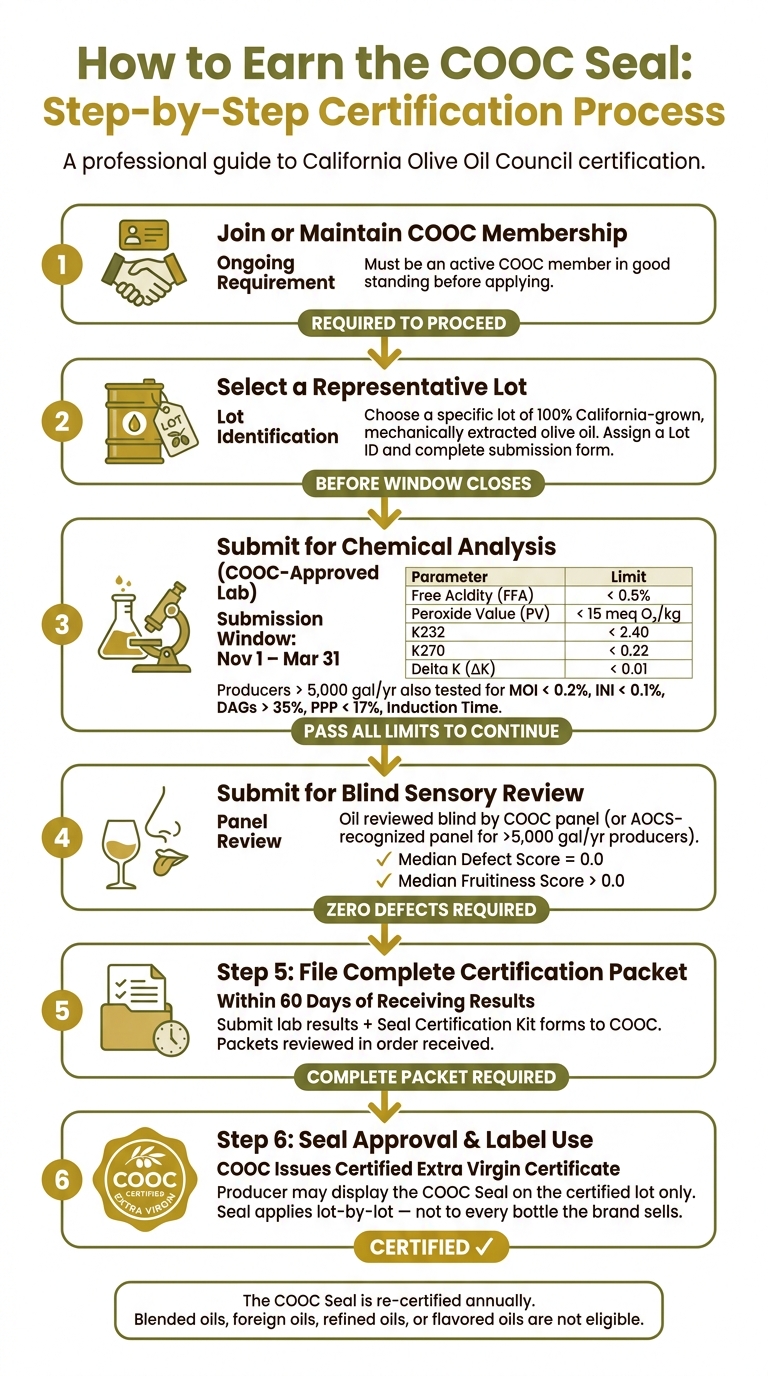
COOC Seal Certification Process: From Harvest to Approval
Once a lot clears lab testing, it still has one more hurdle: a blind sensory review decides whether it earns the Seal. Lab work tells you what can be measured. The tasting panel tells you what’s actually in the glass.
Sensory Panel Standards: No Defects and Positive Fruitiness
The COOC sensory standard is simple: the median defect score must be 0.0, and the median fruitiness score must be greater than 0.0. If the panel finds any recognized defect, the lot fails. Tasters review oils blind, so they don’t know which producer made the sample.
Here are the main defects that can knock out a lot:
| Defect | What It Smells or Tastes Like | Typical Cause |
|---|---|---|
| Fusty-muddy | Fermented, swampy, or muddy | Olives piled in heaps or left in bags or bins before milling; fermentation begins during storage delays |
| Musty-humid-earthy | Moldy, earthy, cellar-like | Ground-picked fruit; humid or dirty storage; mold or yeast growth |
| Winey-vinegary | Vinegar-like, fermented | Poor handling, dirty equipment, or fermentation before milling |
| Rancid | Stale, cardboard, old nuts | Oxidation from air, light, heat, or long storage |
| Metallic | Sharp, metallic aftertaste | Contamination during processing or storage |
A passing oil should show a fresh fruity aroma and flavor, a clean olive character, and balanced bitterness and pungency, without off-notes.
Harvest Timing, Milling Temperature, and Flavor Protection
Harvest timing and milling practices have a direct effect on sensory results. Milling olives within about 24 hours of harvest helps cut the risk of defects. If olives sit in bins or bags for several days, they can ferment and heat up. That makes fusty and winey notes much more likely.
Temperature during malaxation also matters. Keeping the olive paste at or below 86°F (30°C) helps protect the volatile aroma compounds that give fresh oil its fruitiness. Push the temperature higher, and you may get more yield, but you also lose flavor and speed up oxidation. That’s not what a blind tasting panel wants to find.
From Sample Submission to Seal Approval
The yearly submission window runs from November 1 through March 31. Producers have to be COOC members before they can take part. Then they choose a representative lot, send samples to a COOC-approved chemical lab, and submit oil for blind sensory review through the COOC panel, or through an AOCS-recognized panel if they produce more than 5,000 gallons per year.
| Step | Responsible Party | Key Documentation | Timeline | Pass/Fail Criteria |
|---|---|---|---|---|
| Join or maintain COOC membership | Producer | Membership records | Ongoing | Must be an active member |
| Select and identify representative lot | Producer | Lot ID and submission form | Before window closes | Sample must represent the certified lot |
| Submit for chemical analysis | Producer / approved lab | Lab submission paperwork | Nov. 1–Mar. 31 | Must meet all COOC chemical limits |
| Submit for blind sensory review | Producer / COOC or AOCS panel | Sensory results | Same certification cycle | Median defect score = 0.0; median fruity > 0.0 |
| File complete certification packet | Producer | Lab results + Seal Certification Kit forms | Within 60 days of receiving results | Packet must be complete; reviewed in order received |
| Seal approval and label use | COOC issues; producer applies | Approved certification record | After successful review | Oil may display COOC Seal on the certified lot |
If the lot passes both the chemical and sensory checks, COOC issues a Certified Extra Virgin Certificate, and the producer can use the Seal on that certified lot.
What COOC Standards Mean for Buyers and Producers
Once an oil passes testing, the seal becomes a simple sign that its origin and quality have been checked. The COOC Seal verifies California origin and extra virgin quality. To qualify, an oil must come from 100% California-grown olives and pass COOC chemical and sensory testing.
For buyers, that matters because a technical review turns into a practical signal on the shelf. Instead of relying only on label wording, shoppers get an independent check on where the oil comes from and whether it meets extra virgin standards. The seal is also certified every year, which keeps freshness tied to the process.
For producers, earning the seal reflects careful work from harvest through bottling. Passing COOC testing depends on disciplined harvest and milling practices. Label rules also need to line up with the oil’s actual origin:
- If a package uses California origin language, the oil must be made from 100% California-grown olives.
- If it names a specific region, at least 85% of the oil must come from that region.
- If it names a specific estate, all of the olives must come from that estate.
FAQs
How do I verify a bottle is from a certified lot?
Look for the official COOC seal on the bottle or packaging. That seal means the oil passed annual chemical and sensory testing.
It also helps to check for a harvest date. Under COOC standards, certified oils need full traceability from grove to bottle. They also must come from the most recent harvest and be made from 100% California-grown olives.
Why are COOC limits stricter than standard extra virgin rules?
The COOC uses tighter limits than international standards to help make sure certified oils are fresh, pure, and free of defects.
For example, it sets a maximum free acidity of 0.5% instead of 0.8%. Paired with strict chemical checks and required sensory testing, these standards give consumers confidence that the oil is genuine and unadulterated.
Can a flavored or blended oil qualify for the COOC Seal?
No. The California Olive Oil Council (COOC) Seal is reserved for 100% pure extra virgin olive oil with no additives or blends.
To qualify, the oil must pass chemical analysis and sensory evaluation, and it must be made from California-grown olives.