

Cover Cropping vs. Bare Soil in Olive Groves
Which soil management approach works best for olive groves - cover cropping or bare soil? Here's what you need to know:
-
Cover Cropping Benefits:
- Reduces soil erosion by up to 89%.
- Increases water retention and organic carbon levels.
- Improves soil structure and biodiversity.
- Retains key nutrients like nitrogen, phosphorus, and potassium.
- Supports long-term soil health and olive oil quality.
-
Bare Soil Management:
- Easier to implement with lower short-term costs.
- Reduces competition for water and nutrients, especially in young trees.
- Leads to higher erosion, nutrient loss, and long-term soil degradation.
-
Key Trade-Offs:
- Cover crops require upfront investment, labor, and careful timing to avoid water competition.
- Bare soil systems may simplify operations but harm long-term productivity.
Quick Comparison:
| Aspect | Cover Cropping | Bare Soil Management |
|---|---|---|
| Soil Erosion | Low (0.3–2 tons/acre) | High (6–12 tons/acre) |
| Water Retention | High | Low |
| Nutrient Loss | Minimal | Significant |
| Cost | Higher upfront | Lower upfront |
| Long-Term Soil Health | Improved | Degraded |
Bottom Line: Cover cropping builds healthier, more resilient groves over time, while bare soil management offers short-term simplicity but risks long-term damage. Choose based on your grove's layout, water availability, and erosion risks.
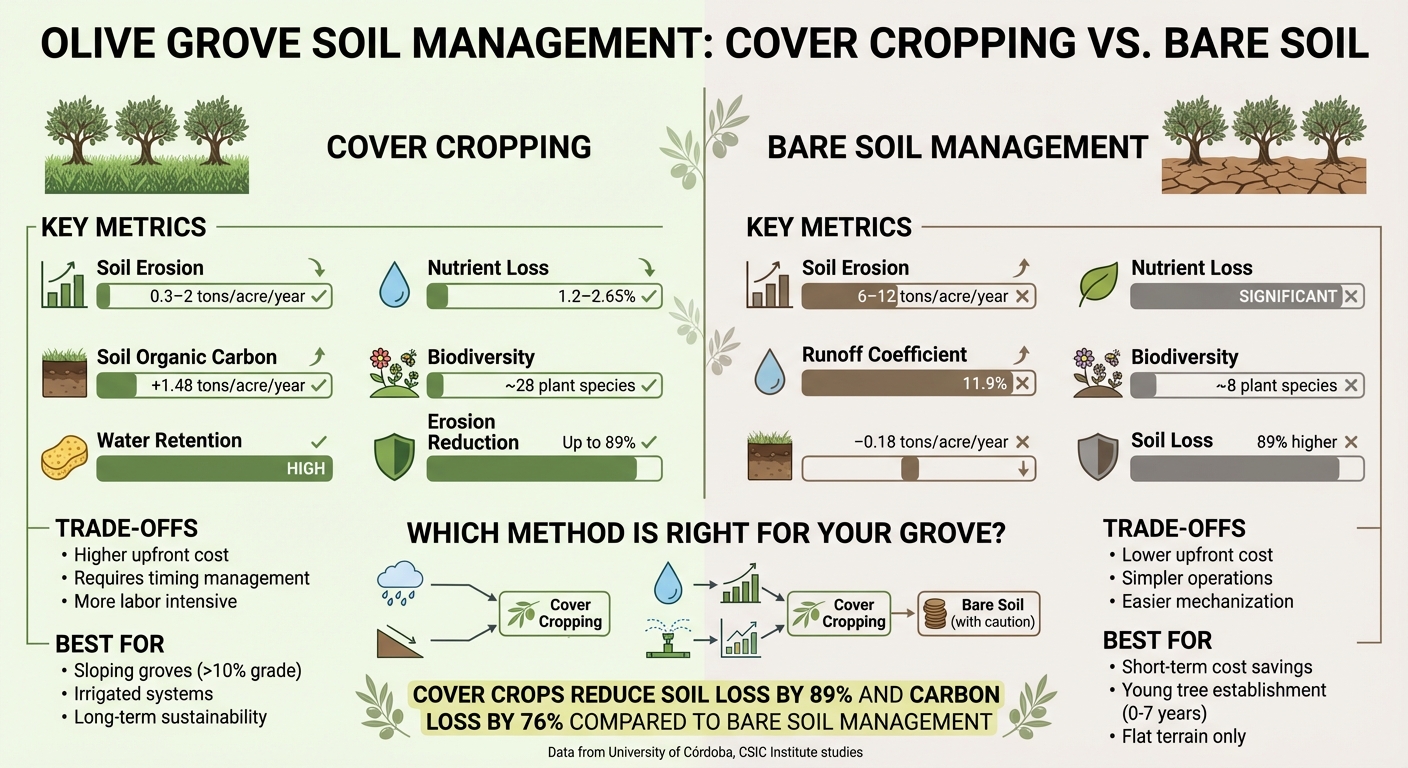
Cover Cropping vs Bare Soil Management in Olive Groves: Performance Comparison
How Native Grasses are Boosting an Olive Grove
sbb-itb-4066b8e
What is Cover Cropping?
Cover cropping involves planting vegetation between rows of olive trees, not for harvest but to protect and enrich the soil. In Mediterranean regions, growers typically sow these crops in the fall and maintain them through the winter, a season marked by high rainfall and erosion risks. These plants act as a protective layer, shielding the soil from raindrop impact, improving its structure with their roots, and contributing organic matter as they break down.
Timing is critical for effective cover cropping. Growers terminate the crops in early spring - usually between late March and April - to prevent them from competing with olive trees for water and nutrients during the vital blooming period. This process repeats annually, with some growers leaving a narrow strip (about 3 feet wide) unmowed to allow the crops to self-seed for the next season.
Olive growers use three main layout strategies for cover cropping. The between-canopy cover approach plants crops in the alleys between tree rows, leaving the area directly under the canopy clear to avoid competition, often through herbicide use. The whole cover strategy blankets the entire orchard floor, offering maximum erosion protection and carbon storage. Lastly, the canopy-clean cover method removes vegetation under the trees to make harvesting easier and reduce moisture stress. These varied strategies provide a flexible alternative to the rigid management required in bare soil systems.
Choosing the right species is equally important. Legumes like vetch and peas help fix nitrogen from the atmosphere, while grasses such as barley and oats produce dense biomass to suppress weeds and control erosion. Crucifers like white mustard grow quickly and are excellent at reducing runoff. Many growers opt for mixtures - such as faba beans and barley - to enhance soil microbial diversity and extend the flowering period for pollinators and other beneficial insects. This careful selection boosts soil health and supports the overall vitality of olive groves.
Trials have demonstrated the effectiveness of cover cropping. Between 2021 and 2022, the CSUC Center for Regenerative Agriculture tested a 12-variety cover crop mix at an olive grove in Artois, California, applying 70 pounds per acre. Over two years, they observed improved soil stability and reduced compaction. Similarly, a trial in Messinia, Greece, from 2022 to 2024 used a mix of peas, faba beans, and barley, increasing soil organic carbon concentration to 1.36% compared to 0.95% in herbicide-treated bare soil plots. These findings highlight how cover cropping supports sustainable and biodiverse olive grove management.
Benefits of Cover Crops
Cover crops offer numerous advantages beyond erosion control. In a 2023 study, Francisco Márquez from the University of Córdoba analyzed eight olive plantations in Andalusia, Spain, over four years. His research revealed that cover crops provided 65.7% soil coverage compared to just 22.4% in tilled plots, resulting in a 76.4% decrease in soil organic carbon loss due to sediment.
"We concluded that ground cover not only reduces erosion and runoff, but also losses of organic carbon in soil, by three quarters compared to tillage."
– Francisco Márquez, Researcher, University of Córdoba
Over an eight-year study in sloping olive orchards, cover crops reduced cumulative soil losses by 89% and runoff by 43%. They also improved soil aggregate stability - its ability to resist breaking apart - by an average of 34.25% in just two years.
Cover crops also excel at retaining nutrients. For instance, barley cover crops have been shown to reduce nitrogen loss by 95%, phosphorus loss by 92%, and potassium loss by 86% compared to bare soil managed with herbicides. Acting as "catch crops", they draw nutrients from deep soil layers and convert them into organic forms that are gradually released as the plants decompose.
Water infiltration and biodiversity benefit as well. The root systems of cover crops create channels that help water penetrate deeper into the soil, while the vegetation provides habitats for beneficial insects and predators like ants and spiders, which help control pests such as the olive fruit fly. In Andalusia, spontaneous cover crops accumulate an average of 19.5 pounds of nitrogen, 2.48 pounds of phosphorus, and 24.30 pounds of potassium per acre annually in their biomass.
Despite these clear advantages, cover cropping is not without its challenges.
Challenges of Cover Cropping
The initial cost of establishing seeded mixtures can be high, including expenses for seeds, specialized equipment, and labor. Spontaneous vegetation, while cheaper, produces significantly less biomass - around 2,417 kg per hectare annually (about 2,160 lb/acre) compared to 8,436 kg per hectare (roughly 7,530 lb/acre) for seeded mixtures.
Water competition and maintenance are major concerns, particularly in regions with dry summers like the Mediterranean. If cover crops aren't terminated early enough in spring, they can deplete the soil's water reserves, leaving less for olive trees during the critical blooming and fruit-setting periods. This requires careful timing, which can vary depending on yearly rainfall patterns. Growers must also manage self-seeding strips, mow or spray crops at the right time, and adjust irrigation schedules as needed. In mechanized orchards, poorly managed cover crops in inter-row alleys can complicate equipment access.
Some species of cover crops can cause nutrient imbalances. For instance, natural cover crops like Oxalis pes-caprae may accumulate excess boron, leading to deficiencies in olive trees on non-alkaline soils. Regular soil testing and thoughtful species selection are essential to avoid such issues.
There is also a learning curve for growers transitioning from bare soil management. They need to acquire new skills, such as selecting appropriate species, determining seeding rates, timing crop termination, and monitoring competition effects. As Rajan Ghimire, Associate Professor at New Mexico State University, explains:
"Cover crops can be an effective tool to improve soil health and water retention, reduce erosion, and maintain or improve crop yields over time."
Tailoring cover crop practices to the specific conditions of each grove is crucial for success. Next, we’ll explore the alternative approach of bare soil management.
What is Bare Soil Management?
Bare soil management involves intentionally clearing all vegetation from the orchard floor, leaving the soil exposed between rows of olive trees. This is typically achieved through mechanical tillage or the application of herbicides to suppress weeds. In traditional systems, the soil is tilled twice a year - once in autumn and again in spring - to maintain the bare surface.
This method is especially common in olive groves, where the wide spacing between trees allows for easy mechanization. Growers often favor this approach for its straightforwardness and ease of implementation.
The main motivation behind bare soil management is to reduce competition for water and nutrients between olive trees and ground vegetation. This is especially important in rainfed Mediterranean regions, where rainfall is scarce. Researchers at the Institute for Sustainable Agriculture explain:
"Traditional olive production is based on low tree densities... weed control via frequent tillage and canopy size limited by pruning, to ensure the productivity and survival of the plantation in a limited rainfall environment."
However, this practice has serious environmental downsides. It can lead to severe soil degradation, with studies showing a 41% reduction in soil organic matter compared to systems that maintain vegetative cover. Additionally, soil and water losses can increase by over 99% compared to mowed vegetation systems. The absence of plant cover also means fewer organic materials are returned to the soil. These consequences will be examined further by comparing bare soil management to cover cropping.
Advantages of Bare Soil
Despite its environmental impact, bare soil management remains a popular choice for several practical reasons. Its simplicity is a key factor - it requires no specialized knowledge beyond operating machinery or applying herbicides. Unlike cover cropping, there’s no need to worry about selecting plant species, determining seeding rates, or managing crop termination.
Cost savings in the short term also make this method appealing. Maintaining a bare orchard floor typically involves periodic harrowing or herbicide use, avoiding the costs of seeds, specialized equipment, or monitoring crop growth. Additionally, a clear orchard floor simplifies tasks like harvesting fallen fruit.
Research conducted from 2000 to 2006 at the "La Conchuela" farm in Cordoba, Spain, highlighted that during the early years of tree development (0–7 years), tillage reduced competition for water, leading to higher yields. However, these benefits diminished once the trees reached maturity.
Another advantage is that bare soil management facilitates mechanized harvesting. With no vegetation to navigate, equipment can move easily between rows, reducing the risk of fruit contamination from plant debris. However, these operational benefits come at a steep environmental cost.
Drawbacks of Bare Soil
The environmental costs of bare soil management are substantial, with soil erosion being one of the most pressing concerns. An eight-year study (2003–2011) at a commercial olive orchard in Benacazón, Spain, revealed that conventional tillage led to cumulative soil losses 89% higher than those in cover-cropped plots. Annual losses peaked at 65.8 tons per hectare (58.7 tons per acre) in the fifth year. In Mediterranean sloping areas, soil losses often exceed 20 tons per hectare (18 tons per acre) annually. Blanca B. Landa and colleagues emphasize:
"Soil managements based on tillage or the use of herbicides to control adventitious vegetation has been proved unsustainable in terms of soil conservation, since it can reach soil losses systematically above 20 t·ha⁻¹·year⁻¹ on Mediterranean sloping areas."
Water conservation is another major challenge. Unlike cover cropping, which helps retain organic matter and reduce runoff, bare soil systems experience significantly higher water losses. In the La Conchuela study, orchards with no-tillage bare soil and herbicides had an average runoff coefficient of 11.9%, compared to just 1.2% in cover-cropped plots. Exposed soil compacts easily, forming a crust that reduces water infiltration and increases runoff. Rainfall simulations showed that runoff began in just 273 seconds on bare tilled soil, while weed-covered soil delayed runoff to 788 seconds.
| Management Type | Soil Loss (tons/acre/year) | Runoff Coefficient | Soil Organic Matter |
|---|---|---|---|
| No-Tillage Bare Soil (Herbicides) | ~6.2 | 11.9% | 1.0% |
| Conventional Tillage | ~2.6 | Intermediate | 1.4% |
| Cover Crops | ~0.7 | 1.2% | 2.0% |
Biodiversity also takes a hit under bare soil management. Studies show that tilled groves support only about 8 plant species, compared to nearly 28 species in groves with native cover crops. Herbicide use further reduces nematode abundance by nearly 58% and degrades the soil food web structure by 14%. Without vegetation, habitats for beneficial insects and predators are lost, increasing the risk of pest outbreaks.
Nutrient depletion is another concern. Bare soil systems have about 40% less microbial biomass carbon compared to soils with mowed vegetation. Rainfall simulation experiments in Sierra de Enguera comparing 20 years of conventional tillage with weed-covered plots found that bare soil had significantly higher bulk density and sediment concentrations (18.6 g/l versus 1.43 g/l). Continuous tillage or herbicide application disrupts bacterial and fungal activity, undermining soil fertility and long-term resilience.
Cover Cropping vs. Bare Soil: A Direct Comparison
Here's a clear, data-backed comparison to help olive growers make informed decisions about soil management. After reviewing each method individually, let's now evaluate their performance side by side on critical metrics.
Soil Erosion and Water Runoff
Cover crops create a protective layer that reduces the impact of raindrops, while bare soil remains highly susceptible to erosion, especially during Mediterranean storms.
At the "La Conchuela" farm, bare soil systems lost 6.9 tons of soil per acre annually, with a runoff coefficient of 11.9%. In contrast, barley cover crops brought those numbers down to just 0.8 tons per acre and a runoff coefficient of 1.2%. Similarly, in Sierra de Enguera, 20 years of weed cover reduced soil loss by 140 times and decreased runoff from 27.6% to 2.65%, while delaying the onset of runoff from 273 to 788 seconds.
| Management Method | Soil Loss (tons/acre/year) | Runoff Coefficient | Time to Runoff |
|---|---|---|---|
| Bare Soil (No-Till + Herbicide) | 6.9 – 13.88 | 11.9% | 273 seconds |
| Conventional Tillage | 2.9 – 9.82 | 3.1% – 10.4% | Variable |
| Cover Cropping | 0.04 – 2.06 | 1.2% – 2.65% | 788 seconds |
"The use of a cover crop can be a simple, feasible soil and water conservation practice in olive groves on rolling lands in the region." - J.A. Gómez, Institute for Sustainable Agriculture
With erosion and runoff under control, let’s explore how these methods affect carbon storage and nutrient retention.
Carbon Storage and Nutrient Retention
Cover crops contribute to a net gain in carbon and help retain nutrients, while bare soil systems often experience carbon loss and nutrient depletion. For instance, cover-cropped groves achieve a positive carbon balance of +1.48 tons per acre annually, compared to a carbon loss of –0.18 tons per acre in bare soil systems. In the top 2 inches of soil, cover crops increase organic carbon by 46% compared to bare tilled soil.
Research from the University of Jaén in 2021 analyzed 46 olive groves in Andalusia. Temporary spontaneous cover crops captured an average of 1,537.8 kg of CO₂ per acre annually. Whole-farm cover layouts fixed 704.9 kg of carbon per acre, more than double the 305.7 kg fixed by narrow strip covers.
Cover crops also excel in nutrient retention, accumulating averages of:
- 19.5 kg of nitrogen
- 2.48 kg of phosphorus
- 24.30 kg of potassium per acre annually.
In bare soil systems, sediment concentrations reached 18.6 g/l in tilled plots, compared to just 1.43 g/l in plots with weed cover. At the Santa Marta orchard, seeded cover crops boosted unprotected soil organic carbon by 88.4% and protected carbon by 28.5% in the top 2 inches compared to tilled plots.
This improved soil composition impacts not only the land’s health but also olive yield and oil quality.
Effects on Olive Yield and Oil Quality
The impact of ground cover on olive yield depends on species selection and timing. When managed correctly, cover crops enhance soil health and productivity. However, mismanagement - such as allowing nitrogen competition - can reduce yields.
A 2020 field trial in central Spain compared different cover types. Permanent grass cover (Brachypodium distachyon) reduced yields due to nitrogen competition, while annual legume cover (bitter vetch) improved soil organic carbon and structure without affecting yields compared to conventional tillage.
"BRA [Brachypodium distachyon] was the treatment with the biggest impact on soil and yield parameters... [it] increased soil organic carbon 1.03 Mg ha⁻¹ yr⁻¹ at 0–10 cm depth but reduced significantly olive yield because of nitrogen competition." - Sastre et al. (2020)
Timing also plays a crucial role. Late spring mowing can overlap with olive flowering and early fruit development, leading to water competition. Terminating cover crops by late March or early April avoids this issue while still protecting against winter erosion.
In a long-term study at Benacazón, Spain, maintaining temporary cover crops for eight years reduced cumulative soil loss by 89% and runoff by 43% compared to conventional tillage. These benefits were accompanied by increased tree growth and yield when cover crops were properly managed.
"The presence of a temporary cover crop (CC), compared to a soil under tillage (TILL), can reduce soil losses and maintain good soil physicochemical properties." - Arias-Giraldo et al. (2021)
Although bare soil might seem less labor-intensive, its long-term drawbacks - like topsoil loss and declining fertility - can undermine productivity. Cover crops, by enriching the soil, offer enduring benefits that support both the land and the harvest.
Practical Guide for Olive Growers
Choosing the Right Method for Your Grove
How you manage the soil in your olive grove largely depends on your grove's layout and water availability. For traditional groves with 32–48 trees per acre, which rely solely on rainfall, water competition during droughts can be a serious concern. In these cases, spontaneous cover offers a balance - providing erosion control while keeping water demand low.
On the other hand, irrigated systems like intensive groves (80–240 trees per acre) and super-intensive setups (400–800 trees per acre) significantly reduce the risk of water competition. For groves on slopes steeper than 10%, cover crops are a must. Bare soil management through tillage on such slopes can result in catastrophic soil losses - up to 20 tons per acre annually. Whether you go for bare soil or cover crops, your choice will impact not only water and erosion management but also the microbial activity and biodiversity that keep soil healthy.
The type of vegetation you use matters too. Legumes such as clover and vetch enrich the soil with nitrogen, while grasses like fescue and rye are better at building soil organic carbon and curbing erosion. Research shows grass covers can boost soil organic carbon by 68.5%, compared to 39.2% for legumes. Take, for instance, a case study in Messinia, Greece (2022–2024), where a 10-acre olive grove used a mix of field peas (Pisum sativum), fava beans (Vicia faba), and barley (Hordeum vulgare). This approach raised soil organic carbon to 1.36%, compared to 0.95% in herbicide-treated bare soil.
"With a green cover you have to interact more with your olive grove, study and observe, as there is no fixed formula, but over time you learn, control and enjoy." - Emilio Morcillo, Manager, Ardachel Farm
| Management Type | Tree Density (Trees/Acre) | Typical Water Strategy | Recommended Soil Practice |
|---|---|---|---|
| Traditional | 32–48 | Non-irrigated | Spontaneous cover or legumes (spring mowing) |
| Intensive | 80–240 | Irrigated | Sown cover crops (grass/legume mixes) |
| Super‐Intensive | 400–800 | Irrigated | Permanent or temporary cover crops |
| Sloping (>10%) | Variable | Variable | Permanent cover crops to prevent erosion |
Once you've assessed your grove's layout and water needs, the next step is to weigh the costs and labor involved in each approach.
Cost and Labor Requirements
If you're looking for minimal labor, bare soil management with herbicides might seem appealing. It typically requires just one or two spray applications per year. However, it does little to improve soil health in the long run. Conventional tillage, which involves two to three mechanical passes annually at depths of 4–10 inches, adds fuel and machinery costs to the equation.
Sown cover crops come with higher upfront costs, including seeding rates of 40–56 pounds per acre and around 45 pounds of nitrogen. Meanwhile, spontaneous vegetation eliminates seed costs but still requires one to four mowing sessions annually. A case study from Torredelcampo, Spain, highlights the benefits of transitioning from conventional tillage to no-tillage with cover crops. On a 1.85-acre grove, sowing oats at 56 pounds per acre - alongside saffron and lavender - reduced erosion rates from 4.38 tons per acre per year (under conventional tillage) to just 0.92 tons per acre per year.
It's worth noting that while conventional tillage can boost fruit production by 35% during the first 4–7 years of tree growth, these yield differences tend to level out once the trees reach maturity.
| Management Method | Primary Labor Requirement | Seed/Input Costs | Soil Erosion Rate (tons/acre/year) |
|---|---|---|---|
| Conventional Tillage | 2–3 machinery passes/year | Low (fuel/maintenance) | 2.6 – 8.8 |
| Bare Soil (Herbicide) | 1–2 spray applications/year | Moderate (chemicals) | 6.2 – 12.4 |
| Sown Cover Crop | Sowing, mowing/spraying | High (seeds/fertilizer) | 0.7 – 1.8 |
| Natural Cover | 1–4 mows/year | Zero | 0.3 |
Balancing these factors - labor, costs, and soil protection - will help you make informed decisions for managing your olive grove effectively.
Conclusion
The discussion above highlights that managing olive groves effectively involves more than just considering immediate costs. While bare soil management - through herbicides or tillage - might appear simpler and less labor-intensive in the short term, it comes at a steep cost to the long-term health of your grove. This approach accelerates topsoil erosion, depletes organic matter, and undermines the very foundation your grove relies on for sustained productivity. On the other hand, cover crops can reduce soil erosion by up to 89% while fostering the biological systems that support a thriving grove for decades.
Cover crops offer additional benefits beyond erosion control. They improve organic carbon levels, enhance microbial diversity, and promote nutrient recycling - advantages bare soil simply cannot provide. Although there may be slight yield reductions early on due to water competition, research from Venturina, Italy, shows that once trees reach full production, there’s no significant difference in fruit yield or efficiency between natural cover systems and tilled systems. The key lies in managing this competition through timely mowing or spraying during early spring.
"The presence of a temporary cover crop (CC), compared to a soil under tillage (TILL), can reduce soil losses and maintain good soil physicochemical properties and modify greatly the structure and diversity of soil bacterial communities and its functioning." - Luis F. Arias-Giraldo et al., Institute for Sustainable Agriculture (CSIC)
For sloping groves, cover crops are essential in preventing severe soil loss. In irrigated intensive and super-intensive systems, water competition is less of a concern, making cover crops an even more practical choice. Meanwhile, in traditional rainfed groves, allowing spontaneous vegetation to grow can provide a cost-effective middle ground, offering protection without the expense of planting specific cover crops.
Investing in soil health through cover cropping ensures the long-term productivity of your grove. The living organisms in your soil - bacteria, fungi, and microarthropods - are vital for nutrient cycling and water infiltration. Bare soil management depletes this living system over time, whereas cover crops help restore and enrich it. By maintaining soil structure and fostering a healthy ecosystem, cover crops support the quality and sustainability behind premium olive oils. Choosing this approach ensures your grove remains productive and resilient for years to come, aligning perfectly with the high standards valued by Big Horn Olive Oil.
FAQs
When should I mow or terminate cover crops to avoid stressing olive trees?
The ideal time to mow or terminate cover crops in olive groves is during the flowering stage, but before seeds are produced. For legumes such as fava beans, this usually means targeting 50–60% flowering, which often occurs in late February or March. To support soil health and reduce stress on olive trees, leave at least three weeks for the crop residue to decompose before planting.
Which cover crop species work best for my grove’s climate and soil?
Cover crops can play a crucial role in maintaining and improving olive groves, especially in regions with Mediterranean-like climates. Some of the best options include legumes like clover and vetch, grasses such as rye and oats, or even mixtures of these. These plants not only help boost soil health but also enhance biodiversity, improve water infiltration, and minimize erosion.
Since local conditions vary, choosing species that are well-adapted to the area often yields the best results. To make the most informed decision, it’s a good idea to consult with agricultural experts or conduct soil testing to determine the ideal cover crops for your grove.
Can cover crops reduce pests like olive fruit fly without hurting yield?
Cover crops can play a role in managing pests, such as the olive fruit fly, by promoting conservation biological control. However, their success in reducing pest populations depends on specific local and regional conditions. While research shows that the effect on pest levels is often minimal or inconsistent, using cover crops generally does not negatively impact crop yields.