

How Data Sharing Prevents Olive Oil Fraud
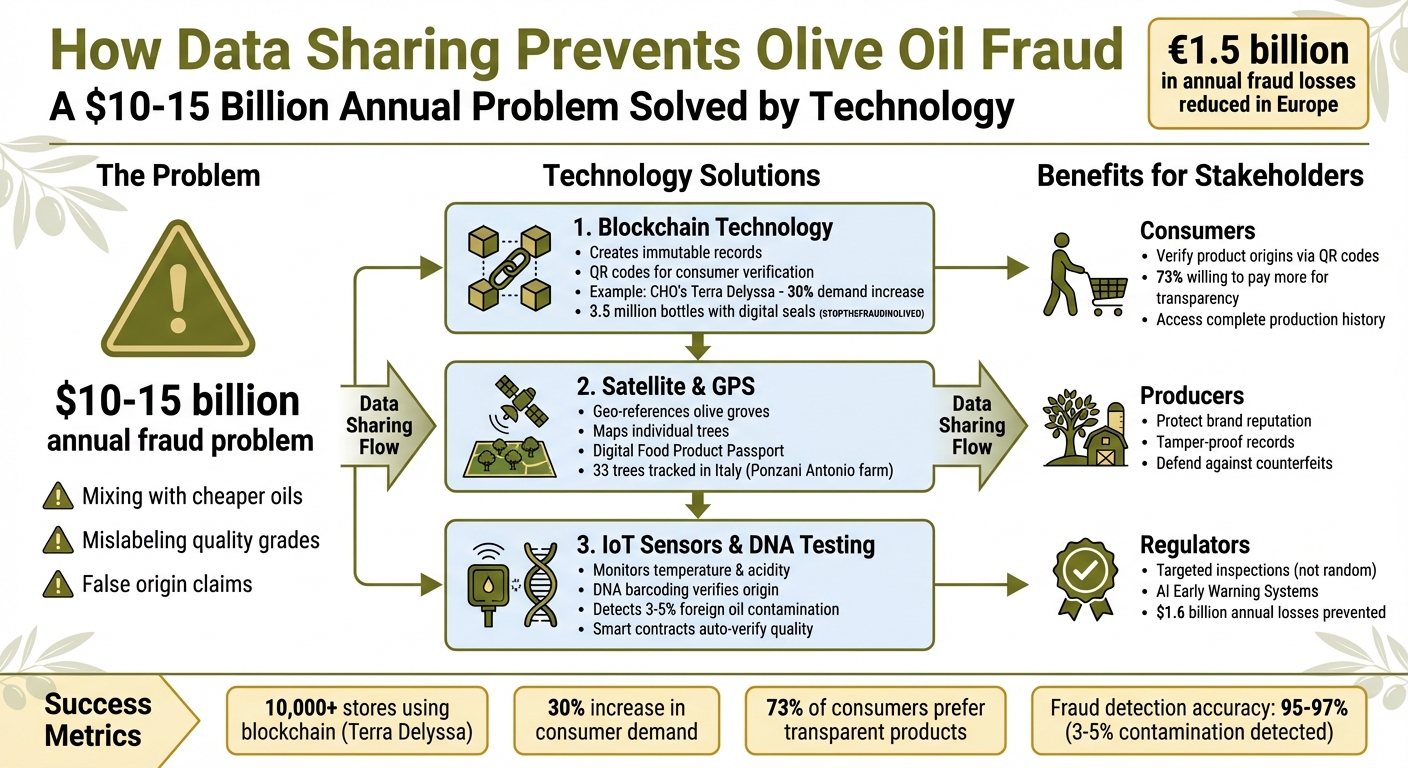
Olive oil fraud is a $10-15 billion annual problem, with counterfeit products deceiving consumers and harming honest producers. Fraudulent practices include mixing high-quality olive oil with cheaper oils, mislabeling quality grades, and false origin claims. Rising prices, driven by supply shortages and extreme weather, have made this issue worse.
Data sharing is changing the game. Technologies like blockchain, satellite geo-referencing, and IoT sensors create transparent supply chains. These tools track olive oil from harvest to sale, exposing fraud and ensuring accuracy. For example, blockchain systems allow consumers to scan QR codes on bottles, revealing detailed production data. DNA barcoding further verifies the oil's origin and purity.
This approach benefits everyone:
- Consumers can confirm product quality and origin.
- Producers protect their reputation with tamper-proof records.
- Regulators target inspections more effectively.
These methods are already reducing fraud losses in Europe and boosting consumer trust in premium brands.
How Data Sharing Technologies Prevent Olive Oil Fraud: From Grove to Bottle
How Data Sharing Detects Olive Oil Fraud
Sharing data throughout the supply chain brings fraudsters out of hiding. When producers, millers, distributors, and regulators collaborate, they create a digital footprint that traces olive oil from the grove to the grocery store, exposing any irregularities along the way.
Shared Databases Track Supply Chain Movement
Industry-wide databases enable stakeholders to verify information at every step of production. For example, if a producer reports harvesting 10,000 pounds of olives but the mill's oil yield seems unusually high, it raises a red flag for potential tampering.
These tools also track geographic origins and shipping routes, quickly identifying discrepancies like a bottle labeled "100% Italian" that actually comes from another country. AI-powered systems analyze real-time data, spotting unusual production surges or shipping patterns. According to Open Food Chain, blockchain technology creates "a transparent and immutable record of every step in the supply chain".
By facilitating real-time cross-checking, shared databases have helped reduce Europe's olive oil fraud losses - estimated at €1.5 billion annually - by enabling more precise inspections. These systems demonstrate how technology can safeguard authenticity, as highlighted in blockchain success stories.
Case Study: Blockchain Creates Permanent Records
Blockchain technology offers a powerful solution to ensure supply chain integrity, and real-world examples show its effectiveness in combating fraud.
In November 2020, CHO, a Tunisian olive oil producer, adopted IBM Food Trust blockchain for its Terra Delyssa brand, distributing it across over 10,000 grocery stores in the U.S. and Canada. This system allowed customers to scan QR codes on bottles, giving them access to images of the olive groves, milling details, and quality certifications tied to their specific product. This transparency initiative resonated with consumers, leading to a 30% increase in demand during the COVID-19 pandemic as more people sought trustworthy products while cooking at home.
Blockchain technology ensures that critical data - such as harvest certificates, genetic profiles, and production logs - cannot be altered or erased. This safeguards the integrity of quality metrics, like acidity levels, which determine whether olive oil qualifies as "extra virgin." Guillermo José Albornoz, Director at Rolar de Cuyo, emphasizes:
"IBM blockchain technology provides the transparency we need to trace the origin of our products, complying with all quality processes to reach consumers' tables".
Another notable example is the STOPTHEFRAUDINOLIVEO project, launched in March 2020 by BlockTac CTO Enrique Lizaso. This initiative introduced digital seals for 3.5 million bottles of olive oil, using double-layer QR codes. When scanned, the blockchain marks a bottle as "opened", and any duplicate QR code triggers an alert to warn consumers of potential fraud. Lizaso explains:
"If the blockchain register does not contain the QR code, the bottle is shown as 'no info, beware, no info, consume at your own risk!'".
This tamper-proof system makes it nearly impossible for fraudsters to mass-produce counterfeit labels using a single legitimate code, adding another layer of protection for consumers and producers alike.
sbb-itb-4066b8e
Technology Tools That Support Data Sharing
The olive oil industry is embracing advanced technology to ensure transparency and authenticity, going beyond blockchain to include satellite systems and sensors. These tools enhance data sharing across the industry, playing a critical role in combating fraud. Here's how satellite technology and IoT-enhanced blockchain work together to safeguard product integrity.
Satellite Technology Confirms Geographic Origin
Satellite geo-referencing and GPS are now being used to map olive orchards by pinpointing the exact location of each tree. This data is stored in a Digital Food Product Passport, which integrates with blockchain systems to directly link the harvest's physical location to the final product.
This technology also helps regulators verify production volumes by comparing them with the expected yield of geolocated groves. This method prevents oils from being mislabeled or imported from outside the declared region. For instance, in November 2020, the Ponzani Antonio farm in Montorio Romano, Italy, tested an electronic traceability system. GPS recorded the positions of 33 trees from three cultivars - Carboncella, Frantoio, and Leccino. The data was connected to an app called "Infoliva" and a blockchain-ready database, enabling each oil batch to be traced back to specific trees.
Tullia Gallina Toschi, Project Coordinator of the OLEUM Project, highlighted the potential of this technology:
"Combining information about quality and authenticity with certified production volumes and their geolocation could form a blockchain to counter fraud".
Satellite data lays the groundwork, while blockchain and real-time monitoring add further layers of protection.
Blockchain Combined with Real-Time Monitoring
When combined with IoT sensors, blockchain becomes even more effective. Sensors monitor key metrics like temperature, acidity, and pesticide residues, automatically uploading this data to the blockchain. This reduces the risk of human error or tampering.
Smart contracts play a key role here. They automatically check whether the oil meets quality standards. For example, if temperatures exceed safe levels or acidity surpasses extra virgin thresholds, the system flags or rejects the batch. RFID tags attached to trees and harvest crates ensure that the origin of the olives is permanently linked to the oil batch.
The Watson Project, which will run from 2024 to 2026 in Italy and Greece, takes this a step further. It uses portable DNA technology at mills to confirm the oil's authenticity. This genetic data is then added to the Digital Food Product Passport on the blockchain, allowing consumers to verify the regional variety of the olives. By combining satellite data, IoT sensors, DNA testing, and blockchain, the industry creates a tamper-proof system known as "infotracing", which ensures the oil's origin and quality are fully transparent.
Benefits of Data Sharing for All Stakeholders
Advanced traceability methods have made data sharing a game-changer for the supply chain. It benefits everyone involved - consumers can verify the authenticity of what they’re buying, premium producers can safeguard their brand reputation, and regulators can focus their efforts on areas most vulnerable to fraud.
Consumers Can Verify Product Origins
Imagine scanning a QR code on a bottle of olive oil and instantly accessing a Digital Food Product Passport. This passport reveals everything: the exact olive grove location, harvest dates, milling techniques like first cold-pressed methods, and even storage conditions. DNA fingerprinting ensures that the olive varieties are authentic and confirms that the oil hasn’t been diluted with cheaper alternatives.
Take CHO America's Terra Delyssa initiative as an example. Their traceability system has increased consumer trust and demand. To combat counterfeiting, double-layer labels mark bottles as "opened" in the system, preventing counterfeiters from reusing QR codes on fake products. Notably, 73% of consumers are willing to pay extra for products that provide full transparency about their origin and production.
Premium Producers Protect Their Reputation
For producers, data sharing is more than just transparency - it’s a way to defend their brand. Companies like Big Horn Olive Oil use these systems to create tamper-proof supply chain records. Blockchain technology ensures every detail - olive grove locations, harvest dates, and production quantities - is permanently recorded and cannot be altered. This protects premium brands from being undermined by cheaper imitations.
AI-powered platforms further enhance protection by identifying irregularities in the supply chain early on. A great example is the "DNAblockchain" tool developed by Greek companies BioCoS and InTTrust in 2025. Funded by the EU S3FOOD project, it combines olive oil DNA with blockchain technology to create fraudproof genetic barcodes for each bottle. For brands like Big Horn Olive Oil, this provides scientific proof of their Ultra Premium Extra Virgin Olive Oils’ authenticity and quality.
Regulators Conduct More Effective Inspections
Regulators also benefit from these tools, using shared data to replace random inspections with targeted ones. The Watson Project, launched in 2025 in Italy and Greece, is a prime example. It equips food authorities with an AI Early Warning System that combines rapid DNA testing with blockchain data to streamline on-site checks and predict fraud risks. The project involves institutions like the Institute of Biosciences and BioResources and the National Research Council of Italy.
Digital seals that are repeatedly opened can signal cloned products. The EU-funded TITAN project, in collaboration with the International Iberian Nanotechnology Laboratory, uses handheld scanners to record data onto the Open Food Chain blockchain. This allows regulators to confirm if olive oil truly comes from the regional varieties documented in the supply chain. With olive oil fraud causing estimated losses of $1.6 billion annually in Europe alone, these tools are essential for protecting consumers and ensuring that reputable producers like Big Horn Olive Oil remain untainted by counterfeit products.
Conclusion: Data Sharing Creates a More Trustworthy Market
How Data Sharing Ensures Product Authenticity
The fight against olive oil fraud has taken a giant leap forward with data sharing, particularly through blockchain technology. By creating records that can't be altered, every step of the journey - from the olive grove to the final bottle - can now be verified. When combined with DNA barcoding, this technology becomes even more powerful. As Stelios Arhondakis, CEO of BioCoS, explains:
"DNAblockchain bridges this gap, preventing any mixing of olive oil with other oils".
This system is so precise that it can detect even 3–5% of foreign oil in a product. Together, blockchain and DNA barcoding are helping to rebuild trust in the olive oil industry.
But there's more to these innovations than just fraud detection. Tools like Digital Food Product Passports and QR codes allow consumers to instantly verify quality claims. For producers, this means their hard-earned reputations are protected, as authentic products are easily distinguished from counterfeits. The S3FOOD Project Report highlights this benefit:
"For producers, it means the value of high-end products will no longer be undercut by cheaper imitations".
By integrating blockchain, DNA barcoding, and real-time data sharing, the olive oil industry is creating a supply chain that is both secure and transparent - offering benefits to everyone involved.
Big Horn Olive Oil's Focus on Quality and Transparency
Big Horn Olive Oil stands out as a prime example of how transparency and strict quality standards can deliver truly authentic products. Thanks to traceability initiatives, their Ultra Premium Extra Virgin Olive Oils are cold-pressed within two hours of harvest and delivered fresh within three months. By adhering to internationally recognized standards and sourcing olives from top-tier groves, Big Horn Olive Oil has built a reputation for trustworthiness.
Their commitment to freshness and antioxidant content reflects the potential of modern data-sharing platforms. These systems provide verifiable proof of quality, ensuring that every product - from their Estate Reserve Ultra Premium EVOO to their single-source Picual and Coratina varieties - is genuine and free from any form of adulteration. Through transparent practices, Big Horn Olive Oil continues to set a high standard for quality in the industry.
FAQs
How can I tell if an olive oil’s QR code traceability is real?
To check if an olive oil's QR code traceability is genuine, scan the code and examine the details provided. You should find clear, verifiable information about the oil's origin, how it was produced, and its authenticity. This information should match standards set by industry-wide platforms that aim to identify and prevent fraud.
What data is tracked from grove to bottle to catch fraud?
Genetic DNA markers are used to create a unique genetic barcode for each bottle of olive oil. This system guarantees both authenticity and traceability across the entire supply chain. By doing so, it plays a key role in identifying and preventing fraud.
Does DNA testing work on bottled olive oil, and how accurate is it?
Yes, DNA testing is a reliable method for verifying the origin and cultivar of bottled olive oil. By analyzing the residual DNA present in the oil, scientists use molecular markers alongside advanced techniques such as qPCR (quantitative Polymerase Chain Reaction), digital PCR, and High-Resolution Melting (HRM). These tools ensure accurate authentication, helping confirm the oil's authenticity and maintain its quality standards.