

DOP vs. IGP: Key Differences
When choosing balsamic vinegar, you'll often see DOP and IGP labels. These certifications indicate quality and origin but differ in production methods, aging, and price.
- DOP (Protected Designation of Origin): Made entirely in Modena, Italy, using 100% cooked grape must. It’s aged for at least 12 years in wooden barrels with no additives. Prices range from $111 to $266 for 100 ml due to its strict standards and rich, syrupy flavor.
- IGP (Protected Geographic Indication): Allows more flexibility, blending grape must (minimum 20%) with wine vinegar (minimum 10%). It’s aged for at least 60 days, with up to 2% caramel color permitted. Prices start at $1.10 for 250 ml, making it an affordable choice for everyday cooking.
Quick Comparison
| Feature | DOP | IGP |
|---|---|---|
| Ingredients | 100% cooked grape must | Grape must + wine vinegar |
| Additives | None | Up to 2% caramel |
| Aging | Minimum 12 years | Minimum 60 days |
| Price | $111–$266 (100 ml) | $1.10–$13.20 (250 ml) |
| Best Use | Finishing dishes | Cooking, marinades |
Choose DOP for gourmet meals and IGP for everyday use. Look for official red-and-yellow (DOP) or blue-and-yellow (IGP) seals to ensure quality.
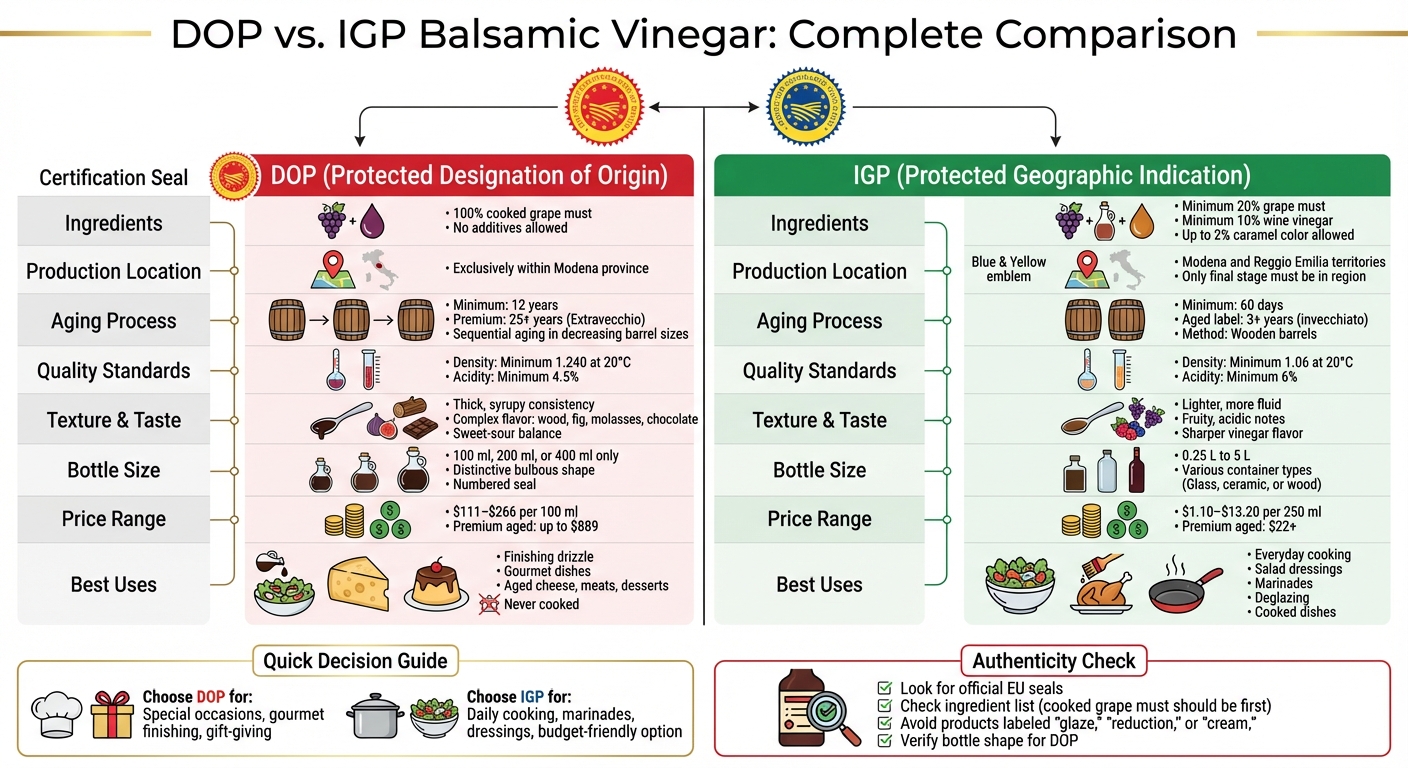
DOP vs IGP Balsamic Vinegar Comparison Chart
How DOP (Traditional) Balsamic Vinegar is Made
What is DOP Certification?
DOP certification ensures that traditional balsamic vinegar is crafted entirely in Modena, following time-honored methods passed down through generations. Let’s dive into the rigorous standards that define the DOP label.
DOP Standards and Requirements
To earn DOP certification, producers must adhere to strict guidelines:
- The vinegar is made exclusively from 100% cooked grape must, sourced from seven specific grape varietals grown in Modena.
- The must is cooked over an open flame at temperatures of at least 80°C (176°F) for 30 minutes.
- Aging takes place in wooden barrels made from select woods like oak, chestnut, mulberry, and juniper. The minimum aging period is 12 years, with products aged 25 years earning the prestigious "Extravecchio" designation.
- Additives, thickeners, and preservatives are strictly prohibited. The only permissible addition is "mother vinegar", a natural bacterial culture essential for fermentation.
Each batch undergoes a meticulous sensory evaluation to ensure it meets standards for color, density, aroma, and flavor. Once approved, the vinegar is bottled in specific sizes (100, 200, or 400 ml) and sealed with a non-reusable, numbered cap to guarantee authenticity.
Benefits of DOP Certification
DOP certification guarantees a density of at least 1.240 at 20°C and an acetic acid content of 4.5 grams per 100 grams. This ensures the vinegar’s signature thick texture and rich, complex flavor. As the Consorzio Aceto Balsamico Tradizionale di Modena states:
Every drop of Traditional Balsamic Vinegar of Modena P.D.O. is the product of a strict quality process inspired by tradition.
The pricing reflects the craftsmanship: a 100-ml bottle aged for 12 years typically costs between $111 and $127, while 25-year "Extravecchio" bottles range from $205 to $266. Rare, limited-edition releases can command prices as high as $889.
What is IGP Certification?
IGP (Indicazione Geografica Protetta) is a European certification that offers some flexibility in production. Unlike DOP, which requires every stage of production to take place in a specific region, IGP allows for only one key production phase or ingredient to originate from the designated area. For example, IGP balsamic vinegar is made by blending grape must and wine vinegar, with at least 20% of the mixture being cooked or concentrated grape must and 10% wine vinegar. To enhance its flavor, a portion is aged for 10 years. This process creates a vinegar with a thinner texture and a sharper, more acidic flavor compared to the richer, syrupy DOP-certified balsamic. These specific production methods form the foundation of IGP standards.
You can identify authentic IGP products by their distinctive blue-and-yellow seal. They are sold in a variety of container sizes, ranging from 0.25 L (8.5 fl oz) to 5 L (170 fl oz).
IGP Standards and Requirements
IGP balsamic vinegar is made under less restrictive guidelines compared to DOP. For instance, the vinegar must be aged in wooden barrels for at least 60 days. If aged for three years or more, it can be labeled as "invecchiato" (aged).
To meet quality standards, IGP balsamic vinegar must have a total acidity of at least 6% and a density of 1.06 (measured at 20°C). Approved grape varieties include Lambrusco, Sangiovese, Trebbiano, Albana, Ancellotta, Fortana, and Montuni. Additionally, up to 2% caramel (E150) is allowed to stabilize the color. When reading the label, note that if wine vinegar is listed before cooked grape must, the product will have a stronger vinegar flavor and a more pronounced acidity. These standards ensure a balance between quality and affordability, making IGP vinegar a practical choice for everyday use.
Benefits of IGP Certification
The production process for IGP balsamic vinegar makes it more accessible and affordable. In Italy, a 250 ml bottle of IGP balsamic vinegar typically costs between $1.10 and $13.20, with higher-quality aged varieties sometimes exceeding $22. By comparison, DOP-certified balsamic vinegar, which undergoes a lengthy 12-year aging process, often starts at around $50 for just 100 ml.
As Eataly explains:
IGP is a good reference (but does not guarantee all phases, like DOP).
This certification strikes a balance between quality and practicality. The shorter aging time and use of blended ingredients allow for larger production volumes, making IGP balsamic vinegar ideal for everyday cooking. Whether you're drizzling it over salads, deglazing a pan, or enriching a marinade, IGP balsamic offers a connection to Modena's rich balsamic tradition - without the premium price tag of DOP-certified options. While it may lack the depth and complexity of a 12-year DOP balsamic, it still delivers authentic flavor and versatility.
Production Differences Between DOP and IGP
When it comes to production, DOP and IGP balsamic vinegars follow distinct methods, starting with their ingredients. DOP vinegar is made exclusively from 100% cooked grape must derived from specific local grape varieties. Meanwhile, IGP vinegar combines at least 20% cooked or concentrated grape must with a minimum of 10% wine vinegar, and it permits the addition of up to 2% caramel color (E150d) to ensure consistency.
The aging process is another key differentiator. DOP vinegar follows the traditional "batteria" system, where the cooked must is transferred through a series of progressively smaller barrels made from selected woods. This meticulous process spans at least 12 years, with some products surpassing 25 years to earn the "Extravecchio" label. Over time, the volume of the vinegar can shrink drastically - 18 gallons may reduce to less than 1 gallon. On the other hand, IGP vinegar is aged in wooden barrels for a minimum of 60 days, and if aged for three years or more, it can carry the "invecchiato" (aged) label.
The Consorzio Aceto Balsamico Tradizionale di Modena describes the DOP aging process as follows:
The alcoholic and acetic fermentation process reaches optimal levels of maturation, ageing and refinement after an appropriate period of time, in any case no less than 12 years.
Another distinction lies in production location. DOP vinegar must be produced entirely within the province of Modena. In contrast, IGP vinegar requires only the final production stage to take place in Modena or Reggio Emilia.
DOP vs. IGP Production Comparison Table
| Factor | DOP (Traditional) | IGP (Modena) |
|---|---|---|
| Production Location | Exclusively within the province of Modena | Modena and Reggio Emilia territories |
| Ingredients | 100% cooked grape must from specific varietals | Grape must (min. 20%) + at least 10% wine vinegar |
| Additives | Not allowed | Up to 2% caramel color (E150d) permitted |
| Aging Period | Minimum 12 years; 25+ years for "Extravecchio" | Minimum 60 days; 3+ years for "Aged" |
| Barrel Usage | Sequential aging in casks of decreasing size | Aged in wooden barrels; wood chips allowed |
| Density | Minimum 1.240 at 68°F | Minimum 1.06 at 68°F |
| Total Acidity | Minimum 4.5% | Minimum 6% |
sbb-itb-4066b8e
Taste and Texture Differences Between DOP and IGP
The taste and texture of DOP and IGP balsamic vinegars reflect their unique production methods and aging processes. DOP balsamic vinegar is known for its thick, syrup-like consistency and glossy dark-brown appearance. Its flavor profile is deeply layered, offering notes of wood, fig, molasses, and chocolate, all balanced by a harmonious sweet-sour blend. As Andrew Wheeler puts it:
"Traditional balsamic vinegar is glossy, viscous, and dark brown... It moves like syrup, and has a velvety texture on the tongue."
These characteristics make DOP vinegar a standout choice for enhancing gourmet dishes. On the other hand, IGP balsamic vinegar is lighter and more fluid, which makes it perfect for even distribution in dressings. Its flavor is more delicate, with fruity undertones and a noticeable acidic sharpness, thanks to its wine vinegar content. The specific flavor can vary depending on the ratio of grape must to wine vinegar - if wine vinegar is listed first on the label, expect a more pronounced acidic taste.
These differences extend to their culinary applications. DOP vinegar, with its rich complexity, is best used as a finishing drizzle on dishes like aged Parmigiano Reggiano, grilled meats, fresh strawberries, or even vanilla ice cream. It’s always used raw to preserve its intricate flavors. Meanwhile, IGP vinegar’s lighter and more acidic profile makes it ideal for dressings, marinades, or cooked reductions, where it retains its essential taste.
DOP vs. IGP Taste Comparison Table
| Attribute | DOP (Traditional) | IGP (Modena) |
|---|---|---|
| Density | Thick, syrupy, and velvety; clings to the spoon | More liquid and free-flowing |
| Flavor Complexity | Deep, layered aromas with a sweet-sour balance | Delicate, with fruity and acidic notes |
| Ideal Aging | 12 to 25+ years | 60 days to over 3 years |
| Primary Notes | Wood, fig, molasses, and chocolate | Fruity, light, and acidic |
| Best Use | Finishing drizzle for gourmet dishes | Great for cooking, marinades, and salads |
How to Identify Authentic DOP and IGP Products
To spot authentic DOP and IGP products, start by checking the EU seals. DOP products are marked with a circular red-and-yellow seal, while IGP items feature a blue-and-yellow seal. Regan Hofmann from Giadzy highlights:
The DOP's rules are so strict, they even control the type of bottle in which the vinegar is sold! This is the easiest way to spot a DOP balsamico.
For Traditional Balsamic Vinegar of Modena DOP, the packaging is a key indicator. DOP vinegar from Modena is sold in a distinct 100 ml (3.4 oz) bulbous bottle with a rectangular base, while the Reggio Emilia version comes in a bottle shaped like an upside-down wine glass. Any variation from these bottle designs should raise a red flag. Additionally, authentic DOP bottles include a numbered paper seal that must be broken to open, ensuring the product's authenticity.
On the other hand, IGP products allow more flexibility in packaging. They can be sold in containers made of glass, ceramic, or even wood. Beyond the seals and packaging, examining the ingredient list is another step to confirm authenticity.
High-quality vinegar will list "cooked grape must" as the first ingredient. If "wine vinegar" appears first, it’s likely a commercial-grade product with a sharper, more acidic profile. Italian regulations also forbid the use of adjectives like "extra", "fine", "selected", "superior", or "classic" on labels. The only descriptor allowed is "aged" (invecchiato), which signifies the product has matured for at least three years.
Be cautious of products labeled as "balsamic glaze", "reduction", or "cream." These often include thickeners, added sugars, or artificial colors and are not certified as DOP or IGP. For complete verification, you can check the EU register of protected designations.
When to Choose DOP or IGP
Deciding between DOP and IGP balsamic vinegar comes down to how you plan to use it. DOP shines in gourmet finishing touches, while IGP is the go-to for everyday cooking. Let’s break it down.
When to Choose DOP
DOP-certified balsamic vinegar has earned its reputation as "the crown jewel of Italian vinegars". This is the choice for special moments - formal dinners, luxury gifts, or when you want to transform a dish into something extraordinary. With prices ranging from $60 to $120 per 100 ml, DOP is best used sparingly, as a finishing touch.
Its thick, syrupy texture and rich, layered flavors make it perfect for drizzling rather than cooking. Picture it enhancing aged Parmigiano Reggiano, rare steak, roasted duck, or even desserts like ice cream and fresh fruit. As Alice Twain puts it:
Traditional Balsamico is not used like regular vinegar, it's a sauce that can be used in very small amounts with aged cheeses, meats, ice cream, and fruit.
For everyday cooking, IGP-certified vinegar is a more practical option.
When to Choose IGP
IGP-certified balsamic vinegar is a versatile choice that fits seamlessly into your daily cooking routine. It offers quality at a more accessible price point, making it ideal for a variety of uses. Think vinaigrettes, marinades for grilled chicken or salmon, deglazing pans for sauces, or even drizzling over roasted veggies and pizzas.
Enoteca Ferrari captures it perfectly:
If you are looking for a versatile balsamic for everyday use, the IGP is the right choice. If instead you want a real gourmet balsamic that will take your dishes to a new level, you should opt for the Tradizionale DOP.
With its tangy, fluid consistency, IGP vinegar blends effortlessly into dressings, marinades, and sauces, bringing a flavorful boost to your everyday recipes.
Conclusion
Understanding the key differences between DOP and IGP balsamic vinegars can make all the difference in your kitchen. DOP balsamic vinegar, crafted with 100% cooked grape must and aged for at least 12 years in Modena or Reggio Emilia, offers a depth of flavor and texture that's unmatched. On the other hand, IGP balsamic vinegar allows a blend with wine vinegar and requires only 60 days of aging, providing a more accessible option for everyday use.
The official seals are your assurance of authenticity. The red-and-yellow DOP emblem and blue-and-yellow IGP seal signify artisanal craftsmanship and the absence of unnecessary additives. As Eataly puts it:
Beyond saving ancient traditions, the product actually tastes better.
These certifications are more than just labels - they represent a commitment to quality. Big Horn Olive Oil offers a range of authentic balsamic vinegars from Modena, Italy, such as their Traditional 18-Year Aged Dark Balsamic Vinegar and Molto Denissimo 25-Year Aged Dark Balsamic Vinegar. These products showcase the rich flavors and textures that genuine certification guarantees.
Whether you're elevating a gourmet meal or adding a touch of elegance to your everyday cooking, choosing certified balsamic vinegar ensures you're enjoying it as it was intended. Always check for the ingredient list and official seals, and steer clear of products labeled as "glaze" or "reduction". With authentic balsamic vinegar, every dish becomes a celebration of flavor - a philosophy championed by Big Horn Olive Oil.
FAQs
What is the difference between DOP and IGP balsamic vinegars?
The key distinction between DOP (Protected Designation of Origin) and IGP (Protected Geographical Indication) balsamic vinegars lies in their production standards and geographic restrictions.
DOP balsamic vinegar, such as Traditional Balsamic Vinegar of Modena, must be produced entirely within a specific region using time-honored methods. Every stage of the process - ingredient selection, production, and aging - follows strict guidelines designed to preserve its authenticity and ensure top-tier quality.
On the other hand, IGP balsamic vinegar, while still tied to a designated region, offers greater flexibility in its production. Ingredients can be sourced from outside the region, and the regulations are less stringent, making it a more accessible option while still retaining a connection to its origins.
Both certifications guarantee quality, but DOP stands as the gold standard for tradition and authenticity in balsamic vinegar craftsmanship.
What are the key differences between DOP and IGP balsamic vinegars, and how can I identify them?
The primary distinction between DOP (Denominazione di Origine Protetta) and IGP (Indicazione Geografica Protetta) balsamic vinegars comes down to their production methods and aging requirements.
DOP balsamic vinegar is crafted solely from cooked grape must and undergoes a rigorous aging process of at least 12 years. For the Extra Vecchio variety, the aging extends to 25 years. This vinegar is aged in wooden barrels, subject to strict quality controls, and is packaged with unique identifiers, like a gold capsule for the Extra Vecchio. In contrast, IGP balsamic vinegar is typically a mix of grape must and wine vinegar, with a much shorter aging period that can range from just a few months to a few years.
To ensure you're purchasing an authentic product, look for the official DOP or IGP label on the packaging. While both certifications guarantee quality, DOP reflects the highest level of craftsmanship and extended aging.
How do I decide between DOP and IGP balsamic vinegar for cooking?
When deciding between DOP and IGP balsamic vinegar, it all comes down to the flavor and authenticity you want for your dish. DOP (Denominazione di Origine Protetta) balsamic vinegar represents the pinnacle of tradition. Produced entirely in Modena or Reggio Emilia, Italy, it follows strict, time-honored methods. With longer aging, it boasts a deep, layered flavor that's ideal for gourmet dishes. Think of drizzling it over aged cheeses, fresh fruit, or even desserts for an elevated touch.
Meanwhile, IGP (Indicazione Geografica Protetta) balsamic vinegar offers a more budget-friendly and flexible option. Made with a blend of local and imported ingredients, it’s perfect for everyday use - whether you're whipping up a salad dressing, marinating meats, or creating a glaze.
For an elevated culinary experience, consider using premium balsamic vinegars like those from Big Horn Olive Oil, sourced directly from Modena, Italy. Their quality can bring out the best in your recipes.