

Douro Valley Olive Oil: Unique Terroir Explained
The Douro Valley, famous for its wine, also produces olive oil with a distinct flavor and character shaped by its challenging terrain and climate. Here's a quick breakdown of why this region stands out:
- Terroir Impact: The rocky schist soils, steep slopes, and dry Mediterranean weather force olive trees to grow under tough conditions, concentrating flavors and nutrients in the olives.
- Climate Variations: Rainfall and temperatures vary across the valley's sub-regions, influencing the oil's flavor - lighter and delicate in wetter areas, richer and more intense in drier zones.
- Soil Benefits: Schist soils retain heat and water, helping olive trees thrive despite low organic matter and harsh weather.
- Traditional Practices: Hand-harvesting methods and centuries-old trees contribute to the oil's quality and complexity.
- Flavor Profile: Douro olive oils are known for fruity, nutty, and peppery notes, with hints of apple, tomato, and banana.
- Health Benefits: High in antioxidants and monounsaturated fats, these oils support heart health and resist oxidation.
Douro Valley olive oil reflects its rugged environment and long-standing agricultural heritage, offering a balance of rich flavors and nutritional value.
PORTUGAL'S DOURO VALLEY WITH MONARCH | AD
sbb-itb-4066b8e
What Makes Douro Valley Ideal for Olive Oil Production?
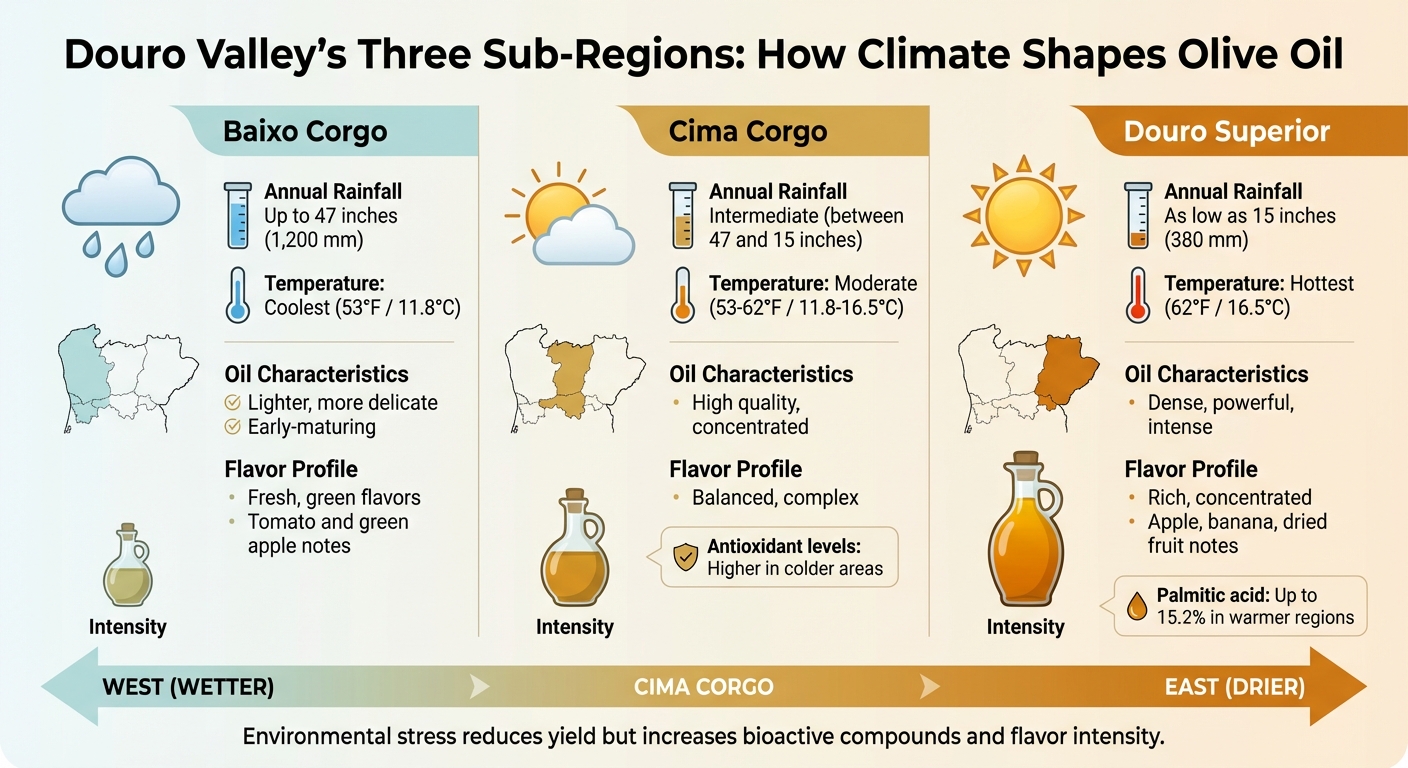
Douro Valley Sub-Regions: Climate and Olive Oil Characteristics Comparison
The Douro Valley’s terroir - a combination of its challenging climate, nutrient-poor schist soils, and dramatic landscape - plays a key role in shaping the quality of its olive oil. Nestled between the Marão and Montemuro mountains, the region experiences cold winters and hot, dry summers, all while being shielded from the Atlantic's moisture. This unique continental climate, combined with the poor schist soils and steep slopes, forces olive trees to adapt, which intensifies their flavors and increases their nutritional compounds.
Interestingly, these environmental stresses enhance oil quality. For example, a study conducted in Mirandela in 2017 found that water scarcity reduced yield from 190 mL/kg to 42 mL/kg but boosted oleacein levels and aromatic notes like apple and banana. Researcher Márcia Araújo explains:
"Climate stress events can reduce oil yield but stimulate the accumulation of bioactive compounds that improve oil quality and nutritional value."
This interplay of environmental challenges creates the distinct characteristics for which the region's olive oils are known.
Climate: Mediterranean Weather and Regional Differences
The Douro Valley is not a monolith - it’s divided into three sub-regions, each offering distinct conditions and olive oil profiles. Rainfall decreases significantly as you move eastward, from 47 inches (1,200 mm) annually in Baixo Corgo to just 15 inches (380 mm) near the Spanish border. Average temperatures range from 53°F to 62°F (11.8°C to 16.5°C) across the valley.
This variation affects the oils produced. Baixo Corgo’s wetter climate yields lighter, more delicate oils, while Douro Superior, the driest and hottest area, produces rich, intense oils with concentrated flavors. Temperature differences also influence the oils’ chemical makeup. Oils from colder areas have higher antioxidants and heart-healthy monounsaturated fats, while warmer regions see increased palmitic acid levels, sometimes up to 15.2%. As researcher Leticia Bortoluzzi notes:
"Olive oils obtained from olives grown in colder regions tend to have higher levels of antioxidants and monounsaturated fatty acids... while oils produced in warmer regions are richer in saturated and polyunsaturated acids."
| Sub-region | Annual Rainfall | Temperature | Oil Characteristics |
|---|---|---|---|
| Baixo Corgo | Up to 47 inches | Coolest | Lighter, early-maturing |
| Cima Corgo | Intermediate | Moderate | High quality, concentrated |
| Douro Superior | As low as 15 inches | Hottest | Dense, powerful, intense |
While climate drives much of this diversity, the region’s distinctive schist soils add another layer of complexity.
Soil Composition: The Role of Schist
The Douro Valley’s schistous rock is a defining feature, with its nearly vertical layers allowing olive tree roots to dig deep for water during the dry summers. Despite having less than 1.5% organic matter, these roots thrive by accessing moisture trapped within the schist even in extreme weather.
Schist also acts as a thermal regulator, absorbing heat during the day and releasing it at night, which helps stabilize temperatures and ensures consistent fruit development. Additionally, the broken rock fragments mixed with clay prevent erosion and help water seep deep into the ground. As Fonseca Port explains:
"The dry conditions and rocky schistose soil, which absorbs and retains heat, contribute to the intensity of the wines [and oils]."
The soil’s natural acidity (pH 4.6 to 5.5) and low phosphorus levels, paired with medium to high potassium content, create conditions that stress the trees just enough to increase phenols and antioxidants in the olives. Wine writer Margaret Rand puts it succinctly:
"The roots can force their way between the layers – and with less than 1.5% organic matter in the soil, the roots have to go well down to survive dry summers and freezing winters."
Topography: Steep Slopes and the Douro River
The Douro Valley, recognized as the world’s largest mountain vineyard, spans 617,763 acres with slopes so steep that mechanical harvesting is impossible. Olive trees are typically planted along the borders of these terraced hillsides, often on gradients of 20% to 30%.
Altitude plays a crucial role in shaping flavor. For every 328 feet (100 meters) of elevation, temperatures drop by about 0.9°F (0.5°C). Oils from higher altitudes tend to be more bitter, spicy, and fruity compared to those from lower elevations. A study of Douro oils found high concentrations of aromatic compounds like (E)-2-hexenal (259 µg/g) and (Z)-3-hexen-1-ol (157 µg/g), which create the signature green and fruity aromas.
The Douro River, winding through the valley, adds yet another layer of complexity with its microclimates. As Sérgio Costa from Portugal EV Tours points out:
"The Douro Valley is famous for its wines, but olive oil has played an equally important role in the region's agricultural history for centuries."
Flavor Profile and Characteristics of Douro Valley Olive Oil
The rugged terrain of the Douro Valley shapes not just the quality of its olives but also the distinct flavor and nutritional profile of its olive oils. These oils stand out for their fruity and sweet notes, offering a softer contrast to the bitter and peppery flavors often associated with oils from less demanding environments. Sensory studies reveal that 65% of Douro olive oils are classified as "ripe fruity", carrying hints of mature fruits and dried herbs, while the remaining 35% lean toward a "green fruity" character with fresher, more vibrant undertones.
Flavor Notes: Fruity, Peppery, and Nutty Elements
Douro Valley olive oils boast a flavor profile that consistently impresses tasting room visitors. Dried fruit notes dominate, with 82% of samples revealing tomato nuances, 81% showcasing banana, and 74% highlighting apple undertones. These flavors arise from volatile compounds released during olive crushing, influenced by the region's unique microclimates. For example, the compound (E)-2-hexenal is responsible for green, grassy aromas and a subtle bitter almond note.
The balance between fruity sweetness and a peppery kick is influenced by harvest timing and environmental conditions. Harvesting olives at a maturity index between 2.5 and 5 helps retain the ripe-fruit character, while the lower phenol content - averaging 274 mg GAE/kg compared to 505 mg GAE/kg in nearby Côa Valley oils - results in a smoother, less astringent finish. Any noticeable bitterness or pepperiness can be traced to secoiridoid compounds, such as oleuropein derivatives, which tend to increase in olives grown under water stress or in colder, higher-altitude areas.
The nutty, almond-like flavors often found in Douro oils are linked to compounds like cis-2-penten-1-ol, which are formed during the crushing process through the lipoxygenase pathway. Traditional olive varieties such as Galega, Madural, Cordovil, and Cobrançosa each contribute their own distinct characteristics to the final product. As Olive Oil Times aptly puts it:
"The result of having something that is unrefined and comes from one particular place is that you experience its terroir... olive oil reflects the conditions where the olives were grown through taste and smell characteristics."
In addition to their rich and layered flavor, these oils offer impressive nutritional benefits.
Health Benefits: Antioxidants and Nutritional Value
Douro Valley olive oils are more than just a culinary delight - they pack a nutritional punch as well. The environmental stresses that shape their flavor also boost their levels of beneficial compounds. These oils contain an average of 274 mg GAE/kg of total phenols, powerful antioxidants that help protect cells from oxidative damage. With an oxidative stability averaging 10.6 hours, these oils resist rancidity and maintain their freshness for longer periods.
Oleic acid, a heart-healthy monounsaturated fat, makes up 70.3%–80.7% of the oil. Varieties like Redondal and Verdeal Transmontana tend to have the highest concentrations. Additionally, these oils are enriched with essential minerals such as potassium (40.00 µg/g), sodium (170.00 µg/g), and trace amounts of iron and zinc. This combination of high monounsaturated fats and phenolic compounds supports healthy cholesterol levels and protects LDL cholesterol from oxidation. These health benefits are deeply tied to the region’s schist soils and the challenging conditions under which the olives are cultivated.
Olive Varieties Grown in the Douro Valley
The Douro Valley is home to traditional Portuguese olive cultivars like Galega, Madural, Verdeal, Cobrançosa, Negrinha, and Cordovil. Unlike the region's sprawling vineyards, olive trees are often planted in small clusters or along vineyard edges. Many of these trees are over 50 years old and thrive without irrigation. Their deep-root systems, developed under challenging conditions, contribute to the olives' intense flavor.
Primary Olive Varieties: Galega, Cobrançosa, and Others
Each olive variety offers unique characteristics to the oil they produce. Galega, for instance, is known for its stability and fruity flavor profile. Cobrançosa stands out with its herbaceous notes and aromas of green apple and freshly cut grass, thanks to compounds like (E)-2-hexenal. Madural, on the other hand, delivers a "ripe fruity" profile but is more prone to oxidation due to its higher polyunsaturated fat content (13.8%). Meanwhile, Redondal is prized for its stability, with oleic acid making up 80.7% of its fatty acid composition.
Fatty acid content varies significantly between varieties. Redondal and Verdeal Transmontana produce oils rich in monounsaturated fatty acids (MUFA), exceeding 81%, which enhances resistance to oxidation and prolongs shelf life. Additionally, Verdeal oils are notable for their higher palmitic acid levels (13.5%), which contribute to a richer mouthfeel.
Farming Practices in Douro Valley
The quality of Douro olive oil is shaped not only by the olive varieties but also by the region's farming practices, which blend tradition with modern techniques. Traditional orchards are typically low-density, with 100 to 240 trees per hectare (about 40 to 97 trees per acre), and most rely on rainfed agriculture. Farmers often use cover crops - such as natural vegetation, cereals, or legumes - to combat soil erosion and improve water retention in the area's schist-heavy soil. Manual pruning, done every two years, helps balance fruit production with the trees' ability to endure frequent droughts.
In June 2024, the Agricultural Cooperative of Olive Growers of Murça (CAOM) gained international recognition by winning two Silver Awards at the 2024 NYIOOC World Olive Oil Competition for their Azeite Porca de Murça brand. Representing around 1,000 farmers across 73 square miles, CAOM processes olives within 24 hours of harvest using a modern communal mill. This approach allows small-scale dryland farmers to produce high-quality oils despite facing costs three times higher than those of super-intensive growers. As CAOM Chairman Francisco António Vilela Ribeiro explains:
"The search for high quality was the answer to the challenges of this region and the higher costs associated with the mountainous environment, the extensive orchards and the dryland farming practices."
Much of the region's production falls under the "Azeite de Trás-os-Montes" Protected Denomination of Origin (PDO). This designation enforces strict standards, including the use of specific cultivars like Cobrançosa, Madural, and Verdeal Transmontana, ensuring the oils retain the authentic character of the Douro Valley.
Why Choose Douro Valley Olive Oil?
Terroir and Production Methods
The Douro Valley is known for its rugged landscape and time-honored methods that create olive oils with unmatched flavor profiles. In this challenging terrain, olive trees must push their roots deep into schist layers to survive droughts. This struggle results in oils packed with bioactive compounds like oleuropein and oleacein, which not only enhance flavor but also boost antioxidant levels.
Researcher Maria Celeste Dias highlights this phenomenon:
"Climate stress events can reduce oil yield but stimulate the accumulation of bioactive compounds that improve oil quality and nutritional value".
The valley is divided into three sub-regions, each offering oils with unique characteristics. Baixo Corgo produces lighter oils with fresh, green flavors, while Douro Superior is known for its bold, rich oils that carry notes of apple, banana, and dried fruits. Expert tasting panels have even identified up to 32 distinct positive flavor sensations in Douro olive oils, including rare hints of rosemary, lavender, and strawberry.
These distinctive qualities make Douro Valley olive oils a versatile choice for elevating any dish.
Using Douro Valley Olive Oil in Everyday Cooking
Choosing the right Douro Valley olive oil can transform your cooking. For fresh salads or light starters, Baixo Corgo oils - featuring bright tomato and green apple notes - are an excellent match. When grilling or roasting, Douro Superior oils bring a robust, peppery flavor that stands up to high heat and hearty dishes.
If you're focusing on heart health, monovarietal oils from Redondal or Verdeal Transmontana are ideal. These oils boast up to 80.7% oleic acid, which helps lower LDL oxidation, supports cardiovascular health, and offers better oxidative stability.
For finishing touches, drizzle green, peppery oils over grilled fish or warm, crusty bread. For more delicate dishes like steamed fish - or even desserts - opt for sweeter oils with nutty or ripe fruit notes. Their subtle complexity adds a special touch to these preparations.
Conclusion: The Douro Valley's Contribution to Olive Oil
The Douro Valley stands out for its remarkable blend of rugged terrain and deeply rooted traditions. Its rocky schist soils, steep hillsides, and Mediterranean climate work together to shape olive oils with a distinctive character. These conditions foster high levels of bioactive compounds, which are key to the oils' quality and health benefits.
This approach to olive oil production mirrors the valley's celebrated winemaking practices, where the focus is firmly on quality over quantity. While water scarcity may reduce yields, it enhances the oils by concentrating compounds like oleacein and oleuropein. Centuries-old heritage trees further enrich the oils, adding unique genetic traits that translate into sensory profiles ranging from fresh, herbaceous notes to sweeter, ripe fruit flavors. The result is olive oil that offers both exceptional taste and nutritional value.
Prominent wine estates such as Taylor's Quinta de Vargellas and Quinta do Noval have embraced this legacy, crafting olive oils with the same care and attention they dedicate to their renowned Port wines. Ana Carrilho, Head of Olive Oil Production at Herdade do Esporão, highlights that olive oil, much like wine, deserves to be celebrated for its diversity and complexity.
Whether you're drawn to oils rich in oleic acid - often reaching around 80.6% - or those with layered sensory profiles, the Douro Valley's olive oils reflect a heritage shaped by its challenging environment and artisanal craftsmanship. These oils are a testament to centuries of dedication, proving that the region's excellence is a direct result of its unique conditions and unwavering commitment to tradition.
FAQs
How does schist soil change Douro olive oil flavor?
Schist soil plays a key role in defining the distinct flavor of Douro olive oil by shaping its terroir. This rocky, layered soil structure enables olive tree roots to reach deep into the ground for essential nutrients and water, which contributes to the oil's rich flavor profile. Additionally, schist absorbs heat throughout the day and releases it at night, ensuring consistent ripening of the olives. The result? Olive oils with intricate, concentrated flavors that beautifully capture the essence of the Douro Valley.
Which Douro sub-region produces the boldest olive oil?
The Moura sub-region in the Douro Valley stands out for crafting some of the boldest olive oils you can find. These oils boast a distinctive flavor profile that's hard to miss - bold, fruity, with a touch of bitterness and spice. Each bottle reflects the unique characteristics of the region's terroir, making it a true taste of Moura's landscape.
How can I tell a Douro olive oil is truly high quality?
High-quality Douro olive oil stands out with its fresh, peppery flavor and a touch of bitterness. To ensure you're getting the best, check that it meets extra virgin standards, which include low acidity (under 0.8%) and no sensory flaws. These characteristics not only meet European regulations for extra virgin classification but also capture the distinct essence of the Douro Valley's landscape.