

Egypt Olive Oil Regions: Study Summary
I wouldn’t choose Egyptian olive oil by region alone. I’d check the harvest date, producer records, and quality tests first. Egypt averaged 715,510 metric tons of olives per year from 2005–2023 - but that’s fruit, not oil.
Here’s what I take from the research:
- Where olives grow: Matrouh, Beheira and El-Nubaria, Ismailia, Fayoum, North and South Sinai, and oasis areas such as Siwa have different soils, climates, and water supplies.
- What drives output: One review places 94.4% of harvested olive acreage in reclaimed land. Irrigation, heat, salinity, cultivar, and orchard design help explain yield differences.
- What shapes oil quality: Cultivar matters, but so do ripeness, milling, packaging, and storage. <u>Lab stability results are not a shelf-life promise.</u>
- How I’d use the findings: I’d treat local irrigation trials as starting points - not rules for every orchard - and store oil tightly closed in a cool, dark place.
The studies use different years and methods, so I’d avoid a single “best region” ranking. Better comparisons need separate table-olive and oil-olive totals, multi-year trials, tasting panels, and storage tests.
Olive Production and Growing Regions
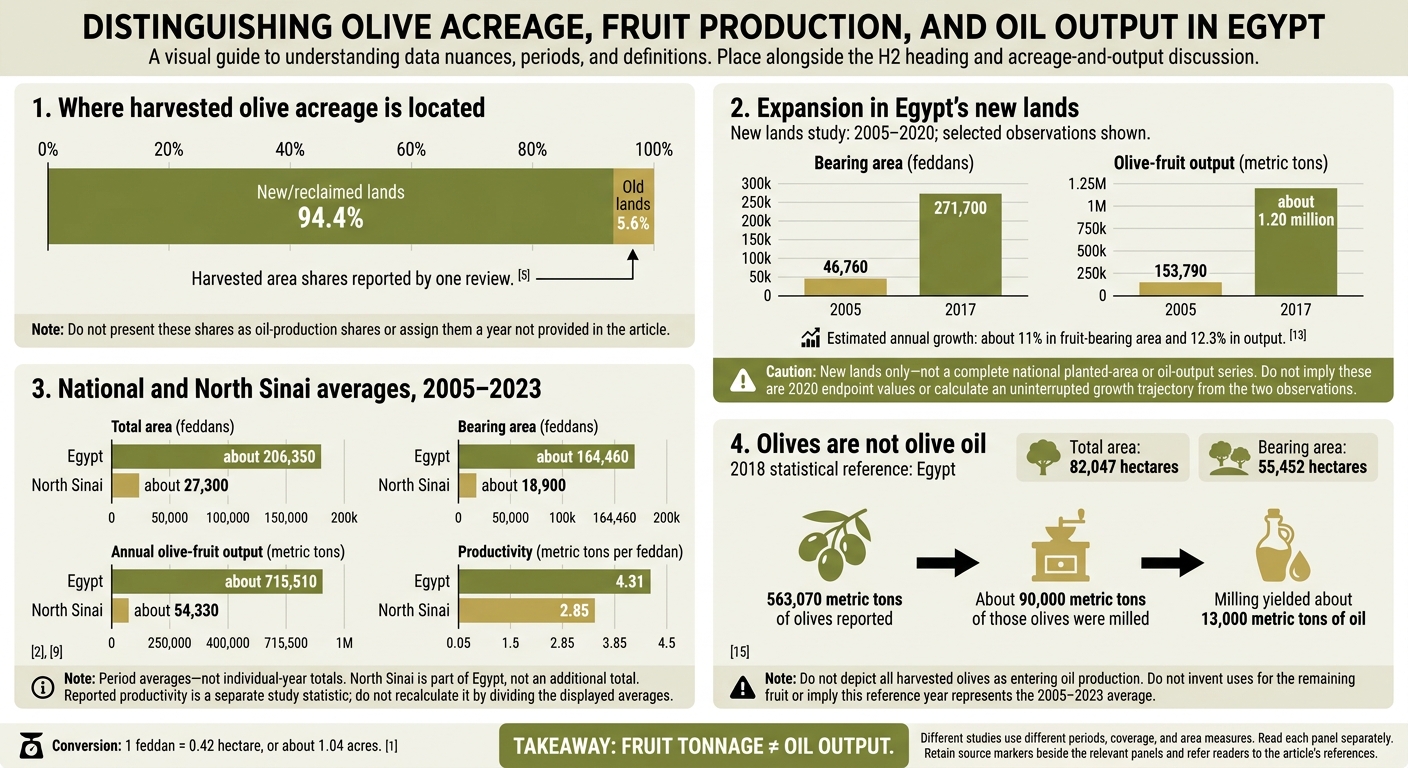
Egypt Olive Production: Acreage, Fruit and Oil
Olive Acreage and Output, 2005–2023
Reclaimed land accounts for most of Egypt’s olive expansion. One review places 94.4% of harvested olive area in new lands and 5.6% in old lands. Most expansion takes place on reclaimed desert land, where irrigation and orchard management shape yields.
The totals also hide sharp regional differences in land use and orchard intensity. Read the figures separately: they measure different things. The reclaimed-land study estimated annual growth of about 11% in fruit-bearing area and 12.3% in output. One feddan equals 0.42 hectare, or about 1.04 acres.
| Study period | Geographic coverage | Area measure | Production measure | Main finding |
|---|---|---|---|---|
| 2005–2020 | Egypt’s new lands | Bearing area: 46,760 feddans in 2005 and 271,700 feddans in 2017 | Olive-fruit output: 153,790 metric tons in 2005 and about 1.20 million metric tons in 2017 | Reclaimed and newly developed areas grew sharply, but these figures are not a complete national planted-area or oil-output series. |
| 2005–2023 | Egypt and North Sinai | National averages: about 206,350 feddans total area and 164,460 feddans bearing area; North Sinai averages: about 27,300 total feddans and 18,900 bearing feddans | National average output: about 715,510 metric tons, with productivity of 4.31 metric tons per feddan; North Sinai average output: about 54,330 metric tons, with productivity of 2.85 metric tons per feddan | Read North Sinai’s figures separately from the national averages. |
| 2018 statistical reference | Egypt | Total area: 82,047 hectares; bearing area: 55,452 hectares | 563,070 metric tons of olives. About 90,000 metric tons were milled, yielding about 13,000 metric tons of oil. | Fruit tonnage and oil volume are not interchangeable. |
Matrouh, Beheira, Ismailia, Fayoum, Sinai, and Oases
Regional names can overlap. Don’t add acreage across Matrouh, the northwestern coast, Beheira, El-Nubaria, and other development zones as though each were a separate system. A region may appear under different administrative names, so the table distinguishes geography from development category.
| Region or system | Land use | Role | Conditions | Crop type |
|---|---|---|---|---|
| Matrouh and the northwestern coast | Mediterranean desert-margin orchards | Matrouh averaged about 38,290 feddans planted, 36,060 bearing feddans, and 147,210 metric tons of output in the cited study. | Low rainfall, heat, wind, and reliance on irrigation | Table and oil olives |
| Beheira and El-Nubaria | Established farmland and reclaimed land | Commercial orchards in Beheira governorate and the El-Nubaria development area. | Irrigation, sandy reclaimed soils, and salinity risk | Table and oil olives |
| Ismailia | Eastern Delta reclaimed land | Experimental intensive and super-high-density orchards; a 2022–2023 study compared Coratina, Koroneiki, and Maraki. | Hot, dry conditions; irrigation and orchard design matter | Oil cultivars |
| Fayoum | Established agricultural and oasis-adjacent land | Long-standing production, including Toffahi, Aggezi Shami, and Aksi. | Heat and reliance on irrigation | Table and oil olives |
| North Sinai | Arid northeastern orchards | A major producer in the 2005–2023 dataset. | Low rainfall, heat, wind, and irrigation constraints | Table and oil olives |
| Siwa and other oasis systems | Long-standing oasis agriculture | Locally adapted orchards, including Hamed, Maraki, Siwee, and Watakin. | Severe aridity; oasis water supply is decisive | Table and oil olives |
Higher planting density has been tested, but it is not the national norm.
In the 2022–2023 Ismailia study, Koroneiki had the highest fruit-yield performance among the tested cultivars under the evaluated systems. This points to matching cultivar to orchard design, not treating one system as universal.
Water and climate help explain these regional differences; the next section examines both.
sbb-itb-4066b8e
Land Use, Water, and Climate
Reclaimed Land and Irrigation
Regional yield gaps reflect differences in water supply, soil type, and heat stress.
Drought tolerance doesn’t mean low irrigation demand. In El-Nobaria, sandy, alkaline soil with little organic matter needs close water and nutrient management. Because sandy soils drain quickly, irrigation should be frequent and well timed. Check root-zone moisture, water salinity, and emitter performance regularly. Mulch can also help retain moisture.
One Egypt-focused assessment estimated olive evapotranspiration at about 815,000 gallons per feddan (3,085 m³) over roughly 270 days. In a Wadi El-Natrun trial, irrigation at 75% of crop evapotranspiration (ETc) produced higher yields than either 50% or 100% ETc. These are local benchmarks, not universal targets. Test changes on a small block first, taking tree age, canopy size, crop stage, and soil moisture into account.
Weather Effects on Olive Growth
A 2024 survey of eight olive-producing regions found that rainfall frequency was the only climate factor with a statistically significant link to average productivity across the full sample. Cold snaps also affected results in some regions. Rain during flowering can disrupt pollination and increase disease risk. Sudden cold can damage actively growing tissues, while excessive heat can reduce flower viability and fruit set.
| Production zone | Climate and soil advantages | Risks and water-management concerns |
|---|---|---|
| Coastal Mediterranean | Milder winters and seasonal rainfall; summer temperatures of about 77–95°F (25–35°C) and winter temperatures of 45–64°F (7–18°C). | Annual rainfall of about 3.9–5.9 inches (100–150 mm), mainly in fall and winter, generally leaves a need for supplemental irrigation. |
| Delta and valley | Established surface-water systems and finer soils can support productivity. | Drainage, salinity, and humidity still affect results; irrigation method and soil type also influence productivity. |
| Reclaimed desert | Large area available for expansion, but high irrigation demand. | Fast drainage, groundwater salinity, wind, and heat complicate irrigation. Moghra receives only about 1–2 inches (25–50 mm) of annual rain, with summer temperatures reaching about 106.5°F (41.4°C). |
Evapotranspiration connects weather to irrigation demand. An Egypt-focused review reported reference evapotranspiration increasing from about 1.42 inches (36 mm) per month in January to 6.57 inches (166.8 mm) in July. Hot, dry, windy weather increases water loss. Higher humidity reduces evaporative demand but can increase disease pressure when foliage stays wet. Estimate ETc using local reference evapotranspiration (ETo) and a crop coefficient, then check the estimate against soil-moisture readings.
A Siwa study projected a summer temperature increase of 3.02 ± 2.95°F (1.68 ± 1.64°C) by 2060 under RCP 4.5 and 8.37 ± 3.28°F (4.65 ± 1.82°C) by 2100 under RCP 8.5. These projections suggest higher evaporative demand.
These stresses also affect the chemistry and shelf-life results discussed in the cultivar studies that follow.
Cultivars and Oil Quality
Cultivar Studies in Egypt
Cultivar affects oil quality, but it doesn’t tell the whole story. Egyptian studies show that its effects depend on location, irrigation, climate, fruit maturity, and processing. Picual appears often in these studies, but it isn’t a universal benchmark.
| Study | Reported findings and takeaway |
|---|---|
| Picual–Koroneiki irrigation comparison | Picual had higher oleic acid, phenolics, tocopherols, and oxidative stability than Koroneiki in this test. Treatment details were not reported. |
| Koroneiki–Coratina comparison, Khatatba, Sadat City, Minufiya Governorate | Koroneiki had 530 mg/kg total phenolics and 155 mg/kg alpha-tocopherol. These measurements alone don’t establish overall quality. |
| Six-cultivar study under Egyptian conditions | Koroneiki and No. 69 showed promise for intensive oil production under the tested conditions - not superiority across all conditions. |
Missing details about season, maturity, extraction, and management make comparisons between studies difficult.
Oil Composition, Flavor, and Shelf Life
Ripeness and processing change oil chemistry, which helps explain why cultivar results vary. Oleic acid resists oxidation better than more unsaturated fats. Phenolics add bitterness and help slow oxidation, while tocopherols provide antioxidant protection.
But chemical measurements aren’t tasting results. High total phenolics alone can’t establish a specific flavor without sensory evaluation. Irrigation and fruit maturity can also change these measurements.
Koroneiki’s oxidative stability fell from 33.41 to 23.70 hours as fruit ripened.
Those lab hours don’t translate into a fixed shelf life at home. Strong lab results don’t guarantee the same flavor or storage life in every bottle.
Damaged fruit and delays before milling can increase acidity and sensory defects. Extraction temperature, malaxation time, air exposure, filtration, and cleanliness also affect the finished oil. Cold extraction describes a method - not a quality guarantee.
Ask about harvest-to-mill time and lab results. Free acidity, peroxide value, and K232/K270 measure different aspects of oil quality; none replaces tasting. Packaging, oxygen, light, and storage temperature affect how fast quality declines.
How to Select and Store EVOO
Storage matters as much as cultivar because both chemistry and handling affect quality. Check harvest information, producer and lot identification, and any available chemical or sensory documentation.
Choose protective packaging, such as dark glass or tins, in a size you can finish without leaving the oil exposed for a long time after opening. Keep it tightly closed in a cool, dark cupboard, away from ovens and windows.
Conclusion: Main Findings and Research Gaps
Egypt’s olive expansion is closely tied to reclaimed land. Reported national averages for 2005–2023 were about 206,350 feddans in total area, 164,460 bearing feddans, 4.31 tons per feddan, and 715,510 metric tons of olives per year - not olive oil. These averages do not show uninterrupted growth.
National totals also mask sharp regional differences. Output depends on irrigation, climate, and cultivar choice, and no single variety works best in every system.
These regional differences make studies hard to compare. The main research gap is comparability: stronger evidence requires multi-year sampling across regions, separate totals for table olives and oil olives, sensory panels, and shelf-life trials.
Oil quality depends on chemistry, processing, and storage - not origin alone. For buyers judging taste and shelf life, verified harvest records, producer traceability, and documented quality results matter more than the region itself.
FAQs
How can I verify an Egyptian olive oil’s quality?
Look for a clear harvest date and olive variety on the label. For the best flavor and shelf life, use the oil within 12 to 18 months of harvest. Quality also depends on how well the olive variety suits the climate where it’s grown.
High-quality extra virgin olive oil should meet strict standards: low acidity - typically below 0.8% - and no sensory flaws.
Does a bitter olive oil stay fresh longer?
Yes, bitter olive oil typically lasts longer. Its bitterness often points to high levels of polyphenols - natural antioxidants that help protect the oil from oxidation and rancidity.
Early-harvest green olives contain the most polyphenols and produce bold, bitter oils with a pungent kick. These oils generally have a longer shelf life than the milder, sweeter oils made from fully ripe olives.
How could climate change affect Egyptian olive oil?
Climate change affects olive oil quality by changing temperature, rainfall, and humidity. Higher temperatures can reduce oleic acid, making the oil less stable and shortening its shelf life. Warmer conditions may also lead to milder flavors while increasing oxidation and deterioration.
Drought can cut yields, though moderate stress may sometimes concentrate antioxidants that help protect the oil. These changes affect its fatty acid composition, antioxidant levels, and how well it holds up over time.