

Environmental Impact of Chemicals in Olive Oil Farms
Olive farming can damage soil, water, and wildlife when growers rely too much on pesticides, herbicides, copper sprays, and mineral fertilizers. I’d sum it up this way: bare soil erodes faster, runoff carries chemicals into streams, copper stays in soil for years, and residue checks still find some pesticides in olive oil.
Here’s the short version:
- Soil loss can climb fast when orchards keep the ground bare. In Córdoba, erosion was under 1 ton per hectare per year with cover crops, versus about 7 tons under bare-soil no-till and 13 tons under tillage.
- Copper can build up in topsoil because it does not break down there. One Mediterranean survey found 30% of olive grove soil samples above 100 mg/kg copper.
- Plant cover helps wildlife. In southern Italy, organic plots had about 78% vegetation cover versus 43% in conventional plots.
- Residues are still checked in oil. One Italian monitoring program found 93.5% of olive oil samples had no detectable residues, and none went over legal limits.
- The main fixes are already known: cover crops, mulching, reduced spraying, compost-based fertility, IPM, traceability, and lab testing.
If I were buying olive oil, I’d look past the label and ask a simple question: How was this grown, and can the producer prove it?
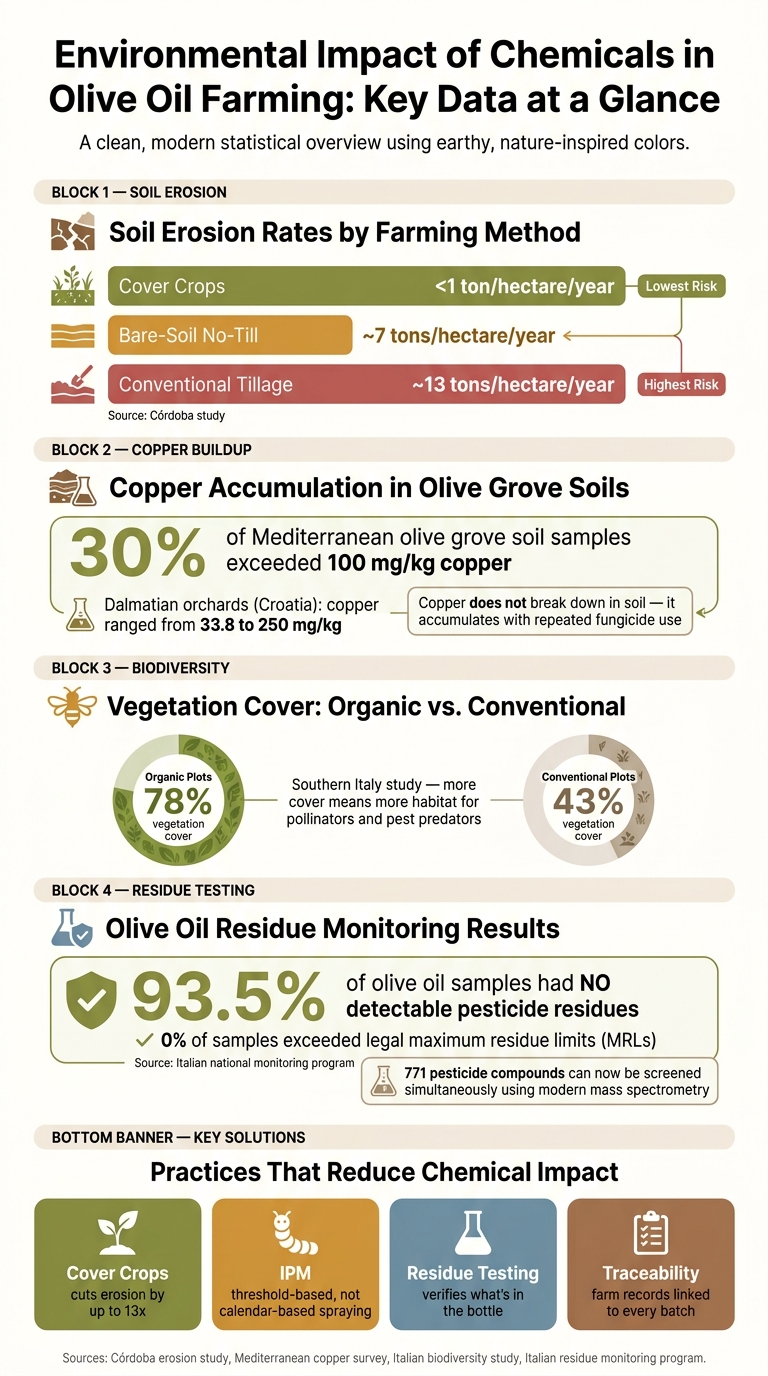
Chemical Impact on Olive Farms: Key Environmental Data
Quick Comparison
| Area | Main risk from heavy chemical use | What lowers the risk |
|---|---|---|
| Soil | Erosion, compaction, loss of soil life | Cover crops, mulching, less bare ground |
| Water | Runoff with herbicides, nutrients, copper | Buffer strips, better nutrient use, less runoff |
| Biodiversity | Fewer plants, insects, and birds | Mixed groundcover, less broad-spectrum spraying |
| Oil checks | Pesticide or metal residue risk | IPM, batch records, residue testing |
The core point is simple: olive oil starts in the orchard, so farm records and lab tests matter just as much as what the bottle says.
sbb-itb-4066b8e
The Problems Caused by Agrochemicals in Olive Farming
Chemical-heavy olive farming can wear down soil, pollute water, and shrink biodiversity.
Soil Degradation, Erosion, and Loss of Fertility
When herbicides keep the ground bare between tree rows, rain has little to slow it down and less to hold the topsoil in place. That’s a big issue on sloped land, which is common in Mediterranean olive farming. In Córdoba, cover crops cut erosion to under 1 ton per hectare per year, compared with about 7 tons under bare-soil no-till and 13 tons under conventional tillage.
The damage doesn’t stop at erosion. Repeated use of synthetic fertilizers and pesticides can weaken the living part of the soil. Microbes, earthworms, and fungi help cycle nutrients, and long-term chemical exposure can hurt those organisms. As soil organic matter drops, the soil gets more compacted, takes in less water, and holds fewer nutrients.
And once rain starts moving across that soil, it carries more than dirt with it.
Water Contamination and Copper Buildup
When rain falls on bare, compacted ground, more of it runs off instead of soaking in. That runoff can carry dissolved herbicides, extra nitrogen and phosphorus from fertilizers, and fungicide residues into nearby streams and drainage channels. In sandy soils or heavily irrigated groves, some of those compounds can also move down into groundwater.
Copper-based fungicides are a major long-term issue. With repeated use, copper builds up in the topsoil. A Mediterranean survey found that 30% of olive grove soil samples went over 100 mg/kg of copper, a level linked to toxicity in soil organisms. In Dalmatian olive orchards in Croatia, copper levels ranged from 33.8 to 250 mg/kg, and researchers tied that directly to long-term fungicide use. Then erosion adds another layer to the problem by moving that copper-heavy soil into nearby waterways.
Less plant cover on the ground also means fewer places for helpful species to live.
Biodiversity Loss and Residue Concerns
Herbicides don’t just remove weeds. They also wipe out mixed plant cover that supports insects, birds, and other wildlife. In southern Italy, organic olive plots had about 78% vegetation cover, compared with about 43% in conventional plots. That gap can mean less habitat for pollinators and natural pest predators.
When broad-spectrum insecticides enter the picture, the pressure gets worse. Helpful insects like bees and predatory beetles can face direct toxicity, along with sublethal effects such as impaired navigation.
Monitoring still finds residues in some oils, though they are usually below legal limits. That’s why orchard management and testing matter.
Farming Methods That Cut Chemical Use in Olive Orchards
Growers can cut these impacts with field-tested practices. Each one goes straight at a main pressure point:
| Problem | Practical Response |
|---|---|
| Soil erosion | Cover crops, conservation tillage, organic mulching |
| Water contamination and copper buildup | Organic fertilization, copper reduction plans, buffer strips or vegetated waterways |
| Biodiversity loss | Mixed groundcover with legumes and flowering plants, reduced herbicide use |
| Pesticide residue accumulation | Integrated Pest Management (IPM), threshold-based treatments, residue testing |
The methods below show what that looks like in day-to-day orchard work.
Organic and Reduced-Input Orchard Management
Organic and reduced-input management lowers synthetic use in fertilization, weed control, and pest control. Instead of synthetic nitrogen and phosphorus, growers apply composts, manures, olive pomace compost, and shredded pruning residues. These inputs help soil microbes, support nutrient cycling, and cut nutrient leaching.
Weed control also changes. Rather than spraying across the whole orchard floor, growers lean on mechanical weeding, mowing, and mulching. Trials in high-density olive orchards show that organic mulching paired with mechanical weeding can control weeds well without herbicide inputs. The payoff is simple: less bare soil and less runoff.
Cover Crops, Groundcover, and Conservation Tillage
Groundcover between tree rows does a lot of heavy lifting. It cuts erosion and helps hold soil in place when rain hits. A four-year trial comparing cover crops with conventional tillage found that runoff under cover crops was only 5.68% of rainfall, with average soil loss of just 0.04 kg/m² per year - far below losses recorded under conventional tillage.
Vegetated groundcover also stores carbon, cuts nutrient loss, and helps biodiversity. Studies show that undisturbed understory vegetation improves ground beetle and bee richness, along with overall arthropod abundance. That matters because more beneficial insects can strengthen natural pest control without extra spraying.
Integrated Pest Management in Olive Groves
IPM swaps routine broad-spectrum spraying for a tighter system built around monitoring, thresholds, and selective controls. For olive fruit fly (Bactrocera oleae), IPM programs use yellow sticky traps baited with sex pheromones and food attractants to track adult populations. Growers step in only when trap counts and fruit sampling pass an economic threshold, instead of spraying by the calendar.
When action is needed, mass trapping and attract-and-kill systems can reduce adult flies without blanket sprays. Studies show these methods rank among the most effective options for cutting adult fly populations compared with conventional sprays. Growers also stack in simple field moves, like harvesting on time to avoid peak fly pressure and removing infested fruit to cut breeding sites.
The residue data backs up that shift. Recent Italian monitoring found 93.5% of olive oil samples had no detectable residues, and none exceeded legal MRLs.
Even then, orchard records and lab testing are what verify results at the bottle.
Traceability, Testing, and Producer Accountability
Chemicals shape soil health, water quality, and residue risk. So buyers usually want more than a claim on a label. They want proof. That proof comes from batch records, lab results, and standards that let someone verify orchard practices all the way down to a single bottle.
How Traceability Connects the Farm to the Bottle
Impact on the grove only matters to buyers if a producer can show what actually happened there. Traceability means tracking one specific lot of oil from a named orchard, through the mill, and into a labeled bottle.
For that to work, each lot needs field records that spell out the basics:
- pesticide applications
- dates
- doses
- operators
- pre-harvest intervals
Batch codes linked to harvest dates and mill runs make the chain easier to follow. If a problem comes up later, that code can connect the bottle back to its source.
California's olive oil standards require traceability and identification records to be kept for at least three years. The EU Court of Auditors also found some olive oils could not be traced to origin, which shows how weak recordkeeping can undermine accountability.
Those records also make the next step possible: testing.
What Certifications and Lab Testing Can Show
The International Olive Council (IOC) trade standards state that pesticide residues must comply with Codex limits and also set trace-metal limits, including copper ≤ 0.1 mg/kg. In plain terms, farm decisions can show up in the final safety profile of the oil.
Modern residue screening can check for a huge number of pesticide compounds at the same time. In 2024, researchers developed a method capable of monitoring 771 pesticide compounds in olive oil using high-resolution mass spectrometry. A 2025 study validated monitoring of 260 pesticide residues in extra virgin olive oil for a multiannual control program. And in the UK, a pesticide monitoring report found that among 72 olive oil samples collected in 2018, none contained a pesticide residue above the MRL.
The table below shows how day-to-day producer practices connect to specific indicators that can be measured:
| Producer Practice | Measurable Indicator |
|---|---|
| Residue testing | MRL compliance, detectable residue levels, pass/fail after accounting for measurement uncertainty |
| Cover crops | Soil organic matter change, erosion incidents per season, reduced contamination risk |
| Integrated Pest Management | Pesticide applications per acre per year, ratio of non-chemical to chemical interventions |
Put simply, traceability shows where the oil came from, and testing shows what's in it. Together, they make it easier to check whether orchard claims line up with the oil in the bottle.
Conclusion: What Responsible Olive Farming Looks Like
Chemical-heavy olive farming wears down the land. It harms soil, pollutes water, and shrinks biodiversity. Over time, those effects stack up and make orchards less healthy.
The fix isn’t more spraying. It’s smarter orchard management.
Methods like cover crops, reduced-input management, and IPM are already cutting these harms in working orchards. They help growers manage pests and orchard health with less chemical pressure.
Just as important, producers need to prove what they’re doing. Traceability and lab testing make sustainability claims something buyers can check, not just take on faith. That’s why buyers should look past the front label and ask how the oil was made.
Responsible olive farming means cutting chemical harm and backing up claims with traceable, tested practices.
FAQs
How does copper buildup affect olive grove soil over time?
The provided sources do not explain how copper buildup affects olive grove soil over time.
Instead, they focus on other issues tied to soil health in olive production, such as:
- synthetic fertilizers
- pesticides
- soil compaction from tillage
- the use of organic amendments
- cover crops
So, while the sources discuss soil damage and soil care more broadly, they do not address copper’s impact on the soil.
What can buyers ask to verify sustainable olive farming?
Buyers can ask for certifications like the hydroSOS quality index. It measures irrigation efficiency and can support better resource use and oil quality.
They can also ask if the producer:
- uses no-till farming
- plants cover crops
- relies on precision irrigation tools like CropWat and OliveCan
- avoids synthetic fertilizers
- runs pesticide residue testing
Those questions give buyers a clearer picture of how the olives are grown and how the oil is produced.
Do cover crops lower pesticide and runoff risks?
Yes. Cover crops can cut runoff risk in a big way because they improve soil structure and help water move into the ground instead of flowing off the surface. Research shows runoff can drop by as much as 43% compared with conventional tillage.
Their effect on specific pests can differ from one farm to another. Still, cover crops can support natural pest control and may reduce the need for synthetic chemical treatments.