

EU Olive Oil Standards: Non-Compliance Penalties
The European Union has implemented strict regulations to ensure olive oil quality, combat fraud, and protect consumers. Updated in November 2022, these rules set clear labeling requirements, chemical and sensory standards, and enforce origin transparency. Violations, such as mislabeling, adulteration, or failing tests, can lead to fines, product seizures, or criminal charges. Rising olive oil prices, driven by climate impacts, have amplified fraud risks, with 50 cross-border alerts reported in early 2024 alone. Member States conduct annual checks and enforce penalties to uphold these standards. Producers must prioritize accurate testing, detailed records, and compliance to avoid penalties and maintain market trust.
Is your olive oil real or fake? How the Food Detectives can fight fraud using DNA tests
Common Violations of EU Olive Oil Standards
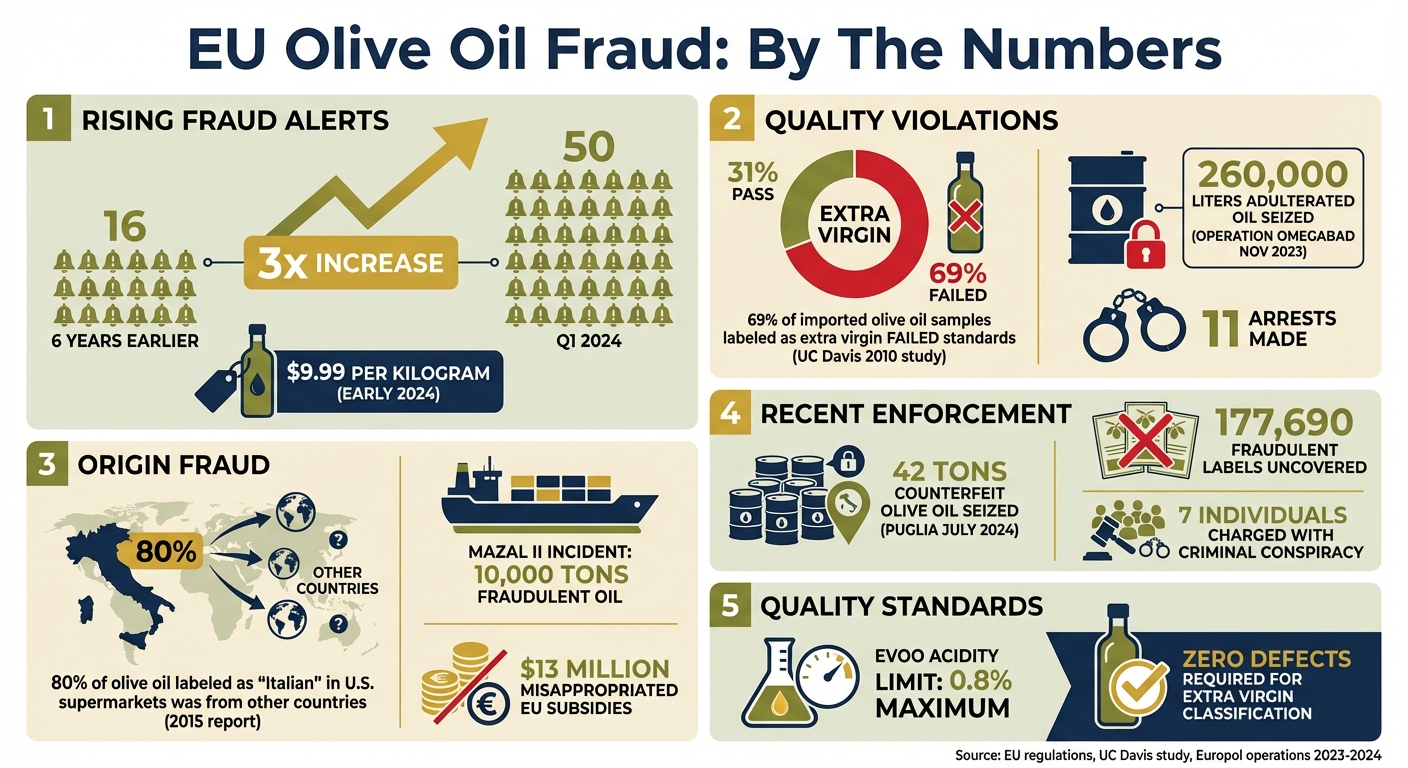
EU Olive Oil Fraud Statistics and Compliance Data 2024
Despite strict regulations, olive oil fraud remains a persistent issue across the EU. In the first quarter of 2024 alone, there were 50 cross-border alerts for olive oil mislabeling - more than three times the number reported six years earlier. Climate-related harvest failures in Spain and other Mediterranean regions have driven prices to record highs, reaching $9.99 per kilogram (about $4.53 per pound) in early 2024. These soaring prices have created strong financial incentives for fraudulent practices. This section outlines some of the most common violations, setting the stage for the enforcement measures discussed later.
False Quality Claims and Mislabeling
One of the most frequent violations involves falsely labeling lower-grade oils as premium products. Grade inflation is a key issue, where virgin or lampante oil (with an acidity level above 2%, making it unsuitable for direct consumption) is mislabeled as extra virgin olive oil (EVOO). A 2010 study by the University of California, Davis revealed that 69% of imported olive oil samples labeled as extra virgin failed to meet the required standards.
Another widespread practice is adulteration - mixing olive oil with cheaper seed oils like sunflower, soybean, canola, or hazelnut oil. These mixtures are then marketed as "100% pure" or "extra virgin." In November 2023, during Operation Omegabad, authorities in Spain and Italy arrested 11 people and seized 260,000 liters of adulterated oil.
More advanced fraudulent methods involve blending EVOO with deodorized lampante oil or "remolido" (oil extracted from a second centrifugation of olive paste), making detection even harder for regulators.
Geographic Origin Fraud
Misrepresenting the origin of olive oil is another common violation. Producers often falsely label oils from countries like Tunisia, Turkey, or Spain as premium Italian or Greek products to fetch higher prices. A 2015 report found that up to 80% of olive oil labeled as "Italian" in U.S. supermarkets was actually sourced from other countries.
One infamous case, the Mazal II incident (August–November 1991), involved a tanker delivering nearly 10,000 tons of Turkish hazelnut oil and Argentinean sunflower-seed oil that was falsely documented as Greek olive oil. This scheme led to roughly $13 million in misappropriated EU subsidies.
Beyond origin mislabeling, compliance issues with technical standards can also affect product classification.
Failing Chemical and Sensory Tests
To qualify for its labeled category, olive oil must pass both chemical and sensory evaluations. Sensory testing, conducted by certified tasting panels, ensures the oil has the required fruitiness and is free from flavor defects.
Misclassification often occurs when oils with sensory flaws or excessive acidity are labeled as extra virgin. For EVOO, acidity must not exceed 0.8%, and the oil must have zero defects while maintaining a fruity profile . As Flavio Zaramella, President of the Corporazione Mastri Oleari, put it:
If there's one defect, it's not extra-virgin olive oil - basta, end of story.
In July 2024, Italian authorities in Puglia seized 42 tons of counterfeit olive oil already packaged for sale and uncovered an additional 177,690 fraudulent labels. Seven individuals were charged with criminal conspiracy for distributing the fake oil.
Degradation issues, such as high peroxide levels or increased acidity, are often linked to poor storage, excessive heat exposure, or the use of overripe or damaged olives .
How EU Olive Oil Standards Are Enforced
In the European Union, each member state assigns specific authorities to ensure olive oil complies with established regulations. These agencies carry out inspections, test samples, and collaborate across borders to combat fraud. The enforcement system uses a combination of risk-based inspections, laboratory testing, and administrative coordination to catch violations before products reach consumers. Here's a closer look at how this process works on a national level.
National Authority Responsibilities
Each country’s designated agencies are tasked with conducting regular conformity checks and reporting back to EU bodies. Larger markets often see stricter oversight due to the volume of production and trade.
To decide which products or operators to inspect, enforcement agencies rely on risk analysis. They consider several factors, including the type of olive oil, its price compared to other vegetable oils, blending or packaging methods, storage conditions, country of origin or destination, and the operator's track record with quality controls. High-risk situations - such as suspiciously low-priced "extra virgin" olive oil or shipments from areas with known fraud issues - are flagged for closer scrutiny.
In Spain, for example, enforcement operates on multiple levels. The Official Service of Surveillance, Certification and Technical Assistance of Foreign Trade (SOIVRE) handles physico-chemical and sensory tests on olive oil exports. Spanish Customs also conducts additional testing for oils destined for the United States. Meanwhile, Spain’s 17 autonomous communities perform inspections at manufacturing facilities. If an irregularity involves an operator in another EU country, authorities use the Information Management System for Official Controls (IMSOC) to coordinate cross-border investigations. Risk-based targeting is followed by standardized testing to ensure compliance.
Testing and Inspection Methods
Authorities adhere to international standards like EN ISO 661 for sample preparation and EN ISO 5555 for sampling procedures. Samples must reach the testing laboratory within five working days. For bulk oils, chemical and sensory tests are required to be completed within six months of sampling.
Testing methods involve both chemical and sensory analyses. Chemical tests measure factors like acidity, peroxide value, UV absorbance (K232, K270), fatty acids, waxes, and ethyl esters, using methods approved by the International Olive Council (IOC). Sensory evaluations are conducted by certified tasting panels.
If an initial test finds non-compliance, operators can request two additional assessments by different approved panels. For oils produced outside the EU, these follow-up tests must be conducted by panels other than the one that made the original finding. If both additional panels confirm non-compliance, the operator is responsible for covering the costs.
To streamline inspections, operators involved in every stage - from milling to bottling - are required to keep detailed records of all olive oil categories they handle. These records, along with product labels and other documentation, are reviewed by authorities to verify that the oil's declared characteristics and origin are accurate.
sbb-itb-4066b8e
Penalties for Violating EU Olive Oil Standards
The EU has a robust enforcement framework to ensure fair practices for both producers and consumers. Penalties for violating olive oil standards range from administrative fines to criminal charges, depending on the severity of the offense. Member States are tasked with applying penalties that are effective, fair, and discouraging, as outlined in Commission Implementing Regulation (EU) 2022/2105.
Fines and Financial Penalties
Administrative penalties often involve monetary fines or even the confiscation of non-compliant products. The severity of these penalties depends on several factors, including the violator's role in the supply chain, the quantity of non-compliant oil, any prior violations, and false claims about pricing or geographic origin. Each year, by May 31, Member States are required to submit reports to the European Commission detailing the results of conformity checks and the penalties imposed. If the violations are particularly serious, authorities may escalate the matter to criminal proceedings.
Criminal Charges and Legal Action
In cases of large-scale fraud, administrative measures may not suffice. Criminal charges are pursued, especially for organized fraudulent activities, often referred to as "Agromafia" operations. Examples include using chemicals to deodorize low-quality oils and selling them as extra virgin or diluting high-quality olive oil with cheaper seed oils like sunflower or soybean. Such practices can lead to severe consequences, including jail time, hefty fines, or even permanent closure of businesses. These fraudulent activities are estimated to generate illicit profits of around $16 million annually.
Real Enforcement Examples
Enforcement efforts have had a significant impact. For instance, Italian authorities have seized thousands of tons of counterfeit olive oil. In the U.S., testing by the National Consumers League revealed that more than half of the sampled products failed to meet standards. This prompted congressional action, requiring the FDA to test imported oils for authenticity and enforce stricter labeling regulations. These examples highlight the global scope of enforcement measures aimed at combating olive oil fraud and ensuring compliance across borders.
How to Meet EU Olive Oil Standards
Complying with EU olive oil standards requires strict quality control measures, transparent supply chain practices, and constant attention to regulatory updates. Producers and suppliers who prioritize thorough testing and meticulous record-keeping can sidestep penalties for non-compliance.
Quality Control and Labeling Practices
To meet EU standards, keeping detailed traceability records is essential. These records track every step of the oil's journey, from milling to bottling, and they’re crucial for passing the annual inspections required for every thousand tons of production.
Producers must also conduct chemical tests to verify quality. These tests measure factors like acidity, peroxide levels, K232, K268, and fatty acid ethyl esters. Additionally, sensory panel evaluations confirm the oil's key characteristics - bitterness, pepperiness, and fruitiness. As Marco Michelini, Field Operations Manager, puts it:
Without the bitter aftertaste - without the bite in the back of the throat, it's not extra virgin.
Proper sample storage is also critical. Samples should be kept away from light and heat and sent to labs within five working days to avoid deterioration. Harvest timing plays a big role in quality as well. Daniela Adamo, owner of Baglio Cappello, explains:
We pick the olives at the beginning of October - I want the olives when they're green because the content of polyphenols is highest. If you don't pick the olives when they're green, they will ripen and turn black. At that point, the polyphenols oxidize and degrade so the oil is less healthy.
Independent certification offers an additional safeguard. EU-approved labs can verify compliance with International Olive Council (IOC) standards before bottling. Considering the IOC oversees 97% of global olive oil production and 96% of exports, its standards are the gold standard for the industry. These steps not only ensure quality but also help prevent fraud.
Preventing Fraud in Your Supply Chain
Fraud in the olive oil supply chain remains a persistent challenge. In November 2023, Spanish and Italian authorities, with Europol's support, uncovered a major fraud operation involving 260,000 liters of counterfeit olive oil labeled "unfit for consumption." Eleven suspects were arrested during this international operation. Factors like price inflation, reduced production, and rising demand often create opportunities for such fraud.
To minimize risks, producers should evaluate suppliers based on factors like oil category, pricing, storage conditions, and compliance history. Testing incoming batches using IOC-approved methods can confirm quality and detect adulteration. Some producers have adopted "tree-to-table" practices, managing every stage - from harvesting to milling - on-site to reduce contamination risks.
Certain Member States offer official approvals and unique identifiers for packaging plants that meet strict storage and documentation standards. This helps track provenance more effectively. If a sensory panel test yields negative results, operators can request two additional tests from other recognized panels to verify findings.
Where to Find Regulatory Updates
Keeping up with regulatory changes is vital for maintaining compliance and improving fraud prevention strategies. Several official sources provide the necessary updates:
- EUR-Lex: The go-to database for EU law, including full texts of key regulations like Commission Delegated Regulation (EU) 2022/2104 (marketing standards) and Commission Implementing Regulation (EU) 2022/2105 (conformity checks) .
- European Commission's Olive Oil Portal: Offers policy summaries, legislative updates, and market data tailored to the olive oil sector.
- International Olive Council (IOC): Publishes the standardized methods for chemical and sensory testing required for EU conformity checks, such as COI/T.20/Doc. No 15.
| Resource Type | Official Source | Primary Use |
|---|---|---|
| Legal Texts | EUR-Lex | Access regulations like (EU) 2022/2104 and 2022/2105 |
| Technical Methods | International Olive Council (IOC) | Chemical and sensory testing protocols |
| Policy & Market Data | European Commission (Agri-food) | Legislative summaries and sector updates |
| National Enforcement | Member State Authorities | Local inspections, approvals, and certifications |
Each Member State has designated authorities to carry out conformity checks and guide local producers. For instance, Spain relies on the Official Service of Surveillance, Certification and Technical Assistance of Foreign Trade (SOIVRE) . The Official Journal of the European Union is another essential resource for tracking new regulations, amendments, and legal updates as they come into effect.
Recently, the EU revised its olive oil framework, replacing older regulations to simplify marketing standards and testing methods. Regular consultation of these resources ensures that producers stay ahead of changing requirements.
Conclusion
EU standards play a crucial role in maintaining both consumer trust and fair market access. Ignoring these regulations can lead to hefty financial penalties, legal troubles, and reputational damage. These consequences highlight the importance of adhering to compliance requirements.
This regulatory framework safeguards consumers by ensuring product quality and authenticity. For instance, recent tests revealed that nearly 40% of Extra Virgin Olive Oil samples failed to meet quality standards, with over 14% being mislabeled. Such lapses not only jeopardize public health but also undermine trust in the entire industry. As Roberta Capecci and Roberto Ciancio from Italy's Central Inspectorate of Quality Protection and Fraud Prevention put it:
Labeling, therefore, is the meeting point of two different needs: that of the producer, who wants to adequately promote his or her olive oil by differentiating it from others, and that of the consumers, who want to know exactly what they are buying.
To uphold these standards, producers must commit to rigorous testing, detailed documentation, and constant vigilance against fraud. The regulatory framework is designed to ensure fair competition where quality takes precedence over deception.
For producers who meet these high standards, the rewards are significant. Compliance not only guarantees product integrity but also unlocks access to global markets. With EU olive oil production expected to grow by 31% by 2025, adhering to these standards is more than a legal obligation - it's a strategic advantage in a market where quality triumphs over fraud.
FAQs
What penalties can be imposed for not meeting EU olive oil standards?
Non-compliance with EU olive oil regulations can lead to serious consequences, including financial penalties and even legal proceedings. These rules are in place to uphold the quality, integrity, and transparency of the olive oil industry.
The severity of the penalties often depends on the type and extent of the violation. Businesses caught breaking these standards could face hefty fines and significant harm to their reputation. Keeping up-to-date with compliance requirements is crucial to avoid these risks and preserve consumer trust.
How does climate change affect olive oil fraud?
There’s no definitive proof that climate change - like altered harvest seasons, reduced yields, or storage difficulties - directly leads to an increase in olive oil fraud. Research and regulations currently emphasize maintaining quality standards, ensuring compliance with EU guidelines, and conducting authenticity tests. While climate factors can affect production, any direct link to fraudulent practices hasn’t been established based on the information available.
How can olive oil producers comply with EU standards and avoid penalties?
To meet EU olive oil standards and avoid potential penalties, producers need to prioritize strict quality control and compliance with regulations. Start by establishing a HACCP-based system to carefully monitor critical stages such as harvesting, production, and bottling. It's also important to routinely test your olive oil in certified laboratories to confirm it aligns with EU criteria, including free acidity (≤ 0.8 g per 100 g), peroxide levels, UV absorption, and sensory characteristics.
Equally crucial is ensuring your labeling and packaging adhere to EU marketing rules. This includes providing accurate product categories and maintaining full traceability from the orchard to the bottle. Securing certification from a laboratory recognized by the International Olive Council can further demonstrate compliance and enhance consumer confidence. By taking these steps, producers like Big Horn Olive Oil can not only meet EU standards but also deliver high-quality olive oil that stands out in the market.