

EVOO Testing: International Certification Explained
If an olive oil fails one lab or taste check, it should not be sold as extra virgin.
Here’s the short version: I’d explain international EVOO certification as a pass/fail system built on three checks:
- Chemistry: free acidity must be 0.8% or less
- Oxidation: peroxide value must be 20 meq O₂/kg or less
- Taste: the oil must show no median defect and some fruitiness
I’d also point out that the process is not just about lab numbers. It starts with the right sample, uses set ISO test methods, follows IOC grade limits, and depends on paperwork that ties the sample to the lot. If the sample is mishandled, shipped hot, or delayed too long, the result can shift.
A few facts stand out:
- In the EU, conformity checks must use EN ISO 5555 for sampling and EN ISO 661 for sample prep
- EU rules call for at least 1 check per 1,000 metric tons marketed each year
- In the U.S., federal olive oil grading is mostly voluntary
- At the 2024 NYIOOC, 44% of defect cases involved fustiness and 27% involved rancidity
So if I were summarizing the article in plain English, I’d say this: certification checks whether the label matches the oil in the bottle. It does that by testing the sample, tasting the oil, and tracking where it came from.
Below is a quick view of the main parts.
| Part | What I’d look for | Why it matters |
|---|---|---|
| Standards | IOC limits, ISO methods, local rules | Sets the grade line and test method |
| Sampling | Lot-based, sealed, labeled sample | Helps the lab test the right oil |
| Transport | Low light, low heat, fast shipping | Cuts the risk of oxidation before testing |
| Lab tests | Acidity, peroxide, UV absorbance | Checks damage, age, and mixing issues |
| Sensory review | Fruitiness and no defects | Finds taste faults chemistry may miss |
| Decision | Pass, fail, or retest | Determines if “extra virgin” fits |
If you want to understand EVOO certification fast, that’s the core of it.
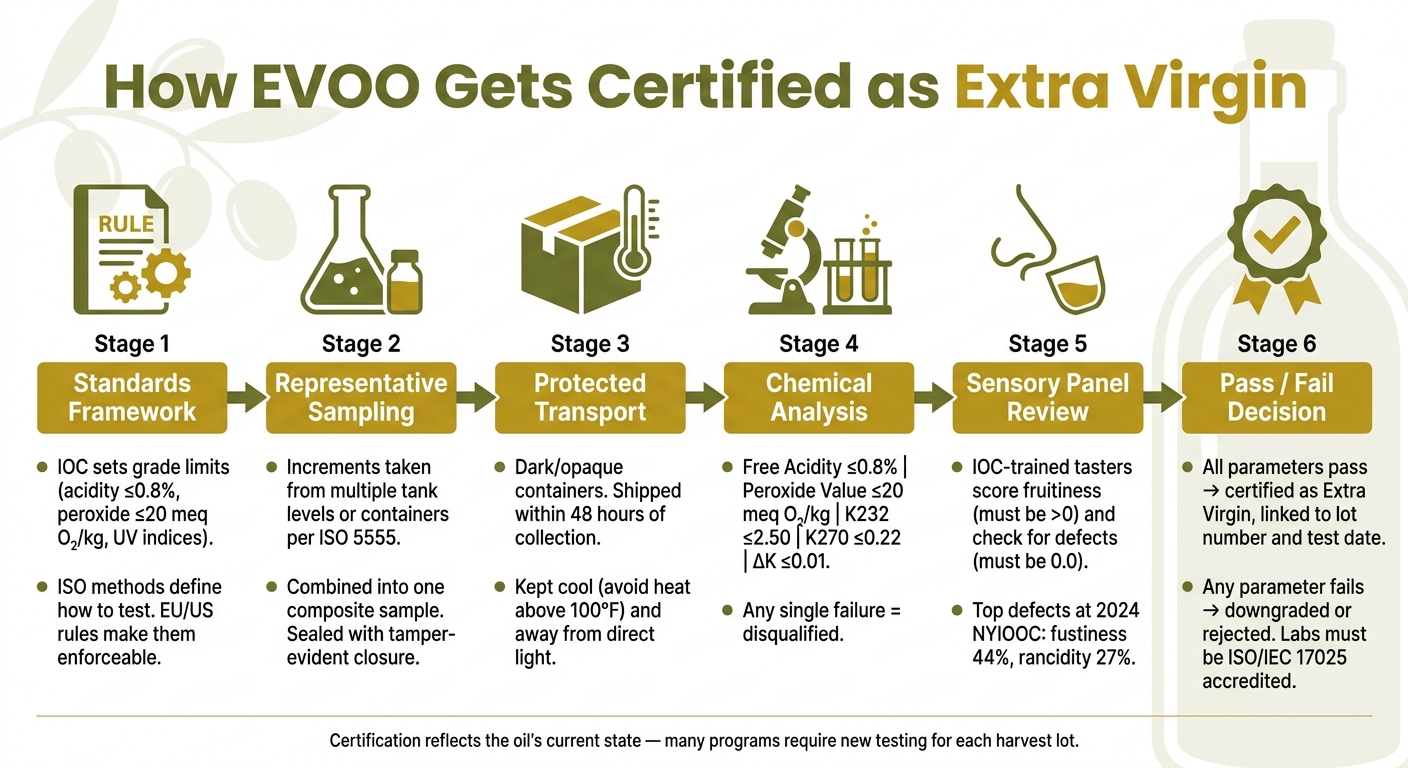
EVOO Certification Process: From Sample to Extra Virgin Status
Interpreting Olive Oil Test Results
sbb-itb-4066b8e
Which Standards Govern EVOO Certification
Three main frameworks shape how EVOO is tested and certified around the world: IOC trade standards, ISO technical methods, and regional or national rules.
IOC, ISO, and Regional Rules at a Glance
The IOC trade standard sets the line for extra virgin. It includes free acidity of ≤ 0.8 g/100 g, peroxide value of ≤ 20 meq O₂/kg, UV absorbance limits of K232 ≤ 2.50, K270 ≤ 0.22, and ΔK ≤ 0.01, plus sensory results showing a defect median of 0 and fruitiness above 0. If an oil misses even one of those limits, it does not qualify as extra virgin.
ISO standards deal with the how, not the grade itself. They set the test methods rather than the pass/fail cutoffs. For example, ISO 5555 covers sampling, and ISO 661 covers sample preparation.
Regional rules turn those IOC criteria and ISO methods into law. In the EU, Regulation (EU) 2022/2105 says conformity checks must use EN ISO 661 for test sample preparation and EN ISO 5555 for sampling. It also requires at least one conformity check per 1,000 metric tons of olive oil marketed each year. In the U.S., there is no mandatory federal olive oil grade. The USDA voluntary standard tracks IOC criteria, but testing is still mostly voluntary.
| Framework | Primary Role | Scope | Relevance to Certification |
|---|---|---|---|
| IOC trade standard | Defines grade criteria, including chemical and sensory limits | International reference used or mirrored by many national rules | Sets what qualifies as extra virgin - acidity, peroxide, UV indices, and sensory results |
| ISO standards (e.g., ISO 5555, ISO 661) | Provides technical methods for sampling, sample prep, and lab analysis | Global technical standards used by labs and cited by IOC guides and regional regulations | Helps ensure consistent, reproducible sampling and testing so IOC limits are applied in a sound way |
| Regional/national rules (EU, U.S./state) | Turns IOC and ISO into enforceable legal rules | Jurisdiction-specific and enforced by government agencies | Governs labeling claims, import checks, and what happens when a product fails |
Next comes the sample itself. If collection goes wrong, the lab result goes wrong too.
How EVOO Samples Are Collected, Protected, and Sent to the Lab
Once the standards are in place, the sample becomes the next big step. Certification only means something if the lab gets a sample that actually matches the lot.
Representative Sampling and Chain of Custody
A sample needs to reflect the whole lot, not just the easiest bottle or the top of a tank. Under ISO 5555-based procedures, samplers take increments from different tank levels, pallets, or bottles, then combine them into one composite sample. That matters because oil at the surface of a tank can be more oxidized than oil lower down. So if you only sample the top, you might get a skewed picture of the lot.
Right after collection, the sample should be labeled with traceability details like the producer name, lot or batch ID, production date, and a sample code that links the container to the paperwork. The seal matters too. Tamper-evident closures, security tape, or crimped caps make it clear if anyone interfered with the bottle before the lab opens it. One small but important point: avoid strong-smelling markers on containers, since odors can affect sensory analysis.
Chain-of-custody records should show:
- who collected the sample
- when and where it was taken
- how it was sealed
- when it arrived at the lab
That paperwork protects both producers and certifiers. If something goes wrong, it helps show where the problem happened. And if the record breaks at any point, the certification result can be challenged.
Protecting Samples from Light, Heat, and Delays During Transport
Light speeds oxidation, so samples need protection from the moment they’re collected. Keep them in dark glass or opaque containers and out of direct light.
Heat can do just as much damage. In summer, the inside of a vehicle or a storage area without climate control can go past 100°F, which speeds oxidation and can increase peroxide values. The simple fix is to use insulated shipping containers or coolers and avoid leaving samples in parked cars, loading docks, or other hot holding spots.
Timing matters as well. Expert guidance says samples should be shipped within 48 hours of collection, not counting nonbusiness days, while staying cool and protected from light the whole way. If shipping drags on, the oil has more time to age. A borderline sample can then slip into failure on chemical or sensory criteria before testing even starts. That protected sample is the one the lab uses to judge extra virgin status.
What Labs Test to Confirm Extra Virgin Grade
Once the sample reaches the lab, it goes through two gates: chemistry and sensory review. To earn extra virgin status, the oil has to pass both.
| Checkpoint | What Is Checked | Extra Virgin Requirement (IOC-Style) | Role in Pass/Fail |
|---|---|---|---|
| Free acidity | % free oleic acid from fruit condition and processing | ≤ 0.8% | Going over the limit disqualifies extra virgin grade |
| Peroxide value | Primary oxidation; hydroperoxide levels | ≤ 20 meq O₂/kg | High values point to oxidation and fail the lot |
| UV absorbance (K232, K270, ΔK) | Oxidation stage and signs of refined oil blending | K232 ≤ 2.50, K270 ≤ 0.22, ΔK ≤ 0.01 | High K270 can expose refined oil in the blend even when FFA and PV still look fine |
| Sensory panel review | Fruitiness presence; defect detection | Median defect = 0.0; median fruitiness > 0.0 | Any clear defect above 0.0 drops the oil below extra virgin |
Chemical Markers: Free Acidity, Peroxide Value, and UV Absorbance
Free acidity shows how much of the oil's fat has split into free fatty acids, stated as a percentage of oleic acid. Lower numbers usually mean the olives were handled well and milled without delay. If the fruit was bruised, overripe, or left sitting too long before processing, acidity tends to go up. So this test says a lot about fruit condition and handling.
Peroxide value, or PV, measures primary oxidation. The IOC limit is 20 meq O₂/kg. If PV runs high, the oil has started to oxidize, often because of heat, age, or poor storage.
UV absorbance gives the lab another way to check what chemistry alone can miss at first glance. K232 points to early oxidation. K270 is especially useful for spotting refined oil in a blend, since refined oils tend to show higher K270 readings. That means a high result can set off alarms even when free acidity and peroxide value still pass. ΔK checks for odd absorbance patterns linked to refining or adulteration. Put together, these tests help labs catch both oxidation and blending issues.
Sensory Panel Review: Checking for Fruitiness and Defects
Chemistry can tell you a lot, but it can't taste the oil. That's where trained sensory panels come in. Using IOC-approved tasting methods, they score each sample for positive traits - mainly fruitiness, along with bitterness and pungency - and check for defects such as fusty/muddy sediment, musty, winey-vinegary, metallic, rancid, and other off-flavors.
For extra virgin grade, the median defect score has to be 0.0, and the median fruitiness score has to be above 0.0. Even a slight but clear defect can knock the oil out of the extra virgin category.
At the 2024 NYIOOC World Olive Oil Competition, fustiness made up 44% of all defect occurrences, while rancidity accounted for 27%. Those were the two most common sensory reasons samples fell short. In many cases, the cause traces back to fermented olives, dirty equipment, or poor storage. And that's the catch: standard chemistry does not always flag those problems. Sensory review fills that gap, which is why it stands beside lab testing as a required part of the grade decision.
Those findings then move straight into the accept-or-reject call.
How Certification Is Confirmed and Maintained
Acceptance, Rejection, and Repeat Testing
After testing, the last step is the certification decision. A lot either passes or fails as a whole. If every result meets the standard, the lot is certified and linked to a lot number and test date. If even one parameter falls short, the lot is rejected for extra virgin olive oil status and may be downgraded to a lower grade, depending on how far off the result is.
If results land near the line, the program may ask for a second panel, repeat the chemical tests, or pull a new sample from the same lot.
Certification doesn't stop at bottling. EVOO changes over time, so many programs require new testing for each harvest lot instead of leaning on older results. Some also run checks during storage. That way, certification reflects the oil's current state, not what it looked like months earlier.
Official labs are usually accredited to ISO/IEC 17025, and sensory panels must hold current IOC recognition and pass proficiency testing. In plain terms, the methods are checked and the labs are audited, which gives third-party results more weight.
FAQs
Why can an oil fail extra virgin status after one test?
An extra virgin olive oil can fail from just one test result.
That means it doesn't need to miss the mark across the board. If it goes past a chemical limit or shows a sensory defect, it can lose its extra virgin grade.
For example, it may fail if:
- free fatty acids are above 0.8%
- peroxide value is over 20 mEq O₂/kg
- a certified sensory panel detects flaws like rancidity, mustiness, fustiness, or winey-vinegary notes
It’s a strict standard, and that’s the point. One bad result is enough to signal that the oil doesn’t meet extra virgin requirements.
How do heat and shipping delays affect EVOO test results?
Heat and shipping delays can do real damage to extra virgin olive oil. They speed up oxidation and breakdown, which lowers quality and freshness over time.
That damage can lead to rancidity. In lab testing, it often shows up as higher peroxide values and more oxidized compounds in UV tests.
For accurate results, samples need careful handling from start to finish. That means protecting them from light, heat, and air.
Big Horn Olive Oil helps cut down these risks with rapid distribution.
Why is sensory panel testing required alongside lab analysis?
Sensory panel testing is required because chemical analysis alone can't show the full profile of extra virgin olive oil.
Lab tests can confirm purity and key chemical benchmarks. But they can still miss defects like rancidity, mustiness, or fermentation.
That's where trained expert panels come in. They assess aroma, flavor, and mouthfeel to spot those flaws and verify positive traits such as fruitiness, bitterness, and pungency.