

Top 7 Faiths Using Olive Oil in Rituals
Olive oil shows up in 7 faith settings for the same few reasons: light, healing, blessing, and setting things apart for sacred use. In this article, I compare Judaism, Catholic and Mainline Protestant Christianity, Eastern and Oriental Orthodox Christianity, Islam, The Church of Jesus Christ of Latter-day Saints, modern Hindu and Buddhist use, and contemporary spirituality or neopagan practice.
Here’s the short version:
- Judaism ties olive oil to the Temple lamp and sacred anointing.
- Catholic and Mainline Protestant churches use it in holy oils for baptism, healing, ordination, and church dedication.
- Eastern and Oriental Orthodox churches keep olive oil at the center of chrismation, unction, and lamps.
- Islam treats olive oil as blessed in scripture and hadith, but not as a sacrament.
- Latter-day Saints use pure olive oil in priesthood healing blessings.
- Modern Hindu and Buddhist settings may use olive oil for lamps, though other oils are more common.
- Contemporary spiritual and neopagan paths often use it for anointing, blessing, candle work, and sacred space.
A few facts stand out fast. 3 Christian groupings on this list use olive oil in fixed church rites. 1 Jewish festival - Hanukkah - keeps olive oil at the center of memory and practice. And in some Eastern churches, anointing can be highly structured, including 36 anointings in Coptic confirmation.
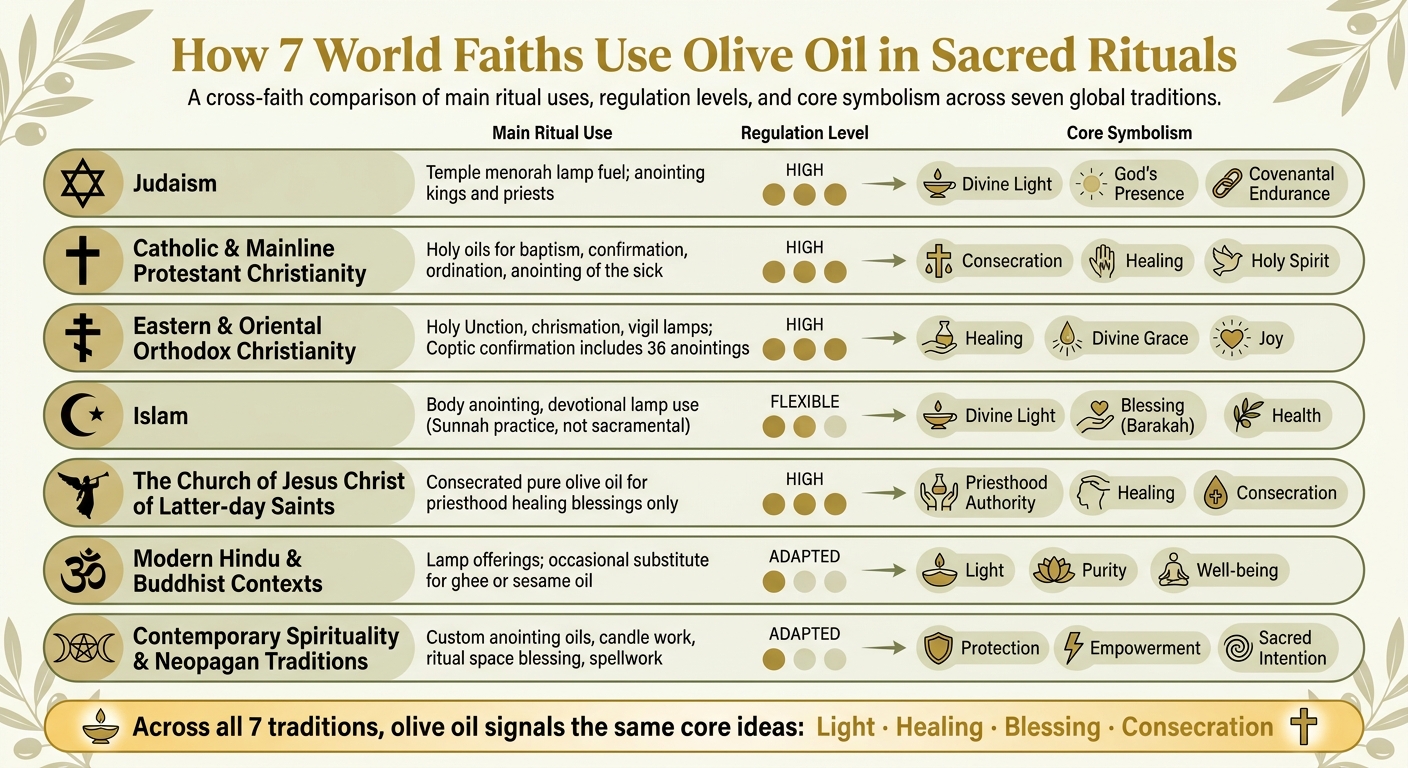
How 7 World Faiths Use Olive Oil in Sacred Rituals
The Spiritual Symbolism of Olive Oil
sbb-itb-4066b8e
Quick Comparison
| Faith | Main use of olive oil | How fixed the use is | Main idea tied to it |
|---|---|---|---|
| Judaism | Temple lamp, anointing | Fixed in ancient law | Light, holiness, God’s presence |
| Catholic / Mainline Protestant | Holy oils, healing, baptism, ordination | Fixed by church practice | Healing, blessing, consecration |
| Eastern / Oriental Orthodox | Chrismation, unction, lamps | Highly fixed | Healing, sealing, divine grace |
| Islam | Personal anointing, healing use, lamp imagery | Flexible | Blessing, light, health |
| Latter-day Saints | Priesthood healing blessings | Fixed | Healing and priesthood authority |
| Modern Hindu / Buddhist use | Lamp fuel, offering use | Flexible | Light and devotion |
| Contemporary spirituality / Neopagan | Anointing, candle work, sacred space | Personal | Protection, blessing, intention |
If you want the big takeaway, it’s simple: olive oil is rarely just oil in religious life. Across these seven paths, it is treated as something set apart, whether by law, prayer, clergy, or personal ritual.
Why Olive Oil Holds Sacred Meaning Across Faiths
Olive oil's ritual role has less to do with the kitchen and far more to do with what it stands for: purity, divine light, healing, protection, honor, and consecration - setting a person, object, or place apart for sacred use.
In the Hebrew Bible, pure olive oil feeds sacred lamps and appears in holy anointing oil. That gives it a lasting link to light and purity. From there, olive oil shows up again and again as a ritual sign in later faiths.
A clear pattern runs through these uses. Anointing marks people, objects, and spaces as sacred. It also carries the same cluster of meanings across time: light, healing, protection, honor, and consecration.
This article looks only at ritual uses. Judaism presents the earliest formal pattern, with olive oil tied to light, consecration, and blessing.
1. Judaism
In Judaism, olive oil sat at the heart of two major ritual uses: Temple light and sacred anointing.
The Torah calls for pure extra virgin olive oil for the Menorah, described as shemen zayit zach katit. That meant oil from the first pressing, clear and pure enough for holy use. The ner ma'aravi, often linked with the eternal lamp, burned through the night as a sign of God's presence.
Oil also set people and objects apart for holy service. The shemen ha-mishchah was a sacred anointing oil made with spices from a recipe given in the Torah. It was used to consecrate high priests, certain kings, and the vessels of the Tabernacle. In plain terms, this oil marked them as dedicated to sacred service.
After the Second Temple was destroyed in 70 CE, those Temple-based rites could no longer continue in the same way. But the symbol didn't disappear. In synagogues, the ner tamid near the Torah ark carried that meaning forward, pointing to divine presence in a new setting.
Hanukkah kept olive oil firmly planted in Jewish memory. The holiday recalls the small flask of pure olive oil that, by tradition, lasted for eight days in the rededicated Temple. Many rabbinic authorities, including the Rema, name olive oil as the mitzvah min hamuvchar for Hanukkah lights - the preferred option - even though other oils are also allowed.
From Jewish lamp rites, olive oil then moves into Christian anointing and blessing.
2. Catholic and Mainline Protestant Christianity
Catholic worship carries forward Jewish anointing and lamp rites, with olive oil used as sacramental matter. In Catholic practice, it becomes three holy oils: the Oil of Catechumens, the Oil of the Sick, and Sacred Chrism. A bishop blesses these oils at the Chrism Mass during Holy Week, and they’re then used across the diocese. The Oil of Catechumens prepares people for Baptism. The Oil of the Sick is used for healing and comfort. Sacred Chrism, which is mixed with balsam, is used in Baptism, Confirmation, Holy Orders, and the dedication of altars and churches.
Fresh extra virgin olive oil is still the preferred base for these oils. Other plant oils are allowed only if olive oil isn’t available. The Anointing of the Sick also now applies to serious illness and major surgery, not only end-of-life care.
Anglican, Episcopal, Lutheran, Methodist, and some Presbyterian churches use olive oil as well, especially in healing services and, in some cases, in baptism, confirmation, ordination, or commissioning prayers.
Eastern Orthodox and Oriental Orthodox churches keep the same symbolism, but in a more fixed liturgical form.
3. Eastern Orthodox and Oriental Orthodox Christianity
While many Western churches use olive oil in sacramental life, Eastern churches keep it at the heart of carefully defined rites.
In Eastern Orthodox practice, olive oil appears in three set uses: baptism, Holy Unction, and vigil lamps before icons in churches and homes.
At baptism, the priest first anoints the person with blessed olive oil, often called the Oil of Catechumens. This anointing points to strength in spiritual struggle and freedom from evil. Right after immersion, the newly baptized receives Holy Chrism, or myron, made from pure olive oil and many aromatic substances. The first anointing prepares the person. The second marks the gift of the Holy Spirit.
Holy Unction puts olive oil at the center of the service. The priest blesses olive oil, sometimes mixed with a small amount of wine, for healing of body and soul. In the older form of the rite, seven priests read, pray, and anoint seven times.
Oriental Orthodox churches follow a similar pattern, though each church keeps its own forms. The Coptic and Armenian traditions use myron in confirmation, the consecration of churches and altars, and the ordination of clergy.
The Coptic Orthodox Church also blesses olive oil for lamps, the sick, catechumens, and Holy Myron itself. In Coptic confirmation, the newly baptized is anointed 36 times with Holy Myron. The anointing covers the head, senses, heart, back, and joints.
The Armenian Apostolic Church prepares Holy Myron from pure olive oil plus about forty aromatic ingredients. It is consecrated in a major ceremony that also includes myron blessed by earlier Catholicoi, a clear sign of continuity with past consecrations.
So the broad pattern stays the same across Eastern Orthodox and Oriental Orthodox life: olive oil serves as the base for blessing, healing, sealing, and consecration. At the same time, each church keeps its own chrism and blessing rites.
Beyond Christianity, olive oil also appears in other faiths as a sign of blessing, healing, and consecration.
4. Islam
Unlike the more formal rites in Christianity, Islam treats olive oil as blessed, but not sacramental. It has no formal sacramental role in Islam. Its meaning comes from Qur'anic imagery and Prophetic guidance.
The Qur'an mentions the olive and its oil in at least six verses. One of the best-known examples appears in Surah An-Nur 24:35, where God's light is described as a lamp lit from a blessed olive tree, whose oil would almost shine even without fire touching it. Muslim scholars read this as a sign of divine light and guidance, which ties directly to one of the article's main ritual themes. In the past, olive oil also fueled lamps in mosques and other sacred spaces, joining physical light with spiritual illumination.
"Eat olive oil and anoint yourselves with it, for it comes from a blessed tree."
This widely cited hadith helps explain why olive oil is treated as a Sunnah practice rather than a required rite.
One place where this symbolism shows up in modern practice is ruqyah, or Qur'anic-based spiritual healing. Some present-day practitioners recite verses such as Al-Fātiḥah, Ayat al-Kursi, and the final verses of Al-Baqarah over olive oil before applying it to the body. But scholars set firm theological limits here: the oil has no power on its own, and healing comes from God alone. Using it in a permitted way is acceptable. Treating it like a charm, or turning it into a required ritual, is considered bid'ah, or religious innovation.
So olive oil in Islam sits in a very specific place. It belongs to devotion and daily practice, shaped by personal intention and Prophetic example, not by a formal institution. That gives it a role somewhere between scripture and lived worship, rather than the more defined anointing systems seen in the next tradition.
5. The Church of Jesus Christ of Latter-day Saints
Like other Christian traditions, this faith uses olive oil in healing. But here, it appears only within a set priesthood blessing. The Church of Jesus Christ of Latter-day Saints uses consecrated olive oil in healing blessings, and only pure olive oil is used for this ordinance.
The scriptural basis is James 5:14, which calls for the elders to pray over the sick and anoint them with oil.
In practice, a priesthood holder places a drop of consecrated oil on the person’s head. Then other priesthood holders lay on hands and give the blessing. Before any of that happens, the oil is set apart through a specific prayer. In this setting, the oil signifies consecration and healing within a priesthood blessing.
In other faith settings, olive oil shows up less as an ordinance and more as a symbolic act.
6. Modern Hindu and Buddhist Contexts
Outside the Abrahamic traditions, olive oil shows up less as a consecrated substance and more as a practical lamp fuel. In Hindu and Buddhist settings, it's usually a modern stand-in, not a long-used ritual oil.
Some contemporary Hindu households use olive oil in diyas. But ghee, sesame, coconut, and mustard oil still remain the customary fuels, with ghee often preferred. In Hindu practice, the meaning comes from offering light to the deity, not from olive oil itself.
Oil lamps also stay central to daily Hindu devotion. In many homes, diyas are lit twice a day, at sunrise and sunset, as part of the sandhya sequence.
On Buddhist home and temple altars, oil lamps symbolize wisdom overcoming ignorance. Contemporary Mahayana guidance allows pure, vegetarian vegetable oils, including olive oil, as offerings to Buddhas and Bodhisattvas.
Across both traditions, olive oil is functional rather than sacred. It's a neutral, easy-to-get lamp fuel, not a customary ritual oil. That flexible, practical use also carries into contemporary spirituality and neopagan practice.
7. Contemporary Spirituality and Neopagan Traditions
Unlike older formal rites, modern Pagan and witchcraft practice tends to use olive oil in a more personal, flexible way. In modern Pagan, Wiccan, and witchcraft settings, olive oil works as a ritual oil for anointing, blessing, and marking sacred space. People use it on the body, candles, tools, and ritual areas, and there isn't one central authority or fixed formula that controls how it has to be used.
A common approach is to mix olive oil with herbs or essential oils based on a chosen intention, then warm it between the palms before anointing the forehead, heart, hands, or feet. It's simple, hands-on, and shaped by the person's own practice.
Many modern practitioners see olive oil as an intention-bearing medium tied to purification, protection, and blessing. Some also view it as spiritually active and connect it with vitality, prosperity, and joyfulness.
Part of this comes from older sources. Hellenic reconstructionists link olive oil to Athena, since the olive was her sacred tree, and may offer it to deities tied to wisdom and household protection. Folk-magic paths keep older biblical links between olive oil and holiness as well; in conjure and hoodoo, it was historically called sweet oil.
At the same time, much of its current use is modern in shape. Self-made spell oils, personal correspondences, and eclectic altar work became especially common through 20th- and 21st-century Pagan revival and Wiccan practice, not through one unbroken line of transmission. Even with that freedom, the same ritual themes keep showing up: blessing, protection, and consecration.
Patterns That Run Across All 7 Traditions
When you look at all seven traditions side by side, the same few ritual roles keep showing up.
The clearest one is anointing. Across these traditions, olive oil marks people, objects, and places as set apart for sacred use.
It also appears again and again as lamp fuel. From the Temple Menorah to church lamps to modern devotional offerings, olive oil feeds a flame that points to the same basic idea: light overcoming darkness.
A third thread is healing. You see it in biblical anointing, formal Christian rites, LDS blessings, and modern healing oils. Where the traditions part ways is not so much in whether olive oil can be used, but in how tightly that use is controlled.
The clearest split is between formal and adapted practice. In Catholic, Orthodox, and LDS settings, olive oil is closely regulated. Specific clergy or priesthood authority is needed, the oil must be pure, and the rite follows a set structure. In Buddhism, Hinduism, and contemporary spirituality, olive oil tends to work more as a practical substitute inside a ritual system first built around ghee, sesame oil, or other oils. That contrast stands out in the comparison below.
| Tradition | Primary Use | Regulation |
|---|---|---|
| Judaism | Temple lamp fuel, anointing | Yes (historically) |
| Catholic / Mainline Protestant | Sacramental anointing, healing | Yes |
| Eastern / Oriental Orthodox | Chrismation, Unction, vigil lamps | Yes |
| Islam | Symbolic blessing | Flexible |
| LDS | Priesthood healing blessings | Yes (pure olive oil only) |
| Hindu / Buddhist (modern) | Lamp offerings, adapted anointing | No - adapted use |
| Contemporary / Neopagan | Anointing, candle work, consecration | No - intuitive use |
Purity of the oil is another pattern that runs across traditions. Jewish ritual sources called for first-pressed oil. Catholic and Orthodox practice specifies pure olive oil for certain sacraments. LDS practice directly requires pure olive oil set apart by priesthood authority. Even Buddhist altar guides lean toward neutral, clean-burning options.
In each case, purity signals that the oil is fit for sacred use.
Quick Comparison: How Each Faith Uses Olive Oil
This table gives you the big picture fast. Across these seven traditions, the main differences come down to how formal the ritual is and how tightly the oil is governed.
| Faith Tradition | Main Ritual Use | Classical or Adapted? | Core Symbolism |
|---|---|---|---|
| Judaism | Pure olive oil for the Temple menorah; anointing kings and priests | Classical (ancient origin, still practiced) | Divine light, God's presence, covenantal endurance |
| Catholic and Mainline Protestant Christianity | Sacramental anointing with holy oil or chrism in baptism, confirmation, ordination, and the anointing of the sick | Classical (ancient origin, still practiced) | Consecration, healing, and the Holy Spirit's presence |
| Eastern Orthodox and Oriental Orthodox Christianity | Holy Unction, chrismation, and blessing homes and icons with blessed olive oil | Classical (ancient origin, still practiced) | Healing of soul and body, divine grace, and joy |
| Islam | Body anointing and devotional lamp use | Devotional, not sacramental | Divine light, blessing (barakah), health, and protection |
| The Church of Jesus Christ of Latter-day Saints | Consecrated pure olive oil for priesthood healing blessings | Restored practice | Priesthood authority, healing, and consecration in Christ |
| Modern Hindu and Buddhist Contexts | Lamp offerings; occasional substitute for ghee or sesame oil | Modern adaptation | Light, purity, and well-being |
| Contemporary Spirituality and Neopagan Traditions | Custom anointing oils for ritual, spellwork, candle work, and personal blessing | Modern adaptation | Empowerment, protection, and sacred intention |
Even with those differences, one theme shows up again and again: olive oil is set apart for sacred use.
Conclusion
Across all seven traditions, olive oil points to the same core ideas: light, healing, blessing, and consecration.
Its place in ritual stays connected to reverence and care. That shared meaning is what gives olive oil its lasting sacred weight.
FAQs
Why is olive oil considered sacred?
Olive oil is considered sacred because it stands for purity, divine favor, and healing. It connects the physical world with the spiritual one.
For thousands of years, people have used it to consecrate altars, sacred vessels, and those chosen for divine service. It also fueled temple lamps and was used in healing and blessings, which made it a lasting symbol of life, hope, and connection to the divine.
Which faiths require pure olive oil?
Several faiths call for pure olive oil in sacred rites. In Jewish tradition, the Menorah in the Holy Temple was lit with “pure-beaten” olive oil, and the holy anointing oil was also made with pure olive oil.
In Christian practice, pure olive oil is required for the Oil of the Sick and the Oil of Catechumens. Catholic teaching also holds that Holy Chrism must be pure olive oil for Confirmation.
Is olive oil symbolic or sacramental?
Yes - olive oil is both symbolic and sacramental in many faiths. People use it to consecrate altars, anoint kings, priests, and the sick, and to light sacred spaces.
It often stands for purity, healing, divine favor, spiritual renewal, and the presence of the divine. In Christian tradition, it is also a key part of sacraments such as Baptism, Confirmation, and Holy Orders.