

Fatty Acid Profiles: Key to Olive Oil Quality
Fatty acid profiles are the cornerstone of olive oil quality. They reveal the levels of key fats like oleic, palmitic, and linoleic acids, which determine shelf life, resistance to rancidity, and authenticity. These chemical markers are essential for verifying geographical origins, detecting adulteration, and ensuring compliance with international standards like those set by the International Olive Council (IOC).
Here’s what you need to know:
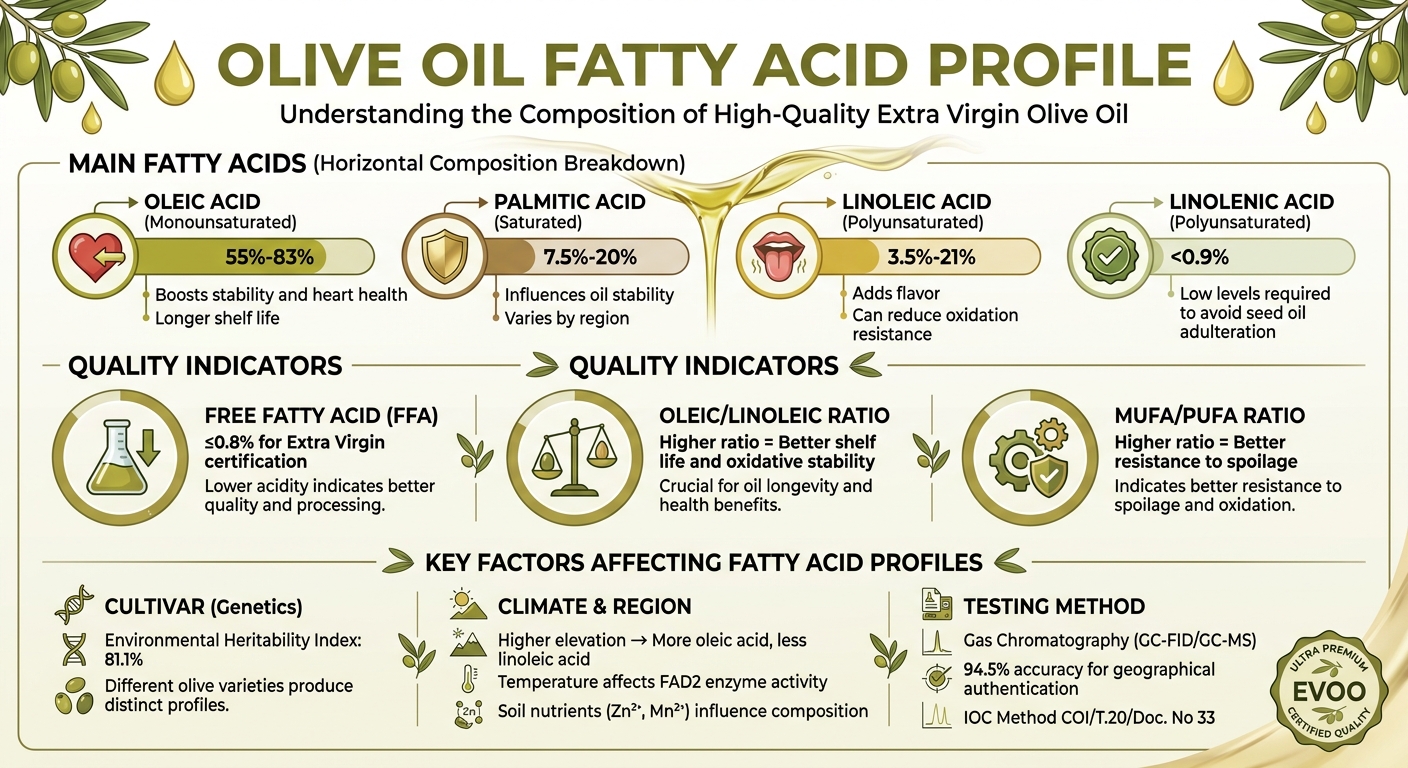
- Oleic acid (55%-83%): Boosts stability and heart health; higher levels mean longer shelf life.
- Palmitic acid (7.5%-20%): Varies by region and cultivar, influencing oil stability.
- Linoleic acid (3.5%-21%): Adds flavor but can reduce resistance to oxidation.
- Linolenic acid (<0.9%): Low levels are required to avoid adulteration with seed oils.
Factors like olive variety, harvest timing, and growing conditions shape these profiles. Advanced testing methods, such as gas chromatography, ensure quality by analyzing these fatty acid compositions. Producers like Big Horn Olive Oil use these standards to deliver high-quality extra virgin olive oil that maintains its flavor, health properties, and freshness longer.
Key takeaway: Fatty acid profiles are the chemical signature of olive oil, ensuring quality, authenticity, and longevity.
Olive Oil Fatty Acid Composition and Quality Standards
EVOO Chemistry: Free Fatty Acids and Smoke Point
sbb-itb-4066b8e
Main Fatty Acids in High-Quality Olive Oil
High-quality extra virgin olive oil (EVOO) offers a carefully balanced mix of monounsaturated, saturated, and polyunsaturated fats. These fats not only affect the oil's flavor and health benefits but also influence its shelf life. Let’s break down the key fatty acids that make EVOO special.
Oleic Acid: The Star Monounsaturated Fat
Oleic acid is the most abundant fatty acid in quality olive oil, comprising 55% to 83% of its total fat content. This omega-9 fatty acid is known for its role in promoting heart health, reducing inflammation, and providing other protective benefits.
In addition to its health perks, oleic acid plays a big role in oxidative stability. Oils with higher oleic acid levels are more resistant to heat during cooking and retain quality longer in storage. That’s why Ultra Premium EVOO, which boasts higher concentrations of oleic acid, typically outlasts lower-grade oils.
The process of mechanical extraction helps preserve oleic acid's integrity. Factors like the type of olive, harvest timing, and even environmental conditions such as drought can all influence how much oleic acid ends up in the final product.
Other Important Fatty Acids: Palmitic, Linoleic, and Linolenic
While oleic acid takes center stage, three other fatty acids round out the profile of high-quality olive oil:
- Palmitic acid: This saturated fat makes up 7.5% to 20% of the oil’s composition. Its levels vary depending on the olive cultivar and region. For instance, Tunisian and Turkish cultivars are known to have higher palmitic acid levels compared to those from Portugal and France.
- Linoleic acid: An omega-6 polyunsaturated fat, linoleic acid contributes 3.5% to 21% to the oil’s total fat content. It enhances flavor complexity but comes with a trade-off - higher linoleic acid levels can reduce oxidative stability. Tunisian olive oils, for example, often have the highest linoleic acid content but maintain stability thanks to compounds like tocopherols.
- Linolenic acid: To qualify as extra virgin, olive oil must contain 0.9% or less linolenic acid. Levels above 1.0% may indicate adulteration with cheaper seed oils, which have a very different fatty acid makeup. The International Olive Council enforces these strict limits to ensure consumers get authentic, unadulterated olive oil.
Fatty Acid Ratios and Their Impact on Quality
Fatty acid ratios are a key part of understanding olive oil quality. The balance between oleic acid (a monounsaturated fat) and linoleic acid (a polyunsaturated fat) plays a major role in how well olive oil resists oxidation and retains its fresh flavor over time.
The Oleic/Linoleic ratio is a strong indicator of an oil’s shelf life. Oils with higher levels of oleic acid and lower levels of linoleic acid tend to stay fresh longer, delay oxidation, and preserve their flavor. This is because monounsaturated fats are chemically more stable than polyunsaturated fats, which break down faster and shorten shelf life. By analyzing this ratio, producers can directly link the oil’s chemical makeup to its ability to remain stable over time.
Another important measure is the MUFA/PUFA ratio - the balance of monounsaturated to polyunsaturated fatty acids. This ratio also reflects the oil’s resistance to spoilage and sensory defects. Together, these ratios ensure better stability and flavor preservation. Sara Haas, a dietitian and spokesperson for the Academy of Nutrition and Dietetics, explains: "Healthy oils and fats have a higher amount of unsaturated fatty acids and a lower amount of saturated fatty acids than their less-healthy counterparts". This balance not only impacts health benefits but also influences how well the oil performs in cooking and how long it retains its flavor.
Interestingly, other compounds like tocopherols (a form of vitamin E) can compensate for less-than-ideal fatty acid ratios. For example, research on Mediterranean olive oils found that certain Tunisian varieties showed strong oxidative stability despite having higher linoleic acid and lower oleic acid levels compared to oils from Portugal, France, and Turkey. This highlights how tocopherols can help protect oils, even when the fatty acid balance isn’t optimal. Still, the best combination for quality remains high oleic acid and low linoleic acid.
These fatty acid ratios are also essential for verifying authenticity. The specific balance of fatty acids acts as a chemical fingerprint, confirming an oil’s geographical origin and cultivar. This helps detect adulteration or blending with lower-quality oils. As noted earlier, these precise markers are central to the International Olive Council’s rigorous standards. For Ultra Premium EVOO certification, maintaining optimal fatty acid ratios is critical to meeting quality benchmarks while ensuring freshness and flavor.
Factors That Affect Fatty Acid Profiles
Differences Between Olive Cultivars
The olive cultivar plays the biggest role in determining the fatty acid composition of olive oil. Each variety produces oils with its own distinct profile, even when grown under similar conditions. For instance, Mediterranean cultivars such as Chemlali and Chetoui from Tunisia, Memecik and Gemlik from Turkey, Cobrançosa from Portugal, and Aglandau from France all yield oils with unique fatty acid characteristics. These genetic differences influence the levels of key components like palmitic, oleic, and linoleic acids, which are essential for the oil's quality and stability.
Research highlights significant variations in oleic and linoleic acid levels across different cultivars. Tunisian varieties, for example, often show higher linoleic and palmitic acid levels compared to those from Portugal, France, or Turkey. These differences affect the oil's freshness and resistance to oxidation during storage and cooking.
The Environmental Heritability Index (EHI) for olive oil stands at 81.1%. This indicates that while environmental factors matter, the genetic makeup of the cultivar is the primary determinant of the oil's chemical profile. Specific fatty acids, such as stearic, oleic, and linoleic acids, act as reliable markers for identifying both the botanical origin and geographical source of the oil.
Although genetics provide the foundation, environmental and regional factors further shape these fatty acid profiles.
Climate and Regional Effects
Beyond cultivar genetics, environmental conditions significantly influence fatty acid composition. Elevation has a notable impact: as elevation increases, oleic acid content rises while linoleic acid levels drop. This occurs because environmental factors affect the activity of fatty acid desaturase (FAD2) - the enzyme responsible for converting oleic acid into linoleic acid during the ripening process. Temperature, altitude, and day-to-night temperature swings all influence how this enzyme operates.
At higher latitudes (42°–46°), conditions favor the production of linoleic acid. Meanwhile, soil nutrients like Zn²⁺ and Mn²⁺ act as cofactors for enzymes that adjust fatty acid composition. Additionally, soil microbial communities play a role, as they contribute to the synthesis of fatty acid precursors through interactions with the olive plants. These combined factors explain why oils from different Mediterranean regions - or even places like South America - develop distinct fatty acid profiles, even when the same cultivar is used.
Testing Methods for Fatty Acid Analysis
Accurate fatty acid analysis plays a key role in upholding the stringent quality standards required for authentic extra virgin olive oil.
Gas chromatography (GC) is considered the go-to method for analyzing fatty acid profiles in olive oil. This process works by separating, identifying, and quantifying individual fatty acids. Since fatty acids aren’t naturally volatile, they first need to be converted into Fatty Acid Methyl Esters (FAMEs) before analysis.
The International Olive Council (IOC) has established Method COI/T.20/Doc. No 33 as the official guideline for determining FAMEs using gas chromatography. This method provides a detailed breakdown of fatty acids, identifying up to ten key components like oleic, palmitic, and linoleic acids in a single test. These standardized procedures are critical for verifying the oil’s authenticity and quality. Since 1988, the IOC has continuously refined these methods, with experts meeting twice a year to improve detection techniques and combat fraud.
Among GC detection methods, GC-FID is the most widely used for quantifying major fatty acids. However, GC-MS offers greater precision for complex tasks, such as identifying seed oil adulteration, with a geographical authentication accuracy rate of 94.5%. These tools are not only vital for ensuring product quality but also for supporting certification processes, particularly for Ultra Premium extra virgin olive oil (EVOO).
"The technological advances in fats and oils analysis have been accompanied by a growing awareness of the need for ever more effective control of the quality, purity and authenticity of the olive oils that are sold." - International Olive Council
Modern GC analysis often employs capillary columns, which are long, slender tubes that provide better separation of similar fatty acids compared to older packed columns. These methods are essential for detecting seed oil adulteration, identifying traces of olive-pomace oil, and verifying compliance with "Extra Virgin" or "Ultra Premium" standards. The IOC frequently updates its methodologies to keep pace with technological advancements, with some standards revised as recently as 2024. These ongoing improvements are crucial for strengthening certification processes, benefiting producers like Big Horn Olive Oil.
How Fatty Acid Profiles Support Ultra Premium EVOO Certification
Meeting Quality Standards Through Chemical Analysis
Fatty acid analysis plays a crucial role in certifying Extra Virgin Olive Oil (EVOO), ensuring it meets strict international standards. Advanced gas chromatography (GC) methods are used to examine these profiles, which are essential for verifying the oil's quality and authenticity. For instance, the International Olive Council (IOC) mandates that EVOO must have a free fatty acid (FFA) level of ≤0.8% to qualify as extra virgin. Laboratories analyze the full fatty acid profile, including FAMEs (fatty acid methyl esters) and TAG (triacylglycerol) coherence, to detect any signs of adulteration or blending with non-authentic oils. These comprehensive tests also ensure compliance with the latest IOC standards, such as the 2025 update (Standard COI/T.15/NC No 3/Rev.21/2025).
Ultra Premium certification takes these requirements even further, focusing on preserving biologically active compounds like polyphenols, oleocanthal, and oleuropein. These compounds are known for their health benefits, such as reducing joint damage and providing anti-inflammatory effects. By combining authenticity checks with health-focused analysis, these rigorous tests help maintain the qualities that make Ultra Premium EVOO stand out.
Big Horn Olive Oil: A Commitment to Quality
Producers like Big Horn Olive Oil exemplify this commitment to quality through their Ultra Premium EVOO offerings. Their oils are cold-pressed quickly and delivered fresh, meeting the updated international standards mentioned earlier. Single-source varieties, such as Picual and Coratina, boast a high ratio of monounsaturated fats to saturated fats - an essential marker of healthful olive oil. Dietitian and chef Sara Haas highlights the importance of monounsaturated fats:
"Monounsaturated fats can help lower your blood LDL [bad cholesterol] level and raise HDL [good] cholesterol, which in turn can help prevent cardiovascular disease."
With elevated antioxidant levels and stringent chemical testing, Big Horn Olive Oil ensures their products retain the beneficial qualities that support a healthy diet.
Conclusion
Fatty acid profiles act as the unique chemical signature of olive oil, offering crucial insights into its traceability, authenticity, and resistance to oxidation. The proportions of key fatty acids - palmitic, oleic, and linoleic - play a critical role in determining the oil's stability against rancidity and its health-promoting properties. These markers enable producers and laboratories to confirm authenticity, detect adulteration, and ensure compliance with international quality standards.
Oleic acid, in particular, enhances the oil's stability, while the ratio of monounsaturated to saturated fats contributes to its heart-health benefits. Factors like geography and olive variety significantly shape these fatty acid compositions. Research has shown that oils from different Mediterranean regions often exhibit distinct profiles, reflecting their origins. Advanced testing techniques further validate these markers, allowing for precise differentiation of oils based on their geographic origin and oxidative stability.
Such rigorous testing ensures that only the highest-quality oils make it to market. Big Horn Olive Oil stands out by adhering to strict chemical analysis protocols and cold-pressing olives within 2 hours of harvest. Their Ultra Premium EVOO varieties, including Picual and Coratina, consistently showcase ideal fatty acid ratios that preserve flavor and deliver health benefits. With fresh harvest oils available within 3 months and compliance with stringent international standards, Big Horn Olive Oil guarantees both authenticity and peak nutritional quality.
For consumers, these chemical markers provide assurance that they are purchasing genuine Extra Virgin Olive Oil. The benefits are clear: a longer shelf life, consistent flavor, and enhanced health advantages - all backed by meticulous quality standards.
FAQs
What fatty acid numbers should I look for on an olive oil test report?
For extra virgin olive oil, make sure the test report indicates oleic acid levels between 55–83%, linoleic acid between 7.5–20%, and linolenic acid below 1%. These values align with international quality standards for olive oil.
How do fatty acid ratios predict an olive oil’s shelf life and rancidity risk?
High levels of oleic acid in olive oil play a big role in its oxidative stability, meaning it’s less likely to go rancid quickly. This stability directly impacts the oil’s shelf life, making fatty acid ratios an important measure of both quality and durability.
Can fatty acid testing confirm an olive oil’s origin and detect adulteration?
Fatty acid testing plays a key role in verifying an olive oil's origin and identifying any adulteration. By analyzing the oil's distinct lipid profile and chemometric markers, experts can trace its source and ensure its purity. Studies have shown that these techniques are highly effective in maintaining quality standards and ensuring the oil's authenticity.