

How AI Predicts Water Needs in Olive Groves
AI is transforming olive grove irrigation by predicting water needs and managing resources more efficiently. Using tools like IoT sensors, satellites, and advanced AI models, farmers can optimize water usage, reduce costs, and improve olive oil quality. Here's what you need to know:
- AI Forecasting Models: Spain's LSTMHybrid predicts weekly irrigation needs with 80% accuracy, helping farmers plan schedules and cut energy costs.
- Real-Time Drip Irrigation: Portugal's system adjusts water flow based on real-time soil and weather data, improving drought resilience.
- Satellite Monitoring: Tools like NDVI and thermal imaging detect water stress early, offering large-scale monitoring without field visits.
- Results: Precision irrigation has saved up to 42% of water and increased yields by 30% in some regions.
These technologies are reshaping irrigation strategies, making olive production more efficient and resource-conscious.
Artificial intelligence boosts olive farming in Crete
sbb-itb-4066b8e
AI Models for Predicting Water Needs in Olive Groves
Two advanced AI systems are transforming how water is managed in olive groves. One, developed in Spain, predicts weekly water needs, while the other, from Portugal, directly manages drip irrigation systems in real-time. Here's a closer look at these groundbreaking technologies.
LSTMHybrid: AI for Weekly Irrigation Forecasting
In July 2023, researchers from the University of Córdoba's Department of Agronomy - Rafael González Perea, Juan Antonio Rodríguez-Díaz, and Emilio Camacho - introduced LSTMHybrid, an AI model designed to forecast irrigation needs seven days in advance. This hybrid system combines several advanced technologies: Fuzzy Logic, Genetic Algorithms, Long Short-Term Memory encoder-decoders, and Dense Neural Networks. Impressively, it operates with 1.5 million parameters.
LSTMHybrid relies on four main inputs: average temperature (°F), reference evapotranspiration (inches), solar radiation, and the previous seven days of irrigation data. The model was trained using four years of climate data from Zújar, Granada, and achieved 80% accuracy in predicting weekly water demands. Moreover, it demonstrated over 94% alignment with real-world irrigation district data.
"The big difference compared to previous models is that it is the first time it has been done on a seven-day scale", said Rafael González.
This seven-day forecasting capability offers significant benefits, such as aligning irrigation schedules with off-peak electricity rates to cut energy costs. Unlike earlier models like CANGENFIS, which required 500,000 factors, LSTMHybrid is streamlined enough to run on standard computers. As Juan Antonio Rodríguez explained:
"The knowledge of the water demand several days in advance would facilitate the management of the system and would help to optimize the water use and energy costs".
Portuguese AI System for Drip Irrigation
Starting in September 2024, the University of Minho's CMAT research center began Project PL24-00057, titled "Artificial Intelligence in the Optimisation of Irrigation for Olive Groves Resilient to Climate Change." Led by Cecília Eduarda Coelho Machado da Cruz Martins, the initiative is funded by the 'la Caixa' Foundation and the Foundation for Science and Technology and will run through February 2028.
This system takes a different approach compared to Spain's model. Instead of forecasting, it directly manages drip irrigation systems. The AI evaluates atmospheric and soil conditions in real-time and adjusts the water released through the drip system accordingly. Additionally, it offers recommendations for nutrient applications, which are crucial for improving olive trees' drought tolerance. Proper nutrient levels play a key role in helping the trees withstand dry conditions.
The project also involves practical partnerships with organizations like the Associação de Agricultores do Vale da Vilariça and Sementinteligente Lda, aiming to ensure the technology is applied effectively in real-world settings.
Using Satellite Data to Estimate Water Stress in Olive Groves
Satellite technology provides a broad perspective on olive groves, identifying water stress before it becomes noticeable to the human eye. Unlike ground-based AI systems that focus on direct irrigation management, satellites offer a wide-reaching solution, scanning vast areas to monitor vegetation health and soil moisture. This approach eliminates the need for manual field visits while complementing ground-level systems with early detection capabilities.
NDVI and Soil Water Content Prediction
A key tool in satellite monitoring is the Normalized Difference Vegetation Index (NDVI), which uses multispectral imagery to assess vegetation health and hydration. When olive trees experience water stress, their leaves reflect light differently, leading to lower NDVI readings. With Sentinel-2 satellite imagery available every five days, growers can quickly identify irrigation issues across large areas, saving time compared to traditional field inspections.
Additionally, NDVI is often paired with the Crop Water Stress Index (CWSI), which relies on thermal imaging to detect differences in canopy temperature. Research published in Precision Agriculture (April 2025) studied a super-high-density 'Arbequina' olive orchard in Villena, Spain, and found that thermal imaging effectively highlighted immediate water stress. Meanwhile, NDVI provided insights into vegetative growth and fruit production under regulated deficit irrigation strategies. Combining both indices - referred to as NDVIcrop+ground - yielded the most accurate results for assessing crop performance and predicting yields in water-limited conditions.
These advancements are now being integrated into algorithms that automate grove monitoring and stress prediction.
New Satellite Algorithms for Grove Monitoring
In March 2025, researchers Isabel Castillejo and Cristina Martínez from the University of Córdoba, in collaboration with the University of Seville, introduced an automated system powered by Convolutional Neural Networks (CNN). This system processes Sentinel-2 imagery to classify olive grove types and predict water stress. Unlike earlier methods that relied on infrequent high-resolution images from Spain's PNOA, this CNN-based approach provides timely and actionable data.
The algorithm achieved an 80% accuracy rate in distinguishing between traditional, intensive, and super-intensive planting systems, which is essential since intensive systems demand significantly more water. The process is fully automated: growers simply input a plot code or cadastral reference, and the system retrieves and analyzes the relevant satellite data. Cristina Martínez highlighted that the team is now working to extend the neural network’s capabilities to predict water stress directly from satellite images, potentially eliminating the need for labor-intensive field monitoring altogether.
Comparing AI Tools for Olive Grove Water Management
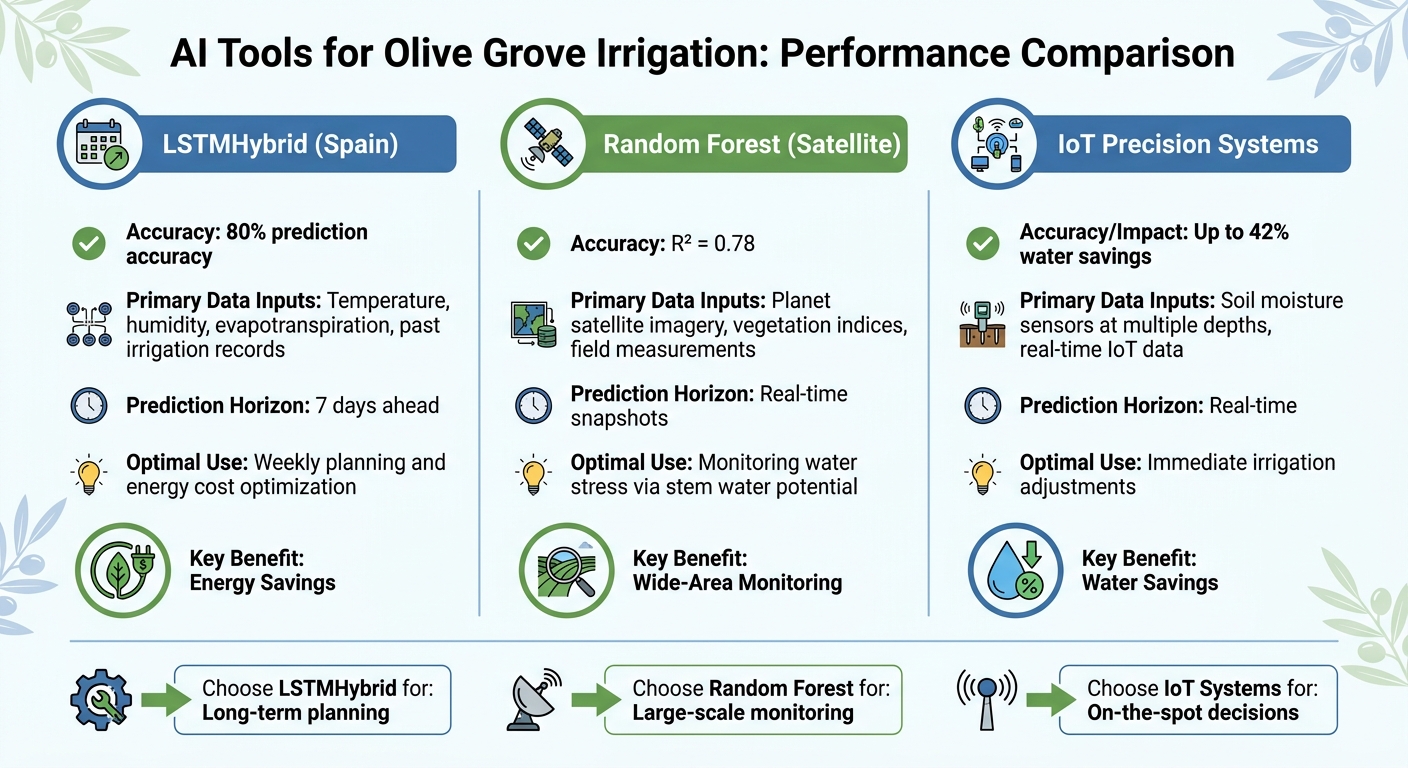
AI Tools for Olive Grove Irrigation: Accuracy, Data Inputs, and Use Cases Comparison
This section dives into the performance and applications of various AI systems designed to optimize irrigation in olive groves. Each tool brings unique strengths, making it essential for producers to understand how these systems align with their farm size, budget, and management priorities.
Comparison Table of AI Tools
Here's a breakdown of key AI tools, evaluating their accuracy, data requirements, prediction capabilities, and best use cases:
| AI Tool/System | Accuracy/Impact | Primary Data Inputs | Prediction Horizon | Optimal Use |
|---|---|---|---|---|
| LSTMHybrid | 80% accuracy | Temperature, humidity, evapotranspiration, past irrigation records | 7 days | Weekly planning and energy cost optimization |
| Random Forest (Satellite) | R² = 0.78 | Planet satellite imagery, vegetation indices, field measurements | Real-time snapshots | Monitoring water stress via stem water potential |
| IoT Precision Systems | Up to 42% water savings | Soil moisture sensors at multiple depths, real-time IoT data | Real-time | Immediate irrigation adjustments |
LSTMHybrid stands out for its ability to forecast water needs a week in advance, helping farmers align irrigation schedules with lower electricity rates. On the other hand, Random Forest models excel at detecting water stress in real time, using high-resolution satellite imagery to achieve an R² value of 0.78. This was demonstrated in field tests conducted in southern Italy from June to October during 2021–2022. Meanwhile, IoT Precision Systems provide immediate, field-level control by leveraging real-time soil moisture data, leading to water savings of up to 42%.
Each tool meets different operational needs: LSTMHybrid is best for long-term planning, Random Forest models are ideal for monitoring water stress across large areas, and IoT systems deliver the responsiveness required for on-the-spot irrigation decisions.
Big Horn Olive Oil applies insights from these technologies to support sustainable and high-quality olive production.
The Future of AI in Olive Production
AI is reshaping how olive groves are managed, extending its impact far beyond just water management. For example, digital twins are being used to simulate grove water cycles and accurately predict irrigation needs. At the same time, convolutional neural networks (CNNs) are analyzing drone and satellite images to detect water stress in plants before any visible signs appear. These tools are already making a difference, and future systems will continue to refine irrigation strategies even further.
Recent AI advancements show that better irrigation management does more than save water - it can also improve the quality of olive oil. By analyzing years of satellite and climate data, AI systems can determine the perfect harvest window to ensure peak oil quality. This level of precision is critical for producers like Big Horn Olive Oil, which prides itself on selecting only the top 5% of harvests. They ship their oil within 1-3 months of harvest to preserve its freshness. Properly optimized irrigation can lead to oils with high biophenol content and bold flavor profiles, the hallmarks of ultra-premium products.
The results speak for themselves. Farmers using AI tools have reported noticeable gains in both crop yields and resource efficiency. This represents a major shift in how resources are managed in olive production.
Interestingly, around 58% of AI research in the olive sector now focuses on maintenance tasks, such as managing water stress. The push toward "Agriculture 4.0" is making this technology more accessible, even for small-scale family farms and cooperatives, thanks to affordable satellite-based monitoring platforms. Looking ahead, AI is expected to integrate features like blockchain traceability and carbon footprint tracking, which are becoming increasingly important for premium markets. These developments build on earlier innovations in water management, reinforcing a commitment to sustainable and high-quality olive production.
FAQs
What data do I need to use AI to predict irrigation in my olive grove?
To predict irrigation needs in your olive grove with AI, you'll need data from sensors tracking key factors like soil moisture, temperature, and nutrient levels. Beyond that, incorporating weather forecasts, IoT device readings, satellite images, and drone-based multispectral or thermal data allows AI to assess conditions and fine-tune water usage effectively.
How can satellite imagery spot olive tree water stress without field visits?
Satellite imagery helps monitor water stress in olive trees by examining canopy temperature and multispectral indexes. These tools provide insights into the trees' water levels, making it possible to track their condition remotely - no need for physical inspections.
Will AI-based irrigation change olive oil quality, not just yield?
AI-powered irrigation systems can play a key role in improving olive oil production by optimizing water usage. By carefully managing the amount of water olive trees receive, these systems help boost crop health, which directly influences both the quality and yield of the oil. Plus, by preventing overwatering or waste, AI ensures resources are used efficiently while supporting the creation of high-quality olive oil.