

How Certification Personnel Train for Olive Oil Standards
Olive oil certification comes down to two checks: trained tasters grade the oil, and lab staff test it. If both sides line up, the oil can be sold under the right label.
Here’s the short version:
- I see two training paths: sensory and chemical testing
- New sensory staff often complete about 40 hours of structured tasting training
- Panel leaders often need 2 to 3 years of panel work before moving up
- Sensory panels use coded samples, defect scoring, and repeat calibration sessions
- Labs test items like free acidity, peroxide value, UV absorbance, fatty acids, sterols, DAGs, and pyropheophytins
- Panels join interpanel checks twice a year
- Labs join proficiency testing at least once a year
- Final decisions depend on both sensory results and lab results
- For extra virgin, the oil needs 0 median defects and fruitiness above 0
In other words, this process is built to answer one plain question: does the oil match the label? I’d sum up the article this way: staff are screened, trained, checked, re-checked, and then used in a documented system that supports category decisions and label claims.
A quick way to look at it:
| Track | Main focus | Core training | Main checks |
|---|---|---|---|
| Sensory | Taste and defects | IOC tasting rules, reference oils, triangle tests | Drift checks, interpanel testing |
| Chemical | Quality and purity tests | Lab test methods, calibration, control samples | Proficiency testing, ISO/IEC 17025 records |
If you want the full picture, the article walks through entry screening, hands-on training, calibration, accreditation, and how those results are used in day-to-day certification.
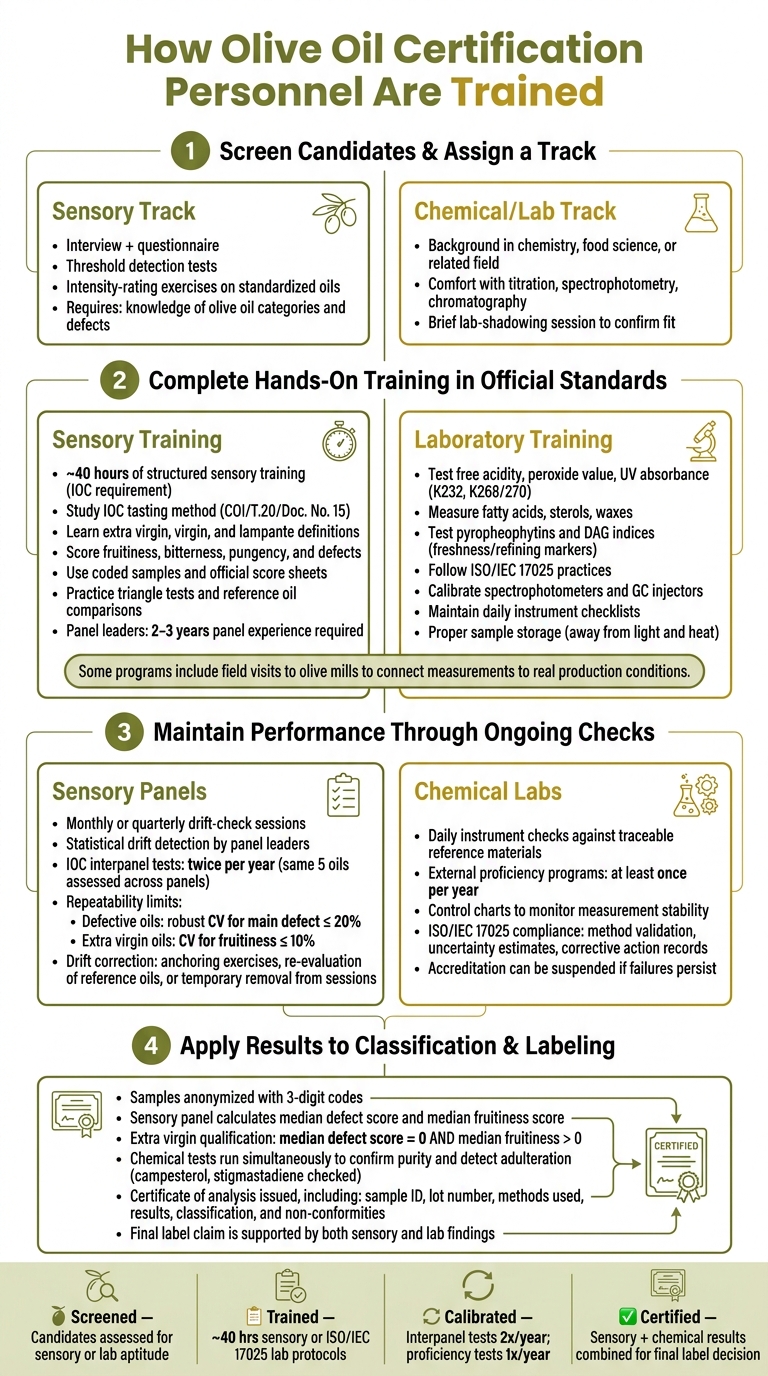
Olive Oil Certification Training: 4-Step Process for Sensory & Lab Personnel
AS University training to become an expert on olive oil tasting
sbb-itb-4066b8e
Step 1: Set Entry Requirements and Choose a Training Path
Organizations usually screen candidates first and then place them on either the sensory path or the chemical path. That first screen decides who moves into sensory training and who heads into lab training.
Baseline Skills for Tasters and Analysts
On the sensory side, organizations want people who already know the basics of olive oil categories and common defects, and who can stick with structured training. IOC guidance recommends about 40 hours of structured sensory training before a new taster is ready to serve on a panel. Groups also tend to start with an interview and questionnaire about health and availability. After that, they use threshold checks and intensity-rating tests on standardized oils to make sure candidates can detect and score attributes in a steady way.
Panel leaders are usually drawn from experienced tasters. Many programs ask for at least 2 years on a recognized panel before someone is considered for leadership training, and some require 3 years on a recognized panel plus expert-taster registration. These roles also need extra training in statistics, quality management, and ISO 17025 application.
For the chemical-testing track, candidates often come from chemistry, food science, or a related field. They should already be at ease with lab work such as titration, spectrophotometry, and chromatography.
Two Main Tracks: Sensory or Chemical Testing
At that point, training splits into two paths.
The sensory path teaches people to score defects and positive traits in a repeatable way. The lab path teaches precision in the tests used to verify quality and authenticity.
The chemical-testing track centers on quality and authenticity measures such as free acidity, peroxide value, UV absorbance (K232 and K268/270), fatty acid profile, and other markers that can show adulteration.
Organizations usually steer candidates with strong tasting skills and hands-on sensory experience into the sensory track. People with science training and lab experience are more often placed in the chemical-testing track. A short tasting exercise or a brief lab-shadowing session helps confirm the fit before advanced training begins. Candidates who clear that stage move on to structured sensory or laboratory instruction.
Step 2: Complete Structured Training in Olive Oil Standards
Once candidates are placed on a track, training shifts into hands-on work: theory first, then supervised practice, then checks to see how well they perform. After that, the sensory and lab paths split.
Sensory Training: Learning Official Tasting Methods
Sensory trainees begin with the theory behind the IOC’s official tasting method (COI/T.20/Doc. No. 15). That includes how extra virgin, virgin, and lampante are defined, and why classification is made by a trained panel rather than one person tasting alone.
From there, trainees work under standard tasting conditions with official score sheets and coded samples. They judge fruitiness, bitterness, pungency, and defects. Then they do it again. And again. That repetition matters.
They compare reference oils for rancid, fusty, and musty defects until their scores line up with the panel median. Triangle tests also help sharpen discrimination. In plain English, this is how tasters learn to tell small differences apart and apply grade rules the same way each time.
The lab track follows that same kind of discipline, just with instruments instead of tasting panels.
Laboratory Training: Measuring Quality and Authenticity
Lab trainees measure free acidity, peroxide value, and UV absorption. They also test fatty acids, sterols, waxes, and related markers tied to adulteration and refinement. For checks on authenticity, training adds pyropheophytins and diacylglycerol (DAG) indices, which serve as markers for freshness and refining.
This work follows ISO/IEC 17025 practices. That means method validation, uncertainty estimates, control charts, known control samples, and proficiency testing at least once a year.
The hands-on side is built into the process too, including:
- proper sample storage away from light and heat
- GC injector maintenance
- spectrophotometer calibration
- daily instrument checklists
All of that supports authenticity and compliance checks.
Field visits help tie these measurements back to what happens before the oil ever reaches a panel room or lab bench.
Field Practice: Connecting Standards to Production
Some programs include visits to olive mills. These visits show how storage, transport, and milling conditions affect the chemical and sensory changes that trainees later measure and judge.
Step 3: Calibrate Performance and Maintain Accreditation
Finishing the coursework is just the beginning. What makes certification work dependable is the stuff that happens afterward: repeat checks, careful records, and outside review. That’s what keeps a trained team from slowly drifting off course.
Regular Calibration for Sensory Panels and Labs
For sensory panels, calibration never stops. Panel leaders run monthly or quarterly sessions to catch score drift early. They use statistical drift checks to spot tasters who keep scoring too low or too high before that affects certification calls.
When drift shows up, there’s a fix built into the process. Tasters may repeat anchoring exercises, re-evaluate reference oils, or be taken out of official sessions for a period until their scores line up again.
The IOC also runs interpanel tests twice a year. In these tests, recognized panels assess the same five oils, and the results are compared with statistical analysis. The repeatability limits are tight:
- For defective oils, the robust coefficient of variation for the main defect must be ≤ 20%
- For extra virgin oils, the coefficient of variation for fruitiness must be ≤ 10%
Chemical labs work from the same basic idea, even though the tools are different. They check instruments against traceable reference materials every day or for each batch, and they take part in external proficiency programs at least once a year. Labs also use control charts to see whether repeat measurements stay inside control limits. If results move outside those limits, the lab has to investigate and fix the issue before running more samples. If failures keep happening, accreditation can be suspended or withdrawn.
Accreditation and Quality Control Requirements
Calibration keeps day-to-day performance in line. Accreditation shows, on paper and under review, that it stays in line.
Both sensory panels and chemical labs need detailed records to show continued competence. Under ISO/IEC 17025, that means keeping staff training files, method validation reports, instrument calibration and maintenance logs, environmental monitoring records, and written corrective actions whenever something falls outside control limits. Sensory panels also keep session records that include sample codes, individual scores, median classifications, and statistical summaries for each evaluation.
The main split comes down to what each group is judged on. Sensory panels are reviewed through panel performance statistics and IOC recognition criteria. Chemical labs, by contrast, are judged on method validation, measurement traceability, and full ISO/IEC 17025 compliance.
Once people stay calibrated and accredited, those results can be used for final classification and certification decisions.
Step 4: Apply Training to Certification Decisions and Consumer Trust
How Trained Personnel Classify and Document Olive Oil
Once personnel stay calibrated, they apply the same process to each lot. Samples get anonymized with three-digit codes so tasters don't know what they're judging. From there, the panel uses the median defect score and median fruitiness score to place the oil in the right category. To qualify as extra virgin, an oil must have a median defect score of 0 and a median fruitiness score above 0.
Sensory work doesn't stand alone. Chemical testing happens at the same time to confirm purity and spot adulteration. Labs also check markers tied to adulteration, including campesterol and stigmastadiene. After that, a classification method lines up the sensory and chemical findings to assign the final category.
The certificate of analysis is the paper trail for all of this. It includes:
- sample ID
- lot number
- methods used
- results
- classification
- non-conformities
Why This Process Matters for Retailers and Home Cooks
This paperwork matters because it connects the oil in the bottle to the grade printed on the label. For retailers, certification helps cut mislabeling risk and back up compliance work. For shoppers, it turns the label from a simple claim into something checked and recorded.
For home cooks, the upside is pretty plain. If a bottle carries a verified extra virgin designation, that label points to a checked grade. In other words, trained tasters and accredited labs looked at it. It isn't just marketing copy.
Conclusion: Key Stages of Olive Oil Certification Training
| Stage | What Happens | Key Output |
|---|---|---|
| Initial Training | Sensory tasters complete formal method training; lab personnel learn chemical test protocols | Prepared panel member or lab analyst |
| Calibration & Accreditation | Panels run regular calibration sessions and ring tests; labs pursue ISO/IEC 17025 accreditation and external proficiency programs | Recognized panel status; accredited laboratory quality system |
| Routine Certification Use | Anonymized samples are evaluated through sensory and chemical workflows, then documented in certificates of analysis | Verified category decisions used for labeling and compliance |
FAQs
Why are both tasting panels and lab tests needed?
Both matter because they check different things.
Lab tests measure objective quality markers. Tasting panels judge flavor, aroma, and any defects the oil may have.
Lab data on its own can miss sensory problems. Panel testing helps confirm whether the oil meets extra virgin standards. Used together, they give a clear, traceable basis for certification.
What disqualifies an olive oil from extra virgin status?
Olive oil keeps its extra virgin label only if it passes both chemical tests and a sensory review.
On the chemical side, it must have free acidity of 0.8% or less, a peroxide value of 20 mEq O2/kg or less, and stay within ultraviolet absorption limits. It also loses that status if testing finds trans fats, too much wax, adulteration, or any sensory defect.
That sensory part matters just as much. If the oil shows rancid, musty, fusty, or winey-vinegary notes, it no longer qualifies as extra virgin.
How do certification teams stay accurate over time?
Certification teams keep results steady through regular calibration and retraining. Sensory evaluators practice with reference oils and blind tastings so defect detection and attribute scoring stay consistent. That work is backed by regular proficiency testing and round-robin testing, which help check that panels are judging oils the same way over time.
Labs support that accuracy with accreditation, quality assurance, and documented verification steps. They also rely on long-term data management to track performance and maintain records, with work aligned with ISO/IEC 17025.