

How GC/MS Detects Olive Oil Adulteration
Did you know? Up to 80% of olive oil sold in U.S. stores might not be pure extra virgin olive oil (EVOO). Fraudsters often mix it with cheaper oils like soybean or sunflower oil, using methods that make detection nearly impossible with basic tests. This undermines the health benefits and quality consumers expect.
The solution? Gas Chromatography-Mass Spectrometry (GC/MS). This advanced technology identifies even tiny amounts of adulteration - down to 0.1% corn oil or 0.2% soybean oil - by analyzing the chemical makeup of olive oil. It examines markers like fatty acids, volatile compounds, and other unique traits to ensure the oil is genuine.
Why it matters:
- EVOO is celebrated for its health benefits, including lowering risks of heart disease and diabetes.
- Fraud costs millions annually and misleads consumers into paying premium prices for subpar products.
- GC/MS provides unmatched precision, identifying fraud that traditional methods miss.
However, GC/MS isn't perfect. It's expensive, requires skilled technicians, and struggles with oils chemically similar to olive oil, like hazelnut oil. Despite these challenges, GC/MS remains a powerful tool in ensuring olive oil quality and protecting consumers from fraud.
OLEUM: Method for the analysis of volatile compounds in virgin olive oil by SPME-GC-FID/MS
sbb-itb-4066b8e
How GC/MS Detects Adulteration in Olive Oil
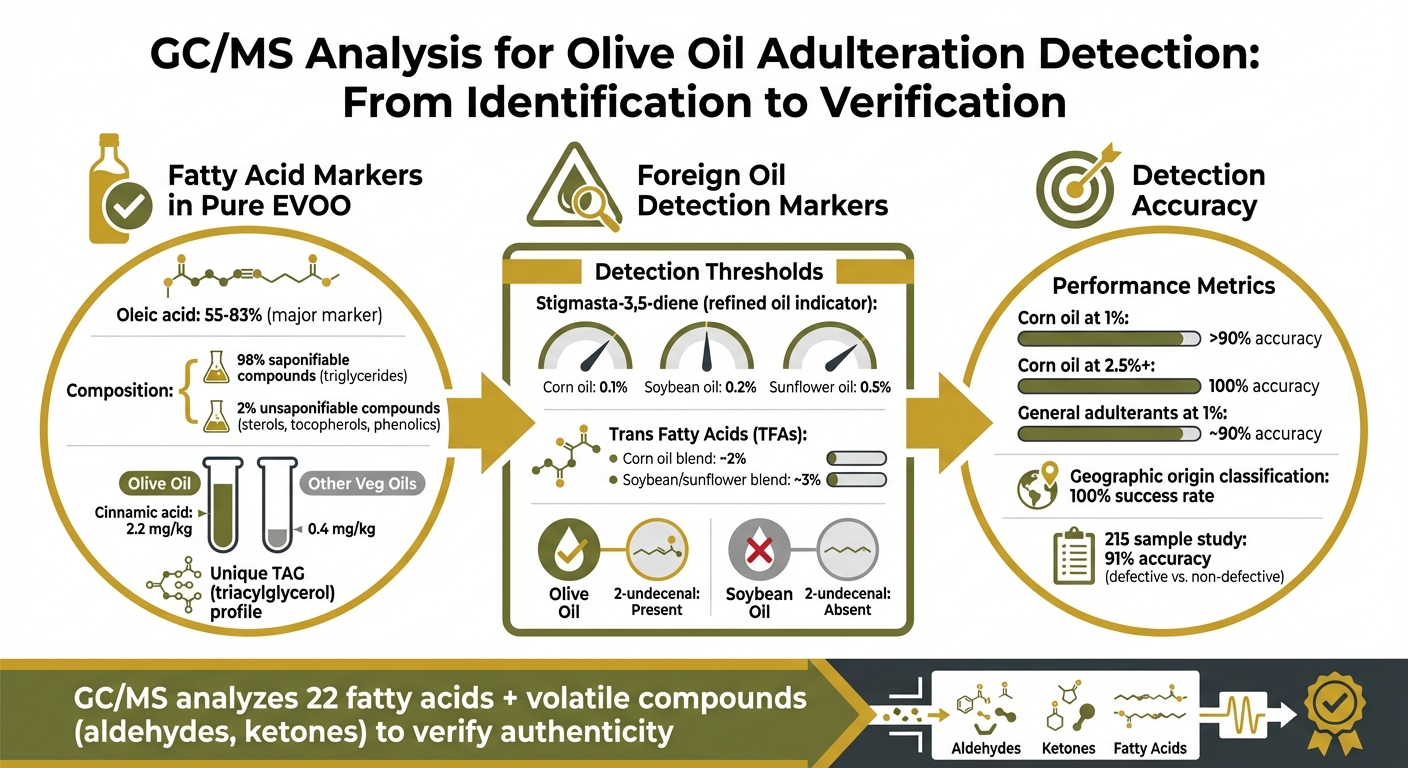
How GC/MS Detects Olive Oil Adulteration: Detection Methods and Markers
Fatty Acid Markers in Pure Olive Oil
Extra virgin olive oil (EVOO) has a distinct chemical profile that can be identified using gas chromatography-mass spectrometry (GC/MS). This technique measures the concentration of key fatty acids, with oleic acid being a major marker - it should account for 55–83% of genuine EVOO. The oil itself is composed of roughly 98% saponifiable compounds (mostly triglycerides) and 2% unsaponifiable compounds (like sterols, tocopherols, and phenolics).
GC/MS also produces a specific triacylglycerol (TAG) profile for EVOO. Additionally, it measures phenolic compounds such as cinnamic acid, which is found at an average of 2.2 mg/kg in authentic EVOO. This level is significantly higher than the 0.4 mg/kg or less typically present in other vegetable oils. These markers enable GC/MS to detect the presence of foreign substances in olive oil.
Detecting Foreign Oils in Olive Oil
GC/MS doesn’t just confirm EVOO’s natural markers - it also identifies adulteration by spotting compounds that don’t belong. For instance, stigmasta-3,5-diene, a compound formed during industrial refining, is a clear indicator of refined oils. This marker can reveal the presence of refined corn oil at 0.1%, soybean oil at 0.2%, and sunflower oil at 0.5%. GC/MS also monitors trans fatty acids (TFAs), which increase when olive oil is mixed with refined seed oils. For example, corn oil adulteration might show up at around 2%, while soybean or sunflower oil blends may appear at approximately 3%. Another marker, the volatile compound 2-undecenal, is unique to olive oil and absent in soybean oil, making it a reliable indicator.
Research Examples of GC/MS Detection
The effectiveness of GC/MS in detecting olive oil adulteration has been demonstrated in various studies.
In July 2015, researchers Hazem Jabeur, Akram Zribi, and Mohamed Bouaziz from the Laboratoire d'Électrochimie et Environnement in Sfax, Tunisia, showcased how GC/MS could detect fraud. Their work identified 0.1% corn oil and 0.2% soybean oil by monitoring stigmasta-3,5-diene levels. They also found that elevated trans fatty acids could indicate blends containing 3% soybean or sunflower oil.
In January 2026, an automated GC×GC–MS workflow was used to analyze 215 certified virgin olive oil samples provided by the Brazilian Ministry of Agriculture, Livestock and Food Supply. This approach achieved a 91% accuracy rate in differentiating defective oils from non-defective ones by focusing on 108 recurring volatile organic compounds. This study addressed significant concerns about olive oil fraud in Brazil.
In December 2021, researchers Xia Zhou and Qinghe Zhang from China’s National Institute of Metrology applied thermogravimetric-gas chromatography/mass spectrometry to detect soybean oil in olive oil. Their findings highlighted 2-undecenal as a unique marker for olive oil, with a correlation coefficient exceeding 0.99 when quantifying blends of 25%, 50%, and 75% soybean oil.
Benefits and Drawbacks of GC/MS Testing
Benefits of GC/MS Testing
GC/MS is highly regarded for its precision and ability to detect even minute adulterations in olive oil. This technology doesn’t just identify adulterants - it quantifies their exact levels, which is crucial for meeting the standards set by the International Olive Council and the EU. For example, when paired with statistical models, GC/MS can identify adulterants like corn, peanut, rapeseed, and sunflower oils at concentrations as low as 1%, with prediction accuracy around 90%. In the case of corn oil, this accuracy surpasses 90% at 1% adulteration and reaches 100% when adulteration exceeds 2.5%.
Another standout feature of GC/MS is its ability to create detailed chemical profiles, making it invaluable for verifying both the geographic origin and botanical authenticity of olive oil. GC-based methods consistently deliver stable and repeatable results. In fact, some studies have reported a 100% success rate in classifying olive oils based on their region of origin. The technology can analyze a wide array of markers - such as 22 fatty acids and volatile compounds like aldehydes and ketones - that indicate both quality and origin.
While these capabilities make GC/MS a powerful tool, it’s not without its challenges.
Drawbacks of GC/MS Testing
Despite its precision and detailed capabilities, GC/MS testing has practical limitations that can hinder its broader use. One major issue is cost. The equipment required is expensive and designed for industrial-grade settings, making it inaccessible for smaller operations or home testing. Michele Suman, Food Safety and Authenticity Research Manager at Barilla Spa, highlights this challenge:
"This approach [non-targeted LC-HRMS] has definite advantages in terms of effectiveness in detecting anomalies, even those not foreseen... but it entails high instrumental costs, technical staff of high competence, and is difficult to be directly implemented by an industrial control laboratory".
The process also involves complex sample preparation. Fatty acids must be converted into methyl esters through derivatization, which requires multiple extraction steps and the use of toxic reagents. This makes the method both labor-intensive and time-consuming.
Another drawback is the difficulty in detecting adulteration with oils that are chemically similar to olive oil, such as hazelnut oil. Additionally, certain fraudulent practices, like soft-deodorization at 212°F (100°C), can mask the thermal degradation markers that GC/MS relies on for detection.
These challenges highlight the trade-offs between the method's accuracy and its practicality for widespread use.
Choosing Quality Olive Oil
Why Quality Matters
The quality of olive oil plays a big role in both its health benefits and its taste. When olive oil is adulterated - mixed with cheaper oils like sunflower, canola, or soybean - it loses the polyphenols and antioxidants that people rely on for health benefits. This compromise isn’t just technical; it directly impacts what consumers expect from high-quality olive oil.
Authentic Extra Virgin Olive Oil (EVOO) is known for its distinct "aroma blueprint", which includes fresh, green, and fruity notes. On the other hand, defective oils can develop unpleasant flavors, such as rancid or vinegary tones, caused by compounds like nonanal and acetic acid.
"The prestige and price of premium olive oil, particularly extra virgin olive oil (EVOO), make it a primary target for economically motivated food fraud." – Analytical and Bioanalytical Chemistry
A striking example of olive oil fraud occurred in 2025 when Brazil's Ministry of Agriculture, Livestock and Food Supply (MAPA) conducted inspections across the country. They uncovered widespread fraud, leading to the suspension of several brands and the confiscation of large amounts of substandard olive oil. This case highlights why it’s critical to choose suppliers that use advanced testing methods, like GC/MS, to verify the authenticity of their products.
These markers of quality emphasize the importance of rigorous testing, as demonstrated by companies like Big Horn Olive Oil.
Big Horn Olive Oil's Quality Standards
Big Horn Olive Oil takes quality seriously, employing advanced GC/MS testing to ensure authenticity. The company adheres to the Ultra Premium (UP) standard, which represents the highest level of quality in the industry. Achieving this standard means every bottle is tested to confirm it’s free from foreign oils and packed with beneficial compounds. Unlike standard EVOO, which only needs to meet basic International Olive Council criteria, Ultra Premium oils undergo a detailed analysis of their fatty acid profiles and sterol composition.
Beyond testing, Big Horn Olive Oil focuses on freshness. They cold-press olives within two hours of harvest and deliver the product to consumers within three months. This quick turnaround, combined with GC/MS verification, ensures their olive oil retains its health benefits and delivers authentic, robust flavor.
Conclusion
GC/MS technology has become a game-changer in combating olive oil fraud, offering precision that conventional tests simply can't match. By focusing on volatile organic compounds, it can uncover sophisticated adulteration methods that hide thermal markers undetectable by standard bulk chemistry tests. A study from January 2026 highlighted its impressive 91% predictive accuracy in distinguishing genuine extra virgin olive oil from lower-grade alternatives across 215 certified samples.
The stakes are enormous. Back in 2019, olive oil topped the charts as the most reported product in the EU Food Fraud Network, with adulteration accounting for around 22% of all food fraud cases. This highlights just how essential reliable testing is - not just for safeguarding consumers, but also for protecting the reputation of premium olive oil brands. When cheaper oils are mixed into high-quality products, the authenticity and sensory qualities of the olive oil take a serious hit.
"This instrumental approach demonstrates a powerful and reliable alternative for forensic analysis of olive oils, generating models that can be interpreted in sensory terms." – Analytical and Bioanalytical Chemistry
FAQs
Can GC/MS tell if olive oil is truly extra virgin?
GC/MS is a powerful tool for detecting adulteration in olive oil by analyzing specific chemical markers. While it can identify impurities or blends that affect the oil's purity and quality, it doesn’t directly determine if the oil meets the standards for being classified as extra virgin.
What adulterant oils can GC/MS detect at very low levels?
GC/MS is highly effective at identifying adulterant oils such as corn, soybean, palm, sunflower, and refined olive oils, even in trace amounts. Detection thresholds can be as low as 0.1% and go up to 2%, depending on the type of oil and the marker being analyzed. This level of accuracy makes it a dependable tool for verifying olive oil purity.
Why can’t GC/MS easily detect hazelnut oil in olive oil?
GC/MS faces difficulties in detecting hazelnut oil in olive oil due to the close resemblance in their phenolic compounds and triacylglycerol profiles. These similarities make it hard for GC/MS to pinpoint adulteration without incorporating other analytical methods or techniques.