

How Organic Olive Oil Gets Certified
Organic olive oil certification ensures the product meets strict USDA standards, covering farming, processing, and labeling practices. Here's what you need to know:
- Certification Process: Farmers must avoid prohibited substances (like synthetic pesticides) for three years before harvest. The oil must be processed without chemical treatments and maintain full traceability.
- Key Standards: GMO use, sewage sludge, and most synthetic chemicals are banned. Farmers rely on natural methods like crop rotation and biological pest control.
- Record-Keeping: Producers must document every step, including soil treatments, harvest dates, and processing details, to ensure compliance.
- Labeling Rules: Only products with 95-100% organic ingredients can use the USDA Organic Seal. Labels must clearly state the certifying agent.
- Annual Inspections: Certified operations undergo yearly reviews and unannounced inspections to maintain their status.
Certification typically takes 3-6 months and requires ongoing compliance, but it helps producers access premium markets and assures consumers of quality.
The Olive Oil Grades | Clear and Simple Definitions
sbb-itb-4066b8e
Organic Standards for Olive Oil Production
Producing organic olive oil isn’t just about skipping synthetic chemicals - it’s about following a detailed set of agricultural practices that ensure quality and sustainability from grove to bottle.
To meet USDA organic certification, the land used for growing olives must remain free of prohibited substances for at least three years before harvesting. This waiting period ensures that any lingering synthetic chemicals are fully cleared from the soil. During this time, farmers must rely on natural methods to maintain soil health. These include techniques like tillage, crop rotations, and planting cover crops, along with using animal and crop waste as fertilizers. Additionally, producers are required to use seeds and planting stock that meet organic standards whenever they are available. Let’s explore the key prohibitions and record-keeping rules that make this system work.
Banned Substances and Methods
Organic certification comes with strict prohibitions. Farmers are not allowed to use genetic engineering (GMOs), sewage sludge, or ionizing radiation. Most synthetic pesticides and fertilizers are also off-limits. Instead, pest and weed control must prioritize physical, mechanical, or biological strategies. If synthetic substances are absolutely necessary, they must be on the National List of Allowed and Prohibited Substances and can only be used after proving that non-synthetic methods are not enough. These bans ensure that organic practices remain as natural as possible, but compliance also hinges on thorough documentation.
Record-Keeping and Traceability
Maintaining detailed records is a cornerstone of organic certification. Every step of the process - from soil treatments to bottling - must be documented to prove adherence to organic standards. This includes tracking everything applied to the soil, logging harvest dates, and recording how olives are handled during processing.
At the heart of this system is the Organic System Plan (OSP), which serves as a blueprint for certification. Miles McEvoy, Deputy Administrator of the National Organic Program, puts it this way:
"The organic system plan is the foundation of the organic certification process".
The OSP outlines procedures to prevent the mixing of organic and non-organic products during critical stages like milling and bottling. Even an accidental mix-up can lead to the loss of organic certification.
To meet these standards, handlers must keep organic oil completely separate from conventional products and prohibited substances throughout processing. These meticulous records ensure that every bottle of organic olive oil can be traced back to its certified source.
How to Get USDA Organic Certification
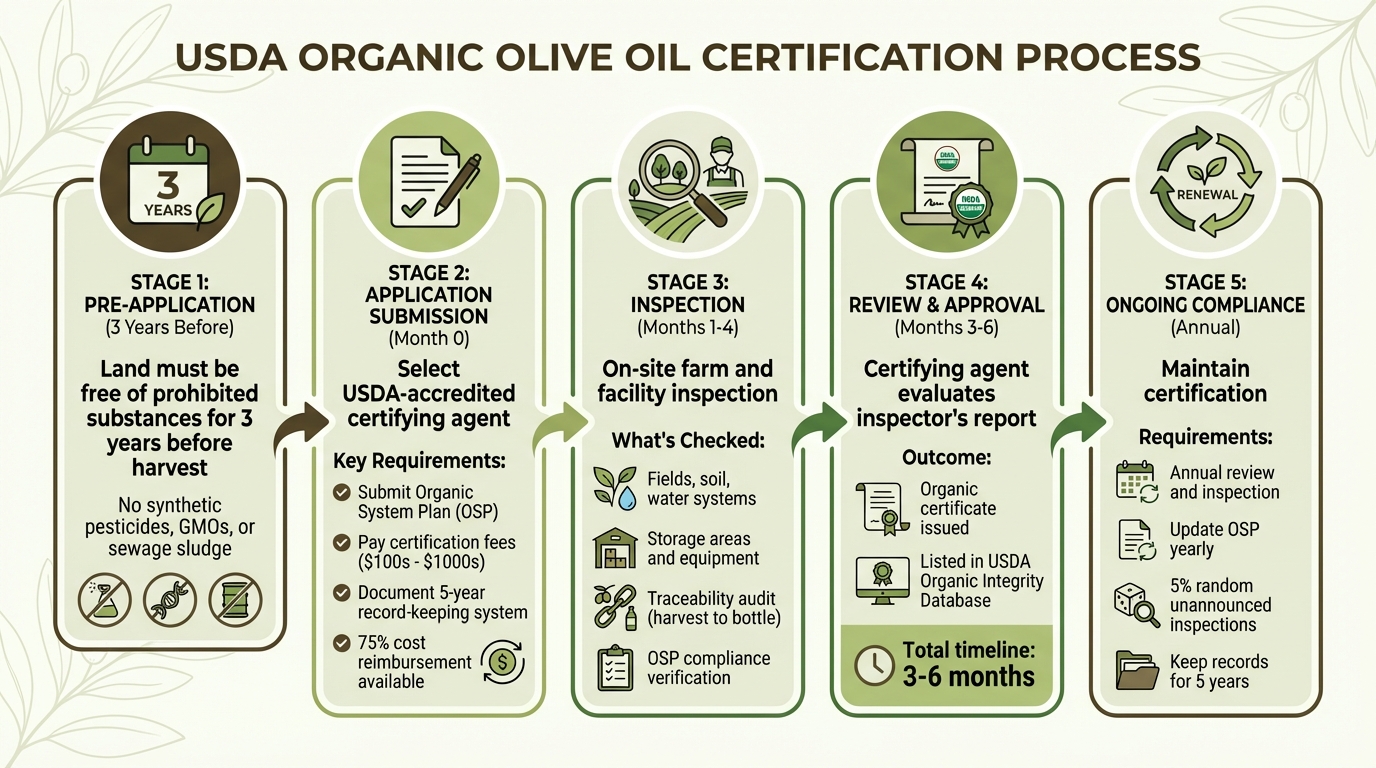
USDA Organic Olive Oil Certification Process Timeline
Getting USDA Organic Certification typically takes three to six months from the time you apply to when it's approved. The process's length depends on how quickly you respond to requests and when inspectors can visit during active growing or processing seasons.
Submitting Your Application
The first step is selecting a USDA-accredited certifying agent and submitting your application along with the required fees. Certification costs vary widely, ranging from a few hundred to several thousand dollars, depending on the size and complexity of your operation. To help offset these costs, the USDA Organic Certification Cost-Share Program can reimburse eligible operations for up to 75% of their certification expenses.
A critical part of your application is the Organic System Plan (OSP). This document outlines your business details, any previous certification history, and documentation of corrective actions if you've received a noncompliance notice before. You'll also need to show that you have a record-keeping system in place that maintains all relevant records for at least five years.
Once your application and OSP are accepted, the next step is an on-site inspection to verify your practices.
Farm and Facility Inspections
After reviewing your OSP, the certifying agent assigns an inspector to visit your farm or processing facility. During this visit, the inspector ensures that your practices align with the details in your OSP. They’ll examine everything from fields and soil to water systems, storage areas, and equipment cleaning processes. A traceability audit is also conducted, which checks if your records can track olives (or other products) from harvest through processing to bottling.
Make sure a knowledgeable representative is available during the inspection to answer questions and confirm the inspector’s findings. Keep all records, like audit trails, inventory logs, and cleaning documentation, organized and easy to access.
If the inspection confirms compliance, you’ll move forward to certification approval and ongoing requirements.
Receiving Certification and Ongoing Requirements
The certifying agent evaluates the inspector's report, comparing it with your OSP and checking for any contamination risks. If everything meets USDA organic standards, you’ll be issued an organic certificate. Your operation will also be listed in the USDA's Organic Integrity Database, which tracks certification statuses.
To maintain your certification, you must undergo an annual review and inspection. Update your OSP each year to reflect any changes in your practices. Be prepared for unannounced inspections, as certifying agents are required to conduct surprise visits on at least 5% of their certified operations annually. These measures ensure that your operation continues to meet organic standards. If prohibited substances are accidentally applied to your land, such as through drift from neighboring farms, notify your certifying agent immediately.
Labeling Rules for Organic Olive Oil
Once certified, proper labeling is crucial to maintain compliance and build consumer trust. The USDA has established clear guidelines for when and how organic claims can appear on packaging.
Using the USDA Organic Seal
The USDA Organic Seal is reserved for products that meet specific criteria. It can only be used on items labeled as "100 Percent Organic" or "Organic".
- "100 Percent Organic": Products in this category must be made entirely from certified organic ingredients.
- "Organic": These products must contain at least 95% certified organic ingredients. The remaining 5% can include non-organic ingredients, but only if they are on the National List of Allowed and Prohibited Substances.
Additionally, the certifying agent's name must appear clearly on any product using the USDA Organic Seal. This transparency allows consumers to verify the organic claims. For flavored olive oils - such as those infused with herbal flavors or citrus - ensure that at least 95% of the total weight (excluding water and salt) is organic to qualify for the seal.
Products labeled as "Made with organic" ingredients, which contain between 70% and 95% organic content, cannot display the USDA Organic Seal. These restrictions ensure that only products meeting the highest organic standards can use the seal.
Organic Content Requirements for Labels
The percentage of organic ingredients in a product determines the labeling options. Here's how the categories are defined:
| Labeling Category | Organic Content Requirement | USDA Seal Usage |
|---|---|---|
| 100 Percent Organic | 100% certified organic ingredients | Allowed |
| Organic | At least 95% certified organic ingredients | Allowed |
| "Made with" Organic | At least 70% certified organic ingredients | Prohibited |
| Specific Organic Ingredients | Less than 70% certified organic ingredients | Prohibited |
For products with less than 70% organic content, you can identify specific organic ingredients in the ingredient list. However, "organic" cannot appear on the principal display panel.
"In order to make an organic claim or use the USDA Organic Seal, the final product must follow strict production, handling and labeling standards and go through the organic certification process".
For multi-ingredient products that meet the 95% threshold, all agricultural ingredients must be organic unless they are unavailable commercially and listed under Section 205.606. Before printing your labels, submit them to your USDA-accredited certifying agent for approval to ensure they align with federal regulations.
Keeping Your Organic Certification Active
Once you’ve earned your organic certification, the work doesn’t stop there. To keep it active, you need to adhere to strict standards, including annual updates and inspections. The USDA requires all certified operations to undergo a complete review and on-site inspection every year to ensure they continue meeting organic regulations.
You’ll need to update your Organic System Plan (OSP) annually. This involves submitting a summary of any changes in your practices or deviations from the previous year, along with plans for the upcoming year. This helps your certifying agent monitor your operation’s progress while ensuring it stays within organic guidelines.
Detailed recordkeeping is another essential part of maintaining certification. Keep records for at least five years, including material logs, harvest and sales data, equipment cleaning logs, and clean-out records for shared equipment. Every bottle of olive oil you produce should be traceable to the specific field and harvest date, creating a complete audit trail.
If minor compliance issues are identified during inspections, you’ll need to demonstrate that you’ve corrected them. After a successful review and inspection, your certifying agent will issue an updated organic certificate. To help with costs, the USDA Organic Certification Cost-Share Program reimburses eligible producers for up to 75% of their annual certification expenses, which can ease the financial burden.
Yearly Compliance Reviews
The annual review process is critical for confirming that your operation continues to meet organic standards. This includes at least one on-site inspection per calendar year, conducted by your certifying agent as required by USDA regulations.
Before your inspection, make sure your OSP is up to date. Include receipts and labels for all inputs used. If you’ve planted new olive trees, document your efforts to source organic stock or verify that any non-organic stock is non-GMO.
Timely payment of your annual certification fees is also essential. These fees vary depending on your operation’s size and complexity and typically include application fees, renewal fees, production or sales-based assessments, and inspection costs. Planning for these expenses as part of your annual budget is crucial.
During the inspection, agents will evaluate your fields, storage areas, processing facilities, and documentation systems to ensure compliance. They’ll verify that your practices align with organic standards and that your records accurately reflect your operations. Be prepared for the possibility of unannounced audits, as certifying agents may conduct surprise visits and test for prohibited substances.
What Happens If You Don't Comply
Failing to comply with organic standards can have serious consequences. Noncompliance results in written notifications, and if issues remain unresolved, your certification may be suspended or revoked.
"A suspended or revoked operation can't sell, label, or represent its products as having been organically produced or handled." - Agricultural Marketing Service
Losing certification means you can no longer market your olive oil as organic, which could severely affect your business. Additionally, the National Organic Program (NOP) enforces penalties for violations, including financial fines for selling products as organic without valid certification. These fines can escalate quickly.
Suspended or revoked businesses are also listed in the Organic Integrity Database, a public resource where customers, retailers, and competitors can view compliance statuses. This public record can harm your reputation long after the violations are corrected. If your certification is suspended or revoked, you do have the option to appeal the decision through the NOP’s formal appeals process.
Conclusion
Organic certification plays a crucial role in safeguarding both producers and consumers. For olive oil producers, it serves as a way to distinguish premium products from lower-quality alternatives, justifying higher prices while ensuring traceability that builds consumer trust.
Certification guarantees that extra virgin olive oil adheres to strict chemical and sensory standards. These include free acidity of ≤0.8%, a peroxide value of ≤20 meq O₂/kg, and spectrophotometric limits like K232 at 2.50 and K270 at 0.22. These benchmarks not only help detect adulteration but also confirm the presence of valuable bioactive compounds such as polyphenols and oleocanthal.
As Olio EVO Shop explains:
"Being classified as 'extra virgin' is not a mere commercial label, but a certification that attests to a virtuous production process and an impeccable chemical, physical, and sensory profile."
This level of dedication is reflected in companies like Big Horn Olive Oil. Their Extra Virgin Olive Oils are cold-pressed within two hours of harvest and delivered fresh within three months. Their approach underscores how organic certification supports not just quality but also transparency, reinforcing consumer trust and encouraging responsible production practices.
Additionally, certification programs undergo annual reviews to align with evolving state, federal, and international standards. This continuous oversight ensures that organic certification remains relevant and reliable.
FAQs
What can cause an organic olive oil certification application to be denied?
Organic olive oil certification can be denied if the product doesn’t meet strict standards. Some common reasons include not using at least 95% organic ingredients, vague or unverifiable ingredient sourcing, or relying on chemical treatments or other non-compliant methods. To gain approval, producers must prioritize transparency and strictly follow organic guidelines.
How can I verify a bottle is truly USDA Organic?
To verify if a bottle is USDA Organic, look for the official USDA Organic seal on the packaging. Additionally, the label should clearly indicate that it is USDA Organic certified, confirming it meets the required USDA organic standards.
What’s the difference between “Organic” and “Extra Virgin” on olive oil?
"Organic" relates to the farming methods used to grow olives. This means no synthetic pesticides, fertilizers, or GMOs are involved, and the process complies with certified organic farming standards. On the other hand, "Extra Virgin" refers to the oil's quality, emphasizing low acidity and adherence to strict chemical and sensory benchmarks. A product can carry both labels if it meets the requirements for each, but they focus on different aspects of how the oil is produced and its overall quality.