

How Pesticide Residue Testing Works in EVOO
Extra virgin olive oil (EVOO) must be free of harmful pesticide residues to ensure safety and quality. Testing methods like LC-MS/MS and GC-MS detect even trace amounts of pesticides, keeping levels well within legal limits. These processes involve:
- Sample preparation: Weighing 2–3 grams of oil, stored and tested within 15 days.
- Extraction: Techniques like QuEChERS and Liquid-Liquid Extraction isolate pesticide residues.
- Cleanup: Removing fats and pigments using sorbents like PSA and C18.
- Analysis: Advanced instruments identify and measure pesticide levels.
Regulations from the EU, EFSA, and U.S. agencies set strict standards, ensuring EVOO is safe for consumption. Companies like Big Horn Olive Oil follow these guidelines, using validated methods to guarantee safety and compliance.
The Pesticide Residue Testing Process
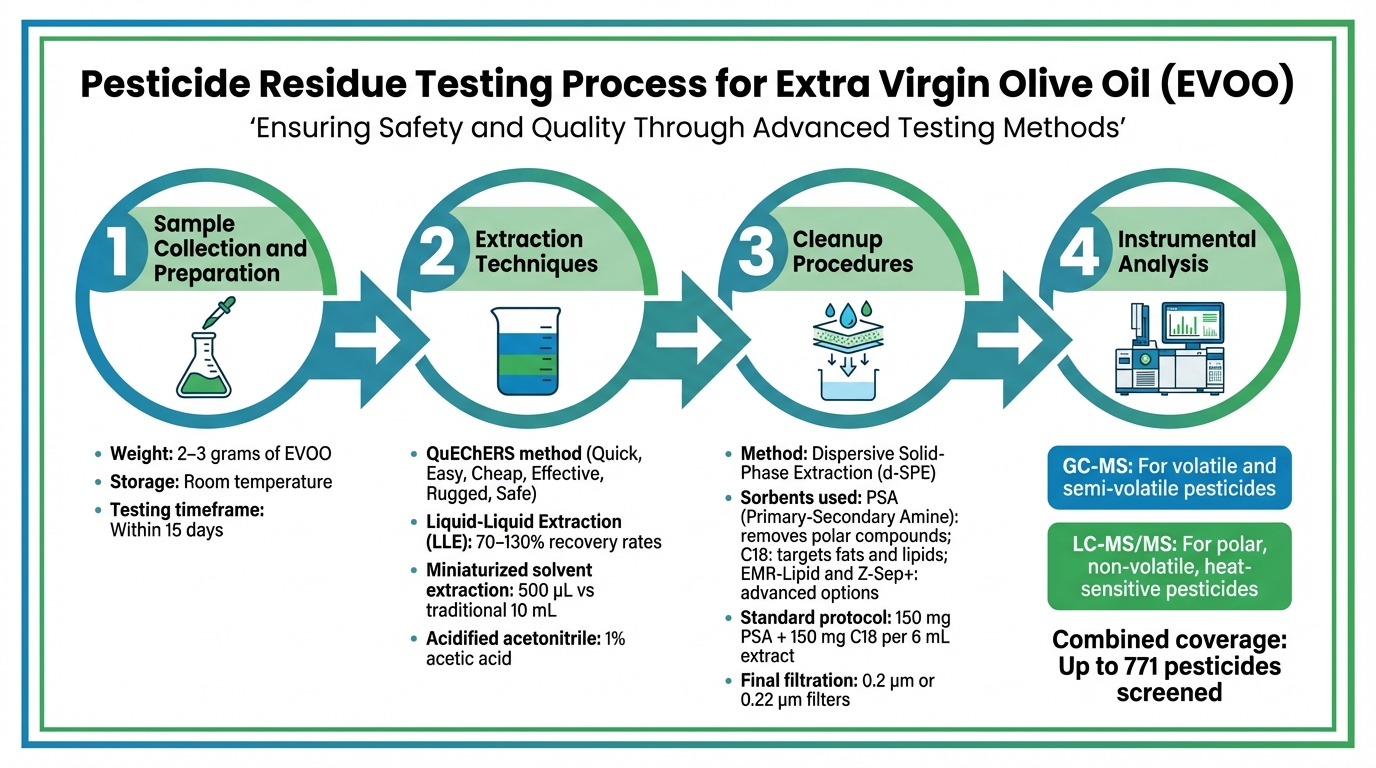
4-Step Pesticide Residue Testing Process for Extra Virgin Olive Oil
Testing for pesticide residues in olive oil involves a series of carefully planned steps aimed at identifying even the smallest traces of chemicals. The process starts with preparing the sample, followed by extraction and cleanup, and ends with instrumental analysis. Each stage is designed to ensure accurate detection and measurement of residues.
Sample Collection and Preparation
The first step in ensuring the purity of extra virgin olive oil (EVOO) is proper sample handling. Analysts begin by weighing 2–3 grams of EVOO into centrifuge tubes. This precise measurement ensures consistency across tests. Samples should be stored at room temperature and tested within 15 days to preserve the integrity of any pesticide residues.
Proper sample handling is critical to avoid contamination and maintain accuracy.
Extraction Techniques
The QuEChERS method (Quick, Easy, Cheap, Effective, Rugged, and Safe) is widely used for extracting pesticides from EVOO. It involves adding acetonitrile to the sample, followed by salts like magnesium sulfate and sodium chloride. This combination triggers a phase separation, isolating pesticide residues in the acetonitrile layer.
Another common method is Liquid-Liquid Extraction (LLE), which uses solvent partitioning to separate pesticides from the oil. This technique typically achieves recovery rates of 70–130%. To enhance the stability of certain pesticides during extraction, some labs use acidified acetonitrile containing 1% acetic acid.
A more recent method, miniaturized solvent extraction, uses only 500 µL of solvent instead of the traditional 10 mL, making it a more environmentally friendly option.
Once the extraction is complete, the next step is to remove any interfering substances through a cleanup process.
Cleanup Procedures
In this step, Dispersive Solid-Phase Extraction (d-SPE) is used to remove unwanted components like lipids, pigments, and organic acids from the extract. Since EVOO is almost entirely fat, this step is essential to protect the sensitive equipment used in analysis.
The d-SPE process involves adding specific sorbents to the extract. PSA (Primary-Secondary Amine) removes polar compounds, while C18 targets fats and lipids. Advanced sorbents like EMR-Lipid and Z-Sep+ are also available to improve efficiency in removing lipids. A standard protocol uses 150 mg of PSA and 150 mg of C18 for every 6 mL of acetonitrile extract.
After cleanup, the extract is evaporated and reconstituted in a solvent suited to the analysis method - typically a methanol/water mix for LC-MS or n-hexane for GC-MS. Finally, the extract is filtered through 0.2 µm or 0.22 µm filters to eliminate any remaining particles that could damage the analytical instruments.
These cleanup procedures ensure that the final analysis produces clear and reliable results.
sbb-itb-4066b8e
Instrumental Analysis Methods
After the cleanup process, the extract undergoes instrumental analysis. Two primary technologies are used to detect pesticides in EVOO, each specializing in identifying different types of chemical residues.
Gas Chromatography with Mass Spectrometry (GC-MS)
GC-MS is ideal for detecting volatile and semi-volatile pesticides. In this method, the cleaned extract is dissolved in n-hexane and injected into a heated column. Here, the pesticides vaporize and separate based on their chemical characteristics. A Programmed Temperature Vaporizer (PTV) in solvent vent mode expertly handles the challenges posed by EVOO's complex oil matrix.
Once separated, the compounds are sent into the mass spectrometer, where Triple Quadrupole detectors operating in MRM mode identify them. This setup filters out background noise caused by EVOO's fat-rich matrix. While traditional Electron Ionization (EI) is commonly used, the newer Atmospheric Pressure Chemical Ionization (APCI) method offers cleaner molecular ions with minimal fragmentation. This improvement allows for the detection of a broader range of compounds.
"GC-MS is mostly used for semi-volatile compounds, whereas LC-MS is favourable for polar and thermo-labile pesticides. Therefore, the combination of these two techniques leads to a significant increase of the analytical coverage that enables the wide-scope screening of pesticides."
- Sofia K. Drakopoulou, Laboratory of Analytical Chemistry, National and Kapodistrian University of Athens
While GC-MS specializes in volatile compounds, LC-MS/MS fills the gap by targeting residues that cannot be analyzed using gas chromatography.
Liquid Chromatography with Tandem Mass Spectrometry (LC-MS/MS)
LC-MS/MS is suited for analyzing polar, non-volatile, and heat-sensitive pesticides that break down in gas chromatography. For this process, the extract is reconstituted in a methanol/water mixture and passed through a C18 reversed-phase column at room temperature, separating the compounds based on their polarity. Electrospray Ionization (ESI), used in both positive and negative modes, ensures extensive detection capabilities.
In April 2024, researchers at the National and Kapodistrian University of Athens developed a method to screen 771 pesticides in olive oil. By combining LC-ESI (which covered 663 pesticides) and GC-APCI (which covered 270 pesticides), they analyzed 20 olive oil samples from Crete and Lesvos. The study successfully detected residues of lambda-cyhalothrin, chlorpyrifos, phosphamidon, pirimiphos-methyl, and esprocarb at low ng/g levels. Interestingly, 80% of the shared analytes showed greater sensitivity in LC-MS compared to GC-MS.
Advanced High-Resolution Mass Spectrometry (HRMS) platforms, such as Orbitrap and QTOF, now allow for retrospective analysis. This means labs can revisit stored data to identify newly discovered contaminants.
Validation and Quality Control in Testing
Using advanced instruments for pesticide detection demands thorough method validation and continuous quality checks. Testing labs must prove their methods are effective before analyzing real-world samples and maintain accuracy through routine checks.
Validation Parameters
Validation ensures that testing methods can detect pesticides accurately at required legal limits. One key parameter is linearity, which confirms that the instrument's response corresponds directly to pesticide concentration across a specified range - typically 5 to 500 μg/kg - with a correlation coefficient (r²) above 0.99.
Accuracy is assessed through recovery tests, where acceptable recovery rates fall between 70% and 120%. Precision is checked by analyzing the same sample repeatedly, both on the same day (repeatability) and over different days (reproducibility). Labs aim to keep the relative standard deviation (RSD) below 20%. A 2023 study highlighted the effectiveness of these methods, achieving recoveries between 70% and 113% for 95% of pesticides tested using an EMR-lipid sorbent.
Sensitivity measures the method's ability to detect minimal pesticide amounts. The Limit of Quantification (LOQ) must be lower than regulatory Maximum Residue Levels (MRLs), which are generally set at 0.01 mg/kg or 0.05 mg/kg for olive oil. For high-resolution mass spectrometry, specificity is confirmed using criteria like mass accuracy within 5 mDa, stable retention times (±0.05 min for gas chromatography), isotopic pattern matching, and distinct MS/MS fragmentation patterns.
"The identification of positive findings in HRMS workflow is relied on several identification criteria that consider all the analytical evidence available (i.e., retention time, mass accuracy, isotope fitting, fragmentation pattern), thus significantly enhancing identification confidence." - Sofia K. Drakopoulou et al.
After validation, strict quality control ensures consistent performance during routine testing.
Quality Control Protocols
Once methods are validated, labs implement daily quality control measures to maintain reliability. One such measure is batch-wise recovery testing, where blank olive oil is spiked at the LOQ with every sample batch to monitor performance. To counteract matrix-induced signal suppression in pesticide analysis, labs use matrix-matched calibration, preparing calibration standards with blank olive oil extracts instead of pure solvents.
Internal standards, such as Triphenyl Phosphate (TPP), are used to offset sample loss during extraction and manage instrument inconsistencies. Labs also run procedural blanks with each batch to detect any contamination introduced during testing. High-resolution instruments require daily calibration with certified solutions to maintain mass accuracy. Routine testing typically achieves an RSD of around 13%, ensuring consistent results.
Additionally, labs participate in external proficiency testing programs, like those conducted by the International Olive Council (IOC), to independently verify their accuracy. These combined measures uphold strict regulatory standards and reinforce the trusted quality of Big Horn Olive Oil products.
Compliance and Regulatory Standards
Ensuring compliance with both international and U.S. regulatory standards is a key step in validating the safety of Extra Virgin Olive Oil (EVOO). By conducting pesticide residue testing, producers not only confirm EVOO quality but also safeguard public health and promote fair trade practices.
International Olive Council (IOC) Guidelines

The International Olive Council (IOC) plays a key role in defining quality and purity standards for olive oil. When it comes to pesticide residue limits, however, these are typically aligned with benchmarks set by the Codex Alimentarius Commission and European Union regulations. For instance, Commission Regulation (EC) No 396/2005 outlines Maximum Residue Levels (MRLs) for pesticides in vegetable oils, including EVOO. These limits are usually in the low microgram per kilogram (μg/kg) range. Since olive oil is processed from olives, MRLs are often adjusted using processing factors.
Testing laboratories must ensure their Limit of Quantification (LOQ) is low enough to detect residues beneath these thresholds. Additionally, multiannual control programs are in place to monitor pesticide levels and evaluate consumer exposure. A 2024 study analyzing 35 Italian EVOO samples found that 34% contained pesticide residues ranging from 0.42 to 6.14 ng/mL - levels deemed safe for human health.
In the U.S., similar regulatory frameworks are in place to ensure EVOO safety.
US Regulatory Requirements
In the United States, the Environmental Protection Agency (EPA) sets the allowable pesticide limits, while the Food and Drug Administration (FDA) enforces these limits on both domestic and imported EVOO. Though U.S. regulations align with Codex standards, they also account for tolerances specific to certain domestic pesticides. To confirm compliance, validated testing methods such as SANTE/12682/2019 or SANTE/11312/2021 are used. These methods ensure recovery rates between 70–120%, a Relative Standard Deviation (RSD) of ≤20%, and expanded uncertainty of ≤50%.
Big Horn Olive Oil works exclusively with producers who follow these stringent protocols. This guarantees that every bottle of their Ultra Premium EVOO meets the highest international and U.S. safety standards.
Conclusion
Ensuring the purity of EVOO involves more than just rigorous testing - it also requires advanced pesticide residue screening. Techniques like LC-MS/MS and GC-MS are used to detect contaminants at trace levels, ensuring they remain well below legal limits. For instance, a study of 35 Italian EVOO samples revealed that while 34% contained pesticide residues, all were deemed safe with no short- or long-term health risks to consumers. Additionally, modern cleanup methods, such as EMR-Lipid cartridges, effectively eliminate over 99% of matrix residues. These processes highlight how careful testing safeguards public health while preserving the quality of premium olive oil.
Big Horn Olive Oil takes this commitment seriously by working exclusively with producers who adhere to stringent pesticide residue testing. Each bottle of their Ultra Premium EVOO is evaluated using validated multiresidue methods, ensuring it meets the highest safety and quality standards. This dedication aligns with both IOC guidelines and US EPA tolerances, guaranteeing customers receive a product they can trust.
FAQs
What’s the difference between GC-MS and LC-MS/MS for EVOO testing?
Gas Chromatography-Tandem Mass Spectrometry (GC-MS/MS) and Liquid Chromatography-Tandem Mass Spectrometry (LC-MS/MS) are both trusted methods for detecting pesticide residues in extra virgin olive oil (EVOO). GC-MS/MS is particularly suited for identifying volatile and heat-stable pesticides, while LC-MS/MS excels with non-volatile, polar, or heat-sensitive compounds. Both techniques are validated for EVOO analysis, and the choice between them depends largely on the specific pesticide properties and the oil's composition.
How low can labs detect pesticide residues in extra virgin olive oil?
Laboratories have the capability to detect pesticide residues in extra virgin olive oil at incredibly minute levels, often measured in parts per billion (ppb). Using advanced techniques, they can identify residues as low as 10 µg/kg (10 ppb), ensuring even the tiniest traces are measurable to meet safety and regulatory standards.
What makes a pesticide test method “validated” and trustworthy?
A pesticide test method is considered validated when it consistently provides accurate and reliable results. This means it can detect pesticide levels below regulatory thresholds while maintaining dependable recovery rates and keeping variability low. Validation typically involves the use of quality control samples, calibration standards, and matrix-matched controls to ensure the method’s accuracy, reproducibility, and effectiveness for regular testing.