

How Terroir Shapes Picholine Olives
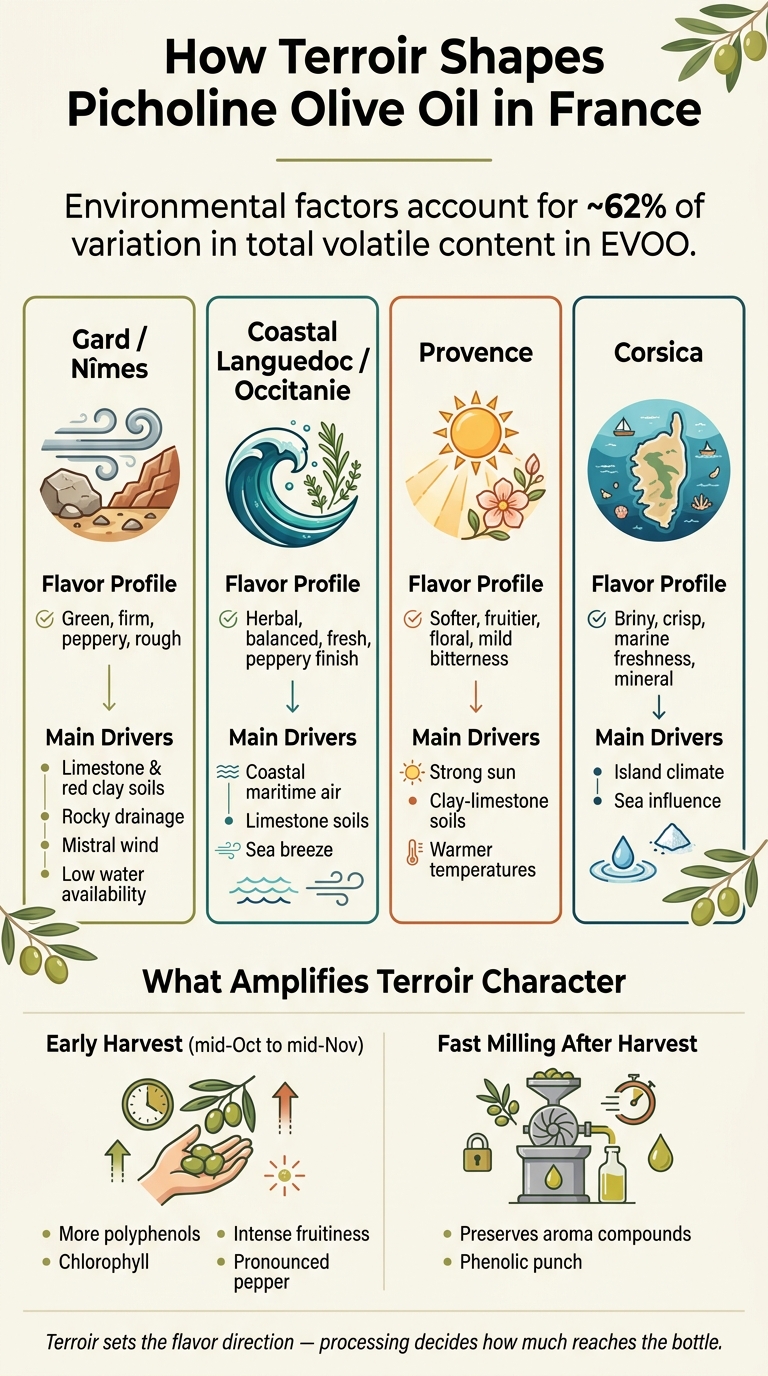
Picholine can taste very different from one part of southern France to another, even when the olive variety stays the same. I’d sum it up like this: soil, heat, wind, water stress, harvest date, and milling time shape whether the oil tastes greener, softer, more bitter, or more peppery.
Here’s the short version:
- Gard and Nîmes often give Picholine oils a green, bitter, peppery style.
- Coastal Languedoc can bring herbal notes, balance, and lift from limestone soils and sea air.
- Provence often leans softer and riper, with more floral and fruit notes.
- Dry conditions tend to increase phenols, which drive bitterness and throat pepper.
- Early harvest olives, often picked from mid-October to mid-November, usually make more forceful oils.
- Research cited in the article says place accounts for about 62% of the change in total volatile content in EVOO.
If you want the plain answer, it’s this: terroir helps set the flavor direction, and processing decides how much of that ends up in the bottle.
| Area | Usual style | Main drivers |
|---|---|---|
| Gard / Nîmes | Green, firm, peppery | Limestone, red clay, dry wind, low water |
| Coastal Languedoc | Herbal, balanced, peppery | Coastal air, limestone soils |
| Provence | Softer, fruitier, floral | More sun, clay-limestone soils |
| Corsica | Briny, crisp | Island climate |
What I take from the article is simple: Picholine is not just about the variety. Where it grows and how fast it is milled after picking both shape the final oil.
Picholine Olive Oil by French Terroir: Flavor Profiles & Key Drivers
Find Your Crush Olive Oil Reviews - Chateau d'Estoublon Picholine
sbb-itb-4066b8e
The French terroirs where Picholine grows best
Southern France gives Picholine the mix it likes most: sun, drainage, and steady wind exposure. That’s where the variety tends to show its clearest character. In France, you see that most clearly in the Gard, coastal Languedoc, and Provence.
Gard and the Nîmes area: sun, limestone, and mistral wind
The Gard is one of Picholine’s main strongholds. The soils fit the variety well: rocks and pebbles lie over red clay, which creates the dry, stony ground Picholine prefers and drives roots deeper in search of water. That drainage plays a big part in keeping the oil green and firm in style.
The Mistral also leaves its mark here. Picholine handles this wind well, and the dry air it brings lowers disease pressure. Around Nîmes, those conditions show up in an oil officially described as having a "rough and slightly peppery" character.
Languedoc and Occitanie: coastal influence and aromatic character
Along the coast, the picture changes a bit. Maritime influence gives Picholine a different expression. In Montagnac, Hérault, Domaines Paul Mas makes a 100% Picholine oil, "Les Tannes en Occitanie." The estate connects its limestone soils and coastal setting with freshness, herbal notes, and a balanced peppery finish. That mix of freshness and structure stands out in maritime sites.
Other southern French sites and likely flavor shifts
In Provence, clay-limestone soils and stronger sun can dial back bitterness and move Picholine toward ripe fruit, herbs, and floral notes. You can see these shifts more clearly when you look at soil drainage, heat, and exposure side by side.
What research shows about soil, climate, and geography
Soil structure, drainage, and water availability
Research helps explain why oils from one area can taste so different from oils from another. With Picholine, well-drained, rocky soils and low water availability play a big role in oil quality. Looking across terroirs, environmental conditions explain about 62% of the variation in total volatile content.
Under rain-fed conditions, water stress tends to cut yield, but it also increases phenols, bitterness, and pepperiness. Irrigation pushes part of that in the other direction: it increases fruit size and yield, delays maturity, and lowers phenolic buildup.
Soil texture matters too. As soil moves from sandier to more silty composition, the way aroma compounds form during fruit growth can change, which then shifts the oil's aroma.
Soil sets the starting point. Heat and drought then intensify the pattern.
Heat, drought, and climate pressure during fruit development
Heat and drought often reduce yield, but they can also increase phenols, oxidative stability, and flavor intensity. Picholine handles drought well.
Altitude, slope, and sun exposure
Topography adds another layer. Altitude can change ripening speed and oil composition, including pigments and fatty-acid balance. Higher elevations may bring bigger day-to-night temperature swings and slower ripening.
Stronger sun exposure can move Picholine toward faster ripening and a softer, fruitier profile.
How terroir changes Picholine oil flavor and composition
Why some Picholine oils taste greener, more bitter, or more peppery
Growing conditions show up most clearly in phenols, pigments, and ripening speed. That’s where a lot of the sensory split between Picholine oils from one region and another comes from.
Phenolic compounds drive bitterness and that peppery kick in the throat. When olive trees face drought stress, the phenol fraction in the fruit and oil goes up. Chlorophyll and carotenoids affect both the green color and the herbaceous side of the oil, and their levels shift with geographical origin and extraction methods.
You can taste those regional patterns in the glass. Languedoc Picholines often lean green and firm, with notes of fresh hay, herbs, anise, and a marked bitterness. Provence oils usually come across as softer, with floral, plum, and green fruit notes. Corsican Picholine tends to have a marine, briny freshness that reflects its island setting.
| Region | Sensory Profile |
|---|---|
| Languedoc / Gard | Green herbs, hay, anise, pronounced bitterness, peppery finish |
| Provence | Floral, plum, green fruit, softer bitterness |
| Corsica | Marine, briny, crisp freshness |
How harvest timing and milling interact with terroir
Flavor potential still depends on how the olives are picked and processed. Terroir sets the stage, but harvest timing and milling decide how much of that character makes it into the bottle.
Picholine olives harvested from mid-October to mid-November at the green stage produce oils with intense fruitiness, fine herb notes, and fresh pepper. Early-harvest green olives contain more polyphenols and chlorophyll, which makes the oil more intense. Later harvests, by contrast, are usually milder and less forceful, with fewer antioxidants.
Processing speed matters too. Pressing soon after harvest helps keep aroma and phenols in place. Cold extraction helps protect the oil and preserve the volatile compounds formed in the grove.
Why terroir knowledge helps when choosing premium EVOO
For buyers, origin and handling are the fastest clues to quality. Origin gives a quick read on Picholine style: Gard and Languedoc usually point to bolder, more peppery oils, while Provence tends to mean a softer, fruitier profile. Corsica adds a distinct briny, mineral edge.
Handling matters just as much. Fresh oil that was processed fast after harvest is more likely to keep its phenolic punch and freshness. High-phenolic oils from drought-stressed terroirs can offer more antioxidants, but only when the oil is fresh and treated well after picking.
Terroir helps because it gives buyers a practical shortcut. It often signals how bitter, peppery, and fresh the oil will taste once it’s in the bottle.
Conclusion: How terroir shapes Picholine olives in France
Picholine is a natural fit for southern France. It comes from the Gard region, and it does well in well-drained limestone and clay-limestone soils, with strong sun, wind, and winter cold. Those conditions - drought, heat, and site exposure - help give the oil its green, bitter, and peppery character.
That taste pattern lines up with the research. Environmental factors account for about 62% of the variation in total volatile content in extra virgin olive oil. Genetics set the starting line, but place has a strong effect on aroma and flavor.
Still, terroir is just the first piece of the puzzle. It shapes the raw material, while harvest timing and milling decide how much of that character makes it into the bottle. A Picholine grown in limestone-heavy soil in the Gard and harvested green can taste very different from one picked later in the same area.
For Picholine, terroir helps explain why oils from the same variety can show such different flavor profiles - and why origin and careful handling matter.
FAQs
Why does Picholine taste different by region?
Picholine olives taste different from one region to another mostly because of terroir - the mix of soil, climate, and geography where they grow. Things like temperature, rainfall, and soil drainage shape how the olives mature and which flavors come through.
This cultivar responds strongly to its surroundings, so the same olive grown in different places can end up with a different sensory profile. Harvest timing, processing, and curing methods also play a big part in the final flavor.
Does irrigation affect Picholine oil flavor?
Yes. Irrigation can change both the flavor and chemical makeup of Picholine olive oil because it affects total phenols, which help shape the oil’s taste, aroma, and overall quality.
Research on Moroccan Picholine showed that full irrigation can lower total phenols and increase free fatty acids. Across multiple studies, oils from water-stressed trees consistently had higher phenol levels than oils from fully irrigated trees.
How can I spot a bold Picholine oil?
Look for Picholine oil’s signature profile: a pronounced fruity character, clear herbal and vegetal notes, a light peppery finish, and a fine, balanced bitterness.
Bolder oils often come from barely ripe, green-harvested olives. That early harvest usually leads to a more intense flavor and higher polyphenol levels.