

International Olive Council Standards: Oxidation Tests
Olive oil quality depends heavily on oxidation testing. The International Olive Council (IOC) sets strict guidelines to ensure olive oils meet high standards for freshness, flavor, and health properties. These tests measure how olive oil reacts to oxygen, which can lead to rancidity and loss of nutrients over time. Key tools include:
- Peroxide Value Test: Tracks primary oxidation by measuring hydroperoxides. Extra Virgin Olive Oil must stay under 20 meq O₂/kg.
- UV Absorption Test: Detects advanced oxidation stages. Limits include K232 ≤ 2.5, K270 ≤ 0.22, and ΔK ≤ 0.01.
- Sensory Evaluation: Trained tasters identify defects like rancidity or fermented flavors using a standardized scoring system.
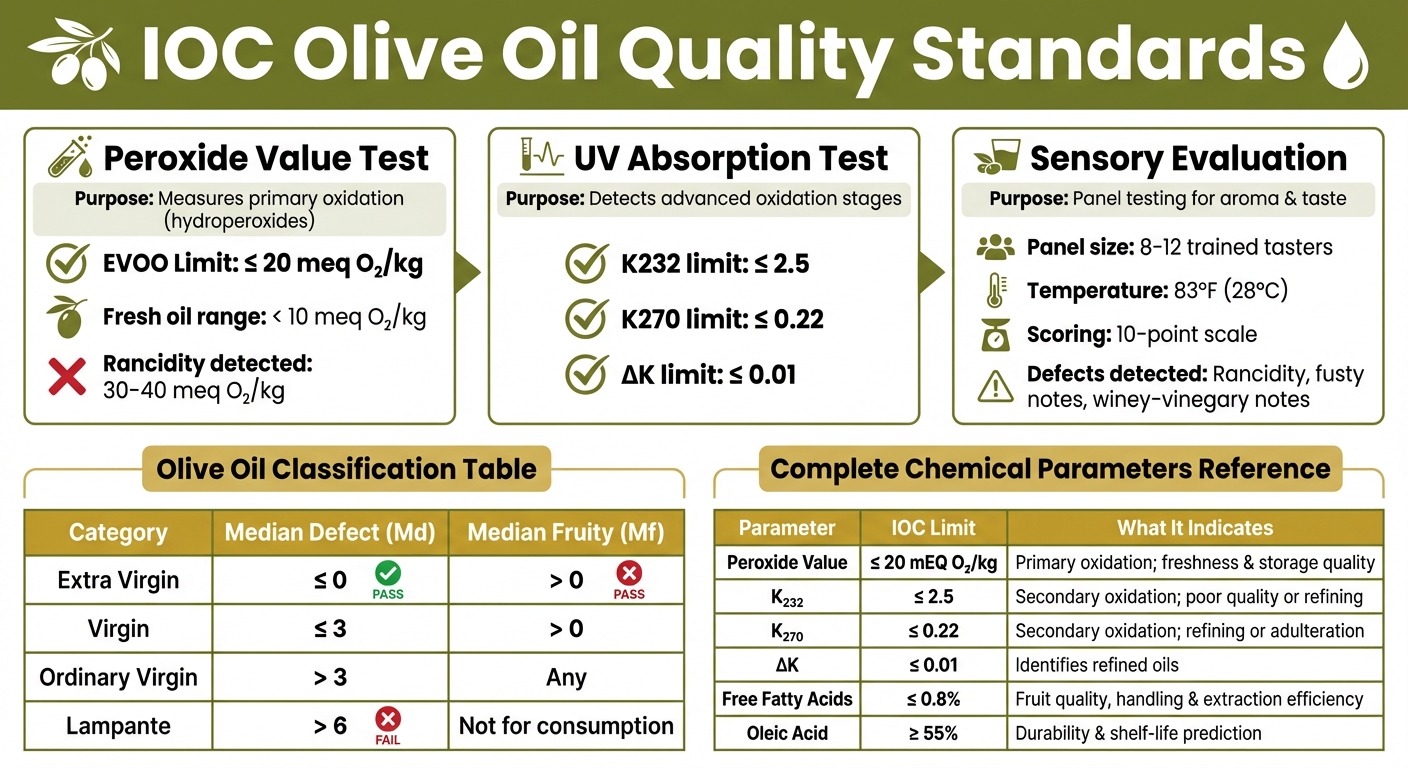
IOC Olive Oil Quality Standards: Chemical and Sensory Testing Parameters
How Oxidation Affects Olive Oil Quality
What Is Oxidation in Olive Oil?
Oxidation is a chemical process where the fats in olive oil interact with oxygen. This reaction produces hydroperoxides, which eventually break down into compounds like aldehydes, ketones, acids, and alcohols. These changes are the main reason olive oil develops unpleasant flavors and aromas, often described as rancid, overpowering the oil's natural qualities.
This process happens in two key stages. As explained by F. Gutiérrez and colleagues from Instituto de la Grasa-CSIC:
During the induction period or slow phase of oxidation, polyphenols, tocopherols, and pigments undergo the most important alterations.
Once these antioxidants are nearly depleted, the oil enters a rapid phase where its fatty acids and volatile compounds degrade significantly.
Virgin olive oil has a natural resistance to oxidation due to its high ratio of monounsaturated to polyunsaturated fats. However, factors like exposure to light and heat can speed up the process. Indicators such as Peroxide Value (PV) and specific extinction coefficients (K₂₃₂ and K₂₇₀) rise even in the early stages of oxidation, making them useful for detecting deterioration early on.
Why Test for Oxidation?
Testing for oxidation is essential to maintain olive oil's freshness, flavor, and health benefits. As oxidation progresses, the oil loses valuable nutrients, including α-tocopherol and phenolic antioxidants, which are key to its health-promoting properties.
By monitoring oxidation, producers can estimate the oil's "average life" or oxidative stability, ensuring it meets quality standards throughout its shelf life. Research from Instituto de la Grasa-CSIC highlights this point:
The tocopherol and orthodiphenol contents are the best indices to determine the average life of the oils.
For both retailers and consumers, combining chemical tests with sensory evaluations helps distinguish high-quality oils from oxidized ones. This approach not only preserves product integrity but also ensures compliance with regulatory standards. Understanding oxidation is key to the rigorous testing methods set by the International Olive Council (IOC), which will be explored further in the next section.
sbb-itb-4066b8e
Peroxide Value Testing: Measuring Primary Oxidation
How the Peroxide Value Test Works
The peroxide value test measures hydroperoxides, which are formed when the unsaturated fatty acids in olive oil react with oxygen. This test is a critical marker for primary oxidation and helps determine the oil's freshness. The process involves a redox titration: the olive oil sample is dissolved in a solvent mixture, often containing acetic acid, and then potassium iodide is added. The peroxides in the oil oxidize the iodide ions, releasing iodine. After stirring for about a minute to ensure the reaction is complete, deionized water is introduced to stop the reaction. The released iodine is then titrated with a standardized sodium thiosulfate solution until the equivalence point is reached. Modern labs often use automated potentiometric titrators equipped with platinum ring electrodes, which provide highly accurate results with less than a 2% standard deviation.
IOC Peroxide Value Thresholds
The International Olive Council (IOC) sets strict standards for peroxide values in olive oil. For Extra Virgin Olive Oil, the peroxide value must not exceed 20 meq O₂/kg to qualify as top quality. Fresh olive oils usually show values below 10 meq O₂/kg, while rancidity becomes noticeable when values climb to 30–40 meq O₂/kg. For comparison, quality olive oil tested in standardized conditions has shown peroxide values as low as 6.4 meq O₂/kg. These thresholds serve as a guide for assessing oil quality.
Reading Peroxide Value Results
High peroxide values suggest that the oil has been exposed to oxygen, light, or heat during storage or processing. Since the peroxide value reflects primary oxidation products - those formed before rancid flavors or odors develop - it provides an early warning of potential quality decline. Proper storage is essential to slow oxidation and maintain freshness. It’s important to note that the peroxide value is a "sum parameter", representing the total hydroperoxide concentration at the time of testing. However, it does not account for secondary oxidation products, such as aldehydes and ketones. For a more thorough evaluation of oil quality, the peroxide value is often paired with UV absorption tests.
UV Absorption Testing: Detecting Advanced Oxidation
How UV Absorption Testing Works
UV absorption testing is a valuable method for identifying advanced stages of oxidation in olive oil, working alongside peroxide value tests. This technique uses spectrophotometry to measure how olive oil absorbs ultraviolet light at specific wavelengths. By doing so, it can detect oxidation levels that peroxide tests might miss. During the process, a sample of olive oil is analyzed in a spectrophotometer, which calculates its extinction coefficients (K values) at defined wavelengths.
The test focuses on three main measurements:
- K232 (232 nm): Detects conjugated dienes, which are primary oxidation products and closely linked to peroxide values.
- K270 (270 nm): Identifies secondary oxidation products, such as conjugated trienes and carbonyl compounds, which emerge due to aging or improper processing.
- ΔK: Highlights whether the oil has been refined or contains unusual levels of advanced oxidation products.
Research indicates that K232 values have a strong correlation with peroxide tests, suggesting they might serve as an alternative for routine quality checks. These measurements are integral to the International Olive Council's (IOC) strict UV absorption standards.
IOC UV Absorption Thresholds
The IOC has set precise thresholds for UV absorption values to ensure olive oil quality. These limits are defined in EEC Regulation No. 2568/91 and No. 1989/03. For Extra Virgin Olive Oil, the established thresholds are:
- K232: Must not exceed 2.50
- K270: Should remain below 0.22
- ΔK: Must not surpass 0.01
Higher K270 values typically indicate secondary oxidation, signaling that the oil may be aged, poorly processed, or nearing significant degradation. These chemical tests work hand-in-hand with sensory evaluations, helping quality controllers detect rancid characteristics before oils reach consumers. Researchers Despina Grigoriadou and Maria Z. Tsimidou noted that incorporating these UV absorption measurements - alongside acidity and peroxide value - can streamline the process of verifying a virgin olive oil's commercial classification.
Sensory Evaluation: Identifying Oxidation Defects
How Sensory Panels Evaluate Oxidation
Chemical tests can measure oxidation levels, but trained sensory panels are essential for identifying flavor and aroma defects. The International Olive Council (IOC) uses certified sensory panels, typically consisting of 8–12 trained tasters, who follow standardized procedures outlined in COI/T.20/Doc. No 15 (Rev. 11-2024).
To ensure objective results, tasters work in a controlled environment illuminated with blue light to reduce visual biases. The oil is warmed to 83°F (28°C) to enhance the release of aromatic compounds. Panelists then assess defects using a 10-point scale, focusing on oxidation-related issues such as:
- Rancidity: Soapy or varnish-like flavors caused by advanced oxidation.
- Fusty notes: Muddy or fermented characteristics from improper storage.
- Winey-vinegary notes: Acidity resembling fermented or sour flavors.
The IOC uses median values, rather than averages, to classify olive oil quality. For an oil to qualify as extra virgin, the median defect intensity (Md) must be ≤0, meaning most tasters detect no flaws, and the median fruity attribute (Mf) must be >0. Virgin olive oil has an Md up to 3, while oils with Md between 3 and 6 are classified as ordinary virgin. Oils with Md above 6 are considered lampante, which is not suitable for consumption.
| Category | Median Defect Intensity | Median Fruity Attribute |
|---|---|---|
| Extra Virgin | ≤ 0 | > 0 |
| Virgin | ≤ 3 | > 0 |
| Ordinary Virgin | > 3 | Any |
These sensory results are combined with chemical analyses to provide a comprehensive evaluation of the oil's quality.
Using Sensory Results with Chemical Tests
Sensory testing works alongside chemical analysis to create a full picture of olive oil quality. An oil may pass chemical tests for peroxide value and UV absorption but still be rejected if tasters detect rancid or unpleasant flavors. On the other hand, chemical tests might uncover early signs of oxidation that are not yet noticeable to the palate.
Complete Quality Verification Using IOC Standards
Combining Test Results for Quality Assurance
To fully verify olive oil quality, it's essential to integrate both chemical and sensory testing. The International Olive Council (IOC) standards consider multiple parameters beyond basics like peroxide value and UV absorption. These include factors like free fatty acids, oleic acid content, and diacylglycerols, which together paint a detailed picture of the oil’s authenticity and shelf-life potential.
Peroxide value is a key indicator of freshness and storage quality, reflecting the oil's exposure to oxidation. UV absorption tests further evaluate rancidity, with elevated values often pointing to oxidation, refining, or even adulteration with refined oils. By combining these chemical results with sensory evaluations, producers can create a complete quality profile, revealing both the oil's current condition and its potential shelf-life.
| Chemical Parameter | IOC Standard Limit | Indicator Significance |
|---|---|---|
| Peroxide Value | ≤ 20 mEQ O₂/kg | Indicates primary oxidation; freshness and storage quality |
| UV Absorption (K₂₃₂) | ≤ 2.5 | Measures secondary oxidation; signals poor quality or refining |
| UV Absorption (K₂₇₀) | ≤ 0.22 | Detects secondary oxidation; suggests refining or adulteration |
| Delta K (ΔK) | ≤ 0.01 | Helps identify refined oils |
| Free Fatty Acids (FFA) | ≤ 0.8% | Reflects fruit quality, handling, and extraction efficiency |
| Oleic Acid | ≥ 55% | Indicates monounsaturated fat content; predicts durability and shelf-life |
Low diacylglycerol (DAG) levels, when assessed alongside oxidation tests, can also highlight sensory defects. This integrated approach ensures producers can maintain high standards in production and storage, keeping the oil fresh and high-quality.
Maintaining Freshness and Quality Standards
Using this robust quality profile, producers can implement specific techniques to preserve freshness and meet IOC standards.
One critical step is keeping Free Fatty Acid (FFA) levels low (≤ 0.8%). This can be achieved by speeding up the time between harvesting and extraction and avoiding high temperatures during processing. Such practices help prevent oxidation before it even begins.
Oleic acid levels are another vital factor. Oils with higher oleic acid content (above the IOC minimum of 55%) tend to have better durability and longer shelf-life. This makes oleic acid a key metric for predicting an oil’s longevity.
Regular UV spectrophotometric testing (K₂₃₂ and K₂₇₀) is also essential for identifying adulteration or confirming that the oil hasn’t undergone improper refining processes like "soft column" refining. Additionally, monitoring the ratio of 1,2-diacylglycerols to total DAGs provides an early warning system for oxidation. This ratio can detect issues before they become noticeable through sensory analysis, complementing peroxide and UV testing. Together, these methods ensure the oil remains fresh and meets the highest quality standards.
Interpreting Olive Oil Test Results
Conclusion
Keeping olive oil fresh, flavorful, and packed with health benefits starts with thorough oxidation testing. Without consistent checks like peroxide value tests, UV absorption analysis, and sensory evaluations, even the best oils can lose their quality over time. These tests work together to paint a complete picture of an olive oil's condition, ensuring its antioxidants and flavor compounds remain intact.
The International Olive Council (IOC) has set rigorous standards to guarantee olive oil quality. Their framework, which includes over 20 different analyses, goes far beyond basic pass-fail tests. By adhering to these standards, producers can confidently distinguish extra virgin olive oil from lower-grade options, giving consumers the assurance that they’re getting authentic, high-quality products.
For consumers, choosing oils tested against IOC oxidation standards means more than just buying olive oil - it means selecting freshness, preserved polyphenols, and the fruity, peppery flavors that make extra virgin olive oil special. Whether drizzled over a salad or used in your favorite recipes, IOC-verified oils deliver the quality you expect.
Big Horn Olive Oil embodies this commitment by offering Ultra Premium Extra Virgin Olive Oil. Their oil is cold-pressed within two hours of harvest and reaches consumers within three months, ensuring it meets the strict IOC standards. With low peroxide values, proper UV absorption profiles, and no oxidation defects, their products set a high bar for freshness and quality.
As awareness of these standards spreads and demand grows in new markets, understanding oxidation testing empowers consumers to make smarter choices. The next time you shop for olive oil, you’ll know exactly what to look for - and why it matters for both your health and your kitchen.
FAQs
Which oxidation test matters most for freshness?
The peroxide value is a key test for determining olive oil's freshness. It indicates how much oxidation and spoilage have occurred. To meet quality standards, the peroxide value should not exceed 20 meq O₂/kg. A lower peroxide value helps preserve the oil's flavor and overall quality.
Can olive oil pass lab tests but still taste rancid?
It's possible for olive oil to clear lab tests yet still have a rancid flavor. Why? Chemical tests primarily measure things like oxidation levels or fatty acid composition. While these are important, they often miss sensory flaws like rancidity. Detecting such issues requires sensory evaluations, where trained tasters assess the oil's aroma and taste for defects.
How can I store olive oil to slow oxidation?
To keep olive oil fresh and maintain its quality, store it in a cool, dark place to limit exposure to light, heat, and oxygen. Use airtight, opaque containers to protect it from air and light, which can speed up oxidation. Avoid placing olive oil near heat sources like stoves or in direct sunlight. Consistently keeping it at a cool temperature will help preserve its flavor and overall freshness.