

International Standards for Olive Oil Moisture
Moisture content in olive oil matters. It directly impacts quality, shelf life, and taste. To meet international standards:
- Extra Virgin & Virgin Oils: Moisture must be ≤0.2%.
- Refined Oils: ≤0.1%.
- Pomace Oils: Varies but typically ≤0.1%.
Key organizations like the International Olive Council (IOC) and European Union (EU) enforce these strict limits, using methods like ISO 662 testing. In contrast, U.S. standards are more lenient, allowing up to 0.3% in some cases, with less rigid enforcement.
For producers, achieving these standards involves precise techniques like high-speed centrifugation. Compliance ensures better market value and aligns with global regulations.
Quick takeaway: To ensure top-tier olive oil, aim for moisture levels at or below 0.2%.
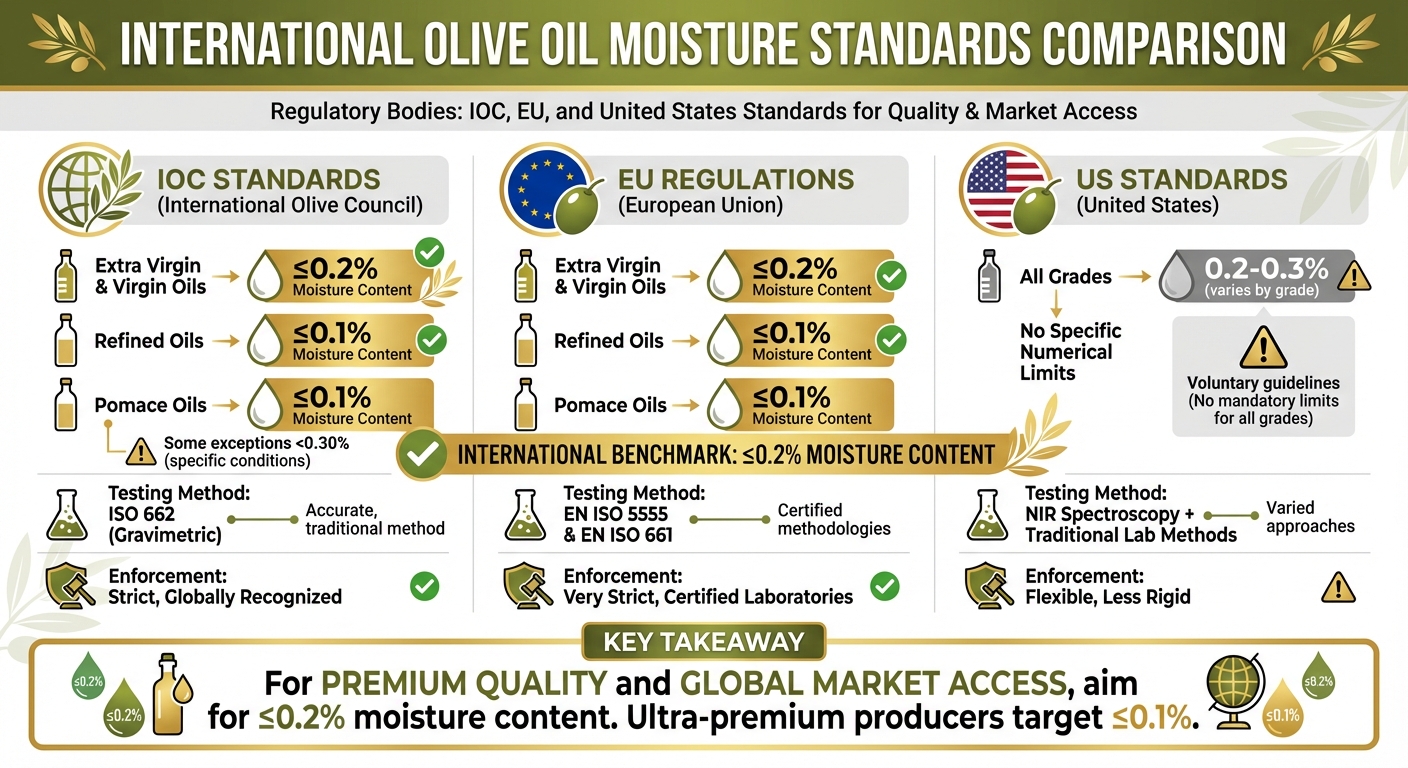
International Olive Oil Moisture Standards Comparison: IOC, EU, and US Requirements
1. International Olive Council (IOC) Standards

Moisture and Volatile Matter Limits
The International Olive Council (IOC) plays a key role in maintaining quality standards for olive oils in global markets. To ensure consistency and quality, the IOC's Trade Standard (REV-20) sets specific limits for moisture and volatile matter: ≤0.2% for extra virgin and virgin oils, ≤0.1% for refined oils, and ≤0.1% for pomace oils, with some exceptions allowing up to <0.30% in certain pomace oil categories.
Measurement Methods
To enforce these limits, the IOC relies on a gravimetric method outlined in ISO 662. In this process, an oil sample is dried in 30-minute cycles, and the weight loss - representing water and volatile compounds - is measured. This standardized method ensures that results are consistent across laboratories and countries.
Impact on Production and Trade
These standards significantly influence production practices. For example, producers must carefully adjust centrifugation processes to meet the ≤0.2% threshold for extra virgin oils and the stricter ≤0.1% limit for refined oils. Failing to comply with these requirements can result in a classification downgrade, ultimately reducing the product's market value. At Big Horn Olive Oil, we take pride in ensuring our ultra-premium extra virgin olive oils consistently meet these stringent IOC standards. This commitment guarantees the quality and freshness our customers expect, while also aligning with international regulations.
These guidelines provide a foundation for understanding how regulatory frameworks shape global olive oil production and trade.
sbb-itb-4066b8e
2. European Union (EU) Regulations

Moisture and Volatile Matter Limits
The European Union (EU) has established clear standards for olive oil through Regulation (EEC) No 2568/91, later amended by Regulation (EC) No 796/2002. These regulations define the physical, chemical, and sensory characteristics that olive oil must meet to fall into specific categories. If an olive oil's properties fall outside these defined limits, it is either reclassified into a different category or deemed non-compliant with EU standards.
Measurement Methods
To ensure consistency, the EU mandates specific methods for analyzing moisture and volatile matter, as outlined in Regulation (EEC) No 2568/91 and its subsequent updates. Sampling procedures must adhere to the EN ISO 5555 and EN ISO 661 standards, ensuring uniformity across all tests. Additionally, strict protocols govern the storage and transportation of samples to maintain their integrity throughout the testing process. These standardized methods form the backbone of the EU's regulatory framework.
Impact on Production and Trade
These regulations don’t just set limits - they also shape how olive oil producers operate. The rules specify how test results must be expressed, including the number of significant digits and rounding practices, ensuring consistency across the industry. Producers must align their processes with these requirements to stay compliant and maintain their product's market value. National authorities enforce these standards using certified laboratories and official tasting panels. If a producer disputes the findings, they have the right to request up to two additional assessments by other approved panels. These rigorous checks ensure that EU olive oils meet both regional and global quality benchmarks.
3. United States Standards
Moisture and Volatile Matter Limits
In the U.S., there aren’t specific numerical limits for moisture and volatile matter in olive oil. Instead, producers rely on voluntary guidelines and industry best practices to maintain quality.
Measurement Methods
American producers often turn to Near-Infrared (NIR) Spectroscopy for quick, non-destructive testing of moisture and dry matter content. Back in November 2020, Felix Instruments, a U.S.-based company in applied food science, introduced their F-750 Produce Quality Meter as a tool for estimating these factors without damaging the product.
"With NIR spectroscopy, it is possible to make repetitive and non-destructive assessments of oil content and polyphenols easily and accurately. Since high-quality olive oils command better prizes, it is best to use reliable technology in simple and easy-to-use tools for guaranteed compliance with industry standards."
- Vijayalaxmi Kinhal, Ph.D. Ecology and Environmental Science, Felix Instruments
While NIR spectroscopy is widely used, traditional lab methods remain essential for confirming results. These precise tests help producers identify the best olive batches and adjust processing techniques as needed.
Impact on Production and Trade
Unlike the rigid limits set by organizations like the IOC and EU, the U.S. approach gives producers more flexibility in quality control. Reliable measurements help millers maintain consistent oil quality for both domestic and international markets. This adaptability, combined with advanced testing methods, allows U.S. producers to compete globally. For instance, companies like Big Horn Olive Oil focus on surpassing basic standards, offering Ultra Premium products tailored to health-conscious buyers.
Pros and Cons
International standards for olive oil quality vary significantly in their strictness, clarity, and practicality. For example, the IOC and EU enforce a moisture limit of ≤0.2% for extra virgin and virgin oils. This ensures consistent quality and strong consumer protection. However, meeting these standards requires advanced lab equipment and ISO 662 testing protocols, which can be expensive and time-consuming - especially for smaller producers.
In contrast, U.S. standards allow slightly higher limits of 0.2–0.3%, depending on the grade. This flexibility helps domestic producers reduce compliance costs and adapt to local conditions. But, this less rigorous enforcement can lead to challenges, such as lower quality perception in global markets and a higher risk of fraud.
Another key difference lies in testing protocols. The IOC and EU offer harmonized and transparent benchmarks, making them well-suited for international trade. Meanwhile, U.S. standards, though more practical for local producers, lack uniformity across grades. This inconsistency can complicate compliance for producers aiming to compete both domestically and internationally.
Here’s a quick comparison of the pros and cons:
| Standard | Pros | Cons |
|---|---|---|
| IOC | Ensures high quality (≤0.2%); globally recognized; uses standardized ISO 662 testing | Expensive lab requirements; burdensome for small producers |
| EU | Strict enforcement (≤0.2%); aligned with IOC; strong focus on consumer protection | Demands advanced testing methods; rigid compliance can be costly for smaller operations |
| U.S. (USDA/CA) | Flexible limits (≤0.2–0.3%); affordable for local producers; lower compliance costs | Less strict enforcement; potential quality perception issues; higher fraud risk on global markets |
These differences highlight the trade-offs that come with setting and enforcing standards. While rigorous benchmarks help ensure product quality, they also require significant investment in testing and process control. For companies like Big Horn Olive Oil, exceeding baseline standards is a way to stand out. By adopting stricter limits, they aim to deliver Ultra Premium quality that aligns with the highest international benchmarks.
Conclusion
The IOC and EU have set strict moisture content standards for olive oils: extra virgin and virgin oils must contain no more than 0.2% moisture, while refined oils are limited to 0.1% or less. These benchmarks are internationally recognized and serve as a measure of quality assurance.
In contrast, the U.S. adopts a more lenient approach, allowing moisture content to range from 0.2% to 0.3%, depending on the grade. While this flexibility accommodates a wider variety of products, it can pose challenges for producers seeking acceptance in global markets.
To meet international standards, producers should aim for a moisture content of 0.2% or lower. Techniques like centrifugation and filtration immediately after harvesting play a crucial role in reducing water content. Additionally, investing in ISO 662 testing methods ensures compliance with moisture standards. Practices such as early harvesting and maintaining proper storage conditions further support optimal moisture levels.
For exporters and high-end brands, striving for moisture levels at or below 0.1% can elevate their products to ultra-premium status. A case in point is Big Horn Olive Oil, which adheres to Ultra Premium standards that go beyond regulatory requirements. This commitment not only enhances product quality but also provides a competitive advantage in the global marketplace.
FAQs
Why does moisture in olive oil reduce shelf life?
Moisture in olive oil can significantly reduce its shelf life. It promotes microbial growth and accelerates spoilage, which compromises the oil's stability and diminishes its quality over time. This makes it less ideal for extended storage.
How can producers lower moisture without hurting flavor?
Producers can lower the moisture content in olive oil by fine-tuning both the extraction and filtration processes. This involves using mechanical methods under carefully controlled temperatures and applying efficient filtration techniques. These steps help reduce water content while maintaining the oil's flavor profile.
Is NIR testing as accurate as ISO 662?
NIR testing offers a quick, non-invasive, and dependable way to assess olive oil quality. Research shows that it can rival the precision of lab instruments and identify adulteration with an accuracy exceeding 80%. However, it hasn't been explicitly confirmed to match the accuracy of ISO 662, the benchmark for chemical analysis.