

IoT Tracking Devices for Olive Oil Traceability
IoT tracking devices are transforming the olive oil industry by tackling fraud and ensuring quality. These tools monitor every stage of production - from harvesting to distribution - while providing reliable data to verify origin, quality, and freshness. By integrating IoT with blockchain, producers can create tamper-proof records, offering transparency to consumers and protecting their products from counterfeiting.
Key Takeaways:
- Fraud Prevention: IoT sensors track origin, harvest dates, and processing conditions to ensure accurate labeling.
- Quality Monitoring: Real-time data on acidity, biophenol levels, and storage conditions ensure premium standards.
- Blockchain Integration: Immutable records and smart contracts automate quality checks and build consumer trust.
- Consumer Transparency: QR codes on packaging allow buyers to verify production details instantly.
For producers, these systems streamline compliance with regulations like PDO certification and reduce losses from spoilage or fraud. While initial setup costs can vary, the long-term benefits include higher product value, stronger customer trust, and reduced operational inefficiencies.
Enhanced Traceability and Quality in our Food System through Blockchain and IOT
sbb-itb-4066b8e
How IoT Devices Monitor Olive Oil Quality Throughout the Supply Chain
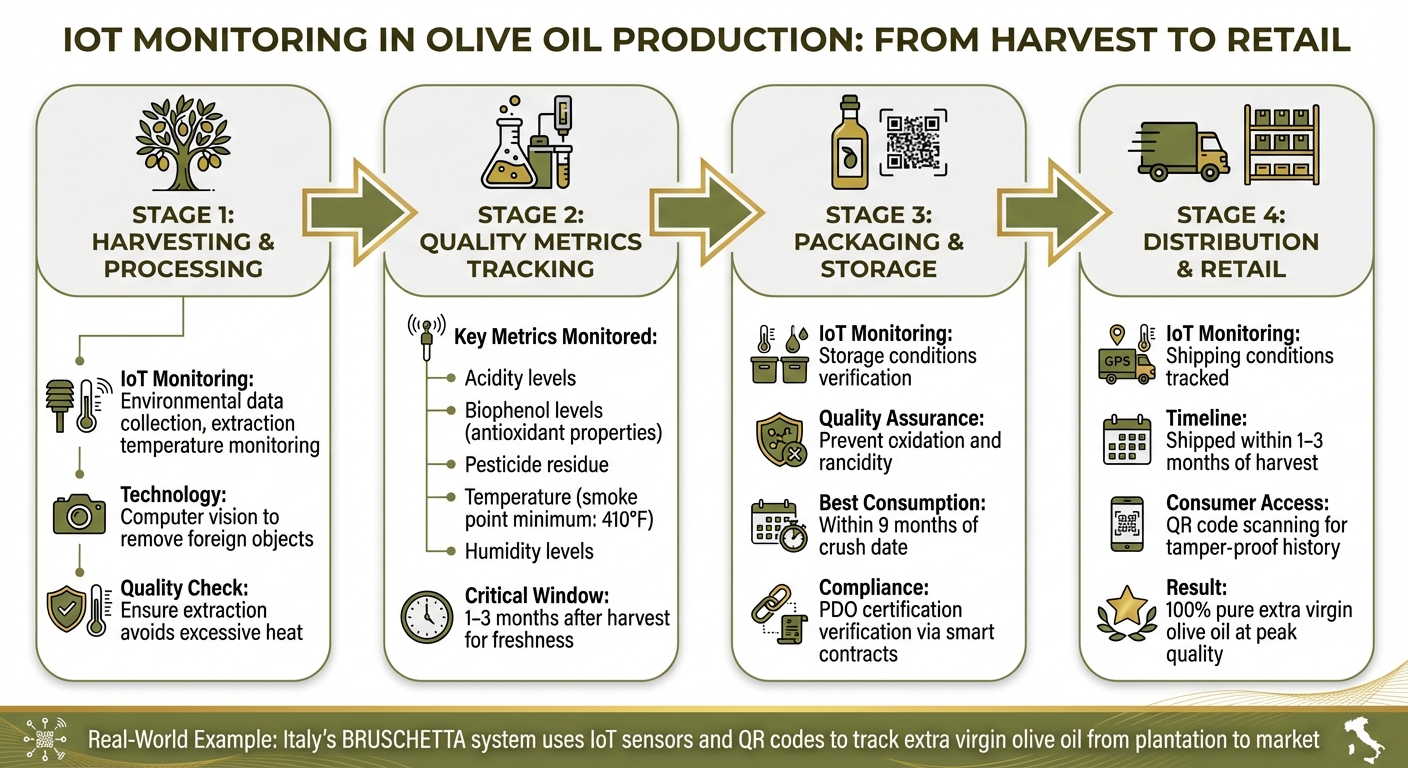
IoT Olive Oil Supply Chain Monitoring: From Grove to Bottle
IoT sensors play a crucial role in tracking olive oil from harvest to retail, ensuring quality, authenticity, and freshness at every stage.
Quality Metrics Monitored by IoT Sensors
IoT sensors monitor several key indicators to maintain the high standards of extra virgin olive oil. These include real-time measurements of chemical composition, such as acidity levels and pesticide residue. Additionally, smart contracts on Ethereum verify compliance with Protected Designation of Origin (PDO) standards, reducing the risk of fraud.
Temperature and humidity are also closely monitored. Extra Virgin Olive Oil must maintain a smoke point of at least 410°F - anything lower indicates degradation. By tracking these factors, sensors help prevent oxidation and rancidity, ensuring the oil stays fresh within the critical 1–3 month window after harvest.
Another essential metric is biophenol levels, which preserve the oil's antioxidant properties and health benefits. Premium producers also pay close attention to the crush date, the moment olives are processed. Olive oil is best consumed within nine months of this date for optimal flavor. As Big Horn Olive Oil advises:
For the best tasting experience, we recommend consumption within 9 months of the olive oil crush date.
These metrics collectively guide every step of the supply chain, ensuring the oil meets strict quality standards.
Supply Chain Stages Monitored by IoT
IoT devices are indispensable for maintaining quality throughout the supply chain. Systems like Italy's BRUSCHETTA use IoT sensors and QR codes to track extra virgin olive oil from plantation to market.
During harvesting and processing, IoT devices gather environmental data and monitor extraction temperatures. For example, sensors ensure that the extraction process avoids excessive heat, which could degrade the oil. Computer vision technology is also employed to identify and remove foreign objects, ensuring the oil remains uncontaminated. As Big Horn Olive Oil notes:
If your olive oil is burning when you bake with it, you're using a low grade olive oil!
In the packaging and distribution stages, IoT sensors verify storage conditions to preserve the oil's purity. These devices ensure that bottles are shipped within 1–3 months of harvest, maintaining freshness and preventing rancidity before the product reaches consumers. This end-to-end monitoring guarantees that customers receive 100% pure extra virgin olive oil at its peak quality.
Integrating Blockchain with IoT for Secure Traceability
Blockchain transforms IoT data into tamper-proof records, offering a reliable way to trace olive oil from grove to table. This approach tackles a major issue: Extra Virgin Olive Oil is among the most frequently falsified food products on the market. By creating an unalterable digital trail, producers can validate authenticity and strengthen consumer trust.
How Blockchain Secures Traceability Data
Blockchain plays a critical role in securing IoT data by providing immutable storage that isn't controlled by any single entity. Quality metrics recorded by IoT devices are instantly and permanently logged on the blockchain. This process minimizes human errors and eliminates opportunities for tampering.
The BRUSCHETTA framework illustrates this concept effectively. Researchers describe its purpose as:
The goal is to enable the final customer to access a tamper-proof history of the product, including the farming, harvesting, production, packaging, conservation, and transportation processes.
Consumers can scan QR codes on product packaging to view a secure, unchangeable record of the olive oil's journey from grove to market. This level of transparency is especially important for premium products, where authenticity significantly influences value.
Beyond ensuring data integrity, blockchain also supports the use of smart contracts to automate quality checks.
Smart Contracts for Automated Quality Verification
Using blockchain-secured IoT data, smart contracts enforce quality standards automatically, eliminating the need for manual oversight. These programs verify that olive oil meets specific conditions before advancing through the supply chain. For instance, they can cross-reference IoT sensor data with established certification criteria to confirm compliance.
A real-world example of this technology in action comes from Frantoio del Monte Pisano. In December 2025, they implemented a blockchain traceability system for their IGP Podere del Pari Extra Virgin Olive Oil. Partnering with Trusty, an Italian Benefit Corporation, they added QR codes to their packaging, allowing consumers to access verified details about the oil's origin and production. The system was designed to align with the EUDR Regulation and received validation from RINA, a recognized certification body. As the producer explained:
Thanks to this technology, every phase of the supply chain – from olive harvesting to milling, from bottling to distribution – is recorded in an indelible and unmodifiable way.
Additional Technologies That Support IoT for Olive Oil Traceability
Several technologies work alongside IoT to ensure thorough traceability in olive oil production. Tools like biotagging, bio-marking, and computer vision each play a role in maintaining quality and authenticity throughout the supply chain.
Biotagging and Bio-Marking for Origin Verification
Biotagging uses DNA markers, while bio-marking relies on chemical or isotopic signatures to verify the origin of olive oil and prevent adulteration. This is especially important for premium olive oils, where geographical authenticity - such as products from Protected Designation of Origin (PDO) regions - adds value and builds consumer confidence. These biological methods act as a foundation for integrating more advanced technologies into the traceability process.
Combining Technologies for Complete Traceability
The real power lies in combining these technologies for seamless tracking from grove to bottle. For instance, computer vision systems paired with IoT can monitor olive processing in real time. AI-driven cameras detect foreign objects, while automated alerts - using lasers, audio cues, or visual warnings - help maintain quality. IoT sensors continuously track environmental and operational data, but gaps in sensor coverage can be addressed with computer vision and smart contracts. Smart contracts further streamline quality checks by automating verification processes.
When paired with blockchain to secure IoT data, these technologies create a robust, end-to-end traceability system. Each tool complements the others, forming a comprehensive solution that ensures authenticity and quality at every stage.
Producers like Big Horn Olive Oil (https://bhooc.com) are already using these integrated systems to boost quality assurance and strengthen consumer trust.
Implementing IoT Traceability Systems: What Producers Need to Know
Implementing IoT traceability systems requires careful planning. Producers need to evaluate technical needs, regulatory requirements, and financial factors to ensure successful adoption. Below, we’ll break down the key technical, regulatory, and financial aspects of these systems.
System Setup and Scalability
The first step in implementing an IoT traceability system is selecting the right hardware and software tailored to the scale of your operation. For smaller producers, starting with basic sensors - like temperature or humidity monitors - can be effective. These are typically placed in critical areas such as storage facilities, transport vehicles, or bottling stations. Larger producers, on the other hand, often benefit from a more extensive setup, with sensors deployed across orchards, mills, storage tanks, and distribution centers.
It’s essential to design systems that can grow with your production needs. Cloud-based platforms are a great option because they allow you to add new sensors without needing a major infrastructure overhaul. Plus, many of these systems integrate wirelessly with existing equipment, ensuring minimal disruption to your current processes.
Meeting Regulatory Standards with IoT
Once the system is in place, IoT technology plays a significant role in meeting regulatory requirements. For example, the FDA's Food Safety Modernization Act (FSMA) mandates detailed records for monitoring temperature, sanitation, and contamination prevention. IoT sensors automatically capture and store this data, creating an auditable trail that simplifies compliance.
For producers targeting international markets, regulations can vary widely. In the European Union, for instance, PDO (Protected Designation of Origin) certification requires detailed documentation of product origins, while some Asian markets demand specific quality certifications. IoT systems can be customized to track the exact metrics needed for each region, helping producers meet these requirements and avoid costly shipment rejections.
Cost and ROI for Producers
Financial considerations are another critical factor. The initial costs of IoT traceability systems depend on the size and complexity of the operation. These costs typically include sensors, connectivity infrastructure, software, and installation. Ongoing expenses might involve cloud storage, software subscriptions, and sensor maintenance.
Despite these costs, the potential return on investment is significant. Automated monitoring reduces the need for manual inspections, while faster detection of issues like spoilage can prevent losses. Additionally, verified traceability can enhance a product’s market appeal, allowing producers to command higher prices and build consumer trust. This transparency often leads to stronger customer loyalty, which supports long-term revenue growth.
Conclusion
The integration of IoT technology is reshaping how olive oil producers ensure quality and build trust, offering a modern approach to product assurance.
IoT tracking devices allow producers to document every stage of the supply chain - harvesting, milling, bottling, and distribution - in a secure, digital format. This transparency benefits both producers and consumers. For example, buyers can now scan QR codes on packaging to instantly access verified traceability records, giving them confidence in the product's authenticity.
For producers, this technology addresses persistent issues like fraud and counterfeiting, while also doubling as a marketing advantage. As Frantoio del Monte Pisano aptly puts it:
Blockchain traceability thus becomes added value: a quality guarantee, marketing tool, and powerful differentiator for those who want to share the authenticity of genuine Italian extra virgin olive oil with the world.
With regulations like the EUDR encouraging the adoption of digital traceability systems, olive oil producers have an opportunity to stay ahead. By integrating QR codes and collaborating with experts in digital traceability, producers can meet regulatory demands while strengthening consumer trust.
This blend of technology and transparency not only safeguards product quality but also positions producers to thrive in an increasingly competitive market.
FAQs
How do IoT sensors prove an olive oil’s origin?
IoT sensors play a crucial role in verifying the origin of olive oil. By monitoring real-time conditions such as temperature and humidity during production and transportation, these sensors collect valuable data. This information is then logged and tied to specific harvests and locations. The result? A transparent record that guarantees the oil's quality and origin throughout its journey - from the farm to the store shelf.
What data should be on a traceability QR code?
A traceability QR code should provide key details such as the product's origin, the production process, the harvest date, the batch number, and any relevant quality certifications. Including this information helps ensure clarity and builds trust by offering a clear view of the product's journey from its source to the store shelf.
Do small producers need blockchain, or is IoT enough?
Small producers don’t always have to rely on blockchain for traceability; IoT devices can often do the job effectively. Sensors can provide real-time data on critical factors like temperature, acidity, and moisture, helping ensure both quality and transparency. While blockchain is great for creating tamper-proof records and preventing fraud, IoT offers a simpler, more affordable way for small producers to meet traceability requirements. It’s a practical approach that builds consumer trust without unnecessary complexity or high costs.