

How Isotopic Footprints Authenticate Olive Oil
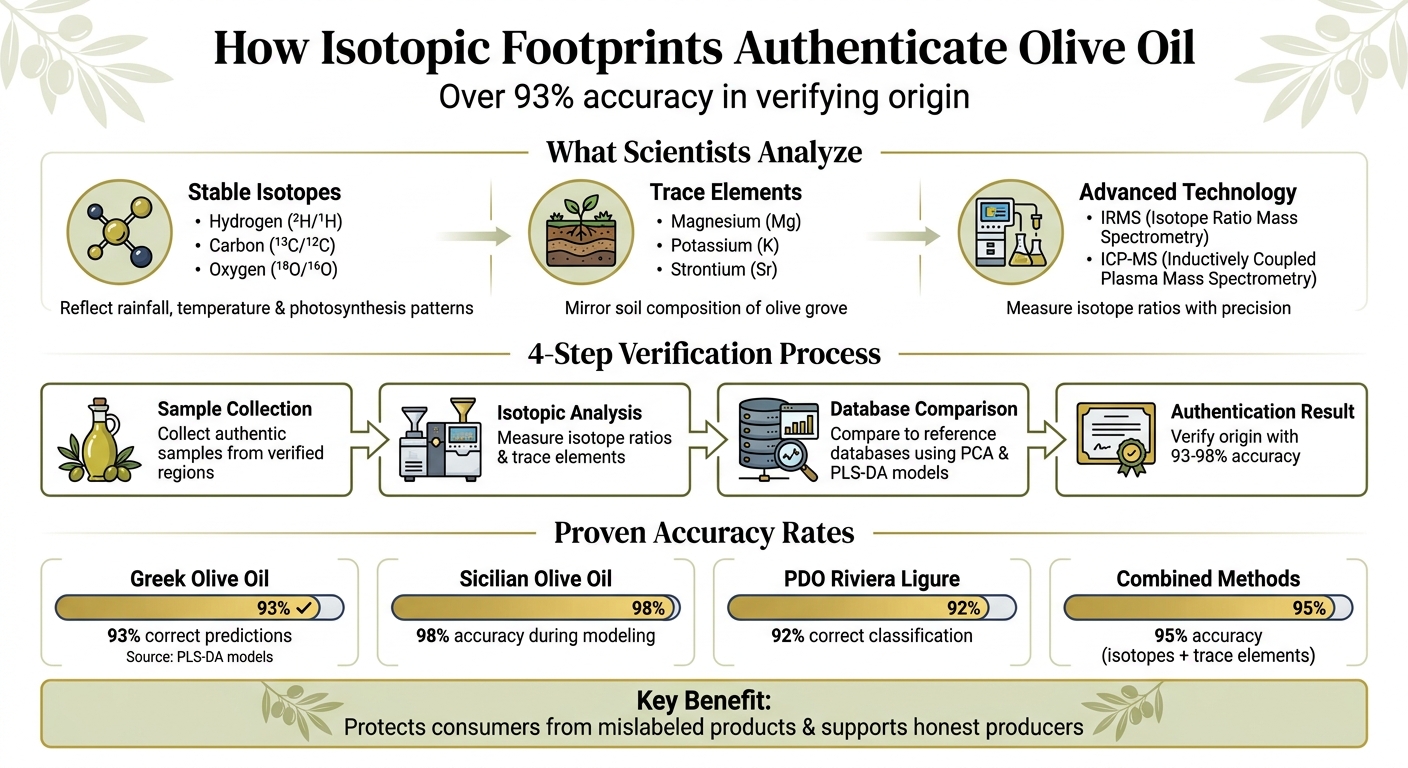
Is your olive oil truly from Italy or Greece? Scientists now use isotopic footprints to verify the origin and quality of olive oil with over 93% accuracy. This method analyzes stable isotopes - hydrogen, carbon, and oxygen - found in the oil, which are shaped by the climate and soil of its growing region. Combined with trace element analysis, these chemical markers create a signature tied to specific locations.
Here’s how it works:
- Stable Isotopes: Ratios of hydrogen, carbon, and oxygen isotopes reflect regional factors like rainfall, temperature, and photosynthesis patterns.
- Trace Elements: Magnesium, potassium, and strontium levels mirror the soil composition of the olive grove.
- Advanced Tools: Technologies like Isotope Ratio Mass Spectrometry (IRMS) and statistical models confirm regional origins and detect fraud.
This approach protects consumers from mislabeled products and supports honest producers by ensuring premium oils meet their origin claims. If you want confidence in your olive oil’s source, isotopic analysis is a game-changer.
How Isotopic Analysis Authenticates Olive Oil Origin
What Are Isotopic Footprints?
Isotopic footprints act like a chemical passport, capturing unique ratios of stable isotopes - mainly hydrogen (²H/¹H), carbon (¹³C/¹²C), and oxygen (¹⁸O/¹⁶O) - found in each bottle of olive oil. As olive trees grow, they absorb water and nutrients from their local environment, embedding these isotopic signatures into the fruit and, ultimately, the oil.
What makes these footprints so effective is their direct connection to geography and climate. The hydrogen and oxygen isotope ratios in olive oil closely align with the isotopic makeup of local surface water, shaped by factors like temperature, rainfall, and proximity to the coast. Meanwhile, carbon isotope ratios are influenced by the way olive trees undergo photosynthesis, which is affected by water availability, latitude, and coastal distance.
"The stable isotope ratios of H, C, and O of olive oils and the ratios of H and O of the relevant surface waters correlated to the climatic (mainly temperature) and geographical (mainly latitude and distance from the coast) characteristics of the provenance sites." - Federica Camin, Researcher, IASMA - Fondazione Edmund Mach
To enhance authentication, scientists also examine the elemental profile of olive oil, including trace elements like magnesium (Mg), potassium (K), and strontium (Sr). These elements reflect the specific geological and soil characteristics of the olive grove. By combining isotopic ratios with these elemental markers, researchers have achieved a 95% accuracy rate in determining an oil's geographical origin.
How Stable Isotopes Work as Chemical Markers
Stable isotopes serve as natural tracers, shaped by environmental conditions that are almost impossible to replicate artificially. Unlike radioactive isotopes, stable isotopes don't decay, making them reliable identifiers for authenticity.
The hydrogen and oxygen isotopes in olive oil are tied to the water source used by olive trees. Rainfall, temperature, and coastal proximity all influence the isotopic makeup absorbed by the trees, resulting in distinct signatures. For instance, olive oil from a coastal region in Greece will have a noticeably different hydrogen and oxygen isotope ratio compared to oil from an inland area in Spain.
Carbon isotopes provide additional information. The ¹³C/¹²C ratio reflects the olive tree's photosynthetic process, which is affected by factors like water stress, latitude, and distance from the coast. These variations influence how the plant processes carbon dioxide, leaving a unique carbon signature in the oil.
Trace elements add even more detail. Soil composition differs greatly between regions due to variations in geology. As olive trees absorb nutrients from the soil, they pick up elements like magnesium, potassium, and strontium in ratios that mirror the geological characteristics of the growing area. Combined with isotopic ratios, this elemental profile creates a chemical signature that’s nearly impossible to counterfeit.
The Science Behind Isotopic Analysis
Scientists rely on advanced technology to decode these chemical signatures. The primary tool, Isotope Ratio Mass Spectrometry (IRMS), measures tiny differences in isotope ratios with precision. For elemental analysis, Inductively Coupled Plasma Mass Spectrometry (ICP-MS) identifies and quantifies trace elements in the oil.
Once these markers are identified, researchers use pattern recognition techniques to compare sample data with reference databases. Tools like Principal Component Analysis (PCA) and Partial Least Squares Discriminant Analysis (PLS-DA) help detect patterns and classify oils by their origin. For example, in January 2015, the Joint Research Centre (JRC) developed a protocol using ¹H-NMR and isotopic fingerprints to authenticate PDO "Riviera Ligure" olive oils from Italy. By comparing the ¹³C/¹²C ratios of oils with reference data, the model successfully identified cases of mislabeling.
These methods not only confirm geographic origins but also help ensure the quality and authenticity of premium olive oils. This level of precision makes isotopic analysis one of the most trusted tools for fighting olive oil fraud.
sbb-itb-4066b8e
How Isotopic Analysis Confirms Olive Oil Origin
Isotopic analysis plays a crucial role in verifying the origin of olive oil by comparing its chemical signature to reference databases. These databases are built using verified olive oil samples from various regions, offering a reliable benchmark for identifying an oil's true origin. By analyzing the ratios of hydrogen (²H/¹H) and carbon (¹³C/¹²C) in both the bulk oil and its unsaponifiable fraction, scientists can pinpoint detailed regional characteristics, particularly in Protected Designation of Origin (PDO) areas.
To authenticate olive oil, researchers use advanced pattern recognition techniques like Principal Component Analysis (PCA) and Partial Least Squares Discriminant Analysis (PLS-DA). These statistical tools create models that distinguish oils from different countries or even specific regions. The isotopic profiles (δ²H and δ¹³C) reflect environmental factors such as latitude, which leave unique geographical markers that are nearly impossible to replicate.
"The relationship between stable isotope abundances of the VOOs and their unsaponifiable fractions and the latitude of the VOO geographical origin was confirmed." - JRC Publications Repository
This approach underpins the development of robust isotopic reference databases for olive oil authentication.
Creating Isotopic Reference Databases
Building reliable isotopic databases starts with collecting authentic olive oil samples from well-defined geographic regions. Researchers analyze these samples to measure isotopic ratios and elemental profiles, creating benchmarks that reflect each area's unique characteristics. In January 2016, scientists from the European Commission's Joint Research Centre, including Rosa M. Alonso-Salces and Nicolas Segebarth, developed a system combining ¹H-NMR and isotopic fingerprinting. By examining oils from countries like Greece, Spain, Italy, Turkey, and France, they achieved over 93% accuracy in authenticating Greek virgin olive oils. The isotopic data played a key role in boosting classification precision when paired with NMR analysis.
These comprehensive databases make it possible to verify an oil's regional origin with a level of detail that would be unattainable without such extensive reference data.
Identifying Fraud and Adulteration
Isotopic analysis is instrumental in uncovering fraudulent practices, such as false origin claims or unauthorized blending. By comparing a sample's isotopic signature to established regional profiles, discrepancies can be identified. For example, an oil labeled as Italian but showing isotopic ratios typical of Spain or North Africa would raise red flags.
Blended oils from multiple regions often exhibit isotopic signatures that don't match any single origin, making them easy to detect. Analyzing the ¹³C abundance in both the bulk oil and its unsaponifiable fraction has proven especially effective, outperforming earlier methods for verifying oils from specific protected regions.
"The PLS-DA models to authenticate VOOs from Greece and detect non-Greek VOOs achieved over 93% of correct predictions." - JRC Publications Repository
This precision makes isotopic analysis a robust tool for identifying mislabeling at both national and regional levels, offering an objective, science-backed method that is difficult to manipulate.
Why Isotopic Authentication Matters for Producers and Consumers
Expanding on the earlier discussion of technical validation, isotopic authentication offers clear benefits for both producers and consumers. It ensures that premium PDO (Protected Designation of Origin) olive oils live up to their origin claims, protecting buyers' confidence and justifying the higher price tags attached to these products.
Building Consumer Trust
When consumers choose premium olive oils, they expect the product to match the claims on the label. Isotopic analysis provides that assurance by delivering precise, scientific verification. The accuracy of this method speaks for itself - external validation tests using partial least square discriminant analysis (PLS-DA) correctly identified over 90% of Greek olive oil samples. For Sicilian oils, accuracy during modeling phases reached an impressive 98%.
This level of precision allows buyers to trust that an oil labeled as originating from regions like Sicily or Riviera Ligure truly comes from those areas. Isotopic ratios, influenced by factors such as rainfall, temperature, and proximity to the sea, create unique chemical signatures tied to specific locations. These signatures are impossible to fake unless the oil is genuinely sourced from the claimed region. Producers who adopt isotopic testing can provide verifiable proof of their product's authenticity, offering consumers peace of mind while reinforcing trust in the brand.
Safeguarding Producer Reputation
While consumers benefit from greater confidence, producers also gain significant advantages. Isotopic authentication acts as a shield against counterfeiters and mislabeled products, helping producers protect their reputation and market standing. For instance, PDO Riviera Ligure oils achieved a 92% correct classification rate, showcasing how effectively this method safeguards regional designations.
Big Horn Olive Oil: Quality and Authenticity Standards

Big Horn Olive Oil sets a high bar when it comes to ensuring the authenticity and quality of premium extra virgin olive oil (EVOO). Founded by Devan Stormont, the company sources ultra-premium EVOOs from renowned regions like Italy and Spain, adhering to strict international quality benchmarks. Their efforts have paid off, with their oils earning gold medals at prestigious events such as the 2023 NYIOOC World Olive Oil Competition and the 2024 London International Olive Oil Competition. Varieties like Hojiblanca and Picual have scored over 90 points, celebrated for their standout fruitiness, bitterness, and pungency.
The company takes a proactive stance against mislabeling, a widespread issue highlighted by UC Davis studies, which found a 69% mislabeling rate in the market. To combat this, Big Horn Olive Oil works directly with growers and employs advanced tools like isotopic and chemical profiling. These methods confirm the geographical origins of their oils, providing transparency and ensuring authenticity.
Freshness is another cornerstone of their quality standards. Olives are milled within hours of harvest and cold-pressed at temperatures below 80°F. The oils are then shipped within three months in temperature-controlled, UV-protected containers to maintain their flavor and quality. Their lineup includes single-origin varieties like Koroneiki and Frantoio, alongside infused options such as garlic and basil. With acidity levels consistently below 0.3% - far below the 0.8% limit for extra virgin classification - their oils meet and exceed expectations for EVOO.
Dr. Lan Tra Nguyen, an olive oil chemist, highlights that companies like Big Horn lead the way by combining isotopic databases with sensory evaluations, achieving more than 95% accuracy in detecting fraud.
This rigorous scientific approach underpins their Ultra Premium designation, justifying their higher price point in the US market. By blending traditional sourcing methods with cutting-edge isotopic and chemical analysis, Big Horn Olive Oil ensures the authenticity of every bottle they produce, reinforcing their commitment to quality and trust.
Conclusion
Isotopic footprints provide a precise, science-driven way to verify olive oil's authenticity and tackle fraud. By examining stable isotopes like ⁸⁷Sr/⁸⁶Sr, hydrogen, carbon, and oxygen, scientists can craft a chemical fingerprint that ties olive oil to its specific geographical origin - something nearly impossible for fraudsters to fake. This method overcomes the shortcomings of traditional testing, which often falls short in pinpointing an oil's true source with absolute certainty.
The value of isotopic analysis goes beyond just identifying fraud. It offers concrete proof for Protected Designation of Origin (PDO) labels, replacing reliance on documentation with solid chemical evidence. This approach strengthens trust between producers and consumers by offering a reliable way to validate claims about origin and quality.
For consumers, this technology brings clear advantages: protection from being misled about what they’re buying, confidence in the nutritional and sensory qualities of their olive oil, and greater transparency about where it comes from. When you choose olive oil verified through isotopic analysis, you’re ensuring that the premium product you paid for is exactly what’s in the bottle.
By combining isotopic databases with other quality control measures, the industry gains a robust system for authentication. Honest producers are shielded from unfair competition, and consumers enjoy the taste, aroma, and health benefits that come from oils with verified origins. This level of transparency not only builds trust but also raises the bar for quality across the market.
Understanding isotopic footprints helps you make smarter choices when selecting premium olive oil. As this technology becomes more widespread, it reinforces the focus on quality and authenticity, ensuring that every bottle of extra virgin olive oil lives up to its promise.
FAQs
Can isotopic testing prove an oil’s exact region, or just the country?
Isotopic testing is a useful tool for determining the country or general region where olive oil comes from. However, it typically lacks the precision to identify a specific area within that region. While some advanced techniques can offer more localized information, their reliability depends heavily on the specific method employed.
Does blending oils from different places show up in isotope results?
Blending oils from various regions can affect isotope analysis results. Since isotopic fingerprints are tied to geographic origin, mixing oils can produce a combined signature. This blended profile may complicate efforts to accurately determine the oil's specific source.
What can shoppers look for to know an olive oil was scientifically authenticated?
Shoppers looking to ensure their olive oil is scientifically verified can check for isotopic footprints. These include stable isotope ratios like δ13C, δ2H, and δ18O, which are used to confirm the oil's geographic origin and authenticity.