

5 Key Criteria for Olive Oil Quality Seals
When choosing olive oil, quality seals ensure you're getting what you pay for. These certifications rely on rigorous testing to verify purity, freshness, and production standards. Here's a quick breakdown of the five main factors:
- Free Fatty Acidity (FFA): Measures olive oil quality; premium oils have FFA ≤0.5%.
- Peroxide Value (PV): Indicates oxidation; lower values mean better storage and freshness.
- UV Absorbency (K232, K270, Delta K): Detects oxidation and refined oils; strict benchmarks ensure high-grade oils.
- Sensory Evaluation: Expert tasters check for fruitiness, bitterness, and pungency while rejecting any defects.
- Production & Origin Verification: Confirms cold-pressing methods and traceability to specific regions.
These criteria protect consumers from mislabeled products and guarantee high-quality oils. Certified options, like those from organizations such as the COOC or NAOOA, undergo both chemical and sensory evaluations to meet strict standards.
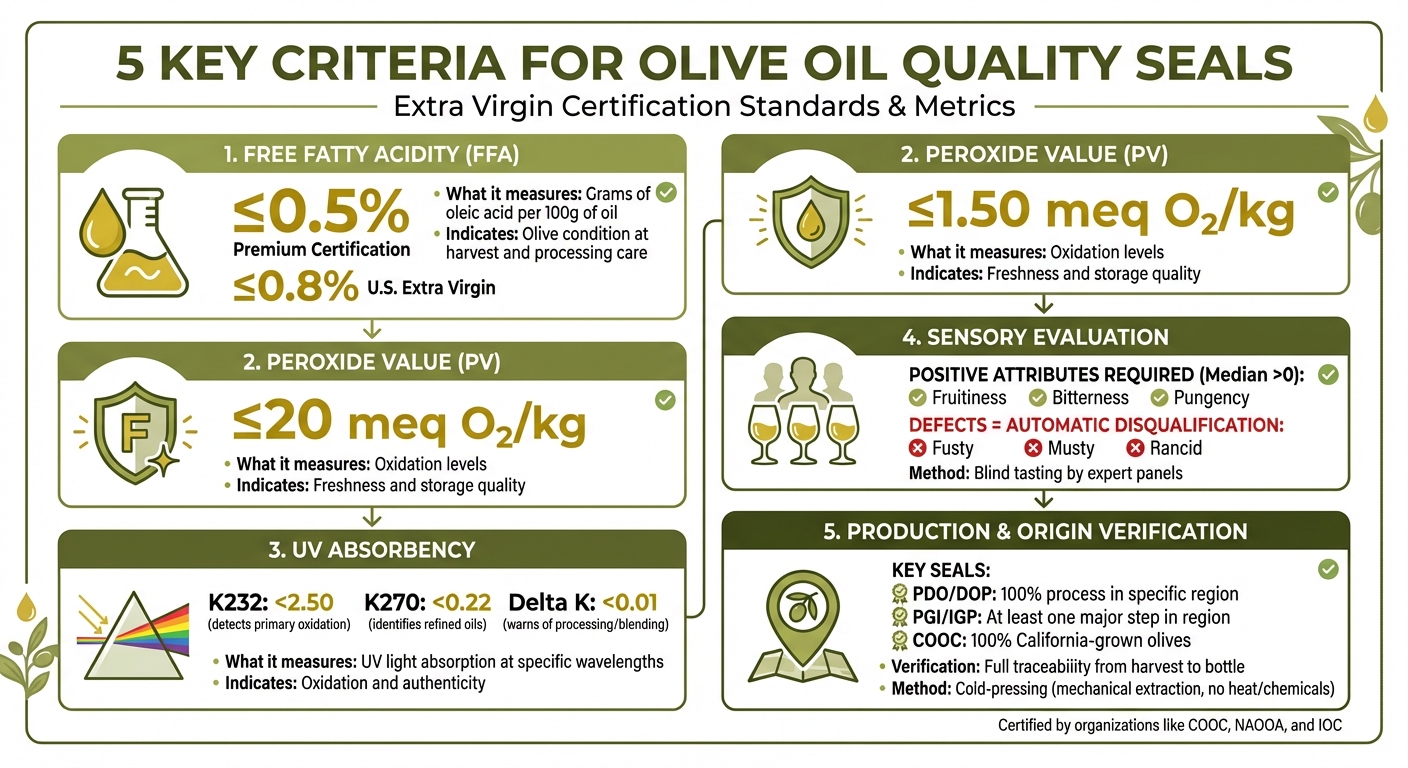
5 Quality Criteria for Certified Extra Virgin Olive Oil
Our Seals of Certification that you can look for on every bottle
sbb-itb-4066b8e
1. Free Fatty Acidity Levels
Free fatty acidity (FFA) is a key chemical marker used to gauge olive oil quality. It’s measured as grams of oleic acid per 100 grams of oil and provides insight into the condition of the olives at harvest and the care taken during oil production. This measurement plays a crucial role in distinguishing standard olive oil from higher-quality certifications.
For U.S. Extra Virgin certification, the FFA level must be ≤0.8%. However, premium certifications often set a stricter limit of ≤0.5%, reflecting a higher standard of quality. This tighter requirement is what separates good olive oil from truly exceptional varieties.
Lower FFA levels are a sign of high-quality olives and meticulous processing. Harvesting olives at their prime ripeness helps keep FFA levels low. On the other hand, damaged or overripe olives lead to higher acidity and often bring sensory flaws. While FFA itself doesn’t directly impact flavor, higher levels usually point to underlying quality issues.
Premium certifications with an FFA threshold of ≤0.5% highlight the importance of selecting the best olives, milling them promptly, and handling them with precision. These practices ensure the oil achieves an outstanding level of quality.
2. Peroxide Value
The peroxide value (PV) is a key metric for assessing olive oil's oxidation levels, which directly impacts its freshness and how well it has been stored. This value is measured in milliequivalents of oxygen per kilogram of oil (meq O₂/kg).
Organizations like the NAOOA and COOC set strict standards for extra virgin olive oil, requiring a PV of 20 meq O₂/kg or lower. These certifications are upheld through regular testing to ensure compliance.
Oxidation, which raises the peroxide value, happens faster when olive oil is exposed to light, heat, or air. A higher PV often points to poor storage conditions, such as extended exposure to warm environments, which can degrade the quality of the olive oil.
In 2026, updated standards introduced more frequent PV testing to catch quality issues earlier in the production and storage process.
3. UV Absorbency and Delta K
After assessing acidity and peroxide levels, UV absorbency testing adds another layer of assurance for olive oil authenticity. This method uses spectrophotometric analysis to measure how much ultraviolet light the oil absorbs at specific wavelengths. The results provide essential insights into oxidation levels and whether the oil has been refined or adulterated - both of which would disqualify it from being classified as extra virgin.
Quality seal programs zero in on three key UV absorbency metrics:
- K232: Measures absorption at 232 nanometers, detecting primary oxidation products like hydroperoxides. High readings suggest early oxidation, often due to subpar fruit or poor storage conditions.
- K270: Assesses absorption at 270 nanometers, identifying secondary oxidation products and exposing the presence of refined oils in what might be falsely labeled as extra virgin.
- Delta K: This value is calculated by comparing specific absorption measurements. It acts as a warning sign for oils that have been processed or blended with lower-grade varieties.
To qualify as extra virgin, oils must meet strict benchmarks. K232 values must remain below 2.50, K270 cannot exceed 0.22, and Delta K must stay under 0.01. These limits are critical because even minor deviations suggest the oil has been refined or contains oxidized components.
Heat or chemical treatments alter the oil’s molecular structure, producing UV absorption patterns that differ significantly from those of mechanically extracted extra virgin olive oil.
4. Sensory Evaluation
Chemical tests might reveal the molecular makeup of olive oil, but sensory evaluation - carried out by skilled tasters - ensures the oil's flavor and aroma meet the mark. This type of testing, known as organoleptic analysis, is just as essential as lab results when it comes to earning a quality certification. Why? Because even oils that pass every lab test can still have flavor flaws that disqualify them from being labeled as extra virgin.
Expert tasting panels focus on three key positive traits that define top-tier extra virgin olive oil: fruitiness, bitterness, and pungency. Fruitiness refers to the fresh aroma and taste of olives. Bitterness and pungency are natural indicators that the oil was made from fresh, healthy olives and processed properly. For certification, organizations like the California Olive Oil Council (COOC) and USDA require oils to have a median fruitiness above zero and no defects. This standard aligns with the International Olive Council (IOC), which defines extra virgin olive oil as having "excellent flavor and odor (median of defects = zero and median of fruitiness > zero)".
Detecting negative traits is just as vital. Certification programs screen for major flaws like fusty (caused by overripe olives fermenting before pressing), musty (from mold contamination), and rancid (due to oxidation). Any trace of these defects automatically disqualifies the oil, even if it passes all chemical tests.
To ensure unbiased results, trained sensory experts conduct blind tastings. By evaluating oils without knowing their origin, they can identify subtle issues - like off-flavors from poor storage or handling - that might not show up in lab measurements like acidity or peroxide levels. This combination of sensory and chemical testing guarantees only the best oils earn certification.
5. Production Method Verification and Origin
Quality seals play a key role in confirming both proper production methods and the origin of olive oil. These seals ensure that the olives are processed correctly - typically through cold-pressing, which involves mechanical extraction without the use of heat or chemicals - and that the oil genuinely comes from its claimed geographic location. This process requires detailed traceability, from the harvest all the way to bottling.
The requirements for geographic origin certification vary depending on the type of seal. For example, the Protected Designation of Origin (PDO) seal guarantees that every step of production - growing, harvesting, pressing, and bottling - takes place within a specific region. This ensures complete local traceability and ties the oil’s character to the unique qualities of that area, often referred to as "terroir and tradition" within the European Union. On the other hand, the Protected Geographical Indication (PGI) seal requires only that at least one significant production step occurs in the named region. Meanwhile, the California Olive Oil Council (COOC) Seal mandates that 100% of the olives used are grown in California, with full traceability from grove to bottle.
| Certification Seal | Geographic Requirement | Production Verification | Governing Body |
|---|---|---|---|
| PDO/DOP | 100% process in specific region | Full traceability from harvest to bottling | European Union |
| PGI/IGP | At least one major step in region | Ties character to geography with documentation | European Union |
| COOC Seal | 100% California-grown olives | Verified by documented records | California Olive Oil Council |
Third-party testing is an essential part of this verification process. Sensory evaluations are conducted by expert panels, while independent laboratories perform chemical analyses to confirm claims like cold-pressing and geographic origin. For instance, the North American Olive Oil Association (NAOOA) carries out random tests on off-the-shelf products. In its 2024 Testing Study, the NAOOA found zero cases of adulteration in 190 samples from leading brands that account for 85% of the market. Notably, the NAOOA seal appears on 49% of branded olive oil sales in the U.S..
At Big Horn Olive Oil, we adhere to these rigorous standards, ensuring that every bottle of our extra virgin olive oil meets the highest levels of quality and authenticity. From production to origin, every step is carefully verified to deliver an exceptional product you can trust.
Conclusion
The evaluation methods outlined above play a crucial role in ensuring the authenticity of olive oil. Quality seals verify that olive oil meets stringent standards, including low free fatty acid levels, controlled peroxide values, specific UV absorbency (K232, K270, and Delta K), ideal sensory characteristics, and confirmed production origins. These measures protect consumers from mislabeled or subpar products falsely marketed as extra virgin.
Organizations like the California Olive Oil Council (COOC) and the North American Olive Oil Association (NAOOA) uphold these standards with even stricter requirements than international guidelines. For instance, both now mandate a free fatty acidity of no more than 0.5%. This higher threshold ensures certified oils deliver unmatched freshness and quality.
Opting for certified olive oils not only enhances your culinary experience but also safeguards your health. Through chemical analyses and expert sensory evaluations, certified oils are verified to maintain their purity and flavor integrity. The NAOOA further ensures accountability by testing approximately 200 samples from grocery store shelves annually. By choosing certified oils, you’re selecting products that are independently validated for authenticity and excellence.
At Big Horn Olive Oil, we take these standards seriously. Our Ultra Premium Extra Virgin Olive Oils are cold-pressed within two hours of harvest and delivered fresh within three months. This dedication to quality reflects our promise to provide you with extra virgin olive oil that exceeds expectations in every way.
FAQs
Do quality seals guarantee the oil is truly extra virgin?
No, quality seals don’t absolutely guarantee that an oil is truly extra virgin. What they do confirm is that the oil has passed rigorous testing and meets strict standards for purity, chemical composition, and sensory quality. While these seals indicate that the oil aligns with high-quality benchmarks, they aren’t a definitive proof of its classification as extra virgin.
How can I tell if an olive oil is fresh when shopping?
To ensure the oil is fresh, check for a recent harvest date or a "best-by" date that falls within 18–24 months. Opt for oils stored in dark glass or metal containers, as these materials shield the oil from light and air, which can compromise its quality and flavor over time.
What’s the difference between PDO and PGI on olive oil labels?
PDO (Protected Designation of Origin) guarantees that every single step - cultivation, harvesting, processing, and packaging - happens within a specific region. This ensures complete traceability and a strong connection to the area's traditions and methods.
On the other hand, PGI (Protected Geographical Indication) is a bit more flexible. It requires that at least one stage of production takes place in the designated region. While it still ties the product to its geographic origin, it doesn't demand the same strict regional exclusivity as PDO.
In short, PDO emphasizes stricter regional authenticity, while PGI offers more leniency, allowing for a broader connection to the region.