

5 Ways Labor Shortages Impact Olive Oil Production
Labor shortages can cut olive harvests, lower oil grade, push costs up, waste fruit, and hurt farm towns. In some areas, 15% to 40% of olives have been left unpicked, while harvest costs climbed 30% to 40% in parts of Italy and daily wages in Morocco rose to about $21/day (around 200 dirhams / €18.50).
If I had to sum it up in plain terms, it’s this:
- Harvests slip when farms can’t find enough workers on time.
- Oil quality falls when olives are picked late or bruised.
- Costs go up from wages, housing, and transport for workers.
- Yields drop because fruit overripens, falls, or gets hit by pests.
- Local economies weaken when mills, haulers, and small farms lose volume.
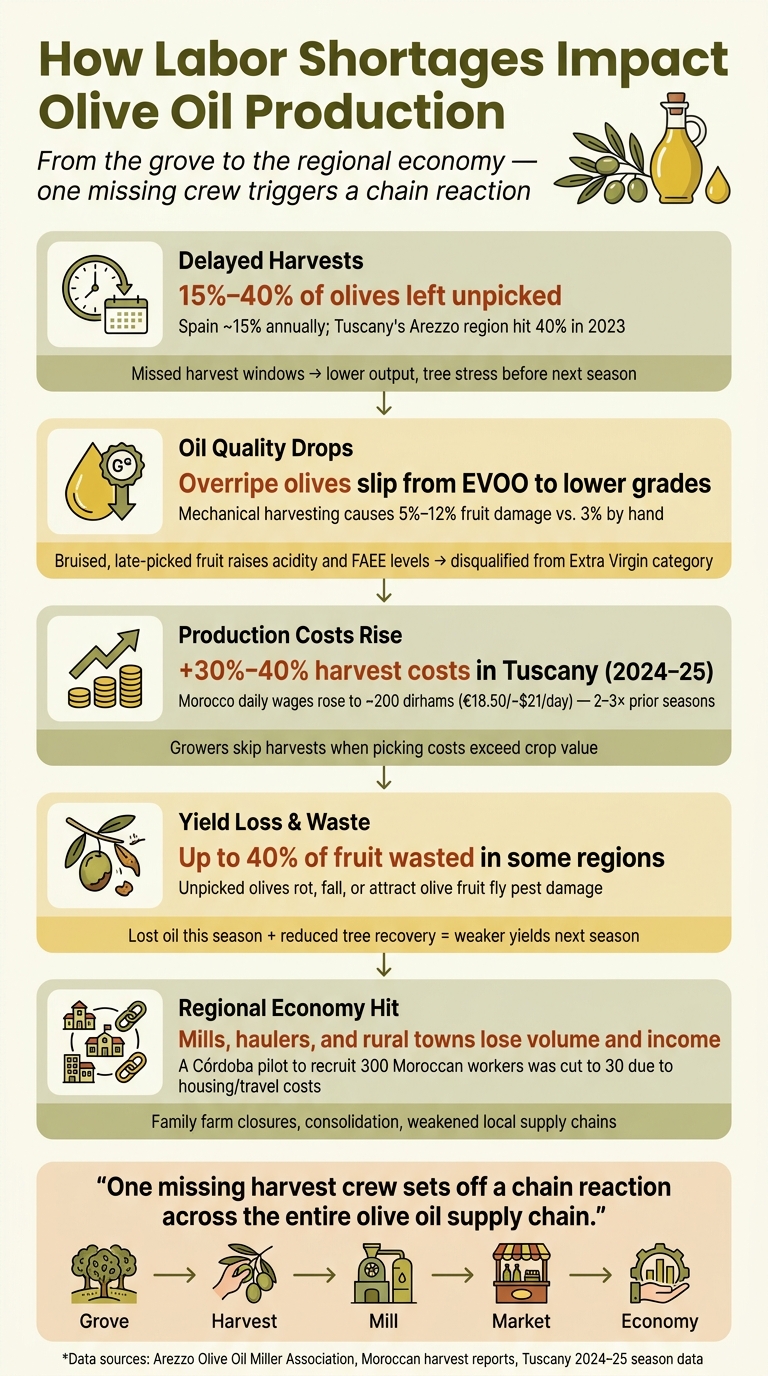
How Labor Shortages Impact Olive Oil Production: A Chain Reaction
Greek olive harvest hit as pandemic leads to labour shortage
sbb-itb-4066b8e
Quick Comparison
| Impact | What happens first | What it leads to |
|---|---|---|
| Delayed harvest | Olives stay on trees too long | Lower output and missed harvest windows |
| Lower oil quality | Fruit overripens or gets damaged | Lower grades and lower sale prices |
| Higher costs | Wages and worker support costs climb | Thin margins or skipped harvests |
| Yield loss and waste | Fruit drops, rots, or gets pest damage | Less oil this season and weaker next season |
| Regional hit | Mills and farms handle less volume | Closures, consolidation, and less local income |
The main point: olive oil depends on getting fruit picked and milled fast. When labor is short, the whole chain gets hit.
Why Labor Matters in Olive Oil Production
Olive oil production runs on labor from start to finish. If there aren’t enough workers, pruning gets delayed, harvest slows down, and milling backs up right after that. The first choke point usually shows up in the grove.
Grove maintenance comes first. Pruning has to be finished before harvest so mechanical shakers can work without harming secondary branches. In delicate varieties, and in groves on steep slopes where machines can’t get in, workers still pick olives by hand. That matters for quality. Manual picking keeps fruit damage to about 3%, compared with 5% to 12% for mechanical methods. So when labor is short, it’s not just a staffing issue. It hits oil quality almost right away.
There’s another problem once the fruit leaves the tree. Mechanically harvested olives bruise easily, and even a short delay getting them to the mill can increase acidity and lower grade. One missed pickup can snowball into lower-quality oil and more waste.
As grower Maria José Bravo of Aceites de Ardales said, the work is cold, hard, and difficult to staff. That strain shows up across the whole production chain, starting with harvest delays.
1. Harvests Are Delayed or Left Unfinished
Olive harvests run from October to February, and a late pick leaves trees with less time to recover before spring flowering. That strain tends to show up fast: first in the harvest schedule, then in fruit quality, and finally in total output.
Timing Impact
When crews are harder to find, the harvest window gets squeezed. Growers end up chasing the same workers at the same time, and the pressure gets worse when rain slows picking.
Quality Effect
Once picking slips past peak maturity, quality starts to take a hit. High-value varieties like Manzanilla and Gordal rely on hand-picking crews. If those crews are short, fruit stays on the tree too long, gets bruised more easily, and drops in grade.
Cost Pressure
Labor shortages also hit the budget hard. As wages climb, thin crew supply pushes harvest costs up during the busiest part of the season. Growers in Morocco and Tuscany reported sharp cost spikes during the 2024/2025 season.
Production Loss
The end result is pretty straightforward: fewer olives make it to the mill. Fruit that isn't collected in time stays on the tree or falls to the ground before it can be milled.
2. Olive Oil Quality Drops
Late picking can pull olive oil down a grade. When labor shortages keep crews from getting into the grove at peak ripeness, olives sit on the tree too long. Once they overripen, the oil starts to lose flavor, freshness, and shelf life.
And it’s not just a taste issue. When harvest slows, the oil’s chemistry shifts too.
Timing Impact
The window for top-grade olives is small. Olives picked at the right time are more likely to qualify as EVOO. But when labor shortages push harvest past that point, overripening gets harder to avoid, and the oil often slips into Virgin or Lampante grades.
Quality Effect
When crews are short, many growers lean harder on mechanical harvesters just to keep the pace. That helps move fruit, but it comes with a tradeoff. Machines can bruise olives, which speeds up the loss of flavor and freshness compounds. That kind of stress can also set off oxidation and hydrolysis, especially when olives sit too long before milling.
Damaged olives spoil faster. That can push up FAEE levels, a key marker that can knock oil out of the Extra Virgin category.
That drop in quality hits price fast.
Cost Pressure
When oil is downgraded, its market value falls just as fast. So when labor shortages delay harvest, growers have far less margin for mistakes.
Production Loss
Once aromas are lost before processing, milling can’t bring them back. If a farm is short-staffed, the end result is often oil that tastes flatter and holds up less well over time.
3. Production Costs Go Up
The same labor shortages that slow harvests also push production costs higher. When there aren’t enough workers, growers end up competing for the same small labor pool, and pay climbs in a hurry.
Timing Impact
A tight harvest window can change wage rates almost overnight. In Taounate, Morocco, daily pay rose to about 200 dirhams (€18.50) per day, which was roughly two to three times higher than in prior seasons.
Cost Pressure
The problem goes beyond wages. If local labor isn’t available, growers often have to cover travel and housing for migrant workers too.
In Córdoba, a pilot program meant to recruit 300 Moroccan workers was scaled back to 30 because housing and travel were too expensive. In Tuscany, harvesting costs increased 30% to 40% in 2024–25, pointing to the need for more infrastructure and technology.
When Costs Exceed Returns
Sometimes the math just stops working. Some growers decide not to harvest at all, leaving fruit on the trees because picking it would cost more than the crop is worth. When costs jump this fast, unpicked fruit becomes a direct hit to yields.
4. Yields Fall and Fruit Goes to Waste
When harvests are missed, ripe olives don't just sit there waiting. They turn into lost crop.
The problem goes beyond a slower pace in the groves. A lot of fruit never makes it to the mill at all. It overripens, drops to the ground, or rots on the tree. Once that happens, it's gone for the season.
Timing Impact
In Morocco's Taounate province, labor shortages delayed the 2025–26 campaign start from October to November. Experts warned that wrapping up later than usual would cut into the trees' rest period before flowering, which could hurt the next season's yield.
Pests and Crop Loss
Fruit left on the tree too long becomes an easier target for pests like the olive fruit fly. That risk doesn't stop with one farm either. The pest can spread through nearby groves and damage later harvests.
When crews are short, this problem gets worse fast. The fruit stays on the branches longer, and the window for pest damage gets bigger.
"Labor shortages left up to 40% of olives on the trees in our area." - Giovan Battista Donati, President, Arezzo Olive Oil Miller Association
Production Loss
In Spain, about 15% of olives go unharvested each year because there aren't enough pickers. In Tuscany's Arezzo region, that share climbed to 40% during the 2023 season.
Each unpicked olive means more than lost oil. It also means the water, fertilizer, and field-prep costs already spent on that fruit are wasted.
The hit spreads beyond the farm. Lower harvest volumes leave mills with less fruit to process and cut business for transport firms and other local operations.
5. Regional Economies Take a Hit
Labor shortages don't stop at the farm gate. When harvests come in light, the pain spreads fast. Mills process less fruit, packing houses handle less volume, transporters move fewer loads, and rural towns bring in less money.
Those farm-level setbacks ripple through the olive economy almost immediately. You see it first in tighter margins and mills that can't run at full pace.
Farm Closures and Consolidation
In Spain, many groves are already losing money. That pressure is pushing family farms toward closure or sale to larger operators.
Cost Pressure and Timing
Higher wages and worker logistics are squeezing margins across producing regions. At the same time, short crews slow the harvest and create a bottleneck, which leaves mills underused.
Quality Effect
When olive quality drops, farmers get lower prices. That cuts revenue not just for growers, but across the whole regional supply chain. Weak harvests also reduce local income and put regional stability at risk.
Impact Comparison at a Glance
The table below shows how a labor shortage can start as a harvest problem and then spread across the whole olive oil business. Side by side, you can see the chain reaction more clearly.
| Impact | Stage Affected | Immediate Consequence | Long-Term Effect |
|---|---|---|---|
| Delayed/Incomplete Harvest | Harvesting | Fruit left to rot on trees or falls to the ground | Weaker competitiveness |
| Quality Drops | Harvesting & Milling | Bruised fruit and overripe olives produce lower-grade oil | Reduced farm-gate prices and lower grades |
| Rising Production Costs | Operations | Harvesting costs rise 30% to 40% in some regions | Shrinking profit margins and mounting debt |
| Yield Loss & Waste | Harvesting | Up to 15% of Spain's olive crop goes uncollected annually | Reduced tree recovery time, lowering yields the following season |
| Regional Economic Hit | Regional economy | Small multigenerational farms consolidate or close | Farm exits and weaker local supply chains |
What starts as a single seasonal labor gap doesn't stay contained for long. It can delay harvests, cut oil quality, push up costs, and put pressure on farms that are already operating on thin margins.
Conclusion
Taken together, these problems add up fast. Labor shortages in olive oil production aren't just a hiring problem. One missing harvest crew can set off a chain reaction: fruit stays on the trees, oil slips below extra virgin grade, costs climb past what prices can cover, and rural farming communities lose income and stability over time.
For buyers, the impact is immediate. For U.S. buyers, weaker harvests can mean a less steady supply, prices that are harder to predict, and quality that varies more from season to season. Stable seasonal labor pathways, along with mechanization where it makes sense, help protect both supply and quality.
FAQs
Why does harvest timing matter so much for olive oil quality?
Harvest timing has a big effect on olive oil’s flavor, health profile, and shelf life. Olives picked earlier usually make oils that taste bolder and more peppery, with higher polyphenol levels. Olives picked later tend to produce oils with a softer, more buttery character.
The maturity stage matters for yield too. Picking olives at the right time helps support better oil accumulation. But timing cuts both ways: poor harvest timing or delays in processing can hurt quality fast, leading to oxidation, higher free acidity, and lower nutritional quality.
Can mechanization solve olive labor shortages?
Mechanization can ease labor shortages in olive farming, but it doesn't solve the whole problem.
Equipment like trunk shakers and over-the-row harvesters can boost output in a big way. But there’s a catch: results depend heavily on the orchard itself. Layout, tree density, and terrain all shape how well these machines perform.
This approach tends to work best in large, high-density operations where rows are built with machine access in mind. In less uniform orchards, the payoff can drop fast.
There are trade-offs, too. Mechanical harvesting can bruise fruit or damage the tree canopy. And some olive varieties are still hard to harvest this way without hurting fruit quality.
How do labor shortages affect olive oil prices?
Labor shortages push olive oil prices up in two ways: they make production more expensive, and they cut supply.
Olive harvesting takes a lot of hands-on work. So when farms struggle to find seasonal workers, they often have to offer higher wages to bring people in. Those added labor costs usually get passed along to shoppers.
There’s another problem too. If workers don’t show up, some olives may never get picked. Others can spoil before harvest. That means less oil makes it to market, which puts even more pressure on supply.
For producers who stick with traditional hand-harvesting, those labor costs aren’t optional. They’re part of what goes into the final product and part of what gives it its value.