

Laser-Induced Testing for Olive Oil Purity
If you need the short answer: LIBS looks useful as a fast screening test for olive oil purity, but it is not the final compliance method.
I’d sum the article up like this:
- LIBS can screen olive oil in about 20 seconds
- It uses a laser-made plasma to read light signals from the oil
- Studies report about 90% to 100% accuracy in lab datasets
- It has been tested for adulteration and geographic origin
- It often needs machine learning to sort similar oils
- GC-MS and HPLC still do the final lab confirmation
If I were running a quality program, I’d treat LIBS as a first-pass filter. It can flag suspect lots fast, with little sample prep and only about 1.5 to 2 mL of oil. Then I’d send flagged samples for GC-MS or HPLC.
A few points matter most:
- What it does well: fast checks, low prep, small sample size
- What it reads: elemental and molecular light signals like C, H, O, N, CN, and C₂
- Where it struggles: liquid splashing, matrix effects, and model performance outside controlled datasets
- Best fit today: incoming lot screening, not final legal judgment
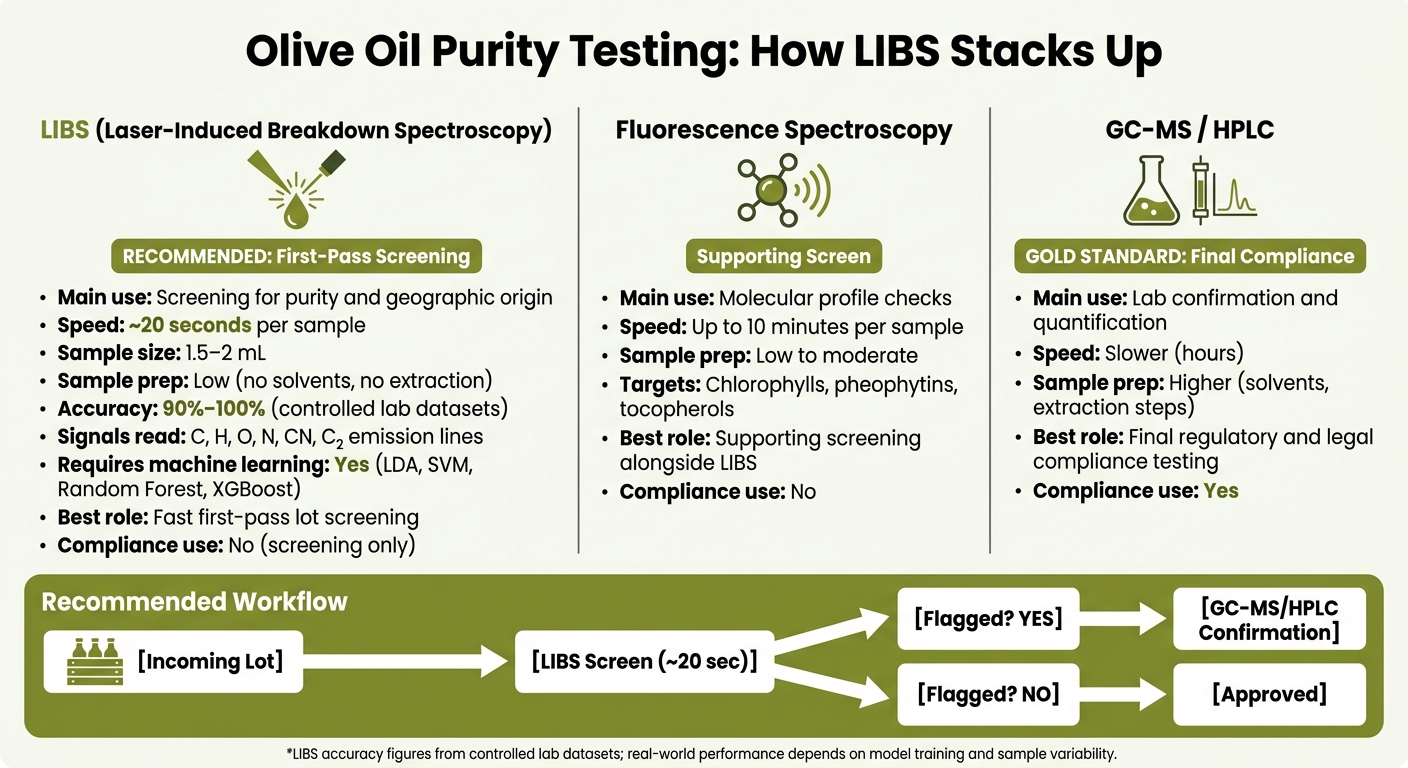
LIBS vs. Fluorescence vs. GC-MS/HPLC: Olive Oil Testing Methods Compared
Quick comparison
| Method | Main use | Speed | Sample prep | Best role |
|---|---|---|---|---|
| LIBS | Screening for purity and origin | ~20 seconds | Low | First-pass screening |
| Fluorescence spectroscopy | Molecular profile checks | Up to 10 minutes | Low to moderate | Supporting screen |
| GC-MS / HPLC | Lab confirmation and quantification | Slower | Higher | Final compliance testing |
So the main takeaway is simple: LIBS is fast and promising, but standardization and repeatability still limit routine regulatory use.
sbb-itb-4066b8e
How LIBS Works for Olive Oil Analysis
Basic Testing Principle and Instrument Setup
LIBS starts with a Q-switched Nd:YAG laser at 1,064 nm. It fires a pulse of about 5 ns onto 1.5–2 mL of oil in a shallow glass petri dish. That pulse creates a microplasma on the oil surface. As the plasma cools, it gives off light.
A fiber optic bundle picks up that light and sends it to a spectrometer. The spectrometer spreads the signal across a CCD or ICCD sensor, usually across about 200 to 1,000 nm. Labs use those signals to spot adulteration and check authenticity.
Some setups add a steady argon flow across the sample surface to cut down splashing and limit interference from the air. For steadier readings, researchers often average 10 consecutive shots for each measurement and collect data from several spots on the sample.
Spectral Signals Used to Separate Pure and Adulterated Oils
Researchers don’t rely on one standout peak. Instead, they track a small group of signals that show up again and again. LIBS spectra for olive oil include emission lines from carbon (C), hydrogen (H), oxygen (O), and nitrogen (N), plus molecular bands from cyanogen (CN) and diatomic carbon (C₂).
| Element / Signal | Wavelength (nm) | Role in Analysis |
|---|---|---|
| Carbon (C I) | 247.9, 795.2, 906.2 | Organic marker; used in ratios |
| Hydrogen (Hα, Hβ) | 656.3, 486.1 | Balmer series; reflects the hydrocarbon nature of the oil |
| Oxygen (O I) | 777 (triplet), 844.6, 926.4 | Elemental component; 777 nm triplet is a prominent feature |
| Nitrogen (N I) | 742.4, 818.8, 868.3 | Used for origin classification; may come from chlorophyll or atmospheric air |
| Cyanogen (CN) | ~388 (Δν=0) | Molecular band formed from C and N fragmentation in the plasma |
| Carbon (C₂) | ~516.5 (Swan bands) | Molecular bands linked to fatty acid fragmentation |
Here’s the catch: these peaks overlap across different oils. So a single signal won’t settle the question. The sorting happens through pattern recognition. Models such as LDA, SVM, and Random Forest scan the full spectrum and look for small shifts that are hard to spot by eye. The data becomes useful when the whole pattern is read statistically.
How LIBS Compares With Other Authenticity Tools
For fraud screening, LIBS is much faster than fluorescence spectroscopy. A LIBS test usually takes about 20 seconds, while fluorescence spectroscopy for olive oil authentication can take up to 10 minutes.
"The present results demonstrate the potential of both techniques for efficient and accurate olive oil authentication issues, with the LIBS technique being better suited as it can operate much faster." - Eleni Nanou, Researcher, Department of Physics, University of Patras
The two methods also look at different parts of the oil. Fluorescence spectroscopy targets molecular compounds such as chlorophylls, pheophytins, and tocopherols, while LIBS reads elemental signals. Some researchers have pushed this a step further by pairing LIBS with UV-Vis-NIR absorption data, which gives a more complete profile of the oil.
What Research Shows About Adulteration and Origin Testing
Studies on Adulteration in Extra Virgin Olive Oil
Once LIBS picks up a spectral fingerprint, the next job is seeing whether that pattern still works when the oil is mixed or mislabeled. That’s where adulteration and origin testing come in. Right now, researchers are studying LIBS as a fast compliance screen for both problems.
Most studies use a straightforward setup. They take pure EVOO, blend it with lower-cost oils at set concentrations, and then check whether the spectra can separate the mixture from genuine oil. Recent papers have tested blends ranging from 10% to 90% w/w.
A 2023 study by E. Nanou and colleagues looked at 184 samples: 40 pure Greek EVOOs and 144 binary mixtures. They found that LIBS could separate pure oil from adulterated samples across the full concentration range tested. Earlier work by Caceres et al. used neural networks for adulteration detection and reported accuracy as high as 95%. Newer studies have reported 99.8% to 100% accuracy in controlled datasets.
That sounds strong on paper. But the spectra on their own don’t make a decision. They need a classification step to turn those patterns into a pass-or-fail result.
Machine Learning Models and Reported Accuracy
Classification is the part that turns a spectrum into a call. A common approach is to use PCA to shrink the spectral data while keeping most of the variance. After that, researchers apply supervised models such as LDA, SVM, and Logistic Regression to sort pure samples from adulterated ones.
Several studies reported 100% classification accuracy when separating pure EVOO from adulterated mixtures. In the 184-sample dataset from Nanou et al., Gradient Boosting reached 99.8% accuracy.
"LIBS technique combined with machine learning can very successfully discriminate pure EVOOs from adulterated ones." - Nanou et al., Molecules
Those numbers are encouraging. Still, they come from controlled lab datasets. In day-to-day use, performance will depend on how varied the training data is and whether the model holds up on separate, independent samples.
Geographic Origin and Quality Grade Classification
LIBS isn’t only being studied for adulteration. Researchers have also used it to classify olive oil by geographic origin, which matters for PDO and PGI labeling.
In a 2021 study, Nikolaos Gyftokostas and colleagues analyzed 170 Greek olive oil samples and 27 binary mixtures from Crete, Lesvos, and the Peloponnese. With LDA and SVC, they reached up to 100% accuracy in geographic origin discrimination. Another 2021 study used XGBoost and Random Forest on 139 virgin olive oils and found that only two emission lines - C I at 247.9 nm and O I at 777.5 nm - were enough to reach 100% accuracy in regional classification.
"The present results demonstrate that machine-learning-aided LIBS can be a powerful and efficient tool for the rapid authentication of the geographic origin of virgin olive oil." - Gyftokostas et al., Nature Scientific Reports
Taken together, these studies show LIBS paired with LDA, SVM, Random Forest, or XGBoost reaching 99.8% to 100% accuracy in controlled datasets. The big issue now is simple: do those high lab scores hold up in routine screening and regulatory use?
Advantages, Limits, and Compliance Use
Why LIBS Is Useful for Fast Purity Screening
Strong lab data only matters if the method also works in day-to-day screening.
That’s where LIBS stands out. It can screen samples in seconds with little prep, which makes it a good fit for checking incoming lots. That matters in a production setting where a facility may need to review dozens of incoming batches before deciding which ones need deeper lab work.
LIBS also needs little to no sample prep and uses only about 1.5–2 mL of oil per test, with no organic solvents and no long extraction steps. It can run at line or inline, which makes it practical for routine quality control in production environments.
That said, speed doesn’t come free.
Current Technical Challenges and Compliance Use
LIBS often relies on machine learning to tell apart oils that have similar elemental profiles. The sample itself can also shift the signal. Physical and chemical traits of the oil, such as color, reflectance, and surface behavior, can affect laser ablation and plasma formation. In plain English, the same test can behave a bit differently across cultivars and geographic origins.
Liquid samples can splash during laser focusing too, so researchers often tune laser energy and focusing conditions. Results also tend to get more stable when several laser shots are averaged for each sample, often around 10–20 measurements.
For compliance, LIBS is more of a support tool than the final call. GC-MS and HPLC still handle compliance work and confirmatory quantification.
What This Means for Quality-Focused Brands
For quality programs, the main issue is where LIBS fits in the workflow.
For premium olive oil brands, LIBS works best as a first-pass screening tool. It can flag suspicious incoming batches in seconds, so GC-MS or HPLC can be saved for the samples that actually trigger concern. That kind of setup is practical: use the fast screen up front, then send the questionable lots for deeper testing.
It also helps to pair LIBS with sensory evaluation and standard chemical assessments. No single method can cover the whole picture, but together they support a stronger case for authenticity, especially for PDO or PGI oils where geographic origin matters.
In practice, LIBS is fast and portable, while GC-MS and HPLC are still stronger for confirmatory testing and regulatory use. So LIBS works best as a screening layer, not the final verdict.
Conclusion: What LIBS Could Mean for Olive Oil Purity Testing
Taken together, these studies suggest LIBS is moving from a lab idea to a practical screening method for olive oil authenticity. Recent research reports 90% to 100% accuracy, with results in about 20 seconds per sample.
That level of performance depends on machine learning. On its own, LIBS produces raw spectral data. Machine learning turns that data into usable authenticity decisions by sorting subtle elemental patterns that people can't read by eye with steady accuracy.
There’s still a catch. Reproducibility, matrix effects, and broader validation continue to slow regulatory adoption. The issue isn’t whether LIBS can detect signals that matter. It’s whether the method can be used routinely, at scale, and with the same output from one setting to the next.
For premium EVOO producers, LIBS looks like a fast first-pass screen that can flag suspicious lots early and help protect brand integrity. Formal compliance still calls for GC-MS or HPLC, but the evidence so far is encouraging. What happens next will depend on standardization.
FAQs
How accurate is LIBS outside the lab?
LIBS works very well for olive oil testing outside the lab. It needs no sample preparation and can run on portable or compact devices, which makes it a strong fit for fast, real-time, on-site analysis.
Pair it with machine learning, and the results get even stronger. Studies have reported 91% to 100% classification accuracy for detecting adulteration and checking geographical origin.
Can LIBS detect all types of olive oil adulteration?
LIBS works very well for spotting common olive oil adulteration, especially when lower-grade oils like soybean, sunflower, corn, or pomace oil are mixed in.
Research shows that LIBS, particularly when paired with machine learning, is a promising option for real-time quality control. That said, it is mainly presented as a tool for identifying these specific fraudulent blends.
Why is GC-MS or HPLC still needed after LIBS?
GC-MS and HPLC are still needed because they can pinpoint and measure specific compounds, including fatty acids and polyphenols. Those compounds matter because they act as key markers when you're trying to characterize olive oil.
LIBS shines when you need fast, on-the-spot, in-situ adulteration checks. It's quick, practical, and useful in the moment. But chromatographic methods are still the go-to choice when accuracy matters most and you need a deeper read on the sample. The tradeoff is simple: they demand more lab work and more sample prep.