

How To Make Basil-Infused Olive Oil At Home
If I make basil oil at home, I need to treat it like a short-life fridge item, not a pantry oil. The big takeaway is simple: use dry basil, keep tools and jars clean, refrigerate at 35–40°F, and plan to use it fast. In most home kitchens, that means 2 to 14 days, depending on the method.
Here’s the short version:
- Best color and strongest basil taste: blanch, blend, strain
- Longest fridge time: warm infusion with dried basil
- Highest risk: steeping fresh basil in oil at room temperature
- Best use: drizzle after cooking, not during cooking
- Smart batch size: about 1/2 to 1 cup
One point matters more than anything else: moisture in oil can support botulism risk. That’s why washing, drying, straining, and cold storage matter so much. And because olive oil often turns cloudy in the fridge, I wouldn’t treat that alone as a spoilage sign.
Quick comparison
| Method | Fridge needed | Use within | Taste | Color |
|---|---|---|---|---|
| Blanch + blend + strain | Yes, right away | 2–3 days | Strong | Bright green |
| Warm infusion with dried basil | Yes | 1–2 weeks | Mild to medium | Light green to golden |
| Room-temp steep with fresh basil | Yes, after steeping | 2–3 days | Mild | Varies |
A few simple rules sum up the whole process:
- Use extra virgin olive oil
- Dry basil until no water is left
- Strain out leaf bits
- Label the jar with the date
- Throw it out if it smells off, shows mold, or looks strange
So if I want basil oil that tastes good and stores with less risk, I’d make a small batch, keep it cold, and use it as a finishing drizzle on pasta, tomatoes, bruschetta, pizza, or grilled chicken.
Homemade Basil Oil Recipe! #basil #oil #easyrecipe #cookingshorts #cookingtips #herbs #food
sbb-itb-4066b8e
Ingredients, Tools, and Prep Before You Begin
Clean, dry ingredients and equipment are the starting point for basil oil that tastes good and stores more safely.
Pick Basil and Extra Virgin Olive Oil
Choose fresh basil with bright green leaves. Skip anything with black spots, wilting, or slime. Damaged leaves can muddy the oil’s color and increase spoilage risk. Pull off any flowers or tough stems before you begin, since they can make the oil taste bitter.
For the oil, use a high-quality extra virgin olive oil so the infusion stays clean and balanced.
It’s best to make small batches, about 1 to 2 cups, so you can use them sooner. For 1 cup of oil, use about 1 loosely packed cup of basil leaves. If you want a stronger basil taste, use up to 1½ cups, but the oil will keep for less time in the refrigerator.
Basic U.S. Kitchen Tools You Need
Use these basic kitchen tools:
| Tool | Why You Need It |
|---|---|
| Measuring cups and tablespoons | Keeps your basil-to-oil ratio consistent |
| Small saucepan | Controls heat for blanching and warm infusion |
| Blender or food processor | Purees basil for the blanch-blend-strain method |
| Instant-read thermometer (°F) | Lets you verify oil temperature instead of guessing |
| Fine-mesh sieve | Strains out larger basil solids after blending or steeping |
| Cheesecloth or coffee filters | Removes fine particles that can trap moisture |
| Salad spinner or paper towels | Dries basil thoroughly after washing |
| Sanitized glass jars or bottles | Non-reactive storage that reduces contamination risk |
Wash, Dry, and Sanitize for Safer Storage
Keep water out of the oil. Moisture on the basil or in the jar can support botulism risk in herb oils stored at room temperature.
Wash the basil in a bowl of cool water. Swish the leaves gently, then lift them out so the grit stays at the bottom. Spin them dry in a salad spinner, then spread them in a single layer on paper towels until they feel completely dry - dry to the touch, with no visible water droplets. A simple check helps here: if a leaf leaves a damp mark when pressed between paper towels, it needs more time.
Wash jars in hot, soapy water, then boil them for 10 minutes to sanitize. Lift them out with tongs, place them upside down on a clean rack, and let them air-dry all the way. If you still see droplets inside, blot them with a clean paper towel. Only fill the jars after they’ve cooled to room temperature.
Once the basil and jars are fully dry, move on to the infusion method that matches your flavor and storage goals.
How To Make Basil-Infused Olive Oil: 3 Home Methods
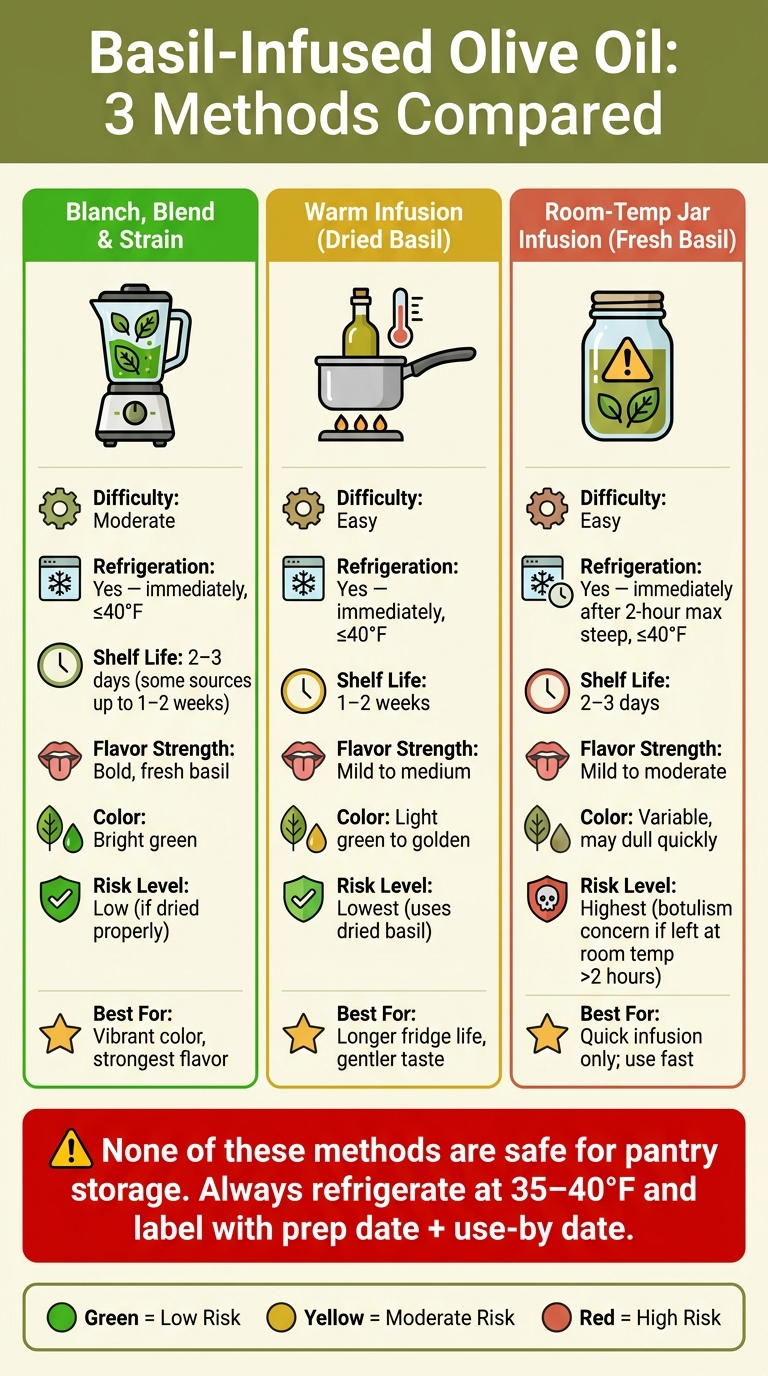
Basil-Infused Olive Oil: 3 Methods Compared by Safety, Flavor & Shelf Life
With your basil dry and jars sanitized, pick the method that fits your goals for color, flavor, and storage time. If you want the safest path and the longest usable life, start there.
Blanch, Blend, and Strain for Green Basil Oil
This method gives you the brightest green color and bold basil flavor. The quick blanch helps hold onto chlorophyll, which keeps the oil looking bright green.
- Set up your ice bath first
Fill a medium bowl with ice and cold water. Keep it right next to the stove so you can move fast.
- Blanch the basil
Bring 4 to 6 cups of water to a rolling boil (212°F at sea level). Drop in your clean, dry basil leaves and blanch for 15 to 30 seconds. You’re looking for bright green leaves, not cooked ones. Don’t go past 60 seconds or the color and flavor will start to fade.
- Shock, then dry completely
Use a slotted spoon to move the basil straight into the ice bath. Let it sit for 3 to 5 minutes, then press out extra water by hand. Pat the leaves between paper towels until they feel completely dry.
- Blend and strain
Add the dried, blanched basil and 1 cup of extra virgin olive oil to a blender. Blend on high for 1 to 2 minutes until smooth. Strain through cheesecloth or a coffee filter over a clean measuring cup for 10 to 30 minutes. Press gently, but don’t force pulp through.
- Label and refrigerate right away
Pour the strained oil into a sanitized glass jar or bottle. Label it with the date and refrigerate at 40°F or below. Use within 2 to 3 days.
Warm Infusion for a Softer Basil Flavor
If you want a gentler basil taste and a bit more refrigerated storage time, this method works well. Use fully dried basil - either home-dried or store-bought - to cut moisture and lower risk.
Combine 2 to 3 tablespoons of dried basil with 1 cup of extra virgin olive oil in a small, heavy-bottomed saucepan. Add both before turning on the heat so the herbs warm gradually instead of getting hit with sudden heat. Then warm the oil over low heat to 170 to 190°F, using an instant-read thermometer to check the temperature. Keep it below a simmer. If you see bubbling, the heat is too high.
Hold the oil in that range for 10 to 20 minutes, stirring now and then. After that, take the pan off the heat and let it cool to room temperature - about 68 to 72°F - for 30 to 60 minutes. Strain it soon after through cheesecloth or a coffee filter. Don’t let the basil sit in warm oil for hours.
Transfer the strained oil to a clean glass jar. Label it with the date and "Refrigerate - use within 1 to 2 weeks," then store it at 40°F or below. Dried-herb infusions kept cold the whole time are lower risk than fresh-herb versions, but they still need refrigeration.
Infused olive oil may solidify or turn cloudy in the refrigerator. That's normal. Set the jar on the counter for 20 to 60 minutes before using it, and it will return to its usual consistency.
If you want a no-heat option, the next method comes with the most risk and needs strict time limits.
Room-Temperature Jar Infusion and Safety Concerns
This is the highest-risk method. Tear or lightly bruise fresh basil leaves, pack them loosely into a pint-size mason jar, pour extra virgin olive oil over them until fully submerged, seal the jar, and let it infuse at room temperature for no more than 2 hours.
Here’s the issue: fresh basil in oil at room temperature creates conditions where Clostridium botulinum can grow and produce toxin, and there may be no smell or taste to warn you. Clemson Cooperative Extension says any herb-in-oil mixture left at room temperature for more than 2 hours should be discarded. Oregon State University Extension recommends refrigerating homemade herb-infused oils and using them within 4 days, or freezing them for longer storage.
Refrigerate the oil right after infusion and use it within 2 to 3 days.
Storage, Shelf Life, and How To Keep the Flavor
Once the oil is bottled, storage affects both safety and taste.
Refrigerate, Date, and Know When To Throw It Out
Keep basil oil in the main body of the fridge at 35–40°F, not in the door. Add a label with the prep date in month/day/year format and a use-by date based on the method. Use the table below for storage limits.
If the oil looks cloudy or partly solid in the fridge, that’s normal. Olive oil often does that when chilled, and it will clear again as the bottle comes back to room temperature.
Throw it out if it smells rancid, shows mold, bubbles when opened, or develops odd sludge or color changes.
Ways To Help Basil Flavor Last Longer
Cold storage keeps it safe. A few extra steps help the flavor stay in better shape.
Use fresh extra virgin olive oil for a cleaner base and longer-lasting flavor. Store the oil in dark glass and keep it away from direct light and heat, since both can speed up flavor and color loss. Strain it twice to remove tiny particles that can make the flavor fade faster.
Also, avoid warming and cooling the whole bottle over and over. Instead, pour out only what you need into a small dish, so the rest stays sealed and cold. Smaller batches, like 8–16 oz, are easier to finish while the basil still tastes bright.
Method Comparison Table: Safety, Shelf Life, Flavor, and Color
| Method | Refrigeration Required | Approximate Safe Shelf Life | Flavor Strength | Color Retention |
|---|---|---|---|---|
| Blanched-and-blended | Yes - immediately, ≤40°F | 1–2 weeks | Bold, fresh basil | Bright green; best in first few days |
| Warm infusion (fresh basil, strained) | Yes - immediately, ≤40°F | 7–10 days | Softer, more mellow | Lighter green; fairly stable |
| Room-temperature jar infusion | Yes - immediately, ≤40°F | 2–3 days | Mild to moderate | Variable; may dull quickly |
All three methods need prompt refrigeration, and none of them are safe for pantry storage when made with fresh basil. If color matters most, the blanched method stands out. If flavor punch is the goal, it also gives the strongest basil taste. The trade-off is simple: that best-quality window is short, so it’s smart to use it soon.
Conclusion: Pick a Method and Use It Soon
Now that you know the methods and storage limits, the last step is simple: dry your basil all the way, start with a high-quality extra virgin olive oil, pick the method that matches the flavor and color you want, strain with care, and refrigerate it right away. Label the bottle with the date you made it and a use-by date in month/day/year format.
If you want the strongest color and flavor, go with blanch-and-blend. If you want something gentler, warm infusion is the better fit. Since basil oil only lasts a short time in the fridge, small batches make more sense. For most households, a ½- to 1-cup batch is plenty.
Use basil oil as a finishing oil, not a cooking fat. Add it at the end, right before serving, so the basil aroma and color stay intact. A small drizzle works well on salads, or use about 1 tablespoon per pasta portion after cooking.
The best batch is the one you use up before the flavor starts to dull. Make a small amount, use it within the refrigerated window, and make a new batch next time.
FAQs
Can I freeze basil-infused olive oil?
The sources don’t say that basil-infused olive oil can or should be frozen.
What they do make clear is this: fresh-infused oils are highly perishable. That means you should store them in the refrigerator and use them within 1 to 2 weeks.
If the oil thickens or solidifies in the fridge, that’s normal. Just let it come back to room temperature before you use it.
Why does basil-infused olive oil turn cloudy in the fridge?
This is usually normal. When you store basil-infused olive oil in the fridge, the cold can make it turn cloudy, thicken, or even partly solidify.
Let it sit at room temperature, and it should go back to its usual texture. That said, cloudiness in fresh-infused oils can also be a warning sign of spoilage, so check for any odd smell or mold before you use it.
Can I use other herbs the same way?
Yes - you can infuse olive oil with lots of herbs, not just one or two. Good options include rosemary, oregano, thyme, mint, dill, parsley, tarragon, cilantro, sage, and marjoram.
The best herb comes down to the flavor you're after. Want something woodsy and bold? Go with rosemary or sage. Prefer a lighter, brighter taste? Mint, dill, or parsley can work well.
You can use either fresh or dried herbs, but safety matters here. Prep and store them the right way. If you use fresh herbs, refrigerate the oil and use it within 1–2 weeks.