

Mass-Produced vs. Premium Olive Oil
Not all olive oils are the same. Here's why it matters:
- Mass-Produced Olive Oils: These are made using industrial processes like heat and chemicals, stripping away nutrients and flavor. They’re cheaper ($0.27–$0.50/oz) but lack the health benefits and taste of higher-quality oils. Many fail to meet true "extra virgin" standards.
- Premium Olive Oils: These are cold-pressed from fresh, early-harvest olives, preserving antioxidants, polyphenols, and bold flavors like grassy or peppery notes. They cost more ($1.50–$3.00/oz) but deliver better taste and nutrition.
Key Differences:
- Production: Mass-produced oils use heat/chemicals; premium oils use mechanical, cold-press methods.
- Nutritional Value: Premium oils retain up to double the polyphenols and antioxidants.
- Taste: Premium oils offer complex flavors; mass-produced oils are neutral or stale.
- Price: Mass-produced is cheaper; premium reflects higher quality and effort.
Quick Tip: Look for harvest dates, dark glass bottles, and certifications like the California Olive Oil Council seal to ensure you're getting premium quality. Premium olive oil is worth the investment for both flavor and health benefits.
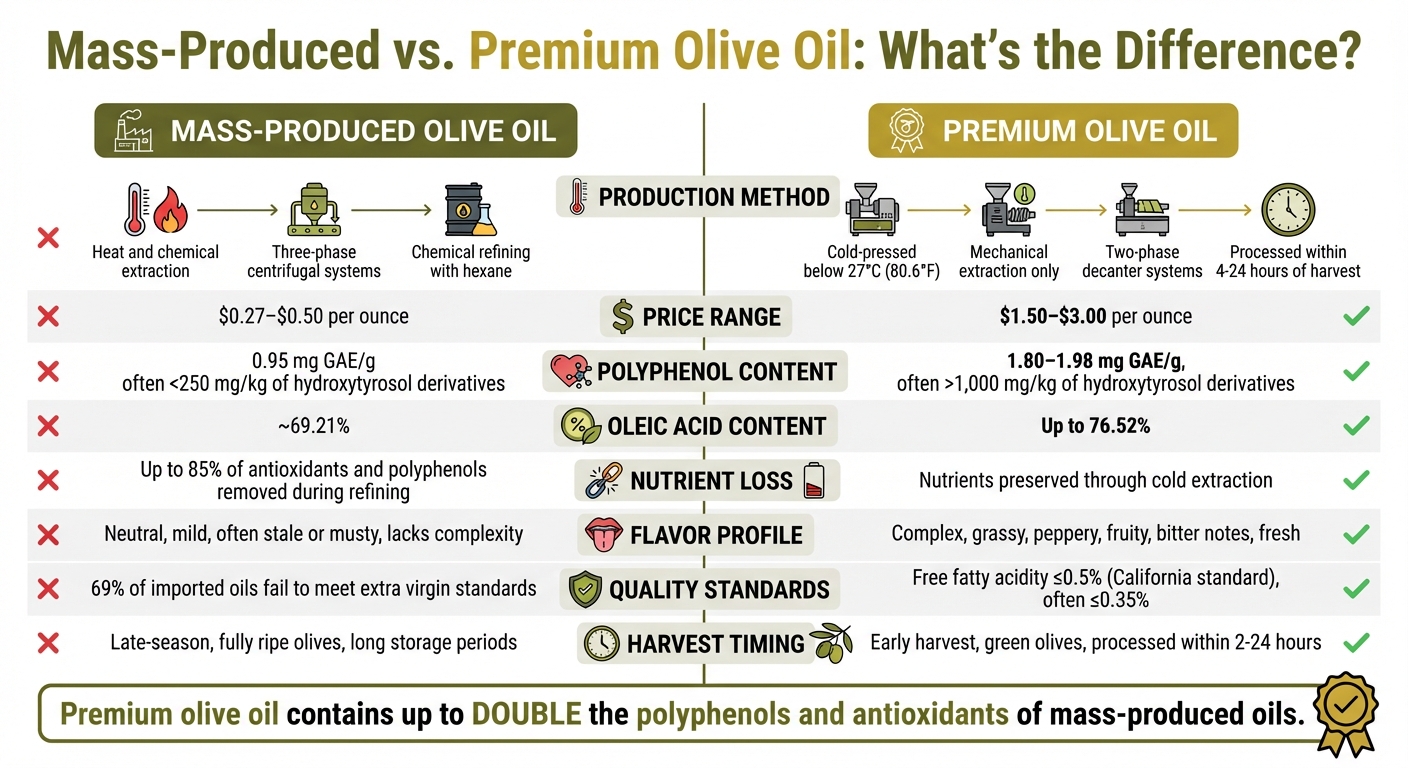
Mass-Produced vs Premium Olive Oil Comparison Chart
Production Methods and Quality Standards
Mass-Produced Olive Oil: Industrial Processing
When it comes to mass-produced olive oil, the focus is on quantity, not quality. These oils often rely on late-season olives that are stored for long periods, leading to fermentation and oxidation issues.
The extraction methods used in industrial production typically involve heat or three-phase centrifugal systems with added water, which significantly reduce the oil's polyphenol content. If the oil fails to meet extra virgin standards, it undergoes chemical refining using solvents like hexane to strip away off-flavors and unwanted colors. The result is a neutral-tasting product that is often mixed with just 15–20% virgin oil to give it a hint of flavor.
"Oils that are extracted with heat or the use of chemical solvents can be very bad for your health."
- Tonio Creanza, Founder, Messors
This industrial process can remove up to 85% of the antioxidants and polyphenols that make extra virgin olive oil so beneficial. What’s left is a mild, consistent product, but it lacks the depth of flavor and nutritional value found in premium oils.
Premium Olive Oil: Cold-Pressed and Small-Batch Production
Premium olive oil is all about timing and precision. The olives are harvested early - when their polyphenol levels are at their highest - and processed quickly, usually within 4 to 24 hours, to lock in nutrients and prevent fermentation. At Big Horn Olive Oil, for instance, olives are cold-pressed within just 2 hours of being picked, ensuring maximum freshness and nutrient preservation.
The extraction process for premium oils is entirely mechanical and performed at temperatures below 27°C (80.6°F) using two-phase decanter systems. This approach avoids adding water, which helps retain phenols and antioxidants. During malaxation, a critical mixing stage, producers carefully control both time (30–75 minutes) and temperature to enhance the oil’s aromatic profile without compromising its quality.
"Authentic EVOO is made without the use of chemicals and industrial refining. Therefore, it's the olive varietals, the terroir where they grow, and the countless decisions and production practices of a dedicated producer that influence the oil's overall quality and taste."
- Tonio Creanza, Founder, Messors
In California, premium extra virgin olive oil must meet stringent standards set by the Department of Food and Agriculture, which requires a free fatty acidity of no more than 0.5%, compared to the international limit of 0.8%. High-quality oils from healthy olives often have even lower acidity, typically not exceeding 0.35%.
After extraction, the oil is stored in stainless steel tanks with nitrogen to prevent oxidation and then packaged in dark glass bottles to shield it from UV light. This rigorous process preserves the oil’s complex flavors and health benefits, which is why premium oils command a higher price.
Taste and Flavor Profiles
Mass-Produced Olive Oil: Mild and Generic Flavor
Mass-produced olive oils often have a neutral, uninspired flavor due to industrial blending. This process can lead to inconsistent taste and even off-putting notes, such as mustiness, staleness, or a fermented aftertaste. In a Consumer Reports test of 26 extra virgin olive oils, only 11 met the expected flavor standards. Many mass-market brands displayed signs of staleness or fermentation, falling short of the quality expected in extra virgin olive oil.
"Extra virgin oil should taste fresh, with olive fruit flavor, plus some bitterness and pungency - which is a peppery, warm, tingling sensation at the back of your throat."
- Amy Keating, RD, Consumer Reports
That peppery sensation isn't a flaw - it’s actually a hallmark of high-quality olive oil. While mass-market options lack this depth, premium oils deliver a rich and complex flavor, reflecting the care taken during their production.
Premium Olive Oil: Complex and Varied Flavors
Premium olive oils stand out for their intricate flavor profiles, achieved through meticulous cold extraction methods. These oils retain a wide range of volatile compounds, such as aldehydes, alcohols, and esters, which contribute to their nuanced taste. Expect a harmonious blend of fruitiness, bitterness, and pungency, with flavor notes that might include grass, tomato leaf, green apple, or even artichoke.
The secret lies in early harvesting. Premium producers pick olives while they're still green, maximizing chlorophyll and phenolic compounds. This not only boosts flavor complexity but also enhances the oil's nutritional benefits. A 2022 study by the University of Barcelona revealed that Arbequina extra virgin olive oils processed at 68°F retained significantly more flavor complexity and sensory appeal compared to oils processed at higher temperatures. Additionally, oils with phenol concentrations above 410 mg/kg are noticeably bitter - an indicator of high antioxidant levels - while those with less than 220 mg/kg tend to have a milder taste.
Big Horn Olive Oil’s Estate Reserve Ultra Premium EVOO exemplifies this care. Cold-pressed within two hours of harvesting, it preserves the volatile compounds responsible for its signature grassy and peppery flavors - qualities you won’t find in standard supermarket oils.
"I'm looking for oil that's alive... I should cough if I'm tasting it raw, and I want peppery and grassy notes that feel very present."
- Nick Anderer, Chef
To fully appreciate premium olive oil, pair its intensity with the appropriate dish. Robust, peppery oils shine as finishing touches for hearty meals like roasted vegetables or red meat. On the other hand, milder, buttery oils complement lighter dishes such as fish or eggs, letting their delicate flavors shine.
How to buy the best olive oil (and what's the difference between them)
Health Benefits and Nutritional Value
The difference between mass-produced and premium olive oil goes far beyond flavor - it’s about what’s inside the bottle. The production process directly impacts the nutrients that make it into the final product, and the contrast between industrial and artisan methods is striking.
Nutritional Losses in Mass-Produced Oils
Industrial processing strips away essential nutrients. When lower-grade oils are refined using high heat and chemical solvents like hexane, most of the polyphenols, antioxidants, and vitamins that contribute to olive oil's health benefits are lost.
"Refining olive oil strips it of its vitamins, polyphenols, and other natural ingredients."
For example, lampante-grade oil, often used as a base for mass-market brands, contains about 0.95 mg GAE/g of total phenols. In comparison, premium extra virgin olive oil boasts 1.80 to 1.98 mg GAE/g - nearly double the phenolic content. Refining also eliminates squalene (a beneficial hydrocarbon) and significantly reduces levels of tocopherols (Vitamin E) and carotenoids.
Mass-produced oils typically have around 69.21% oleic acid, whereas premium oils can reach 76.52%. This higher oleic acid content improves oxidative stability, helping the oil stay fresh longer and resist rancidity.
The European Food Safety Authority has set a benchmark for olive oil to claim it protects blood lipids from oxidative stress: it must contain at least 5 mg of hydroxytyrosol and its derivatives per 20 g of oil. Many mass-produced oils fall short, with some containing less than 250 mg/kg of these vital compounds. In contrast, premium oils can exceed 1,000 mg/kg. This stark difference underscores the nutritional gaps in lower-quality oils.
Higher Nutrient Content in Premium Olive Oils
Premium olive oils, on the other hand, retain far more of the nutrients that make olive oil so beneficial. By using mechanical extraction methods without heat or chemicals, these oils preserve heat-sensitive polyphenols known for their anti-inflammatory and heart-protective properties.
"Extra-virgin olive oil is pressed mechanically from ripe olives and processed without high heat or chemical solvents. This protects chemicals in the oil called phenols. In contrast, regular, highly processed olive oils lose these chemicals."
- Howard E. LeWine, MD, Chief Medical Editor, Harvard Health Publishing
The extraction process itself plays a critical role. A January 2020 study in MDPI Antioxidants compared extraction systems using two Italian olive cultivars, Raggiola and Leccino. Researchers found that switching from a conventional three-way decanter (common in industrial production) to a two-way decanter increased total phenols by 30% in the Raggiola cultivar. The two-way system avoided the water-wash effect, which strips away water-soluble compounds like oleuropein aglycone, oleacein, and oleocanthal.
Timeliness is another key factor. Processing olives within 24 hours of harvest helps retain alpha-tocopherol (Vitamin E) and phenolic content. Delaying processing by just seven days can lead to a 41% reduction in total phenols and a 17% loss of Vitamin E. Premium producers take this seriously - Big Horn Olive Oil, for example, cold-presses its Estate Reserve Ultra Premium EVOO within two hours of harvesting, locking in maximum nutritional value.
High-quality extra virgin olive oil typically contains around 200 mg/kg of alpha-tocopherol (Vitamin E) and is made up of approximately 75% monounsaturated fatty acids (MUFAs), which are known to support heart health. These oils are packed with compounds that combat oxidative stress and inflammation, making them a healthier choice overall.
sbb-itb-4066b8e
Price and Value Comparison
The difference in production methods and nutritional quality between mass-produced and premium olive oils is mirrored in their price points. The price gap highlights the trade-offs between cost and quality.
Mass-Produced Olive Oil: Lower Price, Lower Standards
Mass-produced olive oils are typically priced between $0.27 and $0.50 per ounce. While these oils are attractive to budget-conscious shoppers, the reduced price comes with compromises. Industrial producers often prioritize volume over quality by using fully ripe olives, which yield more oil but sacrifice antioxidants and flavor. Additionally, high-capacity mechanical processes further diminish the oil's overall quality.
Many low-cost oils labeled as "Extra Virgin" fail to meet the strict standards required for the designation. Sensory tests have revealed issues like rancidity, mustiness, or staleness, which disqualify them from being classified as true extra virgin olive oil.
"The oils that failed in our tests had defects such as rancidity - many of these oils just did not taste good."
- Dan Flynn, Executive Director, UC Davis Olive Center
A study revealed that 69% of imported olive oils labeled as "extra virgin" did not meet international standards. Expert reviews confirm that many of these oils fail sensory evaluations. The lower price reflects these quality compromises, making them less appealing to those prioritizing flavor and health benefits.
Premium Olive Oil: Higher Price, Superior Quality
Premium olive oils, on the other hand, are priced between $1.06 and $2.91 per ounce. These oils justify their higher cost through meticulous production practices that focus on quality over quantity. Early-harvest olives, which are richer in polyphenols and offer more complex flavors, are central to premium oil production.
"Olives that are harvested early yield less oil and thus have a higher production cost."
Producers of premium oils also process olives within 4 hours of harvesting, minimizing fermentation and preserving quality. They use shorter malaxation times at lower temperatures to protect the oil's aromatic and nutritional properties. Storage in stainless steel tanks with nitrogen blanketing and strict temperature controls (59°–64°F) ensures the oil remains fresh and oxidation-free.
For example, Big Horn Olive Oil’s Estate Reserve Ultra Premium EVOO is cold-pressed within two hours of harvesting and priced at $8.99 per ounce. This careful attention to detail results in polyphenol levels as high as 654 mg/kg, significantly higher than the 149 mg/kg found in some mass-produced oils. While the price is steeper, it guarantees a product rich in flavor and health benefits, making it a worthwhile investment for those seeking quality.
How to Identify and Choose Premium Olive Oil
Understanding Labels: Certifications and Harvest Dates
When it comes to picking premium olive oil, the label holds the key. Start by checking for the harvest date - not just the "best by" date. High-quality producers often include the specific month and year the olives were harvested, such as "Harvested October 2025." This kind of detail shows a commitment to quality and helps you select the freshest oil.
"The first thing I look for is the harvest date. Freshness is a key quality component."
- Nicholas Coleman, Founder of Grove and Vine
Look for certifications from trusted organizations like the California Olive Oil Council, the North American Olive Oil Association, or the European Union's Protected Designation of Origin. These seals confirm that the oil meets strict quality standards. As David Garci-Aguirre, Master Miller at Corto Olive Oil, notes, “Seal certifications like the California Olive Oil Council... are an attempt to distinguish honestly fresh, high-quality olive oil from an extra virgin category that has become dominated by commoditized low-quality oil.”
Labels that specify a single estate, region, or olive variety - like Koroneiki, Picual, or Frantoio - are also good indicators of quality and traceability. Additionally, check for terms like cold-pressed or cold-extracted, which confirm the oil was processed below 80.6°F (27°C) to preserve its natural flavors and antioxidants.
Packaging matters too. Avoid clear glass bottles, as they allow light to degrade the oil. Instead, opt for dark glass bottles or metal tins to protect the oil from light exposure and rancidity. The back label is another treasure trove of information - look for details like free acidity (which should be 0.8% or lower for extra virgin olive oil) and polyphenol content. These markers reflect the oil's care in production and overall authenticity.
The Importance of Freshness and Early Harvest
Freshness is everything when it comes to olive oil. Over time, both the flavor and health benefits fade. Ideally, premium olive oil should be consumed within 12 to 18 months of its harvest date, and once opened, it’s best used within 30 to 60 days to retain its peak flavor and antioxidant properties.
Harvest timing varies by region. Oils from the Northern Hemisphere - including Italy, Greece, Spain, and California - are harvested between October and December, while those from the Southern Hemisphere, like Chile and Australia, are harvested from May to July. To ensure freshness, choose oils from the most recent harvest. For instance, if you’re buying in February 2026, look for Northern Hemisphere oils harvested in late 2025.
Early-harvest oils, made from olives picked before full ripeness, are especially prized for their high polyphenol content and bold, peppery flavor. That slight tickle or cough you feel at the back of your throat? It’s a natural sign of antioxidants at work. For example, Big Horn Olive Oil processes its olives within two hours of harvest and delivers fresh oil within three months, ensuring top-notch quality.
Proper storage is just as important as choosing the right oil. Keep your olive oil in a cool, dark place - away from heat sources like the stove - and maintain a temperature between 59°F and 64°F (15°C to 18°C). Always seal the bottle tightly to limit oxygen exposure, and only buy what you can use within one to two months. By paying attention to harvest dates and handling your oil correctly, you’ll enjoy its full flavor and health benefits every time.
Conclusion
Mass-produced olive oils often come with sensory flaws like fustiness or rancidity, while premium olive oils stand out for their rich, complex flavors and higher polyphenol content, which can support heart health. This stark difference highlights how production methods directly influence both taste and nutritional value.
Premium olive oil is crafted with care and precision. Typically priced between $1.50 and $3.00 per ounce, these oils are cold-pressed shortly after harvest, without the use of heat or chemicals, to retain their natural benefits. As Nick Anderer, Founding Chef at Marta and Maialino, explains:
"I'm looking for oil that's alive. I want vibrancy; I should cough if I'm tasting it raw, and I want peppery and grassy notes that feel very present".
Big Horn Olive Oil offers an exceptional example of this quality with their Ultra Premium Extra Virgin Olive Oils. Cold-pressed within two hours of harvest and delivered fresh within three months, these oils - featuring single-source varieties like Picual and Coratina starting at $8.99 - bring restaurant-grade flavor and trusted production practices straight to your kitchen. Beyond elevating your cooking, they also provide notable health advantages.
Whether you're drizzling it over roasted vegetables, finishing a salad, or dipping fresh bread, premium olive oil enhances your dishes with its signature peppery kick and fresh, grassy aroma. It's a simple switch that benefits both your taste buds and your well-being.
FAQs
How can I tell if an olive oil is truly extra virgin?
To determine if olive oil is genuinely extra virgin, start by checking for certifications and quality markers. One key indicator is a low free fatty acid content - no more than 0.8 grams per 100 grams. Additionally, the oil should be free from any defects in flavor or aroma. These criteria are regulated by bodies such as the International Olive Council, which ensures the oil meets strict standards for authenticity and quality.
What does a peppery “throat tickle” in olive oil mean?
A slight, peppery "throat tickle" is a hallmark of high-quality, fresh extra virgin olive oil. This sensation points to robust flavors, a rich presence of antioxidants, and a depth of flavor that many seek in premium oils. It's closely tied to the oil's freshness and low acidity - two key markers of top-tier quality.
How should I store olive oil to keep it fresh longer?
To keep olive oil fresh and flavorful, store it in a cool, dark spot where the temperature stays between 60–70°F. If the bottle is clear, transfer the oil to a dark, opaque container or a ceramic vessel to protect it from light. Make sure the bottle is tightly sealed to limit oxygen exposure, which can lead to spoilage. Also, keep it away from heat sources like stoves since heat speeds up the oil's deterioration.