

Medieval Vinegar Production: Guild Practices
Medieval vinegar was controlled from start to finish. In Orléans, guilds decided who could make it, which wine could be used, how barrels were handled, and what quality reached buyers. That system helped turn sour wine from river trade into a steady city industry, with about 300 vinegar makers at its peak and a process that could take 1 to 3 months to ferment plus 1 year to age.
If you want the short answer, here it is:
- Orléans became a vinegar center because wine passed through its port
- Guilds limited entry through apprenticeship, fees, and master approval
- The Orléans method used slow surface fermentation in partly filled oak barrels
- Inspectors sorted spoiled wine for vinegar use before it entered workshops
- Quality rules covered production, pricing, labor, and sales
- Workshop vinegar was more uniform than household vinegar
What stands out to me is how tightly the whole trade was managed. Skill, inspection, and city commerce worked together. The guild did not just watch the final product. <u>It controlled the process itself.</u>
A few facts make that clear:
- The guild in Orléans was set up in 1580
- Barrels often held 225 to 240 liters
- Workers kept barrels only half to two-thirds full so air could reach the surface
- About 15% of finished vinegar was often left behind to start the next batch
- Vinegar then aged at about 59°F (15°C)
This article shows a simple point: medieval vinegar making was a city craft built on rules, slow work, and guarded shop knowledge.
Case study: The Orléans vinegar tradition
Why Orléans became a vinegar center
Orléans grew into a vinegar hub for a simple reason: wine kept passing through the city.
It sat on the Loire trade route, where wine from Burgundy, the Loire Valley, and Bordeaux was unloaded before continuing to Paris. That trip happened in wooden casks carried by boat. And when some of that wine went sour on the way, it didn't go to waste. It was sold to local vinegar and mustard makers instead.
At the docks, inspectors called Piqueurs-Jureurs checked the incoming casks. They decided which barrels were fit to continue to Paris and which ones should be sent into the vinegar trade. On top of that, Orléans had vineyards right up to its walls. Those vineyards produced light, acidic white wines that worked especially well as a base for vinegar.
The trade soon became formal. By 1415, vinegar production appeared in the city's records. By 1580, King Henri III had set up the Confrérie des Vinaigriers et Moutardiers d'Orléans to regulate the trade. With a steady flow of wine and a local market ready to use it, Orléans became a natural home for guild control and skilled vinegar making.
What set the Orléans method apart
The Orléans method stood out because it was slow, careful, and surface-based.
Artisans made Orléans vinegar through slow fermentation at the surface of the liquid. They used oak barrels, usually 225 to 240 liters, laid on their sides and filled only halfway to two-thirds full. That empty space mattered. It kept the liquid exposed to oxygen at the surface, which helped preserve volatile aromatic compounds and pull wood tannins from the barrel. The result was a vinegar with a more layered profile.
At the air-liquid boundary, acetic acid bacteria formed the floating "mother of vinegar." Keeping that mother whole was a big deal. If it broke apart, the bacteria lost access to oxygen, and the batch could spoil. So when artisans added fresh wine, they had to do it gently. They used a long funnel with a U-bend glass pipe that sent the liquid to the bottom of the barrel, so the mother stayed undisturbed.
This was not a fast process. Turning wine into vinegar took 1 to 3 months. After that, the vinegar aged for one year in cool cellars at about 59°F (15°C). Fourteen years after the guild was founded, city aldermen added a formal quality code to back up those standards. In practice, the method depended on strict guild rules that shaped who could enter the trade, how people learned it, and how quality was kept in check.
sbb-itb-4066b8e
[Documentary] Balsamic Vinegar: The Black Gold of Modena
Guild rules, secrecy, and production methods
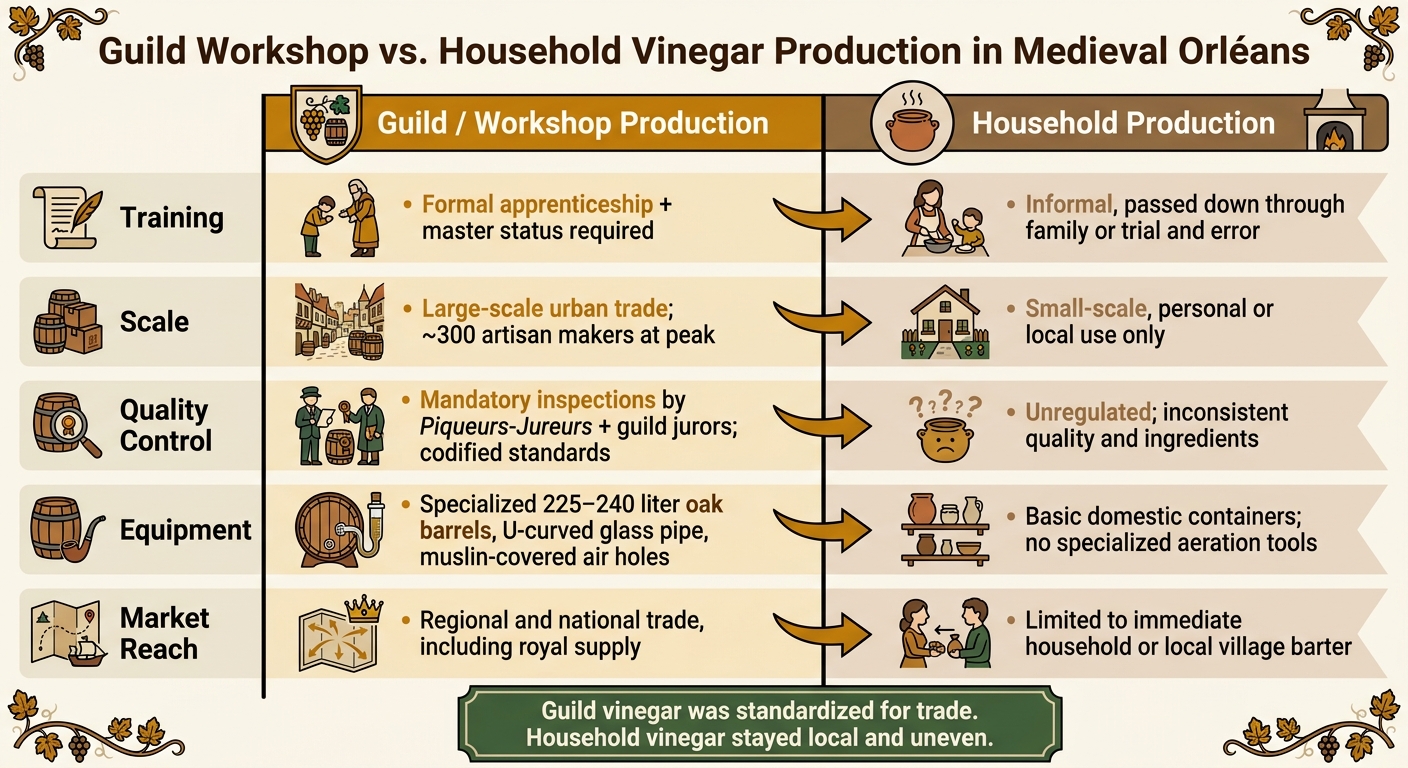
Medieval Guild vs. Household Vinegar Production: Orléans Method Compared
How guilds controlled who could make vinegar
In Orléans, guild rules kept vinegar-making inside a small, trained, licensed group. You couldn't just decide to make vinegar and sell it. Entry into the trade meant serving as an apprentice under a proven master, then spending years learning the craft before working on your own. To become a master, a candidate had to submit a masterwork and show they had enough money to run a workshop. For outsiders, the path was even harder: they faced higher membership fees and needed backing from an existing master.
Over time, many guilds became almost hereditary. Sons of current members had a clear edge, which helped keep the trade inside a narrow circle of families.
Guild oversight went beyond entry rules. Jurors could seize poor-quality goods or send them to charity. Members also weren't allowed to cut each other's prices, steal customers, or work at night or on holy days.
Those rules did two things at once: they kept skills inside the guild and helped protect product quality.
How medieval workshops turned alcohol into vinegar
Guild control shaped not only who could work, but also how vinegar was made batch by batch. One of the main skills was adding fresh wine without disturbing the mother. Workers used a special funnel with a U-curved glass pipe so wine could be added to the bottom of the barrel while the mother stayed floating on top. Muslin-covered air holes let oxygen in and kept vinegar flies out. Louis Pasteur described the danger plainly:
"The vinegar 'mother' must not be broken up when adding additional wine or the pieces will sink to the bottom of the barrel. The acetic acid bacteria contained in the mother will then be deprived of oxygen, die, rot, and ruin the vinegar."
Workshops usually left about 15% of the finished vinegar in the barrel to start the next cycle. Methods like these weren't picked up from a simple set of instructions. They came from years of hands-on work and were closely guarded as trade knowledge.
Guild production vs. household production
| Feature | Guild/Workshop Production | Household Production |
|---|---|---|
| Training | Formal apprenticeship and master status | Informal, passed down through family or trial and error |
| Scale | Large-scale urban trade supplying regional and national markets | Small-scale, intended for local or personal use |
| Quality Control | Mandatory inspections by Piqueurs-Jureurs and guild jurors; codified standards | Unregulated; inconsistent quality and ingredients |
| Equipment | Specialized 225-liter oak barrels, a U-curved glass pipe, and muslin-covered air holes | Basic domestic containers; no specialized aeration tools |
| Market Reach | Commercially viable for regional and national trade, including royal supply | Limited to immediate household or local village barter |
Guild vinegar was standardized for trade. Household vinegar stayed local and uneven.
That gap shaped the labor structure of the workshop economy.
Workshop labor and the artisan economy
Roles inside a vinegar workshop
That control rested on a clear workshop ladder. Each person had a set job, and each job helped keep the vinegar fit for sale.
| Role | Responsibilities | Quality-Related Duties |
|---|---|---|
| Master | Owned the workshop, tools, and raw materials; selected base wines and managed production cycles | Ensured the mother of vinegar was not disturbed during production |
| Journeyman | Drew off finished vinegar and cleaned barrels; moved between workshops | Monitored cellar conditions |
| Apprentice | Filled barrels, cleaned equipment, and helped add fresh wine | Learned to protect barrels from insects with muslin covers and avoid breaking the bacterial surface film |
| Piqueurs-Jureurs (Guild Inspectors) | Inspected incoming wine at the port and sorted it for vinegar use | Tested wine for spoilage to confirm it met production standards |
The setup was simple, but it worked. The master directed the shop and guarded the process. Journeymen handled much of the day-to-day work in the cellar. Apprentices did the hands-on tasks that kept barrels, tools, and fresh wine in order while learning the small habits that mattered. And the Piqueurs-Jureurs checked wine before it even entered production, which gave the trade one more layer of control.
How guild vinegar supported urban trade
These roles helped workshops produce vinegar at a steady pace for both Orléans's port trade and city households.
In Orléans, vinegar makers got their raw material straight from river commerce. Wine that had turned bitter on the trip from Burgundy and the Loire Valley to Paris was diverted at the city's port to vinegar workshops. That gave sour wine a second life instead of letting it go to waste.
Standard methods turned that spoiled shipment into a product people could count on. Buyers knew what they were getting, and local wine merchants had a ready outlet for wine that could no longer be sold as drinkable wine. At its peak, about 300 artisan vinegar makers worked in the city.
Household demand helped keep the trade steady. Guild rules supported that stability too: fixed prices limited undercutting, and shared production methods meant vinegar reached the market with a familiar level of quality.
This labor system also shaped the city's social life, not just its trade. Guilds funded support for elderly members, widows, and orphans, and widows could continue running a workshop unless they remarried.
Conclusion: What medieval guild vinegar production still shows us
Key takeaways from the case study
Orléans shows how guild rules, workshop labor, and production method worked as one system. The main point is simple: good vinegar depended on control - who was allowed to make it, how it was made, and how its quality was kept in check.
Training, oversight, and technique all pointed to the same outcome: dependable vinegar. At its height, Orléans led French vinegar production.
What made that system matter was this: it protected the process just as much as the finished product. Rules, training, and method backed each other up. Knowledge was passed down through apprenticeships, quality checks were handled with care, and slow surface fermentation stayed at the center of the craft. Modern research still backs the value of surface fermentation.
Medieval guild vinegar production shows how guarded know-how and strict standards can build lasting craft value.
FAQs
Why was Orléans ideal for vinegar making?
Orléans became a natural home for vinegar making in part because of where it sat on the Loire River. That location made it much easier to move wine in and out of the city, which mattered a lot for producers working at scale.
Over time, the city built its own way of doing things. Makers often used local, light, slightly acidic wines, and Orléans became known for slow, natural fermentation. That slower process helped keep more of the wine’s subtle character instead of stripping it away.
Why did guilds control vinegar production so closely?
Guilds kept a tight grip on vinegar production for a few simple reasons: quality, control, and profit.
They enforced quality standards, guarded trade secrets, and protected their hold over the craft. That control let them set prices, manage apprenticeships, and keep unregulated competitors out of the market.
In plain terms, guilds didn't just make vinegar. They controlled who could make it, how it was made, and who got to sell it.
How did the Orléans method improve vinegar quality?
The Orléans method improved vinegar quality by relying on a slow, natural surface fermentation process. That slower pace helped preserve the wine’s subtle flavors and protect the integrity of the vinegar mother.
The result was a high-quality, delicate vinegar.