

Mediterranean-Inspired Savory Muffins with Olive Oil
If you want savory muffins that stay moist for 2 to 3 days, olive oil is the key. I’d keep the formula simple: bake at 375°F for 18 to 22 minutes, use 2 cups flour, 2 eggs, 3/4 to 1 cup milk or buttermilk, 1/2 to 2/3 cup EVOO, and cap mix-ins at 1 to 1 1/2 cups for a 12-muffin batch.
Here’s the short version: these muffins work because the batter stays light, the salty add-ins stay in check, and the olive oil gives more taste than neutral oil. I’d use chopped olives, sun-dried tomatoes, herbs, and feta or Parmesan, fold them in at the end, and avoid overmixing.
What matters most:
- Use EVOO, not neutral oil, if you want more flavor
- Dry the olives and tomatoes well so the batter doesn’t get wet
- Keep added salt low, often around 1/4 teaspoon
- Fill cups 2/3 to 3/4 full
- Cool on a wire rack to avoid soggy bottoms
- Swap butter with olive oil at a 3:4 ratio
A few serving and storage points matter too. I’d serve them warm after 10 to 15 minutes of cooling, keep them at room temp for up to 2 days, chill extras for 3 to 4 days, or freeze for up to 3 months.
This article walks through the batter, the mix-ins, the butter swap, and the best ways to bake, store, and serve them without ending up with dense or salty muffins.
Savory Feta & Olive Muffins | Em’s Kitchen
sbb-itb-4066b8e
Choosing the Right Ingredients for Flavor and Texture
Balanced ingredients help these muffins stay light, savory, and nicely shaped.
Base Batter: Flour, Leavening, Eggs, Milk, and Olive Oil
The goal is simple: use a light batter and go easy on the add-ins so the muffins stay tender instead of turning heavy.
Start with 2 cups of all-purpose flour. That gives the crumb enough structure to hold olives and cheese without sinking or falling apart. Then add about 2 teaspoons of baking powder to help the muffins rise. For the wet side, use 2 large eggs, ¾ to 1 cup of milk or buttermilk, and about ½ to ⅔ cup of extra-virgin olive oil (EVOO).
If you want a softer crumb, buttermilk is a smart pick. Its acidity helps soften gluten, which can make the muffins feel a bit more tender. Add a little salt and black pepper, but don’t get heavy-handed with the salt if your mix-ins already bring plenty of briny flavor. For the olive oil, stick with a mild or medium EVOO so it supports the herbs and cheese instead of taking over. If using Big Horn Olive Oil, Estate Reserve Ultra Premium EVOO or Picual EVOO work well in this batter.
Mediterranean Mix-Ins: Olives, Sun-Dried Tomatoes, Herbs, and Cheese
This is where the muffins get their character.
Kalamata olives bring a briny, fruity depth. Black olives are softer in flavor and a bit earthier. Sun-dried tomatoes add a concentrated sweet-tart bite plus a chewy texture that plays well against the soft crumb. For herbs, oregano and thyme bring a savory, slightly woody base. Fresh basil gives a lighter, sweeter note. Dill adds a bright pop and pairs especially well with feta.
For cheese, crumbled feta makes little tangy pockets throughout each muffin. Finely grated Parmesan seasons the batter and can help build a savory top. Shredded mozzarella adds mild creaminess and soft, melty spots when served warm. Chop all mix-ins small - about ⅛ to ¼ inch - so they spread out well and stay suspended in the batter instead of dropping to the bottom.
How to Avoid Salty or Heavy Muffins
This part matters more than people think. Olives, feta, and sun-dried tomatoes already bring a lot of salt, so when you use all three, cut the added salt in the dry ingredients to about ¼ teaspoon.
A little prep helps, too:
- Drain olives in a colander, then pat them dry with paper towels.
- If you're using oil-packed sun-dried tomatoes, blot each piece on all sides until only a light sheen is left.
- Keep your total mix-ins to around 1 to 1½ cups combined for a standard 12-muffin batch.
Go past that range and the batter starts to feel crowded. The muffins may not rise well, and the centers can stay wet. You want mix-ins in every bite, sure, but the batter still needs to do the heavy lifting.
Once your ingredients are in balance, mix the batter lightly and bake just until set.
Step-by-Step Method for Baking Savory Muffins
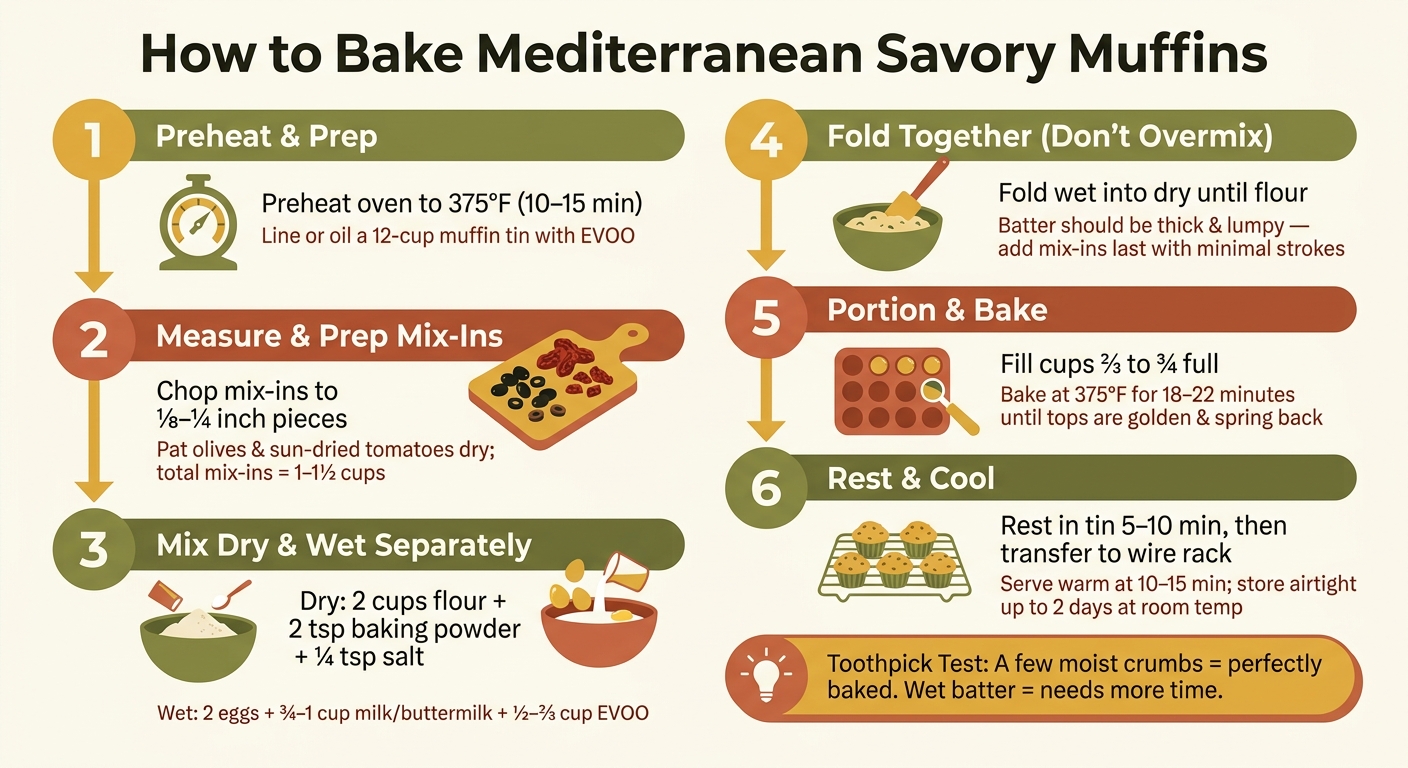
How to Make Mediterranean Olive Oil Muffins: Step-by-Step Baking Guide
Prep the Pan, Preheat the Oven, and Measure Everything First
Set your oven to 375°F and let it heat for at least 10–15 minutes before the batter goes in. If your oven tends to run hot or cool, use a low-cost oven thermometer to check the actual temperature. While the oven heats, get your 12-cup muffin tin ready. Line each cup with a paper liner, or lightly brush each well with olive oil so the muffins release easily and pick up a subtle Mediterranean note.
Before you start mixing, measure and prep all your add-ins. That means having the olives, sun-dried tomatoes, feta, and herbs ready to go. Once the pan is set, move straight into mixing so the batter stays light.
Mix Wet and Dry Ingredients Separately, Then Fold Gently
Whisk the dry ingredients until they’re evenly mixed. In a separate bowl, whisk the wet ingredients until smooth. Then fold the wet mixture into the dry mixture just until the flour disappears.
The batter should look thick and a little lumpy. That’s a good sign. If it turns smooth, you’ve probably mixed too much, and that can leave you with tough, dense muffins. Add the olives, sun-dried tomatoes, feta, and herbs at the very end, and use as few strokes as you can while still spreading them through the batter.
Portion, Bake, and Cool
As soon as the batter is mixed, portion it right away. Use a standard ice cream scoop or a ¼-cup measure to fill each muffin cup about two-thirds to three-quarters full. Try to make sure each cup gets a visible mix of olives, tomatoes, and cheese, so every muffin has balanced flavor.
Bake at 375°F for 18–22 minutes. Still, don’t rely on the clock alone. Look for tops that are light to medium golden brown, set, and matte. When you lightly press the center, it should spring back. A toothpick inserted in the middle should come out mostly clean, with a few moist crumbs.
When the muffins pass those checks, take the pan out and let them rest in the tin for 5–10 minutes. The edges should pull away a bit as they finish setting. Then move them to a wire rack to cool. That step matters because cooling on a rack helps prevent soggy bottoms.
If you want to swap the fat, use the olive oil conversion guide below.
How to Use Olive Oil Instead of Butter in Savory Muffins
If you want to swap butter for olive oil, use a simple volume rule. Butter has water and milk solids. Olive oil is almost all fat, so you need a bit less of it.
The 3:4 Butter-to-Olive-Oil Conversion Rule
Here’s the rule: use three-quarters as much olive oil as butter by volume. In a U.S. kitchen, that looks like this:
- 1 cup butter → 3/4 cup olive oil
- 1/2 cup butter → 6 tablespoons olive oil
- 1/4 cup butter → 3 tablespoons olive oil
- 1 tablespoon butter → about 2 1/4 teaspoons olive oil
If your batter feels stiff or a little hard to mix, add 1 to 2 tablespoons of milk.
How Olive Oil Changes Texture, Moisture, and Flavor
This swap changes both texture and taste.
Olive oil gives muffins a softer, more tender crumb because it stays liquid as the muffins cool. Butter firms up. That difference matters even more the next day. On day two or three, olive oil slows staling, so the muffins tend to stay moist and pleasant to eat longer than butter-based ones.
Flavor shifts too. Butter brings mild, creamy dairy notes. A fresh harvest extra virgin olive oil adds fruity, herbal, and at times lightly peppery flavor. For savory muffins, a mild to medium EVOO usually works best. It supports herbs and cheese instead of taking over the whole bite.
Olive Oil vs. Butter in Savory Muffins: Side-by-Side Comparison
| Feature | Extra Virgin Olive Oil (EVOO) | Butter |
|---|---|---|
| Flavor profile | Fruity, herbal, lightly peppery; pairs well with Mediterranean ingredients | Mild, creamy, slightly sweet; classic flavor |
| Crumb texture | Tender, soft, slightly more open crumb | Firmer, more structured bite |
| Moisture level | Stays moist longer, especially over 2–3 days | Can dry out faster after storage |
With the fat swap set, the next step is picking the olive, herb, and cheese mix that matches the kind of muffin you want.
Flavor Variations, Serving Ideas, and Storage
Once the olive-oil batter is ready, the mix-ins shape the whole mood of the muffin. These three combos all start with the same base batter, so you can change the flavor without changing the method. Keep total mix-ins between 1 and 1½ cups per 12-muffin batch so the muffins stay light instead of turning heavy. Pat olives and sun-dried tomatoes dry before folding them in, and season the batter lightly.
| Variation | Key Mix-Ins | Flavor Profile | Best Use |
|---|---|---|---|
| Olive and Tomato | ¾ cup chopped Kalamata or mixed olives + ½ cup sun-dried tomatoes, patted dry | Savory, tangy, slightly smoky | Brunch side, snack, or salad pairing |
| Feta and Herb | ½–¾ cup crumbled feta + ¼–½ cup chopped fresh parsley, dill, basil, and oregano | Bright, herbal, creamy | Brunch or light lunch |
| Antipasto Style | ½ cup chopped salami or prosciutto + ½ cup marinated artichoke hearts + ½ cup roasted red peppers and/or olives | Complex, bold, hearty | Party appetizer |
A few small tweaks help each version land where you want it. For Antipasto Style, add 1–2 extra tablespoons of EVOO for a richer crumb. Use a mild, fruity EVOO for Feta and Herb. A medium-intensity EVOO fits Olive and Tomato, while a stronger EVOO can hold its own against the cured meats and marinated vegetables in the Antipasto version.
How to Serve Them Warm or at Room Temperature
After baking, timing changes the texture quite a bit. If you serve the muffins warm, about 10–15 minutes after baking, the crumb stays softer and the olive oil aroma comes through more clearly. That’s a great window if you’re serving them with scrambled eggs, a frittata, shakshuka, or a bowl of tomato, vegetable, or lentil soup.
The pairings can be simple, and that’s part of the charm. Olive and Tomato goes especially well with a green salad dressed with lemon and EVOO. Feta and Herb fits nicely next to a Greek-inspired salad or chickpea or lentil soup.
At room temperature, these muffins hold up well on a brunch spread or buffet table. Antipasto Style is the one that feels most like a stand-alone appetizer. If you want a little extra punch, add a small drizzle of high-quality balsamic vinegar - about ½ teaspoon per muffin. It gives a sweet-tart finish without making the crumb soggy.
How to Store, Refrigerate, and Reheat Without Drying Them Out
Storage depends mostly on how soon you plan to serve them. First, let the muffins cool completely on a wire rack. If they’re still warm when stored, trapped steam can soften the tops and make the texture a bit gummy.
For short-term storage, keep them at room temperature in an airtight container lined with a paper towel for up to 2 days. Since these muffins may contain cheese and cured meats, move any extras to the fridge after that. In the refrigerator, well-wrapped muffins keep for 3–4 days.
To reheat refrigerated muffins, let them sit at room temperature for 10–15 minutes first. Then warm them in a 300°F–325°F oven for 8–10 minutes, loosely covered with foil. That gentle heat helps warm the center without drying out the edges.
If you want to freeze them, wrap each muffin individually. They’ll keep for up to 3 months. Thaw them overnight in the refrigerator, then reheat at the same oven temperature for 10–15 minutes.
FAQs
Can I make these muffins ahead?
Yes. These Mediterranean-inspired savory muffins are a good make-ahead option, and the olive oil helps them stay moist while they sit.
Let them cool completely first. Then place them in an airtight container. They’ll keep at room temperature for 2 days, or you can freeze them if you want them to last longer.
Which olives work best in the batter?
Kalamata olives are a great pick if you want a bold, fruity flavor. If you'd rather go with something milder and more buttery, Castelvetrano olives are an especially good fit.
Both bring a clear Mediterranean feel to savory muffins, especially when paired with a rich extra virgin olive oil from Big Horn Olive Oil.
Why did my savory muffins turn out dense?
Your savory muffins may have come out dense because you used butter instead of extra virgin olive oil. Butter tends to make the crumb heavier. Olive oil, on the other hand, helps muffins stay lighter, more tender, and moist.
For the best texture, swap in olive oil at a 3:4 ratio. That means 3 parts olive oil for every 4 parts butter.
If you want the swap to work well, use a high-quality EVOO like Big Horn Olive Oil.