

5 Methods for Microbiological Profiling in Olive Oil
Microbiological profiling in olive oil helps identify bacteria, yeasts, and fungi that affect flavor, safety, and quality. Producers use this analysis to ensure their oil meets high standards and remains safe for consumption. Here's a quick overview of five key methods:
- Endpoint PCR: Identifies and groups microorganisms through DNA fingerprinting. Requires enrichment for higher sensitivity but is moderately fast and precise.
- Real-Time PCR (RT-PCR): Tracks DNA amplification live, offering faster results and higher accuracy for detecting microbes in olive oil.
- LAMP: A rapid and simple method for detecting olive oil DNA and verifying purity, needing minimal equipment.
- Next-Generation Sequencing (NGS): Provides an in-depth microbial profile, identifying rare species but requires advanced equipment and is costlier.
- Culture-Based Methods: Confirms live microbial presence using nutrient media but is slower and less sensitive than molecular techniques.
Each method has its strengths and limitations, making a combination ideal for thorough testing. Producers like Big Horn Olive Oil rely on these techniques to maintain quality and safety.
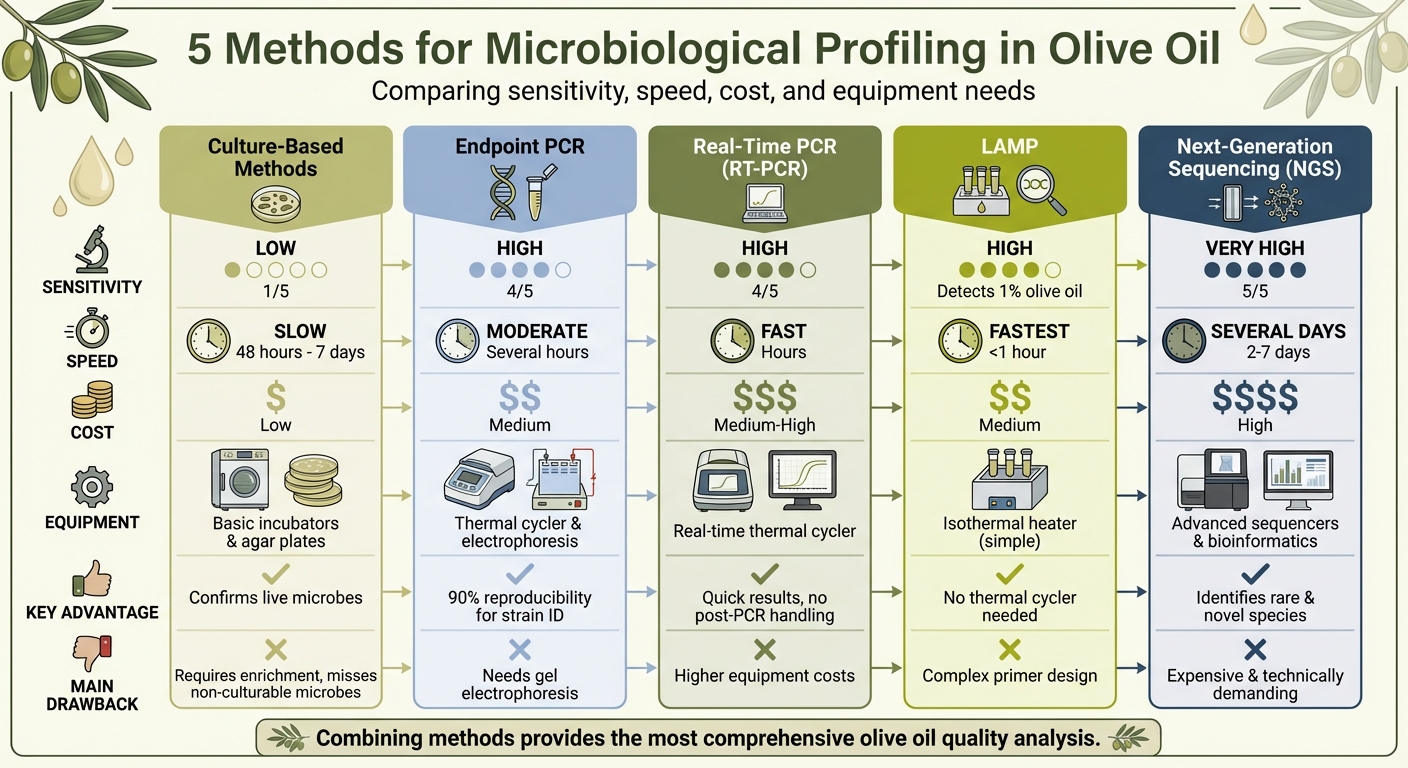
Comparison of 5 Microbiological Profiling Methods for Olive Oil Testing
1. Endpoint PCR
Endpoint PCR is a molecular technique used to identify and categorize bacterial and fungal species in olive oil, following prior culture isolation. By amplifying specific DNA fragments, this method creates a genetic "fingerprint" unique to each microorganism. Researchers often use RAPD-PCR and REP-PCR to group similar strains, which helps reduce sequencing costs.
In January 2020, researchers from the University of Sassari analyzed 15 Italian olive varieties, including well-known types like Frantoio and Coratina, to study bacterial diversity. Using RAPD-PCR with the M13 primer and REP-PCR with the (GTG)5 primer, they genotyped 72 isolates. They then applied 16S rDNA PCR to identify species such as Bacillus amyloliquefaciens, Brevibacillus agri, and Lactobacillus rhamnosus. By clustering the 72 isolates into 36 distinct groups based on a 90% reproducibility threshold for electrophoresis patterns, they managed to cut sequencing costs by approximately 50%.
Sensitivity
Sensitivity is a key factor in DNA fingerprinting. While the technique itself is highly sensitive, olive oil's antimicrobial compounds can lower microbial populations below detectable levels. As a result, direct PCR detection from olive oil is nearly impossible without first enriching the sample. To address this, producers mix olive oil with a nutrient broth like YEPD and incubate it for 24 hours. This enrichment step increases bacterial counts to around 5 × 10³ CFU/mL, making detection feasible.
Speed
Once sensitivity challenges are resolved, the process follows a defined timeline. After a 24-hour enrichment period, samples are cultured overnight for DNA isolation. PCR amplification and electrophoresis take several additional hours. While not the quickest method available, this approach allows for detailed strain differentiation and accurate identification.
Equipment Needs
The successful application of this method relies on specialized equipment for DNA amplification and analysis. Essential tools include a thermal cycler for DNA amplification and gel electrophoresis systems (tanks, power supplies, and imaging tools) to visualize DNA banding patterns. DNA purification kits like QIAquick are needed to prepare samples for sequencing. Specific primers, such as M13, (GTG)5, and universal 16S rDNA primers (W001 and W002), are critical for the amplification process. Additionally, software like InfoQuest is used to analyze banding patterns, helping identify genetically similar isolates and reducing the number of strains requiring expensive sequencing.
sbb-itb-4066b8e
2. Real-Time PCR (RT-PCR)
Real-Time PCR (qRT-PCR) tracks DNA amplification as it happens, making it an excellent tool for analyzing olive oil. This live monitoring feature is especially helpful in overcoming challenges posed by olive oil's antimicrobial compounds, which can suppress microbial populations. By allowing researchers to quickly assess and eliminate underperforming primers, RT-PCR enhances the efficiency of detection methods.
Sensitivity
RT-PCR's effectiveness in olive oil analysis hinges on optimizing the size of the DNA fragments being amplified. Smaller fragments, such as an 80 bp amplicon, are more likely to succeed compared to larger ones like 200 bp. This is because smaller fragments generate more target molecules, improving the chances of detection in olive oil's complex environment. As highlighted by researchers from Digital.CSIC:
The amplicon size should be optimised for olive oil authentication since the higher the number of templates the greater the probability of successful amplification.
This optimization tackles a key issue: olive oil's antimicrobial properties often reduce microbial populations to levels that are hard to detect.
Speed
One of RT-PCR's biggest advantages is how much faster it is compared to traditional methods. Culture-based techniques can take days - requiring a 24-hour enrichment phase followed by 48 hours to a week of plate growth. In contrast, RT-PCR bypasses these steps by directly detecting DNA, even from bacteria that are non-culturable or inhibited. As noted by Digital.CSIC:
qRT-PCR was an efficient tool in assessing primer efficiency to promptly discard low-performing options.
Equipment Needs
To perform RT-PCR, specialized equipment is essential. A real-time thermal cycler with optical sensors is required to monitor DNA amplification in real time. Additionally, DNA extraction and purification systems, like QIAquick kits, are crucial for maintaining sample quality. Analysis software plays a key role in interpreting cycle threshold (Ct) values and evaluating PCR efficiency. For optimal results in olive oil matrices, the equipment must effectively detect small amplicons (~80 bp).
3. Loop-Mediated Isothermal Amplification (LAMP)
When it comes to verifying olive oil authenticity, LAMP offers a fast and reliable alternative to PCR-based methods. Building on the principles of PCR, LAMP simplifies the process of detecting olive oil DNA to confirm authenticity and identify adulteration. Unlike PCR, it operates at a constant temperature, targeting specific genes like the oleosin gene unique to Olea europaea. This method stands out for its efficiency, precision, and minimal equipment needs.
Sensitivity
LAMP can detect as little as 1 ng of genomic DNA and authenticate samples containing just 1% olive oil. Its ability to work even with degraded DNA or in the presence of inhibitors makes it particularly effective for processed oils. In cases where conventional PCR might fail, LAMP remains dependable.
Speed
One of LAMP's major advantages is its speed. The entire process takes less than an hour, a stark contrast to traditional culture-based methods that require a 24-hour enrichment phase followed by up to seven days of incubation. This quick turnaround makes it ideal for routine testing and rapid decision-making in food labs.
Equipment Needs
LAMP's simplicity is another key benefit. Unlike PCR, which requires a costly thermal cycler, LAMP only needs a stable heat source - like a water bath or heat block - to maintain a constant temperature of 62 °C (143.6 °F). As Shyang-Chwen Sheu and colleagues from the Department of Food Science at National Pingtung University of Science and Technology explain:
"The established LAMP assay with specificity could not only be capable for rapid identification but also applicable for olive oil authentication for precluding adulteration in plant oil products."
This straightforward setup makes LAMP a practical and accessible tool for ensuring quality in olive oil production. High-end producers such as Big Horn Olive Oil rely on advanced techniques like LAMP to guarantee the purity and authenticity of their extra virgin olive oil.
4. Next-Generation Sequencing (NGS)
NGS offers a thorough microbial profile of olive oil. Unlike methods that focus on specific DNA sequences, NGS examines the entire microbial community within a sample, identifying both the presence and abundance of various species.
Sensitivity
NGS shines where traditional approaches often struggle. The antimicrobial properties of olive oil create a tough environment for microbial growth, making it difficult for standard detection methods to identify microorganisms, which are often present in very low concentrations. By directly sequencing DNA, NGS bypasses these challenges, providing a more accurate and sensitive analysis.
Equipment Needs
The equipment required for NGS depends on the lab's resources and strategy. Many labs choose to use external services like Macrogen, which allows researchers to access detailed genetic data without the need to invest heavily in their own sequencing equipment. This approach is particularly useful when combining NGS with other methods, such as culture-based techniques, which will be discussed later.
Speed
NGS typically takes several days, from sample preparation to sequencing and data analysis. While traditional methods also require about 2–7 days, NGS delivers a much more detailed microbial profile, making it especially valuable for research and quality control. For high-end products like those from Big Horn Olive Oil, this level of detail can be crucial for ensuring quality. The insights provided by NGS help lay the groundwork for culture-based methods, which will be explored in the next section.
5. Culture-Based Methods
Culture-based methods are essential for confirming the viability of microorganisms in olive oil. Unlike molecular techniques, which detect DNA from both living and dead cells, these methods specifically verify the presence of live organisms.
Sensitivity
Olive oil's natural antimicrobial properties pose a substantial challenge for standard culture methods. According to the MDPI Microorganisms Journal:
"The microorganisms in olive oil are often below the limits of detection with standard culture methods due to the strong selective pressure exerted by the oil's antimicrobial compounds and the fact that the oil's fatty acids constitute the sole source of carbon and energy for any microbial contaminates".
To address this, labs incorporate an enrichment step. This involves mixing 10 mL of olive oil with 90 mL of nutrient broth (like YEPD) and incubating it at 82.4°F (28°C) with agitation for 24 hours. This process increases microbial levels to detectable thresholds. Without this step, filtered extra virgin olive oil often shows microbial counts as low as 0.38 to 0.82 log CFU/mL.
Speed
One major drawback of culture-based methods is their slower turnaround time. The enrichment process alone takes 24 hours, and additional incubation steps mean results typically require 3 to 7 days or more. For example, culturing lactic acid bacteria on MRS agar takes 48–72 hours at 86°F (30°C) under both aerobic and anaerobic conditions.
Equipment Needs
The equipment required for culture-based methods is basic and widely available. Laboratories need incubators capable of maintaining temperatures between 41°F and 113°F (5°C to 45°C) to handle different bacterial types. Shaking platforms or orbital shakers are essential for the enrichment phase, while anaerobic chambers or jars (like AnaeroGen systems) are used for culturing lactic acid bacteria.
Specific media types are used depending on the microorganism being tested:
- PCA: General bacteria
- MRS: Lactic acid bacteria
- YEPD or WL agar: Yeasts and fungi
This straightforward setup is sufficient for quality-focused producers, such as Big Horn Olive Oil, to verify microbial viability and authenticity without the need for costly sequencing equipment. It complements molecular profiles by providing concrete evidence of live microbial presence.
Cost
Culture-based methods are among the most budget-friendly options for microbiological analysis. They rely on affordable, dehydrated media like PCA, MRS, and Brain Heart Infusion (BHI) instead of expensive sequencing reagents or specialized molecular kits. While the process is more time-consuming, the lower costs make it ideal for routine quality control and for validating faster molecular methods.
Comparison Table
When choosing a method for microbiological profiling - essential for verifying olive oil authenticity - it’s important to weigh factors like sensitivity, speed, cost, and equipment needs. These factors, covered earlier, are summarized here to support informed decision-making. Each method has its own strengths, depending on lab resources and testing goals.
Here’s a breakdown of the key features of the methods discussed:
| Method | Sensitivity | Speed | Cost | Equipment | Key Advantages | Main Drawbacks |
|---|---|---|---|---|---|---|
| Culture-Based | Low sensitivity due to detection limits | Slow (48 hours to 7 days) | Low | Basic incubators and agar plates | Simple and affordable; confirms microbial viability | May overlook non-culturable microbes and requires enrichment |
| Endpoint PCR | High | Moderate (hours) | Medium | Thermal cycler and electrophoresis | 90% reproducibility for strain-level identification | Needs additional gel electrophoresis processing |
| RT-PCR | High | Fast | Medium-High | Real-time thermal cycler | Quick results without post-PCR handling | Higher initial equipment costs |
| LAMP | High | Fastest | Medium | Isothermal heater | Rapid detection without requiring a thermal cycler | Complex primer design required |
| NGS | Very High | Several days | High | Advanced sequencers and bioinformatics tools | Identifies rare and novel species with precision | Expensive and technically demanding |
For producers focused on quality, like Big Horn Olive Oil, a combination of culture-based methods and molecular techniques can strike the right balance. This approach confirms the presence of live microbes while providing the sensitivity needed for detailed profiling. This table offers a clear guide to help producers select the method that aligns with their priorities.
Conclusion
Microbiological profiling plays a key role in ensuring the quality and safety of premium olive oil. These testing methods not only identify microbial presence but also uncover how yeasts and bacteria impact the oil's flavor, shelf life, and overall integrity. As highlighted by Francesco Fancello and his team at the University of Sassari, microbial activity has a direct effect on the oil's physicochemical and sensory properties. This makes profiling an essential tool for both safety and quality assurance, helping producers set their oils apart.
For producers like Big Horn Olive Oil, known for its Ultra Premium Extra Virgin Olive Oils that prioritize freshness and internationally recognized standards, microbiological profiling reinforces their dedication to quality. Detecting harmful microbes ensures that each bottle maintains its intended flavor and health benefits. At the same time, identifying beneficial strains, such as Lactobacillus rhamnosus and Bacillus subtilis, opens doors to enhancing the oil's probiotic value. These thorough tests also help mitigate risks from contaminants, including those introduced during manual harvesting.
Techniques like PCR-based tests and Next-Generation Sequencing work together to verify the oil's authenticity and build trust in its quality. As Francesco Fancello and his colleagues concluded:
The results obtained underline that microbial diversity of extra virgin olive oils represents an unexpected sink of microbial diversity and poses safety issues on the possible biotechnological exploitation.
Understanding microbiological profiling empowers producers to make informed decisions about maintaining premium standards. By leveraging advanced testing methods, producers ensure that every bottle meets Ultra Premium expectations, offering both authenticity and quality to consumers.
FAQs
Which test is best for routine quality control versus deep microbial profiling?
When it comes to routine quality control, culture-based methods are often the go-to option. Their appeal lies in their speed, simplicity, and effectiveness at identifying viable microorganisms that could affect product stability. These methods are straightforward and reliable for ensuring consistent quality standards.
On the other hand, advanced techniques like DNA sequencing, such as 16S rRNA analysis, offer a deeper dive into microbial diversity and functionality. These approaches provide a wealth of detailed information, making them ideal for research purposes or comprehensive analysis. However, they are generally not practical for routine quality checks due to their complexity and resource requirements.
Do these methods detect live microbes or just microbial DNA?
These methods focus on detecting microbial DNA, indicating the presence of microbes. However, they cannot determine if the microbes are active or inactive.
How do labs overcome olive oil inhibitors that can block microbial detection?
Labs tackle the challenge of inhibitors in olive oil by employing culture-based methods and DNA sequencing techniques. These strategies work to bypass or neutralize substances that hinder microbial detection, allowing for precise identification of microorganisms.