

How Modena Protects Balsamic Vinegar Quality
Balsamic vinegar from Modena stands out due to strict production rules, historical methods, and regional certifications. Here's what you need to know:
- Two Certifications: Protected Geographical Indication (PGI) and Protected Designation of Origin (PDO) ensure quality and origin. PGI allows slightly broader production rules, while PDO is more restrictive.
- Aging Process: PGI vinegar ages at least 60 days, while PDO requires a minimum of 12 years, with some products aging 25+ years.
- Ingredients: PGI uses a mix of grape must, wine vinegar, and up to 2% caramel for color. PDO is 100% cooked grape must, with no additives.
- Wood Barrels: Aging occurs in barrels made from woods like oak and cherry, which influence flavor.
- Certification Oversight: Independent bodies verify compliance with production standards.
The Consortium for the Protection of Balsamic Vinegar of Modena ensures these standards are upheld, safeguarding the product's legacy and market integrity. Look for official PGI or PDO seals when buying.
Production Area and Raw Material Requirements
Where Production Is Allowed
For vinegar to carry the PDO label, every stage of production - from growing grapes to bottling - must happen exclusively in Modena. This strict territorial requirement ensures the authenticity of the product. On the other hand, Balsamic Vinegar of Modena with the PGI designation has a slightly broader production zone. For PGI vinegar, key processes like sourcing raw materials, refining, aging in wooden barrels, and processing must occur within the provinces of Modena and Reggio Emilia. However, unlike PDO vinegar, bottling for PGI vinegar is permitted outside these areas. Both certifications enforce specific raw material standards to maintain quality.
Raw Material Standards
PDO vinegar relies on seven specific grape varieties: Lambrusco, Ancellotta, Trebbiano, Sauvignon, Sgavetta, Berzemino, and Occhio di Gatta. These grapes must meet a minimum saccharometer reading of 15° and yield no more than 16 tonnes per hectare. Additionally, the must is cooked over an open flame at a temperature of at least 176°F (80°C) for no less than 30 minutes.
PGI vinegar, in contrast, uses a different set of seven grape varieties: Lambrusco, Sangiovese, Trebbiano, Albana, Ancellotta, Fortana, and Montuni. For PGI production, the cooked or concentrated must must reach a minimum density of 1.240 at 68°F (20°C) and include at least 55 g/kg of net dry extract. The finished PGI product must have a total acidity of at least 6%, which is higher than the 4.5° required for PDO vinegar. One key distinction is that PGI regulations permit the addition of up to 2% caramel (E150d) for color consistency - a practice strictly forbidden in PDO production.
What Do Balsamic Vinegar Of Modena Certifications Mean? - Story Of Italy
Composition and Minimum Standards
Modena's balsamic vinegar adheres to stringent composition standards, ensuring its authenticity and high quality.
Ingredient Requirements and Proportions
The recipe for Balsamic Vinegar of Modena PGI is designed to preserve tradition and consistency. It must contain at least 20% cooked or concentrated grape must and a minimum of 10% wine vinegar, which must be produced exclusively through acetification. Additionally, the blend must include vinegar that has been aged for at least 10 years.
One optional ingredient - caramel (E150d) - is allowed, but only to stabilize color and in amounts not exceeding 2%. The final product must meet specific chemical standards, including:
- Minimum total acidity: 6%
- Density: At least 1.06 (measured at 68°F/20°C)
- Reducing sugars: At least 110 g/l
- Alcoholic strength: No more than 1.5% by volume
- Total sulfur dioxide: Capped at 100 mg/l
These carefully defined formulations set PGI balsamic vinegar apart from its PDO (Protected Designation of Origin) counterpart.
Banned Additives and Methods
Strict ingredient regulations protect the integrity of the vinegar. Any substances not explicitly listed are prohibited. For both PGI and PDO products, thickeners and added sugars are strictly forbidden. While PGI production allows the limited use of caramel, Traditional Balsamic Vinegar of Modena (PDO) does not permit any additives at all.
"It is forbidden the addition of any other substance [other than must, wine vinegar, and caramel]."
- Art. 5, PGI Production Regulation
Labeling rules are equally strict. Terms such as "extra", "fine", "selected", "superior", or "classic" are not allowed on bottles of either PGI or PDO balsamic vinegar. For PDO products, even transferring the must or intermediate products outside the Modena province results in a permanent loss of the Protected Designation of Origin status.
Aging and Classification Process
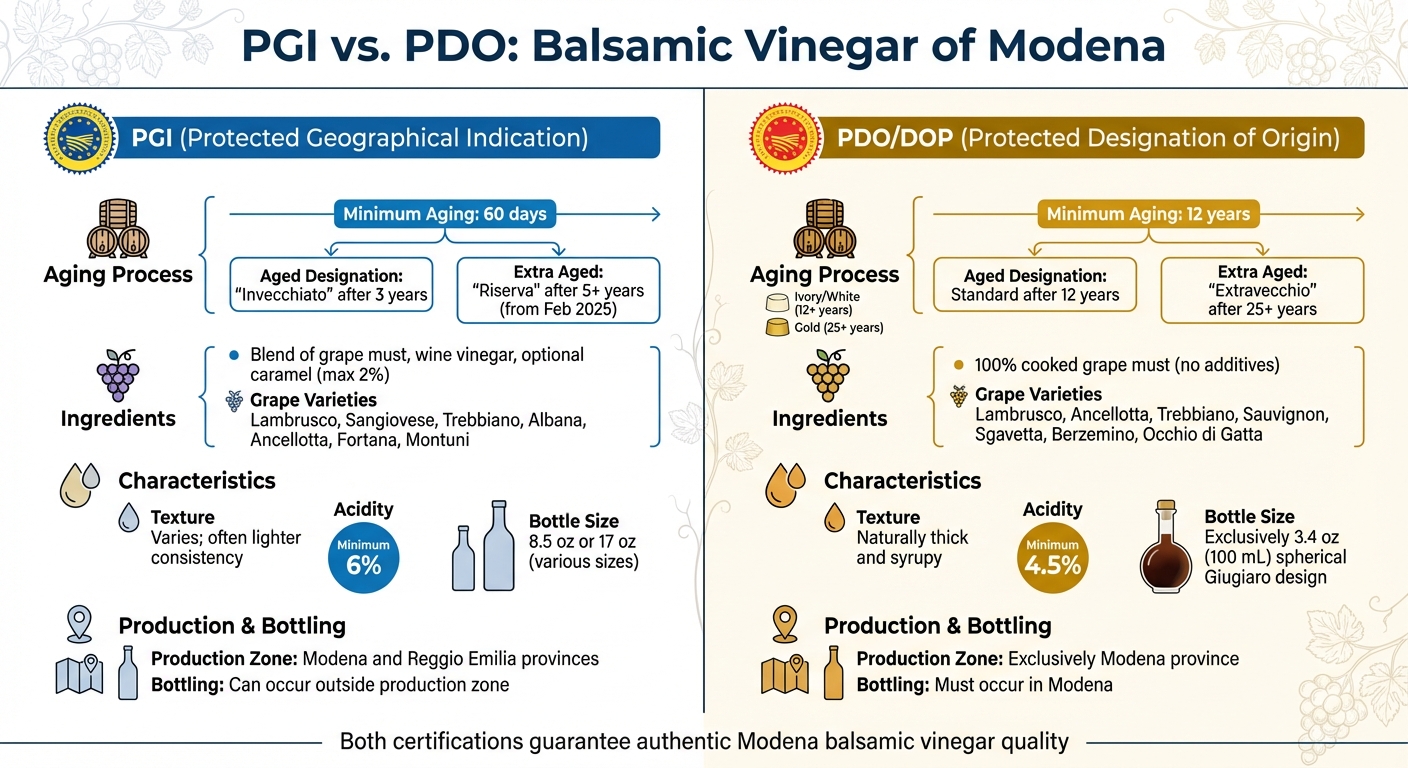
PGI vs PDO Balsamic Vinegar of Modena Comparison Chart
The aging and classification process plays a vital role in defining the character and quality of Modena's balsamic vinegars, adhering to strict production standards.
Minimum Aging Requirements
The aging process is a key factor that sets Modena's protected balsamic vinegars apart. For PGI balsamic vinegar, the minimum aging period is 60 days in wooden containers, ensuring it meets rigorous quality criteria. If aged for three years or more, PGI vinegar earns the designation of "invecchiato" (aged).
On the other hand, Traditional Balsamic Vinegar of Modena DOP requires a minimum aging period of 12 years. Products that age for 25 years or longer are labeled as "extravecchio" (extra aged). This extended aging process is transformative - approximately 18 gallons of must reduce to less than one gallon due to evaporation over time.
These aging standards highlight the clear differences between the PGI and DOP classifications.
DOP vs. PGI Classifications
The DOP classification emphasizes traditional methods, resulting in a flavor and texture that are unparalleled. The differences between DOP and PGI extend beyond aging, encompassing ingredients, production techniques, and the final product's characteristics. For instance, Traditional Balsamic Vinegar of Modena DOP is crafted exclusively from 100% cooked grape must, with no additives. This distinction significantly impacts its texture and flavor profile.
Here's a comparison table that outlines the major differences between PGI and DOP balsamic vinegars:
| Feature | Balsamic Vinegar of Modena PGI | Traditional Balsamic Vinegar of Modena DOP |
|---|---|---|
| Minimum Aging | 60 days | 12 years |
| "Aged" Designation | "Invecchiato" (after 3 years) | "Extravecchio" (after 25 years) |
| Ingredients | Blend of grape must, wine vinegar, optional caramel | 100% cooked grape must |
| Texture | Varies; often lighter in consistency | Naturally thick and syrupy |
| Bottle Size | Available in 8.5 oz or 17 oz sizes | Exclusively 3.4 oz, with a unique spherical design and rectangular base |
For DOP vinegars, the aging process takes place in a batteria - a series of at least three barrels of decreasing size, often made from woods like oak, chestnut, and cherry. Over time, the vinegar is transferred between barrels, allowing it to absorb distinct aromatic notes from each type of wood. In contrast, PGI production involves a simpler process, with no elaborate barrel transfers.
Even the bottle caps of DOP vinegars offer clues about their age. An ivory or white cap typically indicates a product aged for at least 12 years, while a gold cap signifies an "extravecchio" vinegar aged 25 years or more. This attention to detail underscores the heritage and craftsmanship behind Modena's balsamic vinegars.
sbb-itb-4066b8e
Certification and Quality Control Procedures
Rooted in centuries of tradition, Modena's certification process ensures that every bottle reflects its historical legacy. This rigorous system is overseen by the Italian Ministry of Agriculture, Food Sovereignty, and Forests (MASAF), while the Central Inspectorate for Quality Protection and Fraud Prevention (ICQRF) manages daily compliance. For Balsamic Vinegar of Modena PGI, the independent control body CSQA Certificazioni S.r.l. is responsible for certification.
Inspection and Approval Steps
The certification process involves a combination of analytical tests and sensory evaluations. Analytical tests focus on chemical standards, while sensory evaluations are carried out by trained tasters who assess key attributes like color, texture, aroma, and flavor. Each batch must meet the chemical requirements specific to DOP and PGI vinegars.
Trained tasters evaluate the vinegar for its deep brown, glossy appearance, syrup-like consistency, complex aroma, and harmonious sweet-and-sour flavor profile. Detailed production records are maintained to ensure complete traceability.
"The evaluation of the analytical and organoleptic characteristics of the designation is performed, at the request of the interested parties, on all batches before the product is marketed for consumption."
Product Specifications for Traditional Balsamic Vinegar of Modena
Once a batch passes inspection, each Traditional DOP bottle is sealed with a numbered, tamper-evident seal that must be broken to open the bottle, safeguarding against tampering. These rigorous measures guarantee clear identification and uphold the product's authenticity.
How to Identify Certified Products
Certified balsamic vinegar comes with distinct visual markers that preserve its quality and heritage. Traditional Balsamic Vinegar of Modena DOP is easily recognized by the yellow and red European Union PDO (or D.O.P.) logo. It is exclusively sold in a 100 mL (3.4 fl oz) spherical glass bottle with a rectangular base, designed by Giugiaro, and features a numbered, tamper-proof seal over the cap.
Balsamic Vinegar of Modena PGI, on the other hand, carries the blue and yellow European Union PGI (or I.G.P.) logo and is available in a variety of bottle sizes and materials. Starting February 2025, a new "Riserva" designation will be introduced for PGI products aged over five years. Consumers should be wary of bottles using terms like "extra", "fine", or "superior", as these are not permitted on certified labels unless regulated terms like "Extravecchio" (for DOP aged 25+ years) or "Aged" (for PGI aged 3+ years) are used.
Role of the Consortium for Protection
Behind every bottle of certified balsamic vinegar from Modena lies a dedicated organization working tirelessly to uphold its authenticity. The Consortium for the Protection of Balsamic Vinegar of Modena represents 50 companies within the production chain, serving as the key defender of this centuries-old tradition. Let’s explore how the Consortium educates consumers and ensures compliance.
Education and Advocacy Efforts
The Consortium goes beyond Modena’s borders to educate consumers and safeguard the reputation of balsamic vinegar on a global scale. Through trade fairs, media campaigns, and educational events, they highlight what sets authentic balsamic vinegar apart. To simplify the buying process for consumers, the Consortium introduced a practical labeling system. This system uses five segments (1–5) to describe the vinegar's profile, ranging from tangy (agro) to sweet (dolce), based on its density and dry extract content.
Their work isn’t just about education - it’s about preserving the cultural identity and heritage tied to the Modena region. By protecting this legacy, the Consortium also strengthens the product’s presence in international markets.
A significant part of their advocacy involves combating imitations and counterfeits that could harm the integrity of the balsamic vinegar brand. They actively monitor global markets and emphasize the importance of the "MODENA" name on labels, reinforcing the connection between the product and its geographical roots.
While education plays a vital role, the Consortium also takes compliance seriously to ensure Modena's heritage remains intact.
Compliance Monitoring and Enforcement
To maintain the high standards of balsamic vinegar production, the Consortium collaborates with independent supervisory bodies like CSQA Certificazioni. These organizations verify that every step of the production process meets strict requirements before the products reach consumers. Any failure to comply results in the permanent loss of PDO or PGI status.
Additionally, the Consortium provides authorized bottling facilities to help producers consistently meet quality standards across all batches. This rigorous system ensures that every bottle lives up to the legacy of Modena’s balsamic vinegar.
Conclusion
Modena has established a rigorous system to protect the quality of its balsamic vinegar. Every bottle with a DOP or PGI designation undergoes mandatory aging and thorough evaluations, ensuring it meets strict standards before reaching consumers. Importantly, production is confined to the Modena region, preserving its authenticity and heritage.
The Consortium for the Protection of Aceto Balsamico di Modena oversees every step of the process - from grape cultivation to packaging - to ensure traditional methods are upheld. As Mariangela Grosoli, President of the Consortium, explains:
"Our commitment, as a Consortium, is to safeguard this identity, protecting consumers and strengthening our position on international markets."
These meticulous controls foster trust among buyers. For consumers, purchasing balsamic vinegar from Modena - such as that offered by Big Horn Olive Oil - means choosing a product that has passed stringent tests for density, acidity, and flavor. Tamper-evident seals and distinctive bottle designs provide added assurance of quality and authenticity.
FAQs
What is the difference between PGI and PDO balsamic vinegars from Modena?
PGI (Protected Geographical Indication) balsamic vinegar from Modena is crafted using a blend of grape must (20%–90%) and wine vinegar (10%–80%), with up to 2% caramel permitted for coloring. It must be aged for a minimum of 60 days, while products labeled as "aged" require at least 3 years of maturation.
PDO (Protected Designation of Origin) balsamic vinegar, often called Traditional Balsamic Vinegar of Modena, is made solely from grape must, with no additives allowed. This variety adheres to stricter production standards and undergoes a minimum aging process of 12 years, ensuring its rich flavor and authenticity.
While both types honor the heritage and quality of Modena's balsamic vinegar, PDO reflects a deeper commitment to traditional methods and refinement.
Why is the aging process crucial for high-quality balsamic vinegar?
The aging process plays a crucial role in shaping the rich flavor and smooth texture that make traditional balsamic vinegar from Modena so special. Over the years, the vinegar undergoes a slow fermentation and natural enzymatic changes. These transformations are what give it that perfect balance of sweetness and tang, along with the velvety consistency that balsamic vinegar lovers adore.
As it ages, the vinegar becomes more concentrated, intensifying its aroma and ensuring its genuine quality. This meticulous process is what elevates traditional balsamic vinegar into a prized culinary gem.
How can I tell if balsamic vinegar is authentic and from Modena?
To make sure you're purchasing genuine balsamic vinegar from Modena, check the label for the DOP (Protected Designation of Origin) or IGP (Protected Geographical Indication) seals. These certifications ensure the vinegar is crafted using traditional methods, made with local grape must, and produced exclusively in the Modena region of Italy.
The authenticity and quality of Modena balsamic vinegar are strictly monitored and certified by the Consorzio Tutela Aceto Balsamico Tradizionale di Modena. Spotting these seals on the bottle is the most reliable way to verify you're getting the real deal.